Sales tax and VAT software for JD Edwards
JD Edwards calculates tax from tax rate/areas somebody set up, and Oracle's documented route for US and Canadian rates is Vertex. Nothing measures what you sold against a state's threshold, and no localization covers the United States. Commenda covers both gaps from the same JD Edwards data, across all 50 states and 70+ countries.
Trusted by global businesses

































Monitor your global exposure
In JD Edwards a tax rate/area is a code someone set up, with a rate typed in and an effective date. Commenda measures your transactions against economic and physical thresholds in all 50 states and 70+ countries, and notifies you at 80% of a threshold.
Calculate tax without maintaining rate areas
Oracle's documented route for US and Canadian rates is Vertex, which stores the tax authorities and the GeoCode data behind them. Commenda maintains state, county, city, and district rates and applies them to the transactions already in your ledger.
File the returns JD Edwards reports on
Oracle lists country localizations for 34 countries and the United States is not one of them. What you get in the US is a tax report. Commenda files across all 50 states and 70+ countries.
Coverage comparison
What JD Edwards handles, and what it hands back
JD Edwards handles tax through two things: a tax rate/area that says what the rate is, and a tax explanation code that says how it is assessed. Its figures come from Oracle's Tax Processing Implementation Guide, the pages on the Vertex interface and generic VAT reports, and the JD Edwards localization list, checked on July 30, 2026.
Maintaining US sales tax rates
- JD Edwards
- Not handled. A rate is a percentage typed into a tax rate/area, or Vertex's job
- Commenda
- State, county, city, and district rates maintained for you in all 50 states
Registrations for collecting tax
- JD Edwards
- Not handled. A tax rate/area is a code, not a registration
- Commenda
- Permits in all 50 states, EU VAT with OSS and IOSS, and GST across APAC and Canada
Filing your US sales tax returns
- JD Edwards
- Not handled. Vertex sells a separate Returns module that prepares them
- Commenda
- Filed in all 50 states, amendments included
Filing outside the United States
- JD Edwards
- Partly. Localizations in 34 countries produce reports and files you submit
- Commenda
- Filed across 70+ countries from one platform
Knowing where you owe
- JD Edwards
- Not handled. Its tax guide covers calculation and reporting, not thresholds
- Commenda
- Economic and physical thresholds in 50 states and 70+ countries, with alerts before you cross
Exemption certificates
- JD Edwards
- A code, not a certificate. Tax explanation code E marks the customer or line exempt
- Commenda
- Collected, validated, stored, and applied automatically where valid
Keeping up when a rate changes
- JD Edwards
- Vertex's job. Oracle sends you there for automatic rate updates
- Commenda
- Rates change behind the scenes, with nothing to reimport and no setup to touch
| JD Edwards |  | |
|---|---|---|
| Maintaining US sales tax rates | Not handled. A rate is a percentage typed into a tax rate/area, or Vertex's job | State, county, city, and district rates maintained for you in all 50 states |
| Registrations for collecting tax | Not handled. A tax rate/area is a code, not a registration | Permits in all 50 states, EU VAT with OSS and IOSS, and GST across APAC and Canada |
| Filing your US sales tax returns | Not handled. Vertex sells a separate Returns module that prepares them | Filed in all 50 states, amendments included |
| Filing outside the United States | Partly. Localizations in 34 countries produce reports and files you submit | Filed across 70+ countries from one platform |
| Knowing where you owe | Not handled. Its tax guide covers calculation and reporting, not thresholds | Economic and physical thresholds in 50 states and 70+ countries, with alerts before you cross |
| Exemption certificates | A code, not a certificate. Tax explanation code E marks the customer or line exempt | Collected, validated, stored, and applied automatically where valid |
| Keeping up when a rate changes | Vertex's job. Oracle sends you there for automatic rate updates | Rates change behind the scenes, with nothing to reimport and no setup to touch |
Calculate taxes globally on JD Edwards using Commenda
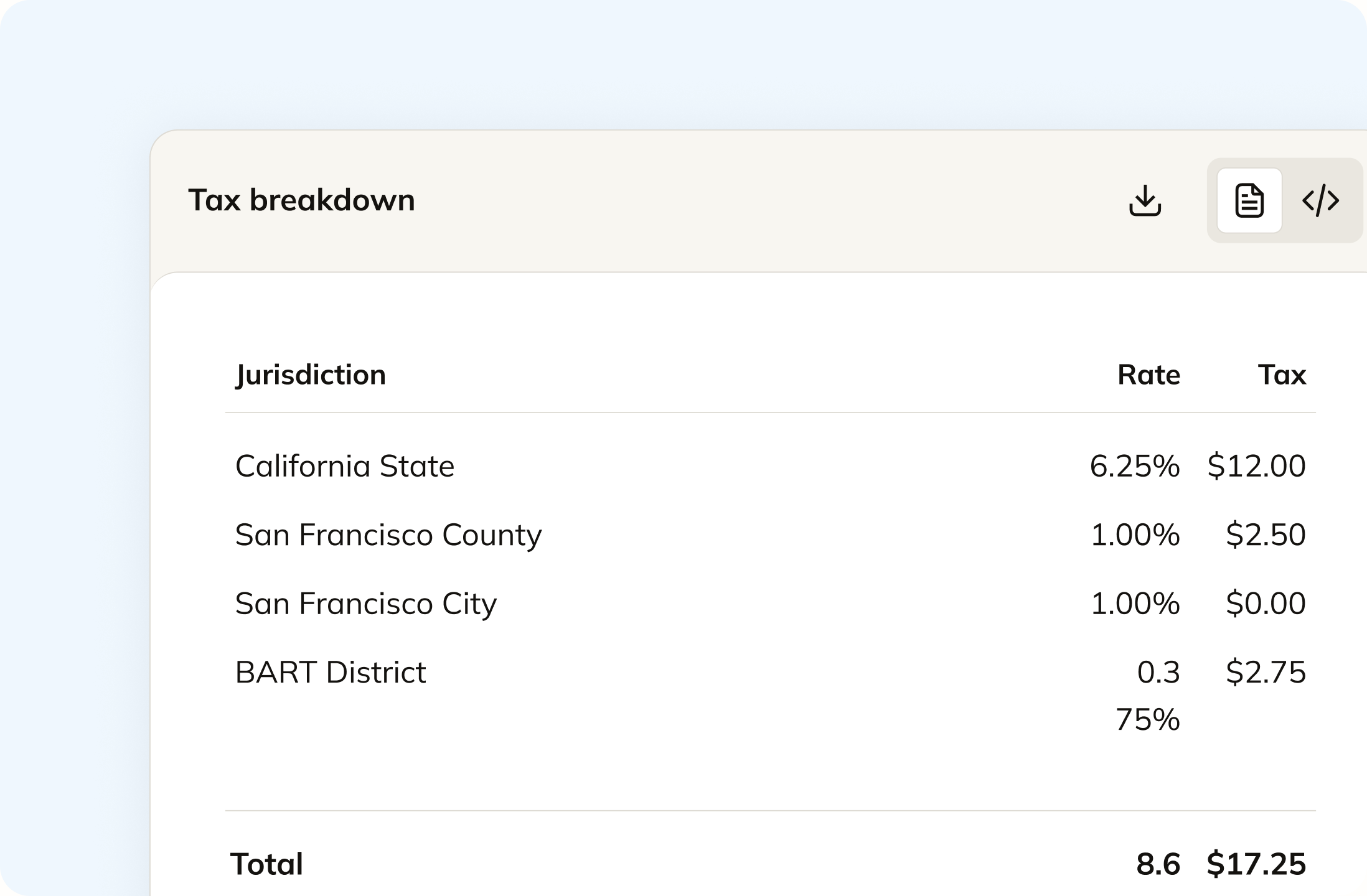
A tax rate/area holds the rate someone typed in, up to five tax authorities per area, each line carrying its own effective and expiration date. Commenda calculates from live jurisdiction rates instead, down to state, county, city, and district. Your existing setup stays where it is, and nothing in your tax rules by company has to be rewritten to get a correct rate.
Track your global exposure from JD Edwards
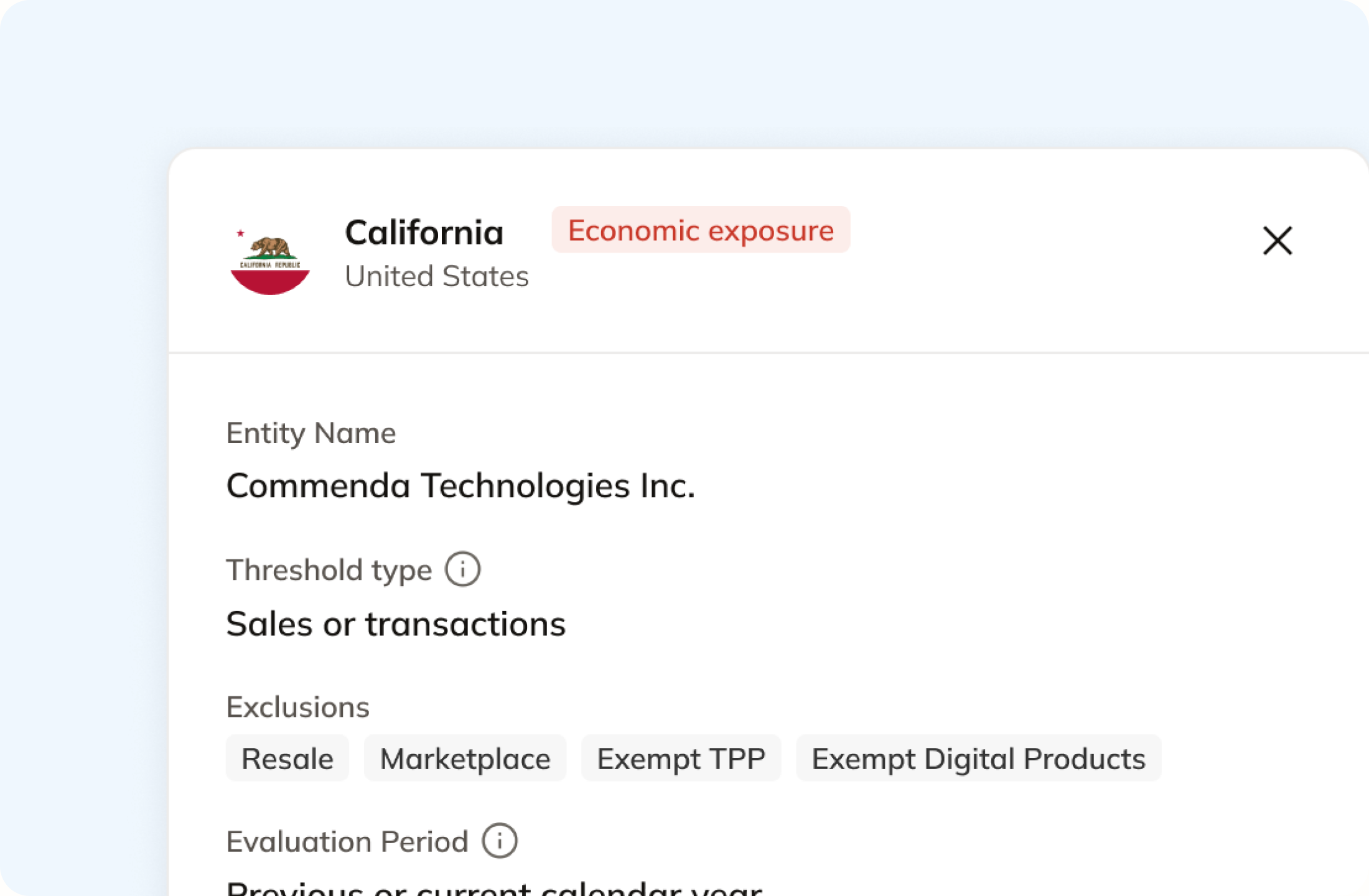
JD Edwards taxes what your tax rate/areas cover, so a state nobody set up is taxed at zero and counted nowhere. Commenda measures the same transactions against thresholds in all 50 states and 70+ countries and tells you at 80%, before you cross. A short questionnaire covers physical presence too, because a warehouse or a remote employee never shows up on a sales order.
Automatically remit transactions around the world
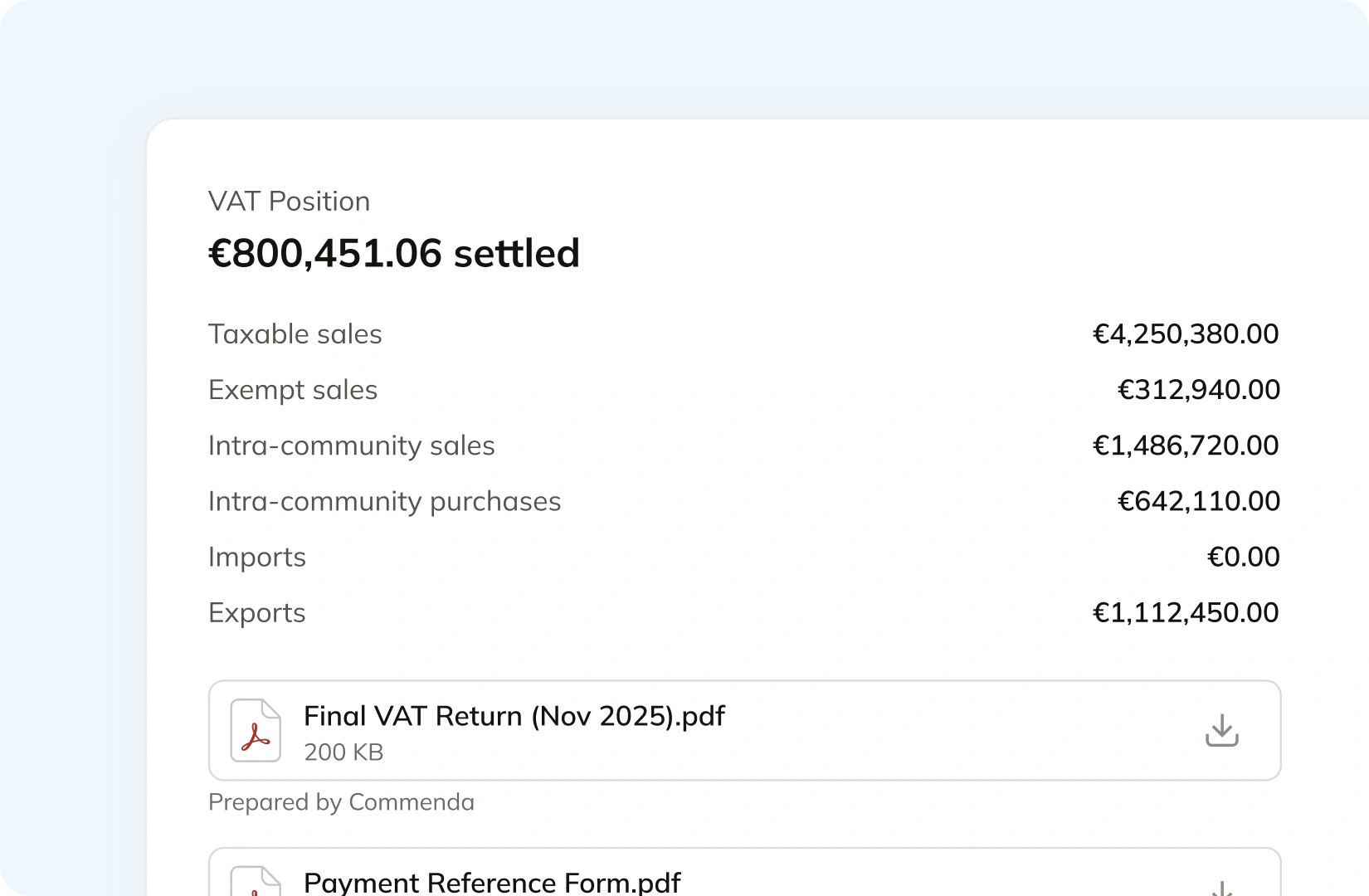
Oracle's US tax output is a report. The Tax Processing guide ships a Tax Detail/Summary report, a Sales Tax report, and a tax reconciliation repository you run and review. Commenda builds the return straight from your JD Edwards transactions, so nothing gets exported or re-keyed. Returns go out across all 50 states, plus EU VAT with OSS and GST in APAC and Canada, with amendments where a period needs correcting.
Manage your customers and exemptions in one place
In JD Edwards an exemption is tax explanation code E on a customer or a line. Oracle documents the code, and Vertex's own advice is to make the customer exempt in its Tax Decision Maker. Commenda handles getting the certificate in the first place. Your customers upload through a portal that can carry your branding, each one is validated on upload, and it applies automatically in the states where it is valid.
Consolidation
Why JD Edwards does not know your total exposure
A JD Edwards deployment is usually older than the tax problem it is being asked to solve. The tax rate/areas were built for a different footprint, the engine underneath may have changed, and revenue arrives from places JD Edwards never sees. Commenda works from the transactions rather than the setup.
Your tax setup is as old as your deployment
Tax rate/areas accumulate. Each one carries up to five tax authorities, a rate typed in as a whole number, and an effective and expiration date, and the person who set up the first batch has usually moved on. Oracle's own tax considerations page asks you to settle four things before you switch the interface on: any special dispensations you have arranged with state or local jurisdictions, how your products fit into tax categories, how customers and suppliers are categorised, and whether returns are filed for one company or several.
Nexus in JD Edwards is a code someone created
Oracle states that a tax rate/area identifies a tax or geographic area with common rates and tax authorities, validated against a table in your database. Nothing in the Tax Processing guide measures what you sold into a state against that state's registration threshold. Anything you sold where nobody built a tax rate/area is taxed at zero. Our nexus threshold guide lists the figure for every state.
The tax engine is a dependency, and it changes your codes
Turning on Vertex moves the US and Canadian tax authorities out of JD Edwards. Oracle also states that the interface recognizes only tax codes E, S, and U out of the twelve it documents, and that procurement and payables transactions coded S are not written to the Vertex tax register. Foreign tax stays yours to maintain by hand either way.
JD Edwards is rarely the only place revenue lands
A storefront, a billing platform, and a marketplace each carry their own tax treatment, and the tax a marketplace already collected is not yours to file again. Commenda reads each source directly, across 100+ supported integrations, and consolidates to one ledger tagged by ship-to state on one global indirect tax platform. Nexus is measured once, against one number per state. You can also check a single address against our sales tax rate calculator for free.
What it takes
What global indirect tax takes in JD Edwards
Oracle does not publish JD Edwards list pricing, so there are no dollar figures here. What Oracle does publish is what each capability depends on. In JD Edwards that is usually a third-party engine, or a table somebody keeps current.
| What you need | What JD Edwards requires | Source |
|---|---|---|
| A correct US sales tax rate on a transaction | Vertex Sales Tax Q Series. Oracle states the U.S. and Canada tax authorities are stored in Vertex, and that Vertex compiles the GeoCode from state, city, zip code, and county and maintains the rates | Tax calculation components |
| Rates that update when tax law changes | The Vertex Tax Decision Maker. Oracle states that for the automatic update of tax rate changes you must use it, and that changed requirements arrive as monthly updates to the tax rate tables | Vertex interface |
| A US sales tax return | A separate purchase. Oracle documents a Vertex Returns module you can also buy, which it describes as automating the preparation of state and local tax returns | Vertex interface |
| Tax on a transaction outside the US and Canada | Either your own tax rate/areas, or rates you maintain manually for foreign locations in the Tax Decision Maker. Oracle gives exactly those two options | Vertex interface |
| A rate inside a tax rate/area | A percentage entered as a whole number rather than a decimal, one line per tax authority up to five per area, each with an effective and an expiration date | Setting up tax rate areas |
| Tennessee sales tax on a sales order | A maximum unit cost on the tax rate/area. Oracle states the field is required for processing taxes in the state of Tennessee, and that anything above it becomes taxable | Setting up tax rate areas |
| Your full set of tax explanation codes, with Vertex switched on | Three of them. Oracle states the Sales Tax Q Series interface recognizes only tax codes E, S, and U, out of the twelve it documents | Tax calculation components |
| A localized VAT return | A country localization. Oracle lists 34 countries and the United States is not among them, and its generic VAT extract feeds BI Publisher rather than a tax authority | Localizations |
| Time to plan any of this | You have it. Oracle states Premier Support for JD Edwards EnterpriseOne 9.2 runs through at least 2037, on premises or on Oracle Cloud Infrastructure, with new capability arriving as updates to 9.2 | Premier Support |
A correct US sales tax rate on a transaction
Vertex Sales Tax Q Series. Oracle states the U.S. and Canada tax authorities are stored in Vertex, and that Vertex compiles the GeoCode from state, city, zip code, and county and maintains the rates
Tax calculation componentsRates that update when tax law changes
The Vertex Tax Decision Maker. Oracle states that for the automatic update of tax rate changes you must use it, and that changed requirements arrive as monthly updates to the tax rate tables
Vertex interfaceA US sales tax return
A separate purchase. Oracle documents a Vertex Returns module you can also buy, which it describes as automating the preparation of state and local tax returns
Vertex interfaceTax on a transaction outside the US and Canada
Either your own tax rate/areas, or rates you maintain manually for foreign locations in the Tax Decision Maker. Oracle gives exactly those two options
Vertex interfaceA rate inside a tax rate/area
A percentage entered as a whole number rather than a decimal, one line per tax authority up to five per area, each with an effective and an expiration date
Setting up tax rate areasTennessee sales tax on a sales order
A maximum unit cost on the tax rate/area. Oracle states the field is required for processing taxes in the state of Tennessee, and that anything above it becomes taxable
Setting up tax rate areasYour full set of tax explanation codes, with Vertex switched on
Three of them. Oracle states the Sales Tax Q Series interface recognizes only tax codes E, S, and U, out of the twelve it documents
Tax calculation componentsA localized VAT return
A country localization. Oracle lists 34 countries and the United States is not among them, and its generic VAT extract feeds BI Publisher rather than a tax authority
LocalizationsTime to plan any of this
You have it. Oracle states Premier Support for JD Edwards EnterpriseOne 9.2 runs through at least 2037, on premises or on Oracle Cloud Infrastructure, with new capability arriving as updates to 9.2
Premier Support
Figures verified on July 30, 2026.
From the field
Trusted by businesses across the globe


“The platform works exactly the way I need it to. I have one team member who manages all of our exemption certificates, and that functionality has been particularly efficient for us. It allows him to handle everything seamlessly, making the handoff significantly easier.”
VP of Finance, TRX





Compare Commenda sales tax software with competitors
Oracle wrote and supports the JD Edwards interface to Vertex, so Vertex is where most serious US deployments end up. We compare the alternatives on coverage, ratings, and real pricing, and we say where each one wins.
More sales tax resources
Guides from the Commenda team on multi-state filing, state returns, and Canadian sales tax.
Frequently asked questions
Custom integration support for your business
No two JD Edwards installs look alike, and the customisations exist for good reasons. We map how yours works, including your tax rate/areas and which transactions should be calculated, and build the integration to match.
Indirect Tax
Monitor nexus exposure, register, file, and remit sales tax and VAT in one platform. Commenda keeps you compliant across 100+ jurisdictions.
Explore the product
