Track economic and physical nexus across every U.S. state.
Enough sales into a state, or a physical presence there, creates sales-tax nexus, and the obligation to register, collect, and remit. See where you're exposed, mapped across all 50 states.
Enough sales into a state, or a physical presence there, creates sales-tax nexus, and the obligation to register, collect, and remit. See where you're exposed, mapped across all 50 states.
Trusted by global businesses
Commenda monitors your sales in real time, alerts you before you cross a threshold, and handles registration and filing once you do.
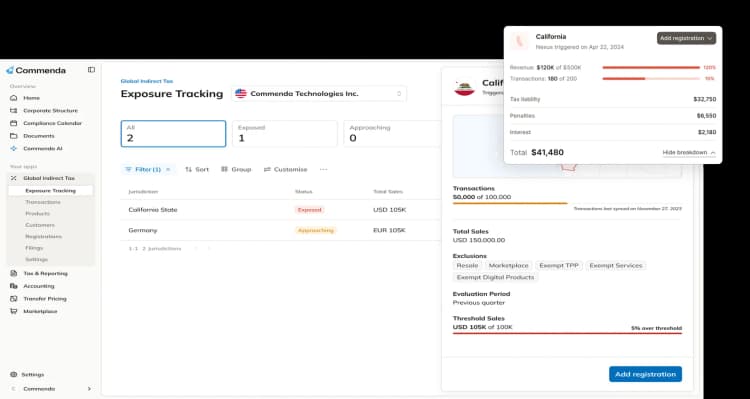
Exposure tracking is knowing, state by state, where your business has (or is about to have) a sales-tax obligation. The US has no national sales tax: each state sets its own rules, and you pick up an obligation either by selling enough into a state (economic nexus) or by having people, inventory, or property there (physical nexus).
For a growing company that exposure shifts constantly: a new warehouse, a remote hire, or a single large order can cross a threshold. Commenda tracks all 50 states in real time so a new obligation never catches you off guard.
Sales-tax nexus comes in two forms, and either one on its own creates an obligation:
Use the toggle on the map above to switch between the two views. The sections below go deeper on economic nexus and how each state measures it.
Economic nexus is the link between your business and a state that obligates you to register, collect sales tax, and file returns there. Unlike physical nexus (established by an office, warehouse, employee, or inventory), economic nexus is triggered purely by crossing a revenue or transaction threshold.
Every state with a statewide sales tax has enacted an economic nexus law. The specific threshold, what counts toward it, and how often it is evaluated differs by state.
Before the 2018 Supreme Court decision in South Dakota v. Wayfair, Inc., a state could only require a business to collect sales tax if it had a physical presence in the state. The Wayfair ruling allowed states to base nexus on economic activity alone, opening the door for every state to require remote sellers - including e-commerce, SaaS, and digital goods businesses - to collect tax once they cross a threshold.
The financial stakes are significant. Failing to register after crossing a threshold can result in back taxes, interest, and penalties stretching back years. A growing business can easily trigger nexus in 20 or more states in a single year without realizing it.
Thresholds fall into four categories, and each state uses one of them:
The measurement period also varies. Some states evaluate the prior calendar year, some look at the current or previous calendar year, and a handful use a rolling 12-month window measured quarterly.
This is where the rules diverge most sharply between states. Common variations:
The detail expanders in the state list below show exactly what each state counts.
Physical nexus is the older, pre-Wayfair standard: a tangible connection to a state. Unlike economic nexus, there is no dollar threshold; a single qualifying presence is enough to require you to register, collect, and remit. Essentially every state with a sales tax asserts it, so the question is rarely whether a presence counts, but which of your activities create one. The most common triggers:
Because physical presence sticks, some states also apply trailing nexus, an obligation that continues for a period after the presence ends. Once any of these applies, the registration and filing requirements are the same as for economic nexus.
The following states do not impose a statewide sales tax, so there is no economic nexus to track at the state level:
Alaska has no state-level sales tax, but local jurisdictions in the Alaska Remote Seller Sales Tax Commission enforce a $100,000 economic nexus threshold - so Alaska is included in the state list below.
Click any state for both kinds of nexus: the economic threshold (what counts, effective date, measurement period) and the physical-presence establishments that create nexus there.
This guide is provided for informational purposes only and does not constitute legal or tax advice. State rules change frequently; verify the current threshold with the relevant state department of revenue or speak with a Commenda specialist before relying on this information for compliance decisions.
By size
By team
Learn
Tools