Transfer Pricing Software
Your TP policy. Documented.
Defensible. Done.
Transfer pricing policy, benchmarking, documentation, and filing — in weeks, not months, and at a fraction of what your Big Four firm quoted. OECD-aligned.
Trusted by global businesses

































Intercompany pricing that
holds up to any audit.
OECD BEPS raised the bar on transfer pricing — and that's an opening. Document your intercompany transactions right once and they become a durable, defensible position in every jurisdiction you operate in. Commenda builds transfer pricing documentation that's ready before an auditor ever asks, so you file with certainty instead of scrambling.
Documentation that's audit-ready from day one
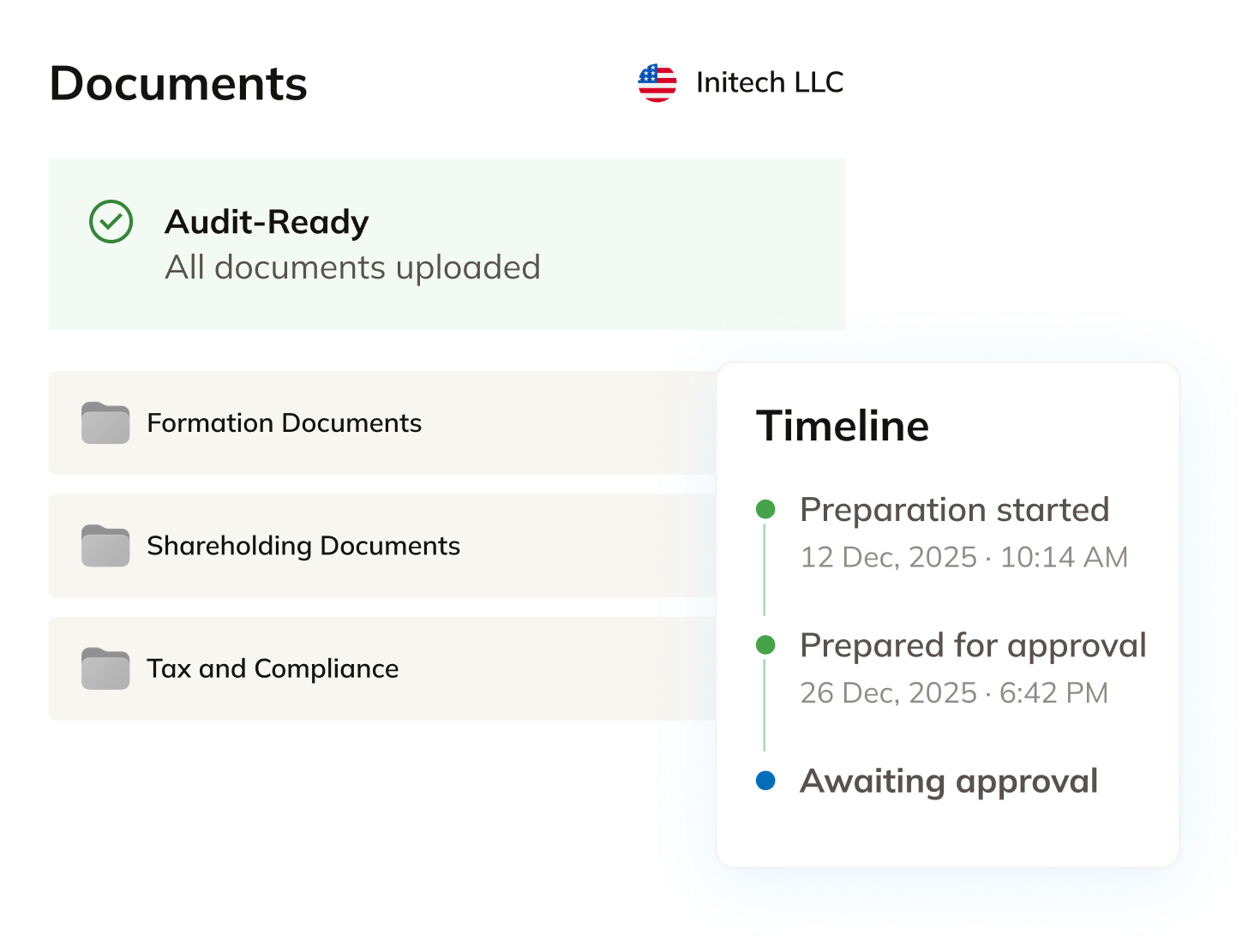
Contemporaneous transfer pricing documentation keeps your intercompany pricing defensible the moment it's reviewed. When a tax authority asks, "here's our benchmarking and our functional analysis" is the answer that ends the conversation.
Positions that hold under BEPS Pillar Two
The 15% global minimum tax is reshaping intercompany structures. Documentation built to account for every jurisdiction keeps your transfer pricing consistent and defensible wherever it's examined — no surprises across corridors.
A policy that stays current, automatically
Annual benchmarking refreshes and policy reviews are built into the engagement, so your arm's length ranges track your business instead of going stale in a folder — and every filing deadline is handled before it becomes a penalty.
What Commenda does
End-to-end transfer pricing.
Policy to filing.
Commenda covers the full transfer pricing lifecycle — not just the documentation package that sits in a folder until your auditors ask for it. Policy, benchmarking, intercompany agreements, documentation, and filing. All maintained. All current. All connected to your ERP.
01 — Transfer Pricing Policy
A policy that reflects how your business actually works.
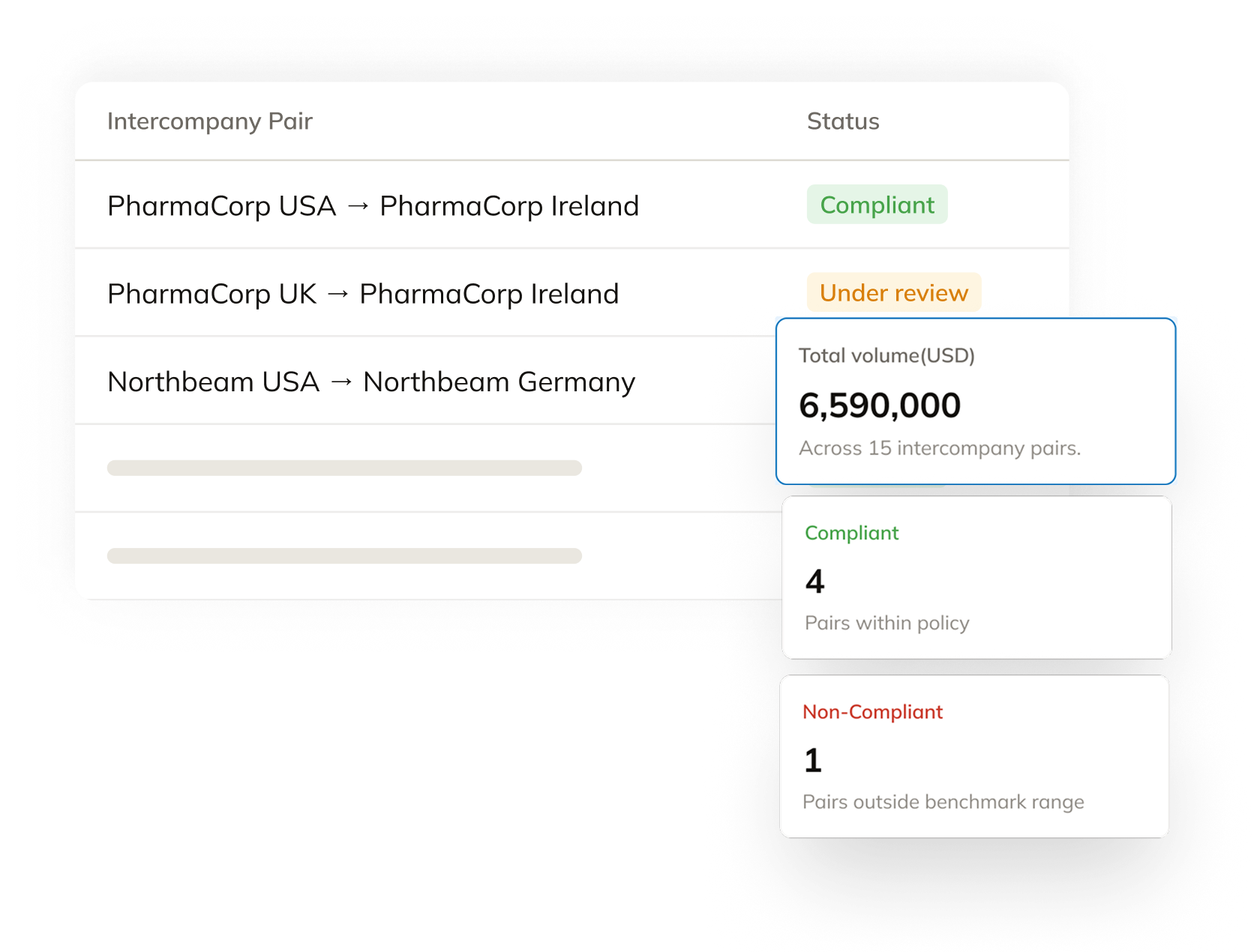
Commenda builds your intercompany pricing policy against your actual entity structure, transaction types, and business model.
- Full intercompany transaction mapping across all related parties
- Transfer pricing method selected per transaction type
- Policy documentation structured to OECD BEPS Action 13 standards
- Functional analysis: functions, assets, and risks attributed per entity
- Annual policy review built into the engagement and not as an optional extra
02 — Benchmarking
Arm's length ranges
grounded in real data.
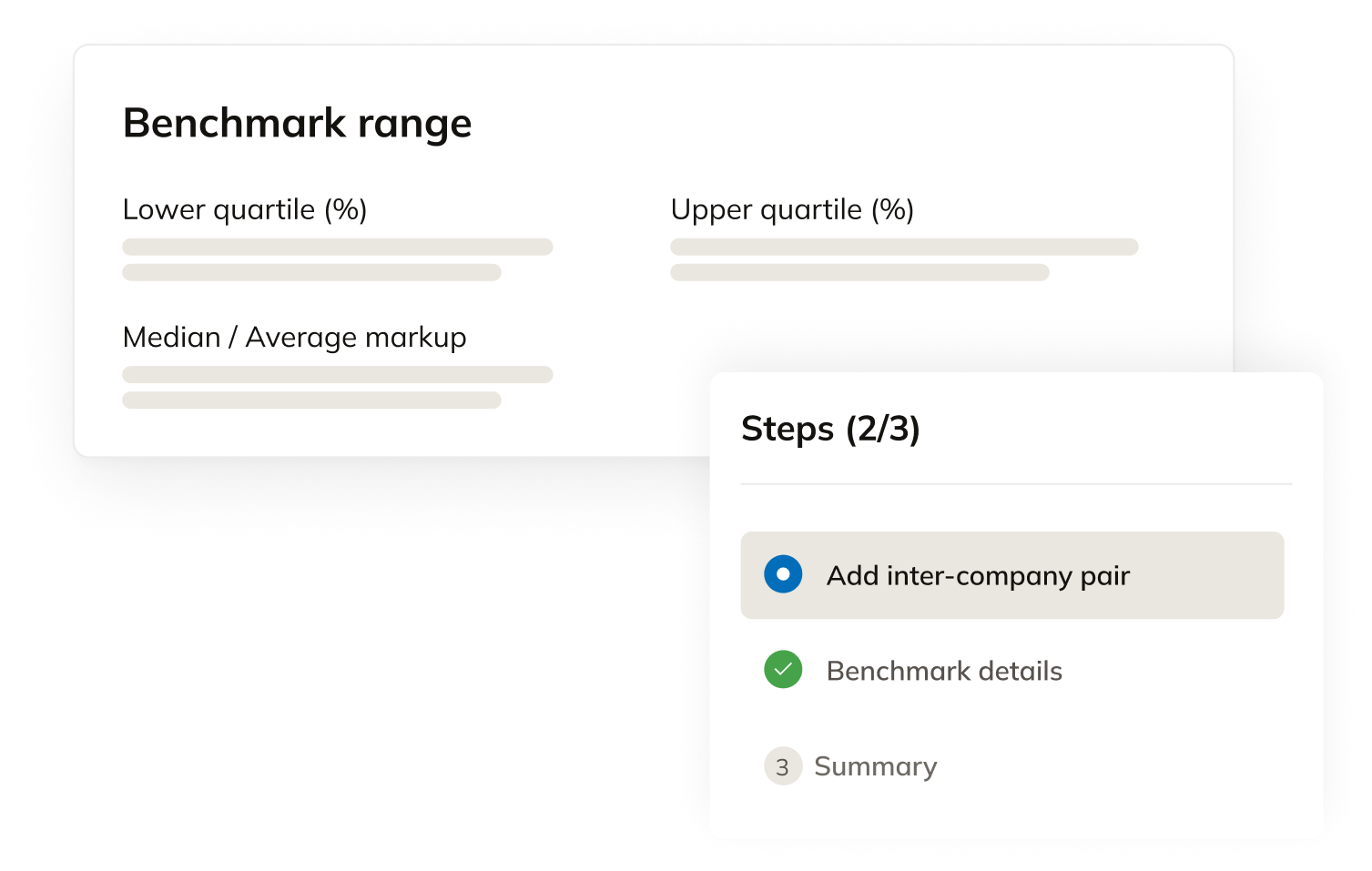
Commenda's benchmarking analysis pulls from commercial databases to establish comparable uncontrolled transactions for each intercompany arrangement.
- Database-driven comparable search
- Arm's length range established per transaction type and geography
- Interquartile analysis with median and tested-party positioning
- Annual benchmarking refresh as market conditions change
- Documented search methodology. Reproducible and auditable.
03 — Documentation
Master File. Local Files.
Audit-ready, always.
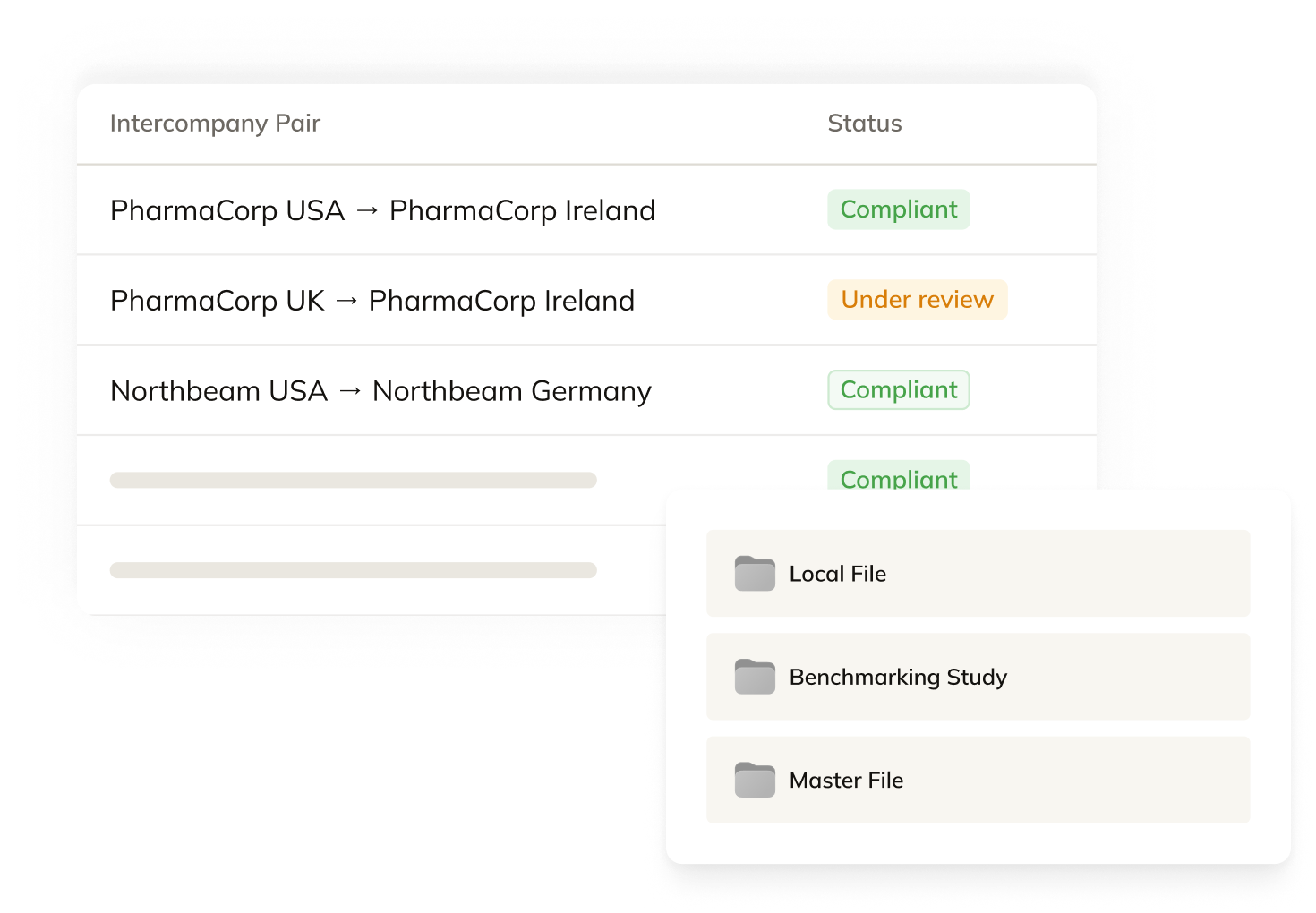
Commenda produces your full documentation package including Master File covering the group, Local Files per jurisdiction, and Country-by-Country Report where applicable.
- Master File (MF) covering group structure, value chain, and global policy
- Local Files (LF) per jurisdiction with entity-level analysis
- Country-by-Country Report (CbCR) prepared where required
- Intercompany agreements drafted or reviewed for policy consistency
- Version-controlled documentation — every update tracked
04 — Filing & Ongoing Compliance
Every deadline met,
every jurisdiction, every year.
Commenda tracks every TP-related deadline across your entity footprint and prepares the required disclosures — filing-ready and on time, jurisdiction by jurisdiction.
- TP disclosures prepared and tracked to every jurisdiction deadline
- CbCR notifications prepared for all required jurisdictions
- Annual Local File updates triggered automatically at year-end
- Intercompany agreement review cycle built into the engagement
- TP-related adjustments flagged in real time via ERP integration
Commenda vs. the Big Four engagement.
This isn't about whether advisors have expertise — they do. It's about whether expertise should cost $60K and take six months for work that a systematized platform delivers in four weeks.
Big Four / boutique TP advisory
Expertise without infrastructure.
- 4–6 months to first deliverable
- $30–80K initial engagement cost
- $15–40K per annual update
- Documentation in a PDF. Not a system.
- No ERP integration; benchmarking done manually
- Disconnected from your entity and tax compliance stack
- Deep jurisdiction expertise (retain for complex one-offs)
Commenda
Infrastructure with expertise built in.
- Policy drafted and docs complete in ~4 weeks
- Transparent platform pricing — no hourly billing
- Annual updates included; documentation stays current
- Connected to entity management and corporate tax in one platform
- ERP-integrated; intercompany transactions flagged automatically
- Defined scope, fixed cost, milestone-based delivery
- TP experts behind every deliverable — same quality, different model
From the field
Trusted by businesses across the globe


“The platform works exactly the way I need it to. I have one team member who manages all of our exemption certificates, and that functionality has been particularly efficient for us. It allows him to handle everything seamlessly, making the handoff significantly easier.”
VP of Finance, TRX





Integrations
Explore 100+ transfer pricing integrations
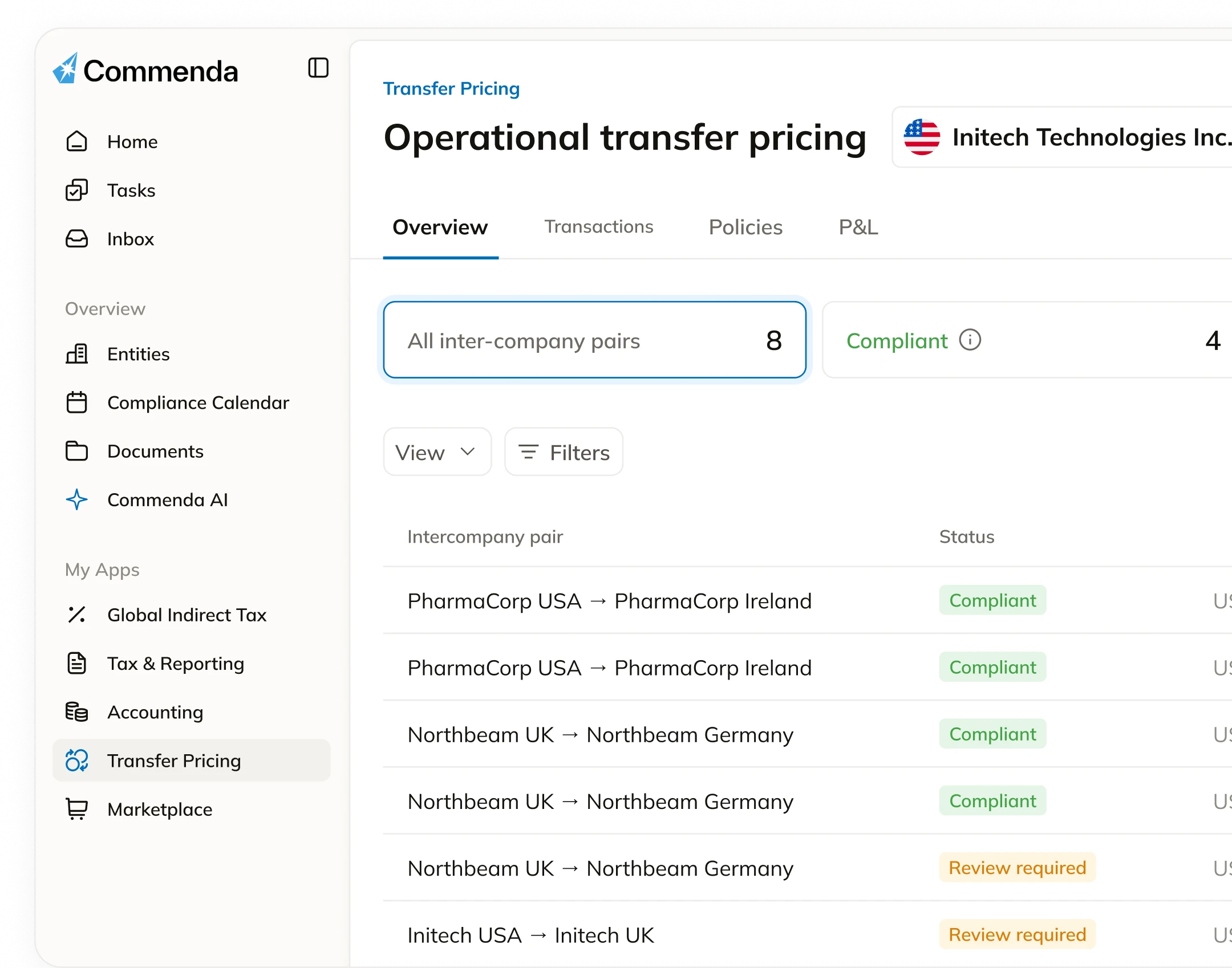
Your policy sets the prices and margins your entities are meant to follow. Commenda pulls intercompany transactions from the systems you already run and checks them against that policy all year, so drift surfaces during the year instead of at filing time.
Explore transfer pricing integrations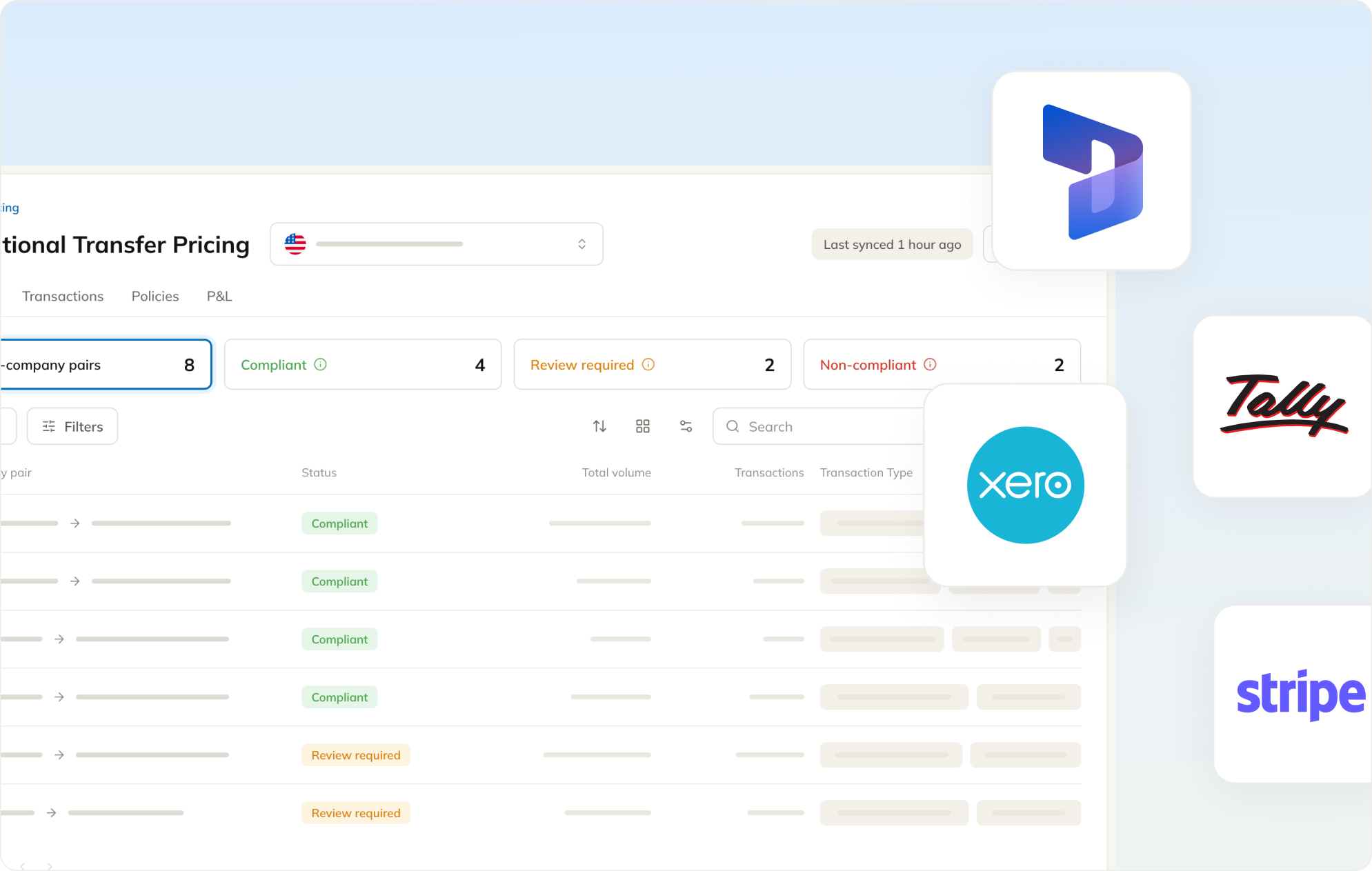
Questions Transfer Pricing teams ask us.
If value moves between related entities — your parent funding a subsidiary, a sub providing development or support, IP licensed across borders, even routine intercompany cost recharges — then yes, you have intercompany transactions that need an arm’s length basis and an agreement. Two entities is enough to create a TP obligation. The clearest exception is a genuine buy/sell flow with no embedded services or IP, which has limited TP implications initially. We’ll confirm which category your actual flows fall into rather than assume, since cost recharges and informal "funding" between entities almost always carry a TP question even when founders don’t realize it.
The right agreement follows what’s actually moving between the entities. A services agreement covers one entity providing development, support, or back-office work to another, typically on cost-plus (markup applied to the cost base — salaries, rent, operational costs). A distribution agreement covers reselling, where one entity keeps an arm’s-length operator margin and remits the rest. A royalty/licensing agreement covers IP. Many setups need more than one — for example, an Indian dev entity on a services agreement and a royalty arrangement on top, depending on how revenue flows. We map your actual transactions first, then put the right contracts around them rather than starting from a template.
The common pattern is the Indian entity providing development or support to the US entity on a cost-plus services basis, with an intercompany services agreement and benchmarking that sets the markup against comparable Indian service providers. The US side documents the markup as arm’s length; the Indian side needs documentation that satisfies Indian requirements as well, with India tying documentation expectations to transaction value. Indian documentation supports an annual filing cycle that runs separately from US deadlines. We handle both ends together so the position is consistent across the corridor rather than two providers telling slightly different stories.
The markup should reflect what an independent provider doing the same functions, with the same risks, would charge — established through benchmarking against comparable companies in recognized databases, with the tested party positioned within the resulting arm’s length range. We set it from data rather than picking a round number that "feels right," and document why it fits given the functional analysis (who does what, who owns what, who bears which risks). That data-backed basis is what makes the markup defensible at audit — an unsupported markup, however reasonable, is the weakest position in any TP inquiry.
The exposure is meaningful and compounds the longer it runs — undocumented or mispriced intercompany flows can lead to adjustments, double taxation, and penalties in any country examining them, and historical losses or profits in the wrong entity can be hard to unwind. The good news is the position can largely be fixed going forward: we build current documentation and benchmarking, put the right agreements in place, and establish a defensible go-forward basis. Prior years can’t be rewritten, but assessing the historical exposure lets you make informed decisions about whether and where to disclose proactively. Getting the next filing cycle right is the cleanest way to stop the bleed.
Your TP documentation is probably 18 months stale.
Book a 30-minute call. We'll review your current intercompany structure, identify what documentation you need, and show you what Commenda would produce — and how long it would take.

