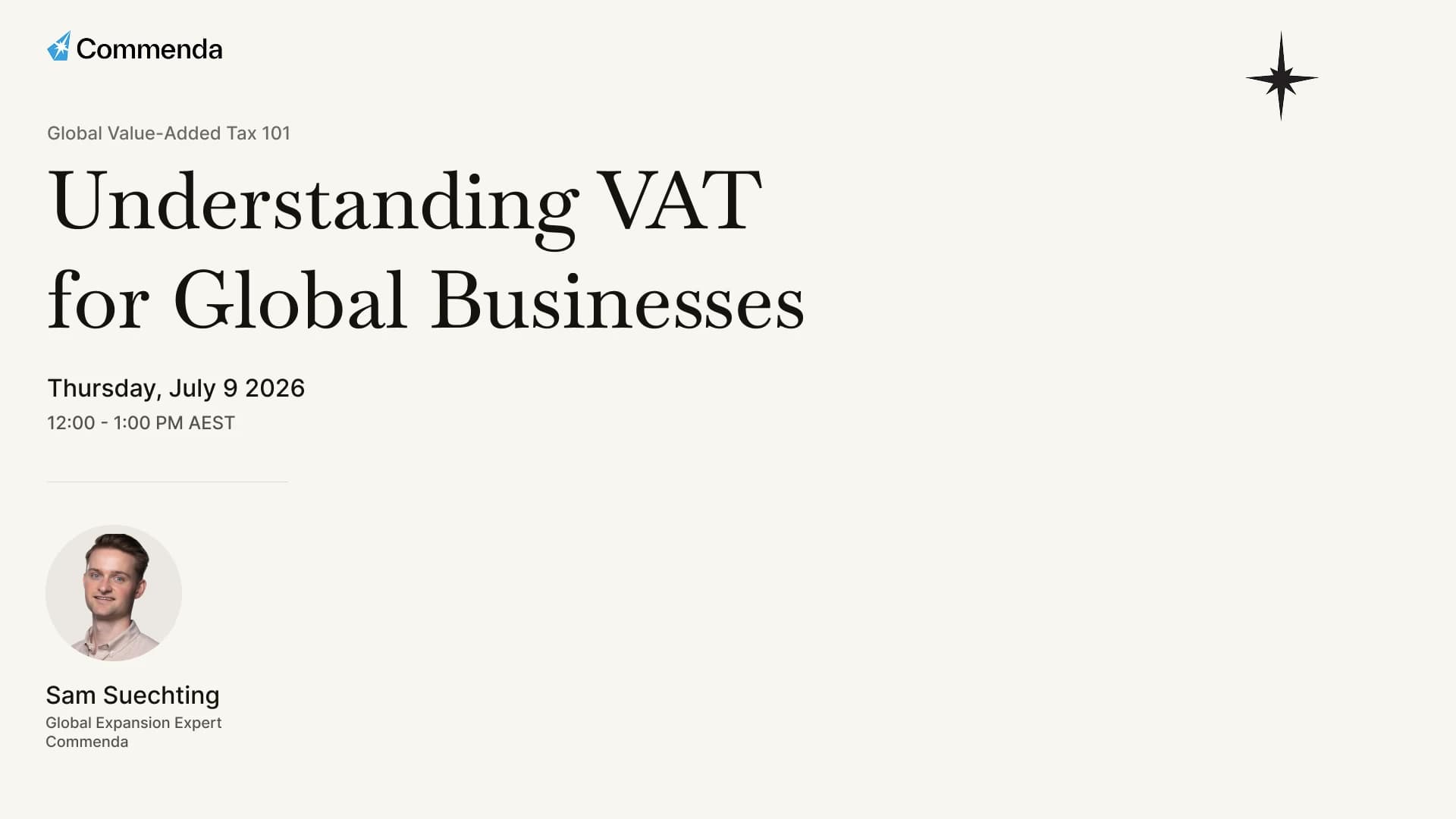
Understanding VAT for Global Businesses
9 July 2026

VAT fundamentals including the credit mechanism, worked examples, rates, zero rating and exemptions, and how VAT differs from US sales tax. The session then covers when VAT applies to a business, registration triggers, place of supply, imports and exports, marketplaces, the EU OSS and IOSS schemes, and compliance in practice from filing through to reclaims and penalties.
Speakers

Sam Suechting
Head of Product, Commenda
Sam owns product at Commenda and built its indirect tax coverage, spanning US sales tax, VAT in Europe and GST elsewhere, including the work to fold compliance into billing and invoicing across ERPs, accounting platforms and payment providers.

Bryce Whitney
Americas Sales and Customer Success, Commenda
Bryce covers Commenda's Americas customers from the Seattle office, where registration thresholds and invoicing rules come up constantly. He took the attendee questions on this session.
View transcript
Sam Suechting:
Everyone. I think we have a few people trickling in. Welcome to our webinar on introduction to VAT. My name is Sam Suechting. I'll be presenting today. I'm joined by my colleague Bryce Whitney who will be assisting. Look forward to getting started in just a couple minutes so we'll let a few more people join.
Bryce Whitney:
As people funnel in, if you wouldn't mind dropping where you're calling in from in the chat, we always love to engage with our audience and know where you're based out of.
Sam Suechting:
We're calling in from Commenda's Seattle office. Commenda has offices in Seattle and San Francisco. We've got a few employees in New York, in London, and then in India as well. So we have teams and experts everywhere. All right. Bryce, while we wait for some additional people to join, why don't you go ahead and advance? And I think you have a poll at the beginning, right? So we can go ahead and do that while we wait for some additional people.
Sam Suechting:
So obviously compliance can be a dry topic. We are gonna try to make this as interactive as possible to be a handful of polls throughout the course of this webinar, like the one you see on your screen now. In addition to that, please feel free to put any questions that you have in the chat. If possible, we'll do our best to answer all the questions throughout this webinar. If it's you know beyond the scope of the webinar or if it's a more detailed question about your specific business case, I would recommend you schedule a free consultation with one of our experts and we can talk about whatever your topic might be in more detail. Like we have some coming in from Australia. I know we have a couple from New Zealand. We always get a lot from Australia and New Zealand. I'm not sure why that is, no matter what the topic is. And while we get some answers to that poll, I'll go ahead and introduce myself and Commenda. So my name is Sam Suechting, I've had a product at Commenda. I've worked pretty extensively on indirect tax, both on sales tax in the US, on VAT in Europe, and of course GST as well and other markets. I've worked on integrations. Of course, you know, when we're talking about indirect tax compliance, it's important that you integrate that into your billing and invoicing. Process. So that's something that I've done pretty extensively with a variety of different ERPs, accounting platforms, and online payments platforms as well. So if you have questions about that or how indirect tax might affect your billing or invoicing process, we will touch on it a little bit, but feel free to raise those questions as well. Commenda is a cross-border compliance platform for VATGST and US sales tax. We also do lots of other tax domains as well, things like incorporation, direct tax, accounting and consolidation for multi-entity group structures and things of that nature. So do check out the rest of our webinars. We do cover other topics with lots of other experts. And if you are interested, feel free to book a call with anyone from our team. But this webinar is mostly intended to be informative. We are not gonna make a hard sale on you. So let's go ahead and get going, Bryce.
Sam Suechting:
So I think we'll cover a lot of those throughout the course of this webinar. Here's our agenda for the next 45 minutes or so. We'll cover VAT fundamentals, the mechanics, worked examples, rates and exemptions, and then a comparison between VAT and US sales tax. We'll talk about when VAT applies to your business, things like registration triggers, place of supply, imports and exports, marketplaces, and then of course OSS and IOSS in the EU. Talk about the compliance process or compliance in practice, the filing lifecycle, reclaiming VAT, invoice. Things of that nature. And then at the end we'll have a short Q<unk>A section where any questions you don't put in the chat during the rest of the content, we can save those for the end and we'll do our best to answer them at that time. So let's go ahead and get going, Bryce.
Sam Suechting:
Great, we'll start with VAT Fundamentals, what VAT is, how the credit mechanism works, and how that compares to US sales tax. And then we'll talk about rates, zero rating, and exemptions as well. I think that's one of the topics that you guys mentioned you have concerns about. So to start off, what is VAT? Value-added tax is a consumption tax charged at every stage of the supply chain, but ultimately paid by the final consumer. So we do typically call this a multi-stage tax, meaning it applies at every stage, whether that's from manufactured retailer and retailer to consumer. Whereas a single stage tax like for US sales tax, that is only applied to the end consumer of a good or service. It doesn't apply at the intermediate stages. So that's sort of the fundamental difference between a multi-stage tax and a single stage tax. Of course, VAT is far more common than like a US sales tax style indirect tax system. Over 175 countries levy some kind of VAT or GST, and roughly a fifth of the world's tax revenue is raised through VAT type taxes. But the important thing to note about a consumption tax is that it's ultimately the end consumer that bears it. But there is an obligation for businesses to remit it, because essentially the government is turning businesses into collection agents. So there is like a legal duty for that collection to take place, but it's the end consumer who's ultimately paying it. Let's go ahead and advance price. So Here we have a brief worked example of how exactly VAT works. In three stages, we have manufacturer, retailer, and consumer, and a 20% VAT rate. You can see here if a manufacturer sells a $100 good, a fifth of that 20% is going to be VAT, which means there's an output VAT of 20 euros in this example, and 20 euros will be remitted to the government. On the next stage, let's say the retailer is retailing a good for 250 euros. 20% of 250 is going to be 50 euros.
Sam Suechting:
The output that is owed, and then they're going to receive an input credit of 20 euros, so the amount remitted will be 30. Ultimately, all of this is going to be paid by the end consumer, but 50 dollars or 50 euros, I should specify, is the amount going to the government. And each business remits tax only on the value it added at its stage in the supply chain here. If we were talking about a US example, there would be no tax collected from manufacturer to retailer, and all of the 50 euros would be collected from the final consumer. During the last stage here. So that's the difference between a multi-stage tax and a single stage tax. Again, if you have any questions, please feel free to drop them in the chat and we'll do our best to answer them as we keep going. So VAT versus US sales tax. As I mentioned, VAT and GST are taxed or applied at every stage of the supply chain with the concept of input credits, whereas in US sales tax, it only applies to the final retail sale. There is, you know, a similar concept of an input credit in the US, but it's typically applied through what we call a resale exemption certificate, which allows those intermediate steps in the supply chain to be tax exempt. So it's a it's a different mechanism and it's administered differently, but there is some parity in that concept. Who administers So this is the big one as well. VAT and GST are almost always administered by national governments. Sometimes a portion of the tax will be remitted to state or provincial or subnational governments, but it's typically administered nationally. Whereas when you talk look in the US, there's over 12,000 state and local jurisdictions, so it's a very different system. And then if we look at VAT and GST rates globally, they typically run anywhere from 15 to 27%. Countries in the EU are going to be on the higher end of that spectrum. Countries in the Gulf and in Asia are typically on the lower end, whereas when you talk about US sales tax, you're typically talking about a rate somewhere between six and ten percent.
Sam Suechting:
The registration triggers are relatively similar. There typically is some kind of turnover threshold that triggers an obligation to get registered. So that could be a sales threshold. For example, you know, you have to sell 30,000 euros or more goods in order to have an obligation to get registered. These thresholds can vary depending upon the type of good you're selling, and of course, the jurisdiction or country that you're selling into. So, for example, if you're a foreign seller, remote selling into a country, oftentimes that threshold is going to be Set at zero, particularly if you're talking about B2C sales. The US has a similar concept called economic nexus. Again, this is a turnover threshold, and that is state by state in the US. Very similar concept, and there are special rules as well for remote or foreign sellers. Lastly, we'll talk about invoicing. Invoicing requirements in VAT and GST countries are very strict. The government and the regulators spell out what is required on a compliant VAT invoice in order to claim credits. Whereas in the US, there is no invoicing requirements whatsoever. You know, we get a lot of customers who come to us, they're might be familiar with VAT or GST in their home jurisdiction, but when they expand into the US, they ask us, you know, what are the invoicing requirements in the US? There really are none. You can put whatever you want to on an invoice in the US. This is mostly because there's no concept of like a VAT or GST ID like there is in VAT and GST countries. So your buyer's not gonna have an ID because there's no concept of input credits. Go ahead, Bryce. Looks like we have another quick poll, so we'll get that up. How many countries are you selling in today? Know we find that more and more businesses are going global more quickly and earlier in their life cycle. Commenda sort of specializes in cross-border businesses. We do get a lot of customers from the Anglosphere, the UK, Australia, New Zealand. We get quite a few from the UAE, India, and then increasingly in mainland European countries as well, like Germany and France, of course. So you can put your number of countries
Sam Suechting:
Great, six to ten. Yeah, so you know, obviously you know that indirect tax gets sort of exponentially more difficult the more jurisdictions you're settling into. That's something we're intimately familiar with. And so hopefully we can dispel some of the complexities around this during this webinar, and feel free to drop your questions in the chat. Let's go ahead and keep going, Rice. Okay, VAT around the world. So here's just a s a selection of VAT rates around the world. These are the standard rates in these countries. A lot of times there will be reduced rates or sometimes elevated rates as well, depending upon the type of good or service that you're selling. And these do change from time to time, so it's important to stay on top of them. Unlike in the US, these tend to be there are fewer rates and they tend to change a little bit less frequency. So typically if you set up one rate in your billing or invoicing system, you'll be good with it for a while. And if you're using an invoicing software, because the rates are relatively simple and typically flat for the types of goods that you might be selling, that calculation or determine rate determination can be deplied directly in your software. Let's go ahead, Bryce.
Sam Suechting:
Okay, so I know we had one concern in the first poll about standard rate, reduced rate, and zero rate. So this matrix here lays out the difference between the three, and I think on the next slide we'll be talking about zero rated versus exempt goods. The standard rate is the default for most goods and services in most countries. You can see UK is 20%, Germany is 19%, France is 20%. This applies to all goods unless a specific reliefs says otherwise. Reduced rates apply to essentials and other favorite sectors. This is things like food. Books, hotels, medicine, wellness, things of that nature typically receive some kind of special or reduced rate in many countries. You can see we have a few examples here of what the reduced rates are. And these apply across a category of goods. So it's not like one good will have one unique rate and another reduced rate good will have another. Typically, it applies a standard reduced rate across any goods that are classified as such. And lastly, we have zero rated. So these are taxable, but at zero percent. This includes exports almost everywhere. And in the UK, most food, books, and children's clothing. The point of zero rated is that you're still able to claim input VAT against it, but the actual output VAT rate is gonna be zero percent. And so this will come up more on the following slide where we'll talk about zero rated versus exempt goods.
Sam Suechting:
Great. So here we have a comparison in zero rated versus exempt goods. Like we said, zero rated still means that a supply is taxable, but at the zero percent rate, you are inside the VAT system, you still have a reporting obligation. But the benefit of being zero rated is that you can still reclaim input VAT on your costs. So there's a few examples listed here. Exports, country specific beliefs in the UK, food and books. The difference between zero rated and exempt is that exempt sales are outside the credit. Chain entirely. There's no VAT charged, but because it's outside of the VAT system, also no input VAT recovery is possible. So this is things like financial services, insurance, healthcare, and education. And lastly, for partly exempt, businesses with mixed activities must apportion their input VAT. So a permanent calculation burden for fintechs, insurers, and edtech exists. So this is where you want to be really certain that your ERP or your accounting software, however you're you know you're maintaining your bills and invoices is set up to c account for this complexity because if you don't if you don't break this out in your billing system, it's gonna taint the goods that are sh that should be treated as exempt by mixing them in with the ones that do need to be taxed at a higher rate. So it's very important to get that right.
Sam Suechting:
Okay, when does VAT apply to you? We'll talk about registration triggers, place of supply, imports, exports, and marketplaces, as well as OSS and IOSS in Europe. Before we keep going, just please feel free to put any questions in the chat. Looks like we might have one message. Let me go ahead and take a look. That was a reply to a poll, so I think we're good to go. But if you have any questions about how this information applies to your business, please don't hesitate to ask away. Great. So what do you need to get registered? So typically there's gonna be a local turnover threshold. Domestic businesses register once sales pass the threshold. This is typically something like 90,000 pounds in the UK, but this will vary by country. And these thresholds can vary pretty dramatically depending upon which country we're talking about, as well as the types of goods or the types of buyers that you might be selling to. For foreign sellers, the threshold is often zero. This is especially true if you're a B2C seller as opposed to B2B. Many countries give not Non-resident sellers, no thresholds at all. Your first sale into a country often creates an obligation to go ahead and get registered and collect tax. So it's important to be very proactive about this. And this is where we see that you know, sometimes your sales team will be, you know, gung-ho to go make a sale into a new market. But then you have to coordinate with your compliance team to ensure that you, you know, you actually have all of your sort of compliance and invoicing and billing infrastructure in place to enable that. So it's typically the sales team who's creating urgency around this and then of course it gets handed off to the finance team or the controller team who actually has to deal with the burden of getting registered. This is where it can be beneficial to have a service provider and a technology company like Commenda assist with this because you know you want to make the sale and you don't want to throw a wrench in your sales process, but you do want to remain compliant at the same time. And if you're expanding into a new market, that can get increasingly difficult because typically if you're selling into a new country you're not already going to have that in-house expertise in terms of how
Sam Suechting:
How to stay compliant. So it could be beneficial to have an external vendor who has broad expertise across all of these jurisdictions. Number three here, there are some special cases for digital services, especially for B2C sales. So SaaS, streaming, ebooks, other types of digital goods sold to consumers are taxed where the customer lives, often from the very first sale. This can be distinct from other types of B2C sales, where they are taxed according to the location of the seller in their home jurisdiction or home country. It's sort of inverted for digital services that are sold direct to consumers. Lastly, we'll mention local inventory. Storing stock in a country, whether that's through a 3PL, an Amazon FBA warehouse, or through another intermediary, typically triggers immediate registration requirements. If you do retain ownership over that inventory, that's typically gonna create this requirement, even if that's your only presence within that jurisdiction. So important to keep in mind. Go ahead, Bryce.
Bryce Whitney:
And then Sam, we actually do have a quick clarifying question regarding Amazon sellers selling into let's say the EU. So they're asking, is registration required when inventory enters the country, when sales exceed a threshold, or immediately?
Bryce Whitney:
So for Amazon sellers selling internationally in general, are they required to be registered for VAT when inventory enters the country, when sales exceed a certain threshold or immediately? I know you already touched on this, but just want to clarify for Raj.
Sam Suechting:
Y yeah, so on the inventory question, it's gonna depend what kind of Amazon seller you are. If Amazon is purchasing your inventory and reselling it, then when it enters that country, you no longer retain ownership over it. So that's not gonna establish any sort of physical presence or establishment. If you are doing Amazon FBA, you still retain ownership of your goods when they enter. That's the case where you need to be con s concerned about creating an establishment. To answer the rest of the question, let me just pull it up so I can reference it. So it if you are if and then if you're in the case where you are retaining or Amazon is purchasing your goods, it's gonna depend upon those sales thresholds. So that's when those will kick in. But what I would recommend as well is you can book a follow-up call with an expert from our team. We'll take a look at your Amazon sales setup and we can answer these questions much more specifically for you, as well as in the specific jurisdictions where you're selling into to make sure you're all set to go. So thanks, Raj.
Sam Suechting:
Great. So now we will touch on place of supply. So for physical products, VAT follows the goods, where they are and where they end up. So for a domestic sale where the goods stay in one country, that country's VAT rate will always apply. This is super simple. When we're talking about an intra EU sale, meaning a sale from one EU country to another EU country, and when you're this is a B2B sale as well, this is typically zero rated when it's dispatched from the seller. The business customer self accounts for the VAT and They're gonna require the customer's VAT number and the proof of the that the goods moved. So you have a unique case here for intra-EU B2B sales. When you're talking about exports, these are typically zero rated in almost all cases, but you need to have proof of export. If you don't maintain this paperwork on file, the authorities are gonna assess VAT as if it never left. So it's very important to keep on top of that paperwork. And lastly, when we talk about imports, there will be an import VAT that's due at the border on top of any other customs duties. So whoever that is the importer of record will have to pay.
Sam Suechting:
Great. And one practical consideration here is that your freight forwarder's customs declaration is the proof. You should make sure it is ending up in your records and not just in theirs. Let's go ahead and continue. Now we'll talk about place of supply for services. The general rule is that they're taxed where the customer belongs. This is usually handled by the customer via reverse charge. So you'll invoice without VAT. This is in the B2B case. When we're talking about B2C services, they're typically taxed where the supplier belongs. So you charge your home country VAT rate to consumers. The notable exception we discussed earlier isn't when we're talking about digital services to B2C. Customers. This is typically taxed where the customers live. So there is a very important carve out. We do deal with a lot of different SaaS or other software sellers, so it's important to keep this in mind. And lastly, we have some important considerations for the sale of land property and other events. It's typically taxed where the property sits or where the event happens, regardless of where the buyer and the end consumer are located. And similarly for transports, restaurant, and catering, this is where the services are performed. So there are a few cases here to keep in mind, but for most customers who are just making sales of normal goods or you're making B2C sales of digital services, the rules are pretty straightforward.
Sam Suechting:
Okay, let's go ahead and continue, Bryce. Okay, so B2B versus B2C, who charges VAT? So when you're selling B2B, your business customer self-accounts for VAT in their own country, you typically don't need to charge for it. This is what we call the reverse charge mechanism. You must validate the customer's VAT number as part of your building and invoicing process. But once you validate the number and you apply the reverse charge, it's kind of out of your hand. So as long as you're meeting your invoicing requirements, you're good to go. There's a few different ways to validate a customer's VAT numbers, such as via the VISO VIES system in the EU. There's other vendors globally. Commenda does offer some functionality around this so that we'll ensure that your invoices, the VAT numbers on your invoices are being validated ahead of when your filings are processed. Another invoicing requirement is that you it must state that the reverse charge applies. And then cross-border goods can still require local registrations as well, so that's important to keep in mind. Okay, selling B2C. So typically you charge VAT at the customer's local rate and rebit it, which means registering where they live or using OSS. So it's important to be proactive in this registration process, like we mentioned before, and get registered ahead of when you start selling into a new jurisdiction, because oftentimes for a cross-border sale for a foreign seller, the very first sale you make will be taxable and create an obligation for you to get registered. For digital services, the place of supply is equal to the customer location. So you need two pieces of evidence. You need either like the IP address, the billing address, or the bank country of your customer to establish where they are located. So it's important that you're collecting that as part of your checkout or your invoicing process. Consumer prices are typically quoted as VAT inclusive in most markets. So you should factor this into your pricing. So again, as part of your billing system, if you're selling in different jurisdictions, they all have different rates, you're gonna want to make sure those are accounting for in your billing system so that you're not affecting your profit margins. This is slightly different in the US. Just to draw another point of contrast. In the US, most prices are quoted as tax exclusive, so the tax is getting added on the shelf price, so to speak. So it's less of a consideration there, as it won't have an impact on your pricing margins because you're adding the tax to whatever your list price might be.
Sam Suechting:
Great. Now we'll talk a little bit about imports, exports, and the cash flow trap. So when you're exporting goods, they're zero rated in nearly every single VAT system globally. There's no VAT on the sale. This is almost universally true. It's important to keep proof of the export, like things like customs declarations, transport docs. The zero rate is conditional on maintaining this proof or evidence that you can produce to an audender. You can still recover input VAT on the costs behind exported sales. So it's like I said, this is another record keeping requirement. If you can't prove that the subject's an export, you're gonna have difficulty recovering input VAT in the event that you have to deal with a regulator. When we're talking about imports, import VAT plus customs duty is due at the border before goods clear customs. It is recoverable, but only the importer of record and only via local VAT registration. So you will need a registration in order to reclaim import VAT. That is a hard requirement. And lastly, there is often postponed accounting in many jurisdictions. This lets you declare instead of pay up front. This can have major cash flow considerations. So different countries have different schemes for how they administer this, but essentially they understand the cash flow hit that the import VAT can incur when cust when goods are moving into a country. And so there are various schemes at various thresholds. To ensure that the cash flow hit isn't so dire. So it's important to set that up properly and that you are jumping through the hoops in order to get the benefit of sort of these cash flow savers that certain jurisdictions offer. Go ahead, Bryce.
Sam Suechting:
All right, now we'll talk a little bit about marketplaces. So I know we had a question about Amazon earlier, but we'll talk about the other ones as well, including eBay, Etsy, and app stores. Sometimes the platform owes the VAT, not you. But again, this is gonna depend upon the type of seller that you are on the platform. So just because you're s you think you're selling through Amazon, there's different types and different ways to sell on Amazon, on eBay, on Etsy. Some aspects of the sales made through Amazon are marketplace sales and others are not. So it's important to make sure that just because you're selling through a platform, that you're actually getting the correct treatment and that your compliance process is lined up accordingly. So I think you know, a very confusing case, for example, is Shopify. You can make Shopify sales and just use it as an enablement platform where you still have to do your own indirect tax returns, or you can sell through the Shopify marketplace, in which case that burden then shifts to Shopify. A lot of these platforms have similar concepts and you to make sure that you understand which bucket you fall into. Okay, so when the platform is the deemed supplier in the EU and the UK, the marketplace is typically going to collect VAT on imported B2C goods and on EU or UK sales by non-established sellers. App stores generally handle VAT on B2C app purchases and on in-app sales. This means that the burden of collection is shifting from You as the business to the marketplace. So it makes your life a little bit easier. When it stays your problem, or what stays your problem, is that sales on your own website that are not made through a platform or marketplace, there's no shield for that. You still need to do your own reporting separately. B2B sales and higher value consignments are typically going to be your filing obligation as well. Stock in local warehouses, like the FBA case we mentioned earlier, still triggers registration requirements. And lastly, your data is reported to tax authorities. By these marketplaces. So it's important to keep that in mind as well. So like this note says here at the bottom, it's important to understand if you are selling through a marketplace, whether they've fully eliminated the reporting burden or whether you still have other obligations that you need to take care of. And that's something that Commenda can assist with you know, we can talk about on a case by case basis if you'd like to book a call, we'll get we'll get some experts on the line to help you assess that.
Sam Suechting:
Great, so now we're going to talk about the EU schemes that are most common. These are OSS and IOSS, which stand for one-stop shop and import one-stop shop. This is an effort by the EU to standardize and simplify reporting so that you don't have to get registered in so many countries. The one-stop shop covers B2C sales of services and intra-EU goods to all 27 member states. You register in one EU country, file one quarterly return, and pay once. That is distributed for you. So this makes it so that you don't have to get registered in 27 different countries or wherever you might be selling, and you can just do it in one. There are some countries are easier than others. And the easiest one is probably Ireland because they're English speaking, which is typically most friendly to people who are getting foreign registered, and they have a relatively favorable scheme as well. But we certainly do see Germany and the Netherlands as common sort of anchor countries is what they're refer to for registration as well. So once you pick that anchor country, you then are able to remit tax through the OSS scheme in all of the EU member states. Non-EU businesses can use the non-union scheme for services. So there is some special considerations for non-EU businesses as well. For IOSS, it's a very similar concept, but it's the import one-stop shop. This is for B2C goods rather than services that are imported into the EU. And consignments up to 150 euros. You still need to collect VAC at checkout, file one monthly return. There's no ch surprise charges for your customer at delivery. You get faster customs clearance, and without it, couriers would need to collect that plus handling fees from your buyer, which obviously is not great in B2C sales scenarios and would you know diminish the odds that someone's gonna purchase from you in these markets. I believe the EU just did rework its small-sale consignment scheme. The threshold is still 150 euros, but there is now a fat, a flat VAT of three, I believe it's three Euros that's assessed on all sales under 150 Euros that are entering the EU. So that just changed as of July 1st. If you'd like some more information on that, we can we're happy to follow up with you and discuss how that might apply to your business in more detail.
Bryce Whitney:
Yeah, we actually have a question from Malcolm. I'll just read it out. What's the situation if you specifically want to ship goods from New Zealand to the UK where price will always exceed a hundred and thirty five pounds sterling? In those circumstances is registration required avoided, or is the shipper collecting the VAT from the customer?
Sam Suechting:
So it's gonna be dependent upon who is the importer of record, where that Import VAT will be assessed. And it's also going to depend on so in it if that is your business, then you'll have to get registered through the non-union OSS scheme. So there are some simplifications for foreign sellers like you. This is what is referred to in this last column here as the non-union scheme. So typically, yes, there will be a VAT obligation. What I would recommend is we'll get you on a call with someone from our indirect tax operations team. We have people that are just dedicated to getting registered in the EU and we can talk about exactly what implication or registration requirement applies to your business. Okay, in this section we'll talk a little bit about the compliance process, we'll talk about the filing lifecycle, reclaiming input VAT, and foreign refunds, a little bit about e-invoicing, which is increasingly, you know, important and the you is making a big push on this, and then we'll talk about mistakes and penalties as well.
Sam Suechting:
Okay, the compliance life cycle. Step one is get registered. You need to apply to each tax authority where you have obligations. You can avail an OSS or an IOSS scheme for simplicity if we're talking about the EU. Non-residents may need a fiscal representative. So there will be a handful of countries where you can't just register as a foreign or remote seller. You will need a local fiscal representative in order to complete a filing. So you'll need to find a service provider that can facilitate that if you don't want if you don't have one in-house. This can be anywhere from a two to 12-week process. And there are some ways to sell compliantly in the meantime. So, like I said, you want to be proactive about this. You know, you don't want your sales or your revenue team sort of breathing down your neck. You want to be as proactive as about possible. So if your sales team can give you a heads up that they have a big contract that's going to close, you should get started with this registration process as soon as you can. Lastly, on the invoice step, this is where the most errors live. It's important to get the invoicing requirements correct and that you have your billing or invoicing system set up and for compliance in these new markets as you expand into them. And we do increasingly have e-invoicing mandates that are More countries and jurisdictions are adopting. So it's important to keep it keep that in mind, depending upon wherever you are exceeding thresholds and you to get registered. We're happy to talk to you about these in e-invoicing requirements in more detail. Commenda can assist in the invoicing mandates and ensure that your business is compliant with them. Step three is file. You need to submit turns, returns either monthly, quarterly,
Sam Suechting:
And this is typically per country unless you're availing IOSS or OSS. You need to report your output VAT collected as well as your input VAT reclaimed. And the deadlines and formats typically differ in a lot of countries. Even within the EU, certain countries are quite easy, and others are notorious for being very difficult. I think Hungary probably has the worst reputation as being one of the most difficult countries in the EU. So it's important to keep that in mind. And this should inform the anchor country you choose if you are choosing to get registered through one of those simplifying schemes. Discussed on the last slide. The last step is to remit. You pay what you owe, typically in local currency, and obviously you should do so on time to avoid penalties. Excess input VAT can be refunded or carried forward to future returns. So let's go ahead and keep going, Bryce.
Sam Suechting:
Okay, reclaiming input bat, what the rules are. So one important thing to keep in mind is that if there's no invoice, there's no credit, in practice If you need to chase suppliers for proper VAT invoices at purchase time, a card receipt usually isn't enough. So, what can you actually reclaim? You can reclaim VAT on goods and services used for taxable business activity. You can reclaim import VAT where you're the importer of record. And lastly, you can reclaim VAT on costs behind zero-rated sales. This is the case for zero-rated sales versus exempt that we were mentioning earlier. Zero-rated sales can still reclaim input VAT. What do you need? You need a valid VAT invoice in your business's name. If there's no invoice, you're not going to receive any credit. You need an active VAT registration in that country. So this is why we pointed out the case in the import scenario. If you don't have it a registration, you will not be able to claim an import VAT credit, regardless of whether you qualify for it. And lastly, claims made within a certain time limit. So this is typically something like four to five years. Sometimes last it varies by jurisdiction. So what are some of the common blockers we see? Business entertainment is blocked almost everywhere as you can't reclaim input VAT on that. Company cars, partial or four blocks in many countries, and lastly costs tied to exempt activities or private use. And then you see we have a note here at the bottom. If you have excess input VAT, most countries can refund it or carry it forward. You should build this refund timing into your cash flow planning.
Sam Suechting:
Foreign VAT, refunds without a registration. So paying VAT in countries where you're not registered, there are there is typically a claim route for this, but it is a little bit more difficult. Where it comes from, hotels, travel, and conferences for your team abroad, trade shows, exhibitions, and local event costs, foreign supplier invoices with local VAT on them, and tooling, warranty, and repair costs incredible abroad. How do you actually get this back? In the EU, businesses can do an electronic refund claim via their home portal. For non-EU businesses, including the US, this is what we refer to as the 13th directive. 13th directive claims, and these are typically country by country. There are reciprocity rules and strict annual deadlines. If you miss the date, you're gonna lose the money. So there is a route here to reclaim these types of credits, but it is a little bit more difficult, and the rules and deadlines are a bit more strict than you would find if you have VAT registration. Most companies don't claim these. There are billions in recoverable VAT that are often forfeited in these types of scenarios. So if this is something you're looking at you know implementing in your business process, it can save you a good amount of money. And a vendor like Commenda can assist you in doing this, in doing so.
Sam Suechting:
Okay, now we'll talk a little bit more about e-invoicing, which is getting increasingly more popular and more mandatory as the years go on. You know, it started out rolling out just to certain sectors like financial services, and as the years have gone on, more jurisdictions are requiring it for more types of industries. And you know, later this year or next, we'll start to see this roll out a lot more broadly in Europe. So tax authorities are increasingly seeing the transaction before you file a return. What exactly is changing? You'll have a mandatory e-invoicing requirement that clears through government platforms even before a sale is made. France is rolling this out right now. This is basically real-time transaction reporting. And these obligations are you know coming up in the next few years here. What does this actually mean for you? The compliance needs to be tightly integrated into your billing system. Because this is a real-time mandate, you need to have some kind of software in order to assist this reporting requirement. Cometa can certainly assist with this, but there are other vendors out there as well. And some of the online platforms like Shopify can assist with this as well. Each country has its own format and platform, so it is important to keep that in mind. It's not like the e-invoicing reporting sort of interface is the same in all markets. It is sort of it does vary country by country. The EU is relatively standard, but if you go to a country like the UAE, which is considering this, it's gonna be a different system. So it's important to keep that in mind.
Sam Suechting:
Okay, common mistakes. No office means there's no VAT. Physical presence is irrelevant. Sales create obligations. So this is a turnover threshold. Physical presence can also create an obligation, but you can still have an obligation even in the absence of a physical presence. Our customers handle it. This is only true for B2B reverse charge, never for B2C. We're too small to matter. Many countries have zero thresholds for foreign sellers. So even if you are a small, a small seller, you still have an obligation to get registered on your first sale in most of these countries if you were a foreign seller. And lastly, we'll register when we're bigger. Liability accrues retroactively from your first taxable sale. We see lots of cases at Commenda where customers, you know, they think that they don't have a lot of exposure, but this liability accrues and then penalties and interest accrue exponentially on top of it. So if you let this go for too long, it's gonna be a bigger headache down the road than it down the road than if you handle it proactively. And you can see some of you know the financial or pecuniary dings that look at you with on the right side here. Incl including the penalties and interest, which really do stack up. I mean, you know, Commenda had a customer come and they probably owed roughly one million in back liability, but by the time you accrued all the penalties and interest on top of it, it was something like five million that they actually owed. That's because it compounds year over year and some of the penalties can be quite high. So like I said, it really pays to be proactive because this can be a big cash flow implication on your business. It also can affect any sort of like MA activity. If you're plan planning on selling your business Being acquired, this is gonna hold up the process of that transaction because this is gonna come up during due diligence. And there'll typically be some kind of clawback provision, or you'll have to you know leave funds in X escrow after the sale closes in order to cover these unpaid tax liabilities. So if you are looking at making some kind of business exit, you should get this in order because it will come up during due diligence and you know potentially prevent a sale of your business. Let's go ahead, Bryce.
Sam Suechting:
Here's your five question compliance self-check. We will share a copy of this presentation after the fact, so if you'd like to refer back to this, you can. These are sort of the key questions that you should be asking yourself as you expand into new markets. Go ahead, Bryce. And three things to remember. So one of the first things we covered, consumers ultimately owe this tax, but you have an obligation to collect and remit it. This is sort of like why you should be proactive because it's not you paying the tax at the end of the day, it is the end consumer on the on the value added. So if you don't get registered proactively, you are sort of in practice going to inherit that liability even though it wasn't yours to pay to begin with. Lastly, If your customers set the map, obligations follow you where you sell, not where you sit. So foreign seller thresholds are often zero. And it's important to understand that as you start expanding into new jurisdictions. And finally, noncompliance compounds silently. This is back to the point about penalties and interest we made on the last slide. If you don't take care of this early, it's gonna bite you later on. Where Commenda fits in. We offer tax technology as well as services around all of the topics we've discussed today. We have both a professional in house filing and operations team that can assist you in getting registered, figuring out whether you have to get registered, and helping you, you know, really being your compliance partner as you expand into new markets. We can also assist you with the filing process as well, as well as the invoicing process. So integrating the tax compliance into your billing invoicing or online. Online checkout is critical as you expand into these markets. And you don't want to get that wrong for the you know the reasons we highlighted on the last slide. And so this is where the tax technology aspect of Commendus offering comes into play. You know, we don't bite. I'd encourage you to book a call with one of our experts if you have any questions about you know how this fits into your business expansion as you hopefully conquer the world. And we hope to hope to assist you so that you can keep doing your thing and we'll take care of the rest. So I think to end here, we will end on questions. If you have any additional questions, please feel free to put those in the chat. We will share the presentation after the fact so you can refer back to it.
Sam Suechting:
And we do lots of other webinars as well on various tax topics on various markets or countries. So do keep an eye out for our additional webinars with hosted by other experts. I also host a webinar on US sales tax. So if you have any other questions on US sales tax, I can answer those as well. But hope to see you at a future webinar. Just looking at the chat for any additional questions. Think we might be good to go. In any event, thanks everyone for attending. You are welcome to reach out to me if you have further questions. Sam at Commenda.io. That's my normal email. I'll reply to you directly. Otherwise, you can always just go to our website and you can book a call for free with one of our experts. We have lots of great people on staff who are super experienced. For instance, our head of filing operations formerly managed indirect taxes at Amazon. We have some really high-powered people. We even have some former indirect tax auditors who have worked for the regulators directly. So if you have additional questions, Please feel free to reach out and we look forward to assisting you. I think with that, we'll wrap it up. Thanks everyone for attending and we look forward to seeing you next time. We did get one question. Let me go ahead and pull that up.
Sam Suechting:
Do you handle the monthly or quarterly filing or is that passed to an external accountant? In most cases, we do handle that in-house. If there is a requirement for a local fiscal representative in a market where we don't have someone, we will then work with the fiscal representative in that market. But in most cases, Glenn, it is entirely in-house. Great. Any further questions, please feel free to put those in the chat. Otherwise, thanks everyone for attending. I think we're good to go. All right. Thanks everybody.
Get access to the video
Add your details to access the recording. It starts playing here as soon as you do.
Poll
Insights from the webinar
175+
countries levy some form of VAT or GST, and roughly a fifth of the world's tax revenue is raised through VAT-type taxes.
£90,000
is roughly where a domestic UK business has to register for VAT, though the threshold varies considerably by country.
Download the masterclass deck
Every slide from the session, including the frameworks and worked examples our experts walked through.
Questions asked during the masterclass
It depends on the type of Amazon seller. If Amazon buys your inventory and resells it, you no longer own the goods when they enter the country, so that does not create an establishment and the sales thresholds decide when registration kicks in. With FBA you still own the goods on entry, which is the case where an establishment may be created. Worth reviewing your specific setup and jurisdictions.
It depends who the importer of record is and where the import VAT is assessed. If it is your own business, you register through the non-union OSS scheme, which is the simplification available to foreign sellers. There will typically be a VAT obligation, so it is worth confirming the exact registration requirement for your setup.
In most cases filing is handled in-house. Where a market requires a local fiscal representative and there is nobody there, the work is done with a fiscal representative in that market.
Recommended sessions

AI and Transfer Pricing: What Global Businesses Need to Know
How the arm's length principle works, and where AI helps with transfer pricing policies, benchmarking and documentation.

Transfer Pricing Basics
Transfer Pricing for Global Businesses

Conor Kirkland
International Sales and Partnerships, Commenda

Swastik Shrey
GM of Tax, Accounting and Transfer Pricing, Commenda
Transfer Pricing for Global Businesses
How the arm's length principle works, which documents each country expects, and what an audit asks for.
Expanding into the U.S.
Choosing a state, picking between a C corporation and an LLC, and the taxes that follow once you land.

EOR vs. Entity: When to Make the Switch for International Hiring
What it costs to hire abroad through a local entity, an employer of record, or contractors, and when to switch.

Understanding U.S. Sales Tax for Global Businesses
Who has to collect US sales tax, which rate applies, and how registration and filing work in practice.
Subscribe to our masterclass today
Stay up to date with legal and financial updates around the world. Finance leaders trust Commenda with keeping their businesses in 70+ countries compliant everywhere.
Explore our product
Let our compliance experts help you choose the right setup for your business.
Global indirect tax
Sales tax, VAT, and GST registrations, returns, and exposure tracking in one place.
Explore the product
