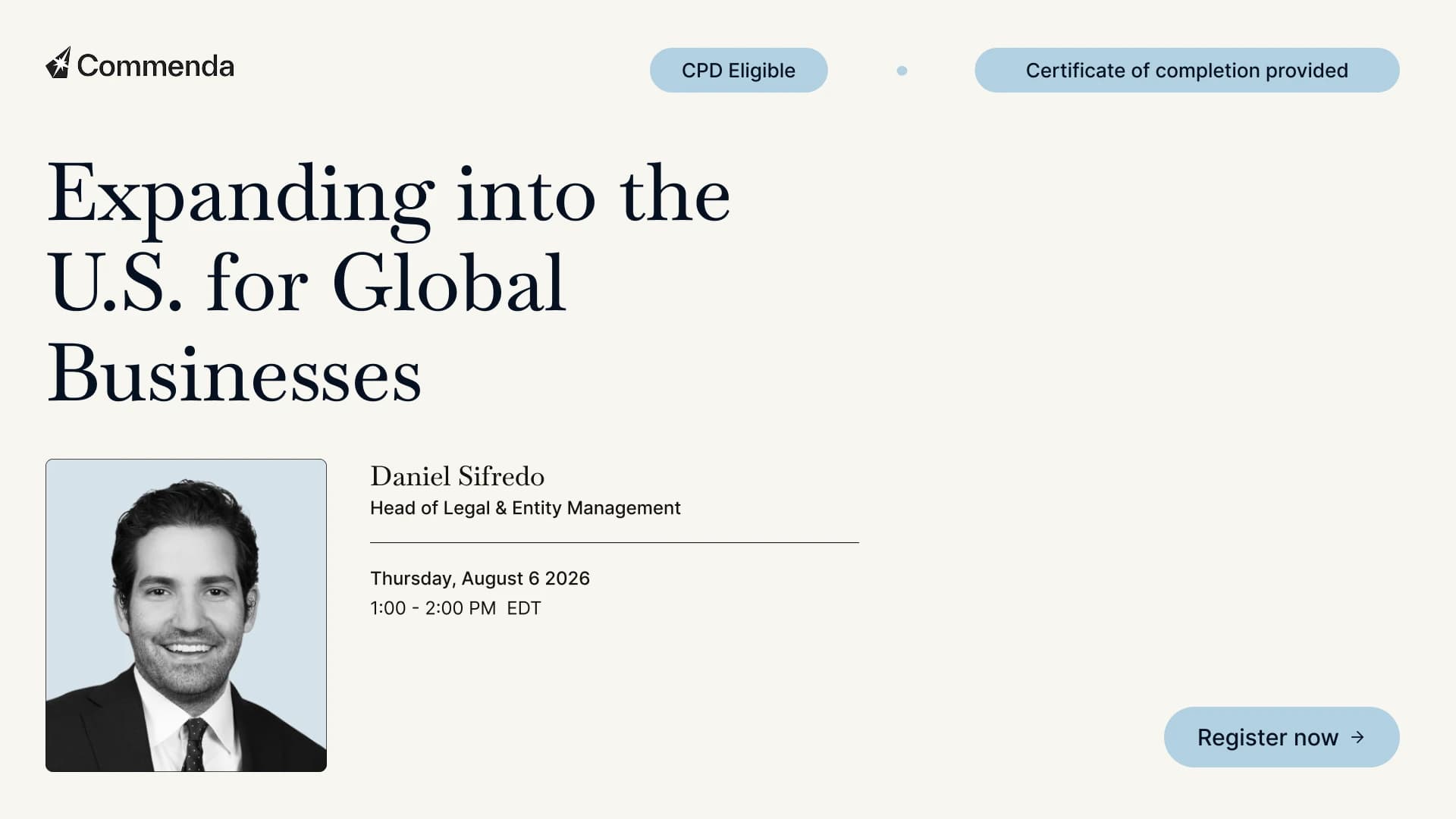
Expanding into the U.S.
6 August 2026

Why companies expand into the US, and the legal and regulatory landscape across federal, state and local government. The session walks through forming a US entity and opening a bank account, state selection, C corporation versus LLC, franchise tax and sales tax nexus, an introduction to US taxes, and the rules around hiring and benefits.
Speakers

Daniel Sifredo
GM of Entity Management and General Counsel, Commenda
Daniel is a lawyer by training. Before Commenda he was at Simpson Thacher & Bartlett in New York, working on M&A, private funds and structuring for private equity sponsors. He is based in New York and works daily with founders navigating the US regulatory landscape.

Bryce Whitney
Americas Sales and Customer Success, Commenda
Bryce covers Commenda's Americas customers from the Seattle office, working with companies through incorporation and the compliance that follows it. At the time of recording he was helping five European companies set up in the US.
View transcript
Bryce Whitney:
Low and Hello and welcome everyone. Excited to have you for our webinar today. We're still let some people filter in, but as we begin, would love to know where everyone's calling in from. We'd love to engage with our audience, so if you could drop in the chat where you're base out of, that'd be great. I myself based in our Seattle office and Daniel's based in New York. We've got Vancouver, very nice.
Daniel Sifredo:
Yep, I'm based in New York City. If you guys joined this webinar and are confused why someone's wearing a hockey jersey, and if you're wondering if you're in the wrong webinar, don't worry, you're in the right place. Our marketing guy told me we're gonna have a ton of people from Canada. So I'm based in New York City, I'm a Rangers fan, and I'm wearing a Marc Messier jersey, my favorite Canadian. He won us the Stanley Cup in ninety four and has all been downhill since then. But I figured we're The hot the jersey of my favorite Canadian since we're gonna we're getting so many people from Canada today.
Bryce Whitney:
We were great for the first time in a while and got a young core. I was actually talking with Owen, who was our colleague, who went to Penn State, and he was telling me about Gavin McKenna going to the Leafs and how he's supposed to be the new Messiah. We'll see if that's actually true, but
Daniel Sifredo:
Yeah. I mean, it's been painful for the Leafs fans. Really all Canadian NHL team fans, the last twenty years. Raleigh in North Carolina, that's great. I'm I actually went to Chapel Hill for my undergrad degree and law and law degree. So love Raleigh, love the triangle. Conor McJesus, yeah. That's true. I you know, I'm not gonna bring up what happened at the Winter Olympics. At the Olympics, so you know.
Daniel Sifredo:
Yeah, too close. All right folks, we'll give it like another minute or so. And then we can get started with this. Ross is can you guys can you hear can you hear me okay? Sa you said you had that you had some very soft voices. All right, great. Give it another minute or so or thirty seconds and then we'll get started. Thanks everyone for joining.
Daniel Sifredo:
Ha It'd nice if this webinar software had live translations. That'd be cool. Yes, recording of the session will be provided in email to all people who attended the webinar. There go. All right. So we'll get started here. So again, folks, welcome to our Commenda Doing Business in the USA master class. Obviously it's super relevant for a lot of folks across the border in Canada as you guys are looking to expand your business in the US. You can go to the next slide. So a little bit about me who I who's leading this webinar, obviously. So I am a lawyer by training. So before joining Commenda, I was at Simpson Thacher & Bartlett in New York City. If you guys haven't heard Simpson Thacher, they're a big corporate Wall Street law firm. There, I represented a ton of private equity sponsors and big companies around their MA, private funds, and structuring work across different companies, across different jurisdictions. And it's really the main reason I joined Commenda because we saw how I saw personally how many issues there are when you try to go cross border and handling cross border entities. So you know, I joined Commenda for that reason. As Bryce mentioned, I'm based out of New York City, go Rangers. And you know, I work daily with founders and businesses navigating the US legal and regulatory landscape as well as other countries, including even Canada. So yeah, we have a lot of experience in Canada as well. Yeah, we can go to the next slide. So this is a basic agenda for the presentation today. So the five topics here are gonna be why you should do business in the US, introduction in the US and the US leg legal and regulatory landscape, the steps to set up a US energy bank account and you know, get all s get your business all set up in the US, a basic introduction of US taxes, and also an explainer about hiring in the US and considerations around that as well.
Daniel Sifredo:
So before we get into that, we'd love to run a quick poll and you can answer through the software. What are you looking to do in the US? Is it hire staff, employees, sell to Americans, access capital, something else? You know, drop a comment.
Bryce Whitney:
Looks like we're pretty split so far, so kind of a wide range of answers. And then just one other thing to note, guys, if you have a question during the presentation, please drop the questions in the chat and Daniel will try to get to them as soon as possible and I will also be answering questions directly.
Daniel Sifredo:
Yeah, as I run through this presentation, we'll check for your questions in the chat and answer them live. I know I'm sure you guys will have a lot of questions as I run through these specifics. Nice. Yeah, it's pretty even split. Subtle Americans is a big one. Access capital is always something we see. Hire staff. Great. Next slide. So why should you do business in the US is kind of our first section here. Next slide. So as I said before, why do business in the US? At Commenda, we see four main reasons, which basically match those polling answers. The first is market access. Look, look, like the US is the biggest economy in the world, GDP over 30 trillion. It's you know, it's a huge market. So if you're looking to sell goods, sell services, it's it could be a huge market to expand the revenue for your business. The second part here is, you know. It's pretty open for business. You know, despite turmoil around international relations and the current administration, the US still has a pretty low barrier regulatory landscape, and I'll get into how that works compared to a lot of other countries. For instance, there's no I mean, some countries have requirements around you have to have directors from that country for the entity you set up. The US doesn't have any requirements like that. You don't need local resident directors. There's no strict foreign ownership requirements. So, you know, very low barrier to entry. And this and point three kind of ties into point two, but very business friendly laws. It is an extremely favorable legal environment. Given it's the biggest economy in the world, the court system, the legal system is extremely familiar with business disputes, contracts, et cetera. And you know, very low regulatory burden to set up and maintain entities in the US. And fourth is a super common reason we see a commenda is access to capital. The US has the most robust cup robust capital markets on earth. There's hundreds and hundreds that if thousands of investors here who are looking to finance different companies, ventures, et cetera. So those are the four main reasons why we see people want to expand in the US. And it looks like based on the poll answers, they kind of match what we see.
Daniel Sifredo:
Ted, yeah, great question. Why am I wearing a p hockey jersey? So, basically we had a lot of people from Canada joining. So I'm based in New York. I'm a huge Rangers fan. And given that we had a lot of attendees from Canada, I decided to wear the hockey jersey of my favorite Canadian who's Mark Messier. So just a fun little thing. So about the US. So as of before, you know, largest economy in the world, third largest country on earth by land mass, population. And this is really important for later on. It's divided into 50 states, one federal district, which is Washington, DC, and 14 territories. The 50 states, you know, function as their own mini governments as well. Similar to if you know, for the folks in Canada. You know, provinces in Canada. You know, most of the economic activities are concentrated in a few areas: California, Texas, Florida, and New York, where I'm from. And most of the largest cities are on the coast as well. So like New York City, San Francisco, Los Angeles, Miami, et cetera. Next slide. That's a great joke, Ronald. So the Federal System 101, the legal system, so this is basically how the legal system and the regulatory landscape functions in America. So the federal government is oversees everything. And they're based out of it's based out of Washington, D.C. It's managed by a president who enforces the laws, a Congress who passes laws, and a in a federal court system who interprets the laws. The federal government oversees nationwide policymaking, including corporate taxes, immigration, work visas, customs and tariffs, and federal labor laws, among other things. And then there's the 50 states, who as said before, function like a small little country. They're each managed by a governor, state legislature, and a local state and local court system, which is similar to the system for the federal government. And important for the folks on this call, the states are the ones that oversee entity formation and governance. Sales tax, employment laws, consumer privacy laws, et cetera. So there is no federal system for entity governance, corporate governance, et cetera. You cannot incorporate federally. I know in Canada you can under the CBCA. And you can also I know in Canada you can also do a provincial incorporation, but in the US you can only incorporate in one state, or you can you choose to incorporate in one state and all the state laws dictate corporate governance, business disputes, etcetera.
Daniel Sifredo:
And then you have local governments. These are the thousands of local counties, towns, and cities that are managed by municipal governments. They oversee very niche in local policy making. This could include business licensing, property taxes, sales taxes. Yes, there are local sales taxes as well in the US on a city and county basis, and they oversee schools and local infrastructure. Next slide.
Daniel Sifredo:
And then important for everyone on here on this call is the full faith and credit clause of the constitution. So as I mentioned before, you're gonna have to pick one of the 50 states in the US to incorporate your entity in. But the good news is because of the full faith and credit call clause, you only need to incorporate once in one state. Because what the full faith and credit law clause says of the constitution is documents issued in one state are valid in all other states, which means once you incorporate a legal entity in one state in the US. You don't have to incorporate an another legal entity in another state. You can operate let's say you incorporate in Delaware, you can operate using that Delaware entity in California or in Texas, et cetera.
Daniel Sifredo:
Yes, so there are state corporate taxes. I'll get into that later in the presentation. There's also a federal corporate tax as well. Both of those corporate taxes are on profits of your corporate entity. Yes, and we'll send a copy of the webinar, recording of the webinar, Mary Jo, to all attendees of this webinar. And Rami, we're gonna cover sales taxes and state and locals and state taxes later in the presentation. Basically all these questions will be answered. What are the best states in terms of ease of operations? All these questions will be answered in the coming slides. Next slide. And Hart, on your question, that's a great question. The short answer is yes, and I'll cover how the registration works in other states later in the presentation. So US entities 101. So these are different types of entity types you see in the US: corporations, limited liability companies, partnerships, joint ventures, trusts, and nonprofits. For the purposes of 99% of the people on this call, corporation your choice is gonna be between a corporation or a limited liability company. Partnerships are really for people setting up investment funds. If you have like, you know, if you want to raise money from people and then invest in other companies, that's a partnership structure usually. And then the other ones usually aren't relevant for people who are setting up entities in the US. As I said before, the US business registration laws operate at the state level. Each state has its own laws, taxes, and processes for opening an entity. Some states are far more popular for businesses than others, and I'll get into why that's the case. And then the third point here is corporations are people here, are people too, which means they can sue and be sued, they can enter into contracts on their own, et cetera.
Daniel Sifredo:
So, I mean, this is one of the many questions we got in the chat so far is how do you go about picking one of the 50 states? That's like a common source of questions we get at Commenda. So there's four kinds of like we have a protocol for this. First is, you know, determining the corporate tax rates in the state. Second, and honestly, it's the most important one, is how business friendly the court and government system is in that state. Third is the sales taxes and fourth is the ease of doing business in the state, which ties into point two. If you can go to the next slide. So this is the Commenda protocol for picking a state. These are the four most popular states to incorporate in that we see at Commenda. And honestly, like even outside of Commenda for anyone, these are the four most popular. By far, the most popular one is Delaware, far and away. Texas is gaining a lot of steam, Wyoming as well, and as well as Nevada. So the reason why Delaware, and this is also covered in later slides, but I can get into it now. The reason why Delaware is the most popular one is because Delaware has been the go-to state for the last 100 years. And the reason to start it is a fun little legal nerd history fact. Basically, in the 1910s up until the 1920s, New Jersey was where everyone incorporated in because they had the best business laws. Then they elected a governor Woodrow Wilson who wanted to be stronger against business. Woodrow Wilson will later become the US president. So he like basically reversed all these laws, and then Delaware saw an opportunity and it copied all of the New Jersey business friendly laws, and then every company moved to Delaware for their incorporations and their entity setup. So that's a fun little hist history lessons for you. And then because since then Delaware has been the main choice, they have developed a an extremely sophisticated court system over a hundred years. So they've had a hundred years to develop case law, which means that the Delaware courts have seen every single business dispute between different businesses, between businesses and their shareholders, between investors and directors of a business. And they have developed all this case law. So since there's really no I mean, there might be novel disputes, but for the most part, they've seen almost every type of dispute. They have had rulings. So you know, if you're a company, if you have a certain dispute, you know exactly. How Delaware and the Del and the Delaware Court of Chantery will rule on that dispute. Investors in your company, investors in companies really like you to form in Delaware and will tell you they will not invest unless you form in Delaware, mainly because as said before, it's a very predictable business court system. So it has a hundred years of case law. So and investors know how Delaware courts are gonna handle certain issue disputes between investors and companies.
Daniel Sifredo:
So that's why Delaware has developed as the numbers as the go-to one. And then, you know, Nevada, Texas, and Wyoming have risen in popularity. Texas has risen in popularity mainly because of Elon Musk. So Elon Musk's companies, SpaceX, Tesla, et cetera, were all incorporated in Delaware up until pretty recently, like until a couple years ago. And there was this dispute where the Board of Tesla approved a pretty crazy compensation package for Elon. And then one of the shareholders sued saying that, you know, we're paying Elon too much in stock. And a Delaware judge basically said the compensation package should be lowered and changed. And Elon got pissed and then moved all his companies to Delaware. And then there's been concerns that, you know, this judge might rule for certain other big businesses in a way they don't like. So they have also moved to Texas as well. So that's really why Texas has increased in popularity. But for the most part, and this is what the slide covers, Delaware is still the go-to. It's a very simple setup and annual maintenance. Because they have they manage so many entities in Delaware, the Delaware government is like very sophisticated. It's you can form your entity as fast as a day. The compliance and annual filing requirements are extremely simple. And as I said before, it's preferred by most investors. I mean, to be honest, if you're looking to raise capital for your entity, investors will basically require you to incorporate in Delaware. If you're not looking to raise capital, maybe you're just looking to sell goods or just hire some people, you don't have to incorporate in Delaware. And it's the strongest business court system and remains a top choice for international businesses. Let me I'm gonna run through it looks like Bryce has answered a lot of the questions.
Daniel Sifredo:
David, so we were told that a common way to get up city setup is a Delaware corp that then we can use to hire key people to bring them down. Is that correct? That's right. You could a very common way to do this is you set up an entity in Delaware and then you hire the people through the Delaware entity. And then I'll get into taxes. I know like we both have c have talked about taxes, I've asked about taxes here. Yes, Delaware has a franchise tax. I'll get into what a franchise tax is later. Juan, if you already have a d a Canadian entity, would the Delaware entity be a subsidiary of the Can Canadian or would it be an independent entity? And that's a great question. Book a call of us, we can talk more about the specifics, but for the most part, the short answer to your question is the structure we see is it's a Canadian parent, and then you have a Delaware or US entity as a wholly owned subsidiary of that Canadian parent. That's the most common structure, but you know, hop a call of us, maybe you have certain things you want to do that might require a different structure.
Daniel Sifredo:
So yeah, so then picking an entity type. So main the main two entity types, and every all 50 states of the US have these entity types, which are C Corp and limited liability companies. So how do I pick between these two? So C corporation is extremely flexible if you want to raise capital from investors. Mainly because in a C corporation, you can create different classes of stock, which means you can give different investors different rights, different distribution, different dividend rights, etc. So if you're looking to raise money from investors, this is the way to go. And investors, as I said before, how investors require you to incorporate in Delaware. They also most likely require you to incorporate in Delaware as a C corporation. They will likely not want to invest if you have a limited liability company, mainly because a C corporation is extremely flesh flexible for giving different types of rights to different investors. There is a double taxation risk with C corporations. And what that means is in the US, if you have a C corporation, there's a corporate income tax at the federal level, which is a flat 21% on profits. So that the entity's profits, a C corporation, they will get taxed at a 21% rate. And then there are state level corporate taxes as well. It depends what this the tax rate is. I'll get into that in a little bit later. But then that state corporate tax level rate is also added. So then Basically, you're paying a federal tax rate and a state corporate tax rate on your on your entity's profits. The entity pays those taxes. And then the distributions, you know, get distributed to the shareholders, and the shareholders have to pay their own taxes for those distributions. So that's the double taxation risk. LLCs do not have that concept. So if you have an LC, it's a pass-through entity, which means there is no corporate. Tax rate at the LLC level. There's no tax rates that apply. And then basically what happens is you know the LLC makes its money, it makes its profits. It distributes those profits which aren't taxed at any level. It distribute those profits to its members. It's instead of shareholders, it's members of an LLC. And the members or the individuals or you know the parent pays its own taxes after it receives the profit. So it is a little bit more tax efficient, but it's a more simple structure. It's harder to issue different types of stock.
Daniel Sifredo:
Different types of rights to investors. So it's the way to go if you think you just want a subsidiary in the US and you just want to hire people, you just want to sell goods or services, but you don't think you're gonna raise capital from investors ever. One quick qu one question we always get is can you convert from a C Corp to an LC or an LLC to a C Corp later on in the process? After you've incorporated, the answer is yes, but that process is very complicated. So it's good to think about what you want this entity to do. If you want to raise capital, you should want to hire employees, et cetera, before you incorporate. Next slide. Yeah, Jody, we actually can support accounting in Canada for both tax filings as well as your books. So we can support that in-house. So happy to talk to you about that. And we have partners, legal partners in Canada that we can refer you to. So just book a call at the link and we can talk all about that.
Daniel Sifredo:
So then and then SARV, you'd have to pay more taxes, maybe double taxation in the US and Canada, as an LC, if I recall correctly. I mean, it's so all this that depends on tax treaties and stuff like that are, you know, pretty complicated. We can talk more about the distributions to the Canadian entity. Book a call with us, we can talk you through exact it really depends on the entity you have in Canada, the entity you're looking to set up in the US, et cetera. Toby's question is, will investors still invest in the Delaware C Corp as a subsidiary to the Canadian company or the parent? Is or is there a preference to it being parent, as investors are not really being invested investing out of the US? So Christopher just answered your question. For the most part, they want to invest in a parent entity. There are rare cases where they're invest a subsidiary. It really just depends on your business. And we can talk you through more of that if you book a call with us. But for the most part they wanna invest in the parent because that the parent holds all the assets, IP, et cetera.
Daniel Sifredo:
So folks, feel free to keep answering questions, but I'll I'm gonna run to the slides so we don't go over on time. So these are the basically the eight basic steps of forming an entity in the US. First, you'll choose a state and entity type, which we already talked about. Then you'll define your shareholding or membership structure. Then you'll look up if your name is available in the state you're incorporating in. All the states have a registry where you can look up all the businesses that have been incorporated there. You're the fourth is you appoint a registered agent. So all 50 states will require this for incorporation. What this is, is I think Canada companies have a similar process, but it is registered agent is someone that will receive your service a process if your entity gets sued in the US. It's some like if someone needs to sue you or a government needs to send a government notice, it's the address that they send these notices in lawsuits to. And then those notices. Get forwarded to you. We accommend to support the registration process. We can appoint the registered agent for you. And then you could see all your notices, all your services processes through our software. Then you would file your articles of incorporation. Then you would receive your formation documents. Different states have different timelines. The more sophisticated states, you can get them packed pretty quickly, like Delaware. And the seventh step here is obtaining an EIN. What an EIN is, is your taxpayer identification the taxpayer identification number for the entity with the US tax authorities, which is the IRS, the federal level. One important note here, given that all of you are outside the US, in order to open a bank account, which is the eighth step in this process, you're gonna need to obtain an EIN before you open a bank account. A bank, any bank of bank account provider in the US will not let you open a bank account without an EIN. Usually when you apply for your EIN, you can apply electronically, but you can only apply electronically if you have a US social security number, if someone at your company has a US Social Security number. If you no one at your company has a US Social Security number, which means that no one at your company is a US resident, which might be the case for a lot of you. What that means is you cannot apply electronically and you have to fax your EIN application to the IRS.
Daniel Sifredo:
I know I still can't believe the federal government still uses fax machines, but they do. And when you do the fax process, that instead of, you know, electronically today, the fax process can take five or six weeks, given the cuts to the IRS. And it they've been really slow. We handle this all for you at Commenda, you don't have to worry about it. But what I flag for this is you know, you want to set up an entity in the US and raise money for investors, your investors are ready to wire money into a bank account. You know, what I would recommend is get started sooner rather than later because you don't want the EIM process to hold up the bank account process. And therefore you can't accept wires into a bank account because you don't have a bank account. You know, we've gotten clients before that they come to us, they hear about us for the first time, they come to us and it's like, Hey, I haven't invest ready to go. They w they want to wire money next week. And we have to tell them, look, you don't have a US social you don't have anyone of a US social security on barrier company. You have to do the fax process. That's gonna take five weeks and then it holds up the investor process. So you don't wanna be in that position. So my advice is if you don't have a US resident at your company that you could use your so US social security number to obtain an EIN, get started sooner rather than later. So you don't want you don't wanna be in that position.
Daniel Sifredo:
Next slide. Yeah, and a quick note on bank accounts. The requirements are gonna be once you're formed, you're gonna have to provide the bank over your certificate of incorporation, your EIN number, a proof of address, and a detail for someone who can sign for the entity. The timeline for fintech banks, once you've provided all the documentation, it can take as little as an hour. The traditional banks like USB Bank, JP Morgan, can take a week or more. The difficulties and considerations here are. Sometimes banks, the traditional banks ask you for passports as part of their KYC process. Some really regional small banks will require an in-person visit. This is not the case for the most huge bank account providers in the ThinkTech banks, so I wouldn't worry about that. And then most banks obviously have no monthly fees and small minimum account balances. And the I mean the biggest consideration here is that EIN process I talked about earlier.
Daniel Sifredo:
So this is a quick note on domestic versus foreign entities. And what I mean by foreign entities, and someone had this question before. What I mean by foreign entities is not a foreign entity from another country. So basically, how this is gonna work is you incor let's say you pick a state to incorporate. Let's say it's Delaware. You've incorporated in Delaware. Now you want to operate that Delaware entity in different states. Let's say you want to hire someone in California or you want to sell into Texas. Because you're you only have to incorporate once instead before. But if you wanna operate, you know, hire staff, et cetera, in other states in the US, you're gonna have to call do what it's called a foreign qualification in those states or a foreign rut registration. And because your entity is foreign to that state, it's not incorporated in that state. This is a pretty simple filing that we can handle for you, but that's something to flag. And it's also required, let's say, for instance, you're trying to get a certain license. And this comes up a lot with like insurance companies. They need to get an insurance license in a state. You know, the state insurance agency will require you to be foreign qualify before you apply for that license. So foreign qualifications are extremely important to keep track of. And once you foreign qualify in a state, you'll also have to make an annual filing in that state as well. And we handle all of this through our software, but something I wanted to flag. I know someone had a question about that earlier.
Daniel Sifredo:
Next slide. So intro to US taxes, which you've gotten a ton of questions about. And Paul, I know you did mention before sales tax is a headache. This is what I'm gonna cover in these slides. It is indeed a headache. And I'll talk about what Nexus is. Next slide. So true or false, US corporate tax compliance is the same across every state. I've kind of given that away, based on my presentation so far. But yeah, feel free to answer. Yeah, and Jung brought this great question, this great point. Yeah, if you have a banking partner in Canada, it might be easier to use them banking partner in the US, mainly because they might run less strict KYC with you than like a bank that doesn't know you would run. And then David Lindover, you had a question. So I would for your question I would recommend booking a call with us because it can get a bit complicated with tax treaty and we can talk you and it required us to learn more about how your business operates right now. But we can definitely help that question. Just book a call with us and we can walk you through that.
Daniel Sifredo:
And Drew, your question, does a strong US presence look better to potential investors and customers regarding resilience and knowledge of the game? I mean, you can start you know, I would say like if you're looking if you don't have a strong US presence now and you want to build one, like I would incorporate the entity now and build that entity, like and build up that business. I think for investors, it's gonna really depend on like how strong your business is. But it's always good to have that entity just so you're investor ready and ready to sell. And employ people, etcetera. Christine, I believe RBC can handle US banking. I have to check. They're a partner of ours actually for Canadian bank accounts. But yeah, you can check your bank account provider. We can also connect you with bank account providers as well. Thanks, David. I appreciate the compliment. So the primary use US taxes here. Let me just see that the poll. I didn't read the answer to the poll. So all of you were correct. The answer is false. US corporate ta tax component is not the same across every state. Every state has different tax rates at the state level.
Daniel Sifredo:
So the three main taxes, and I've talked about income taxes, are the first one. So there's a federal tax rate on C corps of a flat 21% on profits, and then state corporate tax rates vary. The federal tax, your the your federal taxes are filed annually of form 1120, which we can handle and do for you at Commenda. We also handle state tax returns as well. The second one is franchise tax, which some folks may be less familiar with, but this is a tax you pay for. Do for the pleasure of having your entity incorporated in a state. So what that means is let's say you incorporate in Delaware or in Texas. Once you incorporate, you're gonna owe franchise taxes to that state on a yearly basis. I wouldn't freak out too much about this. Franchise taxes are very low in most states. Also, as with the same with set state corporate taxes, every state calculates franchise taxes differently. Delaw Delaware actually has two methods that you can choose from to calculate it. Usually in our experience, it's usually a couple hundred bucks to pay for the for franchise tax. So it's not a crazy burden. And then also something to know, I mentioned foreign qualifications as well. If you f if you incorporate in one state and then you're foreign qualifying in a couple other states, some states may require you to pay franchise tax after your foreign qualification as well.
Daniel Sifredo:
So then the third thing here is sales tax. So this is the US equivalent of HST in Canada. It's a consumption tax on goods and services. It works a bit differently than HST. There is no federal sales tax. There are si state and local sales taxes, and you know those rates vary from zero to seven point twenty five percent. And how sales taxes work is basically once if you're selling goods and services into a state or a municipality. After you cross a certain threshold, which is called Nexus, which I'll get into what that is, and it the Nexus rules vary by different state. You're when you sell goods to a customer, you're gonna have to charge that customer the sales tax rate in that jurisdiction and then collect that sales tax rate from the customer and then remit it to the government. Commenda tax engine handles all of this for you. And some states, you know, will say after this is very common in some states. They'll say after you have $100,000 in sales in the state, you're gonna have to start collecting a remitting sales tax. Before that, you don't have to, but after you breach that threshold, you will. So other states ha have physical nexus. Let's say you for and qualify in that state, that automatically qualifies you for sales tax. And that means you're gonna have to start collecting. You may have an office in that state or a building or real estate. That's physical Nexus, you're gonna have to start collecting as soon as you start owning that property. Let's say you have employees in that state. If you hire an employee in a state, that breaches the Nexus requirement. And as soon as that employee gets hired, you're gonna have to start collecting and remitting sales taxes. Next slide.
Daniel Sifredo:
So state corporate taxes. The highest rate is New Jersey with eleven point four percent. The lowest there's some states that have zero percent corporate taxes. This includes Texas, Nevada, Washington, Wyoming, and South Dakota. State corporate taxes are filed and paid separately from federal corporate taxes. State corporate taxes may be deductible from federal corporate tax liability, and we can talk more about that. Book a call for us. We can talk you through that. And then an intro to franchise tax. I'm not gonna go into this too much because I kind of covered this in the last slide. But these are different states, the main four states for incorporation handle franchise taxes. For Delaware actually does it differently if you have a C Corp or an LLC. An LC is a flat rate, the C Corp is a bit more complicated. Texas has a percent-based system. Wyoming has no franchise tax. As long as you don't have any assets in Wyoming. Same thing for Nevada. Nevada does have a bit a business license fee you have to pay every year, which can range from two hundred dollars to five hundred dollars. Chris, great question. Yes, we'll be sharing ev you everyone who attended this webinar will be getting a recording of the webinar.
Daniel Sifredo:
Yeah, yeah, and share with your partners and so you guys can prep for the consultation call. And just to be clear, the consultation call is totally free. We have questions like, do I have to pay for this? No, it is totally free. We talk to you, we c we show you how we can help when we go from there. So what is sales tax? I basically kind of covered this, but it's a consumption tax, it applies to gross sales, not profit. It varies by location, state, city, county, etc. And it's added the time of sale. So it's added. When you sell the good or service to your custom the customer, you charge it to the customer and then you remit it to the government. Next slide. There are 13,000 plus sales tax jurisdictions because you have the 50 states, plus you have all the counties and the cities within those states that also can charge sales tax rates. So this can get really complicated really quickly. Luckily, our software handles all this for you. We connect with your ERPs, and we have all these other integrations that can track all your sales and tell you exactly how much to collect, how much to remit, et cetera. So you don't have to worry about this headache. Next slide. So, introduction to Nexus Laws. I kind of covered this already a little bit in answering questions in the previous slides. But first is physical Nexus. This is established. And then what Nexus is, is that you don't have to start collecting and remitting sales tax to the government until you breach Nexus in a certain jurisdiction. Once you breach Nexus, you have to immediately start applying those rates. There's several ways you can breach Nexus. First is the physical Nexus, which I talked about. You have an office space in that state, you have employees in that state. That's how you commonly breach econom physical nexus. Economic nexus, and different states have their own rules around this. Certain states will say after you pass fifty thousand dollars in sales in our in our state, you breach nexus. Others will say a hundred thousand, et cetera. And the third is legal nexus. If you incorporate in a state, you foreign qualify, you'll probably breach nexus and you have to start collecting and remitting for sales into that state immediately.
Daniel Sifredo:
Jody, yeah, so like every state has just different Nexus rules. Some of the times they're similar, some of the times they're more onerous. It really depends. Our software tracks all the Nexus rules to make sure you're never in breach. To make sure we notify you when you're in breach and you can turn on the collecting and remitting. Sorv, a great question. Is a government grant considered revenue? Would a grant of a hundred K be considered having reached Nexus? It really depends where that government where that grant came from, the accounting treatment of that grant, et cetera. I think that question is more suitable for a constitutional plus. We can talk you through that and how we can help with that. So for Delaware, Toby, franchise taxes, it applies to C Corps and LLCs. It's a different calculation for C Corps and LLCs, but it only applies if you incorporate in Delaware. If you incorporate somewhere else, you obviously won't have to pay the franchise taxes in Delaware. You'll have to pay the franchise tax in whatever state you incorporate in.
Daniel Sifredo:
And then so US hiring basics. You know, payment currency, everyone knows the US dollar payroll cycle is usually set at the state level, there's best practices around this. There is no statutory termination or probation periods. You can give one week notice, two week notice, one day notice, etc. Minimum wage is seventeen to five at the federal level, although some states might have higher rates. So, like if you hire employees in California or New York, I think New York, the minimum wage is fifteen dollars an hour. So For your New York employees, you'll have to pay them at least fifteen dollars an hour. And then taxes and costs to the employer. The typical US employer should expect to spend twelve percent on top of salary for social security taxes, unemployment, insurance, taxes, withholding, et cetera. Next slide.
Daniel Sifredo:
Benefits and leave. So mandatory benefits, and these are issued by the government, these are not paid for by private corporations, or Social Security and Medicare and Workers' Comp. Leave and time off. Mm very infamously, the US has no mandatory time off or parental leave at the federal level. Some states and cities may require sick leave. And in terms of health, and there's some there's some Niche laws at the federal level as well and the state level around parental leave, but for the most part, it's not as comprehensive as other countries. Healthcare, much to very infamously, the US has a privatized healthcare system. And there is no mandate for employers to offer healthcare insurance or healthcare coverage as long as you have under 50 employees. Next slide. So wanna run a quick poll here. What's stopping your business from expanding into the US market right now? One, we don't know where to start. Hopefully after this presentation, you have a better idea of where to start. You could talk to us and, you know, get more comfortable. Number two, uncertainty about the cost or what's required. Number three, too much to coordinate. Number four, not ready for the US market. Five, nothing, we're ready.
Daniel Sifredo:
I'm just looking at the results now. So looks like zero percent before we don't know where to start. Uncertainty about the cost or what's required. Totally understand that. Too much to coordinate. You know, luckily for Commenda, you book a call with us, we'll let you know what the cost is, what's required. We'll handle all the coordination for you so you don't have to do it. And you know, if you guys are ready, book a call with us and we'll help. Next slide. So for the accountants in the room who want CPD credits, we're running a poll now, just answer yes to this poll and we will email you your s your certificate of completion. Ronald to book a call, we'll drop a link in the chat right now and you can go on there and book a call with us.
Daniel Sifredo:
Chris, on your question, sorry if I already covered how much easier and more complicated to expand into US via MA. So that's if you're, I'm guessing, acquiring a US entity using your Canadian entity. That might be a bit more complicated. We can talk you through that. Just book a call with us and we can see how we can help. And then I'll run through what we'll have I'll run through more QA at the end of this presentation, but I'll just give kind of give a brief overview of what we do at Commenda. So basically we do everything that keeps your entities compliant. So that means incorporating an entity, doing all your tax filings, your accounting, your transfer pricing, which I just did a webinar on. If you guys don't know what transfer pricing is, we can talk you through that. But it's really important if you're setting up subsidiaries. We do your US sales tax and other on demand legal tax and compliance, filings and services. Basically, you should think of us if you want to set up an entity or you already have an entity in the US or any other jurisdiction on earth, we cover seventy jurisdictions at Commenda, we will do everything for you to keep that entity compliant. And not and you don't have to worry about it at all. And it's all managed through our software. So that's basically what Commenda does.
Daniel Sifredo:
All right. So I'll run through I'm just gonna scroll start scrolling up on the chat here. Can I set up a US office with a virtual office? Yes, you can. That's pretty common. Well, we can email you as well if you're locked out of the link. Yes, Sarv, we actually do handle India. India was actually the jurisdiction that we started with. We handle everything in India. India can be a huge headache. But we can ha we handle tax compliance, incorporation, accounting, you name it, we do in India.
Daniel Sifredo:
Yeah, I'm actually going to Bangalore next week. We have an Indi we have an office in India which I'm visiting for two weeks. First time in India, I'm actually really excited about that. Heart, what level government administers workers' compensation insurance? That's administered usually at the state level. And it's you and depending on where you hired, it might there might be obligations in the different states, but it's just depending on where you hire. Yeah, feel free to a ask me any more questions. I'll stay on for a couple more minutes. Heartache, yes, we manage we manage Private Limiteds India pretty easily. We can handle everything for those types of entities. Yeah, Jody, we can connect you with immigration partners we have, book a call with us. We can learn more about the type of business you're doing, why you need immigration experts, and then we can see how we can help.
Daniel Sifredo:
Luke, great question. What if you have a sales agent? I'm guessing like a consultant or an independent contractor versus an employee. Usually for sales tax, that will still count as breaching Nexus. There are more complicated rules with the IRS for income taxes and stuff like that, you pay that employees pay and the filings you have to make when you're paying your employees. So book a call at us and we can talk you through that. Yeah, heartache. Just book a call with us at the link and we can talk more about India Private Limited as well.
Bryce Whitney:
And Ronald, just on pricing, our incorporation fee for an LOC or C Corp is one thousand dollars. Happy to walk you through what is required after that as well.
Bryce Whitney:
And Glenn, our rep allocation is based on time zone. So we have reps in the US, in North America, Europe, as well as in Asia.
Daniel Sifredo:
So we just match it based on where your time zone's at. Do you have experience in helping start up from Europe to expand to North America, US Canada, essentially Mexico? We have handled setting up and managing entities in Europe as well as US Canada and also Mexico. So we can help with all of those.
Daniel Sifredo:
What kind of work visa work permit Canadians can get to work for their parent company in the US? Do you need visa for running business in America? You sometimes you actually don't need the visa. It really just depends. We can walk you through your specific situation, Hema, and give you a more concrete answer if you book a call with us. It really just depends on your unique situation, where you're located in, what company you're looking to incorporate, etcetera. Alan, same yeah, same answer to Emma's question. It really just depends on the structure of your entities, et cetera, whether it's gonna require a visa, and all that good stuff. Just book a call with us, we can walk you through that. Thanks, Glenn. I really appreciate the compliment. All right. Thanks all thanks again all for the compliments. Really appreciate it. Hopefully you got a lot of value out of this webinar.
Bryce Whitney:
And then as mentioned before, our team will obviously be following up with the slides, recording, as well as a link to book directly with one of our sales members.
Get access to the video
Add your details to access the recording. It starts playing here as soon as you do.
Poll
Insights from the webinar
21%
flat federal corporate income tax on the profits of a US C corporation, with state corporate tax charged on top.
11.4%
the highest state corporate tax rate in the country, in New Jersey, which is why state selection changes your total tax bill.
Download the masterclass deck
Every slide from the session, including the frameworks and worked examples our experts walked through.
Questions asked during the masterclass
Yes. There is a federal corporate tax and separate state corporate taxes, and both apply to the profits of the corporate entity. State rates vary widely.
The structure we see most often is a Canadian parent with the Delaware or US entity as a wholly owned subsidiary of that parent. A different structure may make sense depending on what the business is trying to do.
For the most part investors want to invest in the parent, because that is where the assets and the IP sit. Investing directly into a subsidiary happens but is rare and depends on the business.
For sales tax purposes that usually still breaches nexus. The IRS rules for income taxes and for the filings required when you pay people are more complicated and worth a separate conversation.
Recommended sessions

AI and Transfer Pricing: What Global Businesses Need to Know
How the arm's length principle works, and where AI helps with transfer pricing policies, benchmarking and documentation.

Transfer Pricing Basics
Transfer Pricing for Global Businesses

Conor Kirkland
International Sales and Partnerships, Commenda

Swastik Shrey
GM of Tax, Accounting and Transfer Pricing, Commenda
Transfer Pricing for Global Businesses
How the arm's length principle works, which documents each country expects, and what an audit asks for.

EOR vs. Entity: When to Make the Switch for International Hiring
What it costs to hire abroad through a local entity, an employer of record, or contractors, and when to switch.

Understanding U.S. Sales Tax for Global Businesses
Who has to collect US sales tax, which rate applies, and how registration and filing work in practice.
Understanding VAT for Global Businesses
How the VAT credit mechanism works, when you have to register, and what place of supply means for your sales.
Subscribe to our masterclass today
Stay up to date with legal and financial updates around the world. Finance leaders trust Commenda with keeping their businesses in 70+ countries compliant everywhere.
Explore our product
Let our compliance experts help you choose the right setup for your business.
Entity management
Incorporation, registered agents, and every recurring filing for each entity you run.
Explore the product
