Sales tax software for Shopify
Shopify collects sales tax at checkout. It will not register you, file your returns, or tell you where you are exposed. Commenda sizes that exposure, calculates sales tax, VAT, and GST on every order, and files in every jurisdiction you sell to.
Trusted by global businesses

































Monitor your global exposure
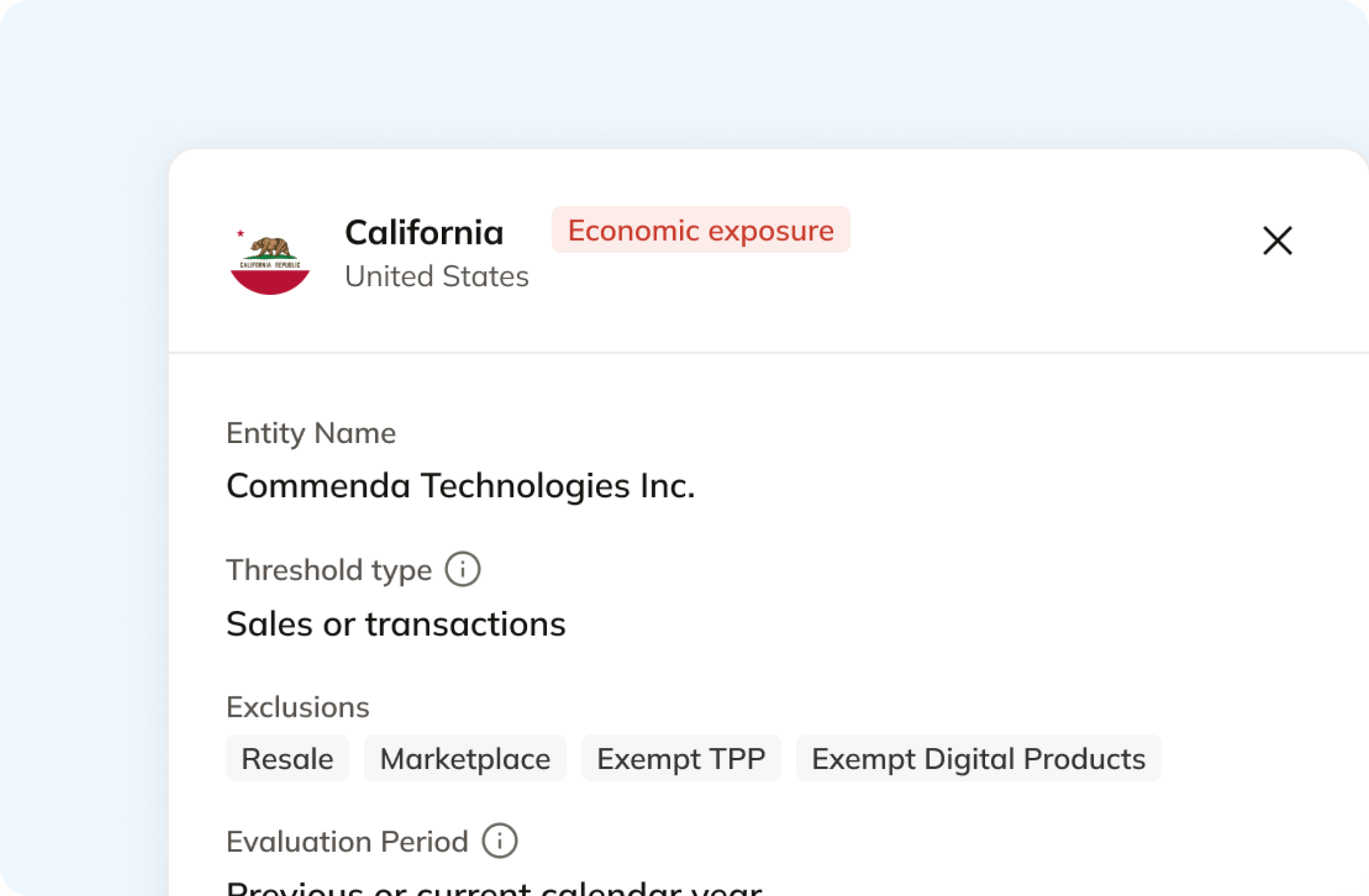
Every Shopify order counts against economic and physical thresholds in all 50 states and 70+ countries. You see where you are close before you cross.
Collect and calculate taxes
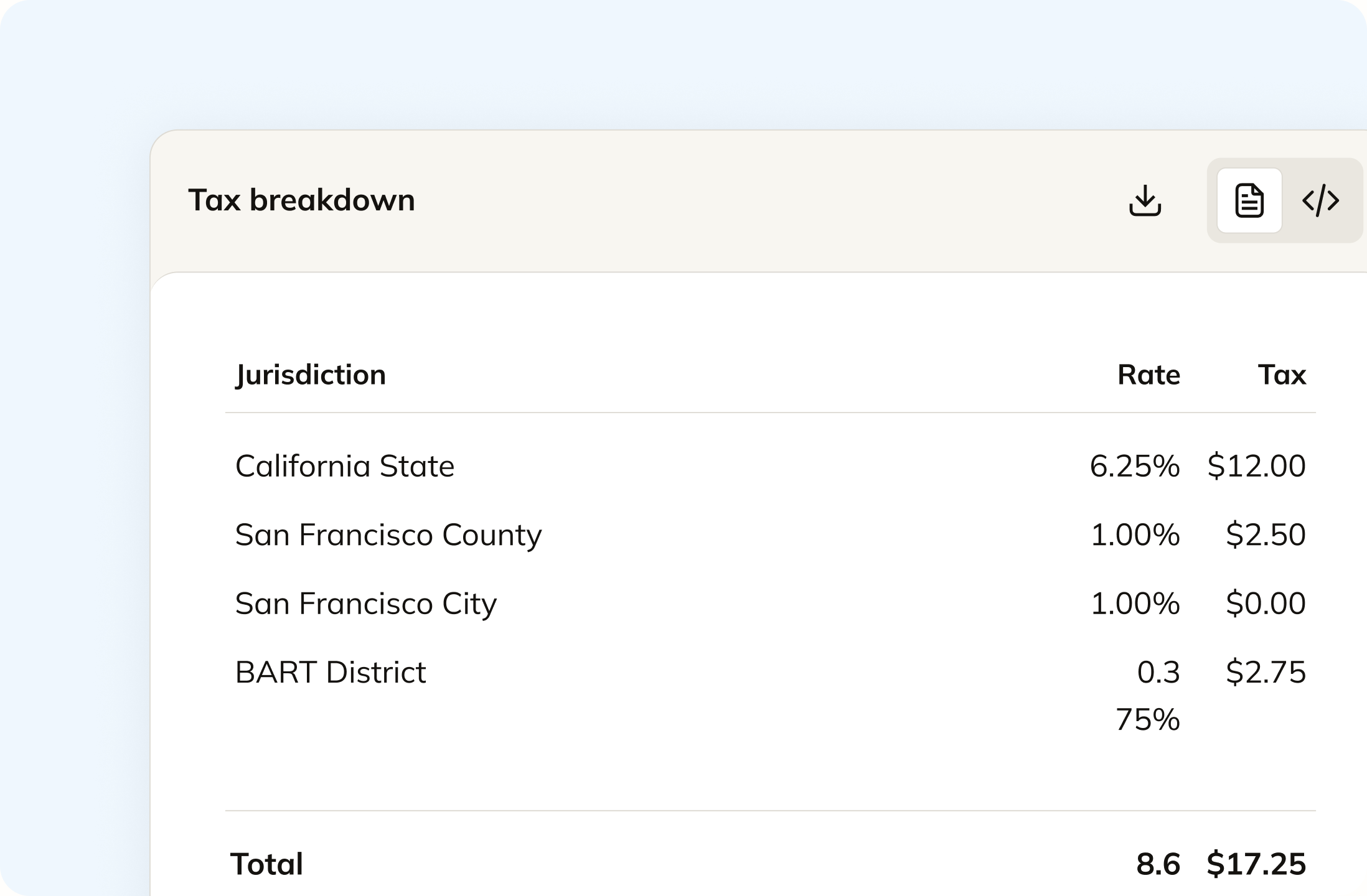
Rates apply per country, per state, and per product. A digital service in Germany and a physical good in Texas are each handled correctly.
Automatically remit them across the world
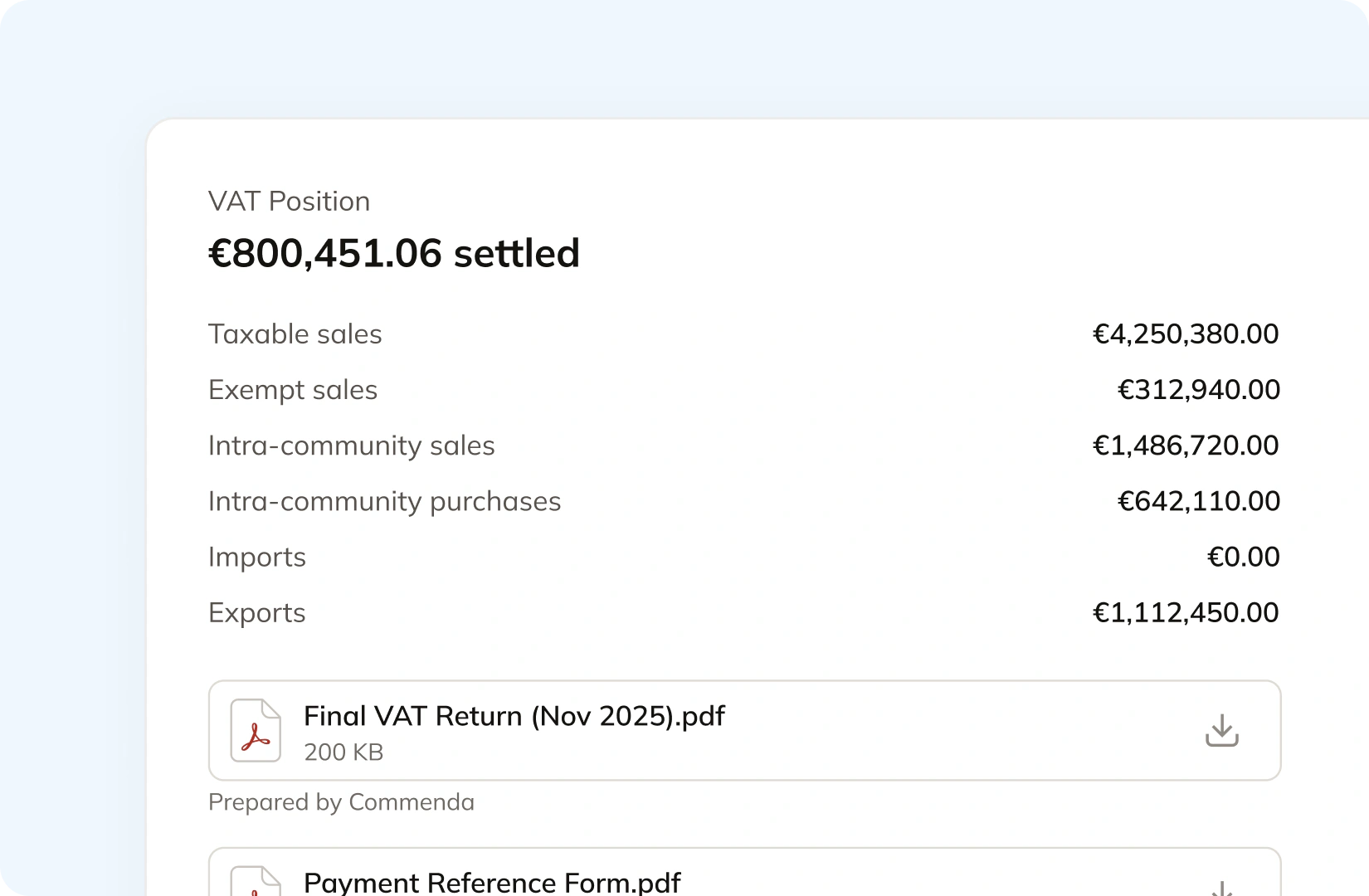
Returns are built from your synced data and filed on each jurisdiction's own frequency, with remittance tracked per filing.
Coverage comparison
What Commenda covers that Shopify does not
Shopify Tax calculates and collects at checkout. Everything after the checkout is a separate job, and these are the seven that matter. Shopify's own figures come from its automated filing eligibility and filing pricing pages, checked on July 29, 2026.
Registrations for collecting tax
- Shopify Tax
- Not offered
- Commenda
- Permits in all 50 states, EU VAT with OSS and IOSS, GST in Australia, Canada, New Zealand, and Singapore
Filing your returns
- Shopify Tax
- $75 per return, $50 on Plus, billed per return generated
- Commenda
- Filed on each jurisdiction's own frequency
Back and amended returns
- Shopify Tax
- Not supported. Shopify points you to a tax professional
- Commenda
- Filed, including back periods under a voluntary disclosure agreement
Revenue outside the store
- Shopify Tax
- Excluded: imported orders, unconnected channels, and Amazon, Meta, or TikTok
- Commenda
- Every source rolls into one exposure number
Exposure monitoring
- Shopify Tax
- Not offered
- Commenda
- All 50 states and 70+ countries, with alerts before you cross a threshold
Exemption certificates
- Shopify Tax
- Not offered
- Commenda
- Self-service portal, validated, applied automatically to future orders
Filing outside the US
- Shopify Tax
- US stores only
- Commenda
- 70+ countries
| Shopify Tax |  | |
|---|---|---|
| Registrations for collecting tax | Not offered | Permits in all 50 states, EU VAT with OSS and IOSS, GST in Australia, Canada, New Zealand, and Singapore |
| Filing your returns | $75 per return, $50 on Plus, billed per return generated | Filed on each jurisdiction's own frequency |
| Back and amended returns | Not supported. Shopify points you to a tax professional | Filed, including back periods under a voluntary disclosure agreement |
| Revenue outside the store | Excluded: imported orders, unconnected channels, and Amazon, Meta, or TikTok | Every source rolls into one exposure number |
| Exposure monitoring | Not offered | All 50 states and 70+ countries, with alerts before you cross a threshold |
| Exemption certificates | Not offered | Self-service portal, validated, applied automatically to future orders |
| Filing outside the US | US stores only | 70+ countries |
Calculate taxes globally on Shopify using Commenda
Commenda reads every Shopify order as it lands and applies the right rate for the ship-to address and the product. Rates run per country, per state, and per product code, so a digital service in Germany and a physical good in Texas are each handled correctly. Shipping and handling stay split from item revenue, and every SKU in your catalogue carries its own tax code.
Track your global exposure from Shopify
Your Shopify transactions sync at the transaction level, payables and receivables both. Commenda counts them against thresholds in all 50 states and 70+ countries, and tax a marketplace already collected stays separate from revenue that still needs it. Connecting the store backfills your order history too, so exposure you already have surfaces next to the sales landing today.
Automatically remit transactions around the world
Returns are built from the same synced Shopify data, so nothing gets exported and nothing gets re-keyed. Commenda files on each jurisdiction's frequency, tracks remittance per filing, and files amended returns where a period needs correcting. Confirmations and reference numbers land in the audit trail.
Manage your customers and exemptions in one place
Commenda syncs your Shopify customers, then manages their exemption certificates as part of the product. Your customers upload through a self-service portal. We validate each certificate, store it against the customer, and apply it automatically to future orders in the states where it is valid. Wholesale customers who have not sent one can be batch-requested, with reminders.
Consolidation
Commenda consolidates multiple integrations in one platform
Enterprise sellers run Shopify, marketplaces, a billing platform, and an ERP at once. Filing a return means collecting transactions from all of them, aggregating them, and then filing once. None of those platforms talk to each other. Commenda solves that.
Accounting systems do not talk to each other
Shopify Tax covers orders where you are the merchant of record. Its automated filing excludes imported orders, channels not connected to Shopify, and marketplaces such as Amazon, Meta, and TikTok. Each marketplace reports only what it facilitated. Your ERP holds invoices but cannot tell which orders a platform already taxed.
Exposure is never measured across systems
Economic nexus is assessed on your total sales into a state, not on one channel's share of them. Counted state by state, 27 states count marketplace sales toward your own threshold and 18 exclude them (TaxJar), so the same Amazon revenue changes your position in one state and not the next. No single platform holds the figure that decision depends on.
Partial filings invite penalties
A state issues one permit per entity and expects one return covering every taxable sale into it that period. File on one channel’s data and the return is wrong: direct sales, marketplace sales the platform already remitted, exempt wholesale revenue, and jurisdiction-specific shipping rules all have to reconcile. Understated returns draw penalties that have run 20% to 30% of the liability in cases we have cleaned up.
One ledger behind every channel
Every source connects to one ledger. Each transaction carries its origin, SKU, shipping amount, and any tax already collected, so platform-remitted revenue stays separate from revenue that still needs tax. The result is one exposure figure per state and one filing per period, with every line traceable back to the order it came from.
Cost of growth
How competitor pricing grows with your business
Shopify Tax meters you. Your bill climbs with your volume, your filing frequency, and every market you open. Commenda is priced as a subscription, so it does not.
| What gets metered | What Shopify charges |
|---|---|
| Free until | $100,000 USD in sales, after which every order in a collecting state is metered |
| Fee on every order | 0.35% of the order on Basic, Grow, and Advanced. 0.25% on Plus |
| Per-order cap | $0.99 USD, however large the order |
| Cap resets per region | $5,000 USD per region, per calendar year, so each new market adds its own $5,000 |
| Every return carries a fee | $75 on Basic, Grow, and Advanced. $50 on Plus. Charged per return generated, not per return filed |
| Where it stops working | Shopify Tax is only for stores under $25,000,000 USD in sales per year |
Free until
$100,000 USD in sales, after which every order in a collecting state is metered
Fee on every order
0.35% of the order on Basic, Grow, and Advanced. 0.25% on Plus
Per-order cap
$0.99 USD, however large the order
Cap resets per region
$5,000 USD per region, per calendar year, so each new market adds its own $5,000
Every return carries a fee
$75 on Basic, Grow, and Advanced. $50 on Plus. Charged per return generated, not per return filed
Where it stops working
Shopify Tax is only for stores under $25,000,000 USD in sales per year
Figures verified on July 29, 2026 against Shopify Tax pricing and Shopify automated filing pricing.
From the field
Trusted by businesses across the globe


“The platform works exactly the way I need it to. I have one team member who manages all of our exemption certificates, and that functionality has been particularly efficient for us. It allows him to handle everything seamlessly, making the handoff significantly easier.”
VP of Finance, TRX






Compare Commenda sales tax software with competitors
Ten apps, side by side on coverage, ratings, and real pricing. We say where each one wins, including where a point solution is enough and you do not need us.
More sales tax resources
Guides from the Commenda team on nexus, remittance, and surviving an audit.
Frequently asked questions
Shopify can calculate and collect at checkout. It does not register you, file, or remit. That gap is worse than it sounds. Collecting tax without a permit is a bigger red flag to a state than never collecting, because the money is held in trust and the state can see it was charged. We have picked up a Shopify seller who had collected roughly $18,000 over four years and remitted none of it. Marketplaces work differently: on Amazon, Walmart, eBay, and TikTok Shop, facilitator rules put collection and remittance on the platform. Your own store is not a marketplace.
Scope. Shopify Tax calculates at checkout, free to $100,000 in sales and then 0.35% per order, 0.25% on Plus, capped at $0.99 an order and $5,000 per region a year. Its filing add-on is $75 a return, $50 on Plus, covers current periods only, and is US-only. It does not register you, chase exemption certificates, or see revenue that never touched Shopify. Commenda covers the whole lifecycle in 70+ countries. Many customers run both during the switch, then retire Shopify Tax once we are filing.
A voluntary disclosure agreement usually waives penalties and leaves interest, and the waiver succeeds in roughly 98% of the ones we run. For scale: on one $104,000 liability that had been exposed about 22 months, penalties would have run $21,000 to $31,000, against roughly $6,000 to $8,000 of interest with a VDA in place. Lookback periods are two to four years in most states and unlimited in a few, Nevada among them. Below a meaningful liability a plain backdated registration costs less than a VDA, and we will tell you which one your numbers point to.
The VDA first, wherever exposure already exists. Registering announces you to the state and lets it back-charge tax, interest, and penalties from your original nexus date. The order that protects you is: pull the Shopify order history, quantify the exposure per state, file the VDA, then register and start collecting.
Physical presence, and it catches sellers out more often than thresholds do. Inventory at a 3PL, a warehouse, a remote employee, a traveling sales rep, or an office all create physical nexus in that state, at any revenue. It also lingers: trailing nexus keeps an obligation alive after the employee or the inventory leaves. Economic nexus is the other half, usually $100,000 in sales or 200 transactions a year, and 45 states plus DC levy sales tax at all. Commenda prompts you each quarter for employee locations so a new hire does not open a state quietly.
Yes. Multi-storefront setups are natively supported, including a separate legal entity per store, and Shopify Plus is covered. You switch entities on one dashboard with consolidated registrations, exposure, and filings. Older tax integrations often could not do this without manually splitting the stores.
Every source is read separately and rolled into one exposure number, with the source visible on each transaction. Tax a marketplace already collected is tracked apart from revenue that still needs it, and we can usually see how much the platform remitted, so a direct ERP sale gets tax applied while an already-taxed Amazon order does not. Line items carry SKU, shipping amount, tax on shipping, and tax collected, so a filing traces back to the order.
Yes, and this is where B2B sellers get caught: a US business-to-business sale is taxable unless a valid certificate is on file. You need one per state you deliver into, though multi-jurisdictional certificates cover larger customers across several. Your customers upload through a self-service portal, we validate and store each one against the customer, and it applies automatically to future orders. Expiries are tracked and chased, including annual refreshes in states like Florida, and we can batch-request certificates from customers who have never sent one.
You can start collecting on the "applied for" registration number in Shopify rather than accruing more exposure while paperwork clears. Once the registration or the VDA is approved, that collection is retroactively authorised.
Custom integration support for your business
Every business runs its accounting differently, and those processes exist for good reasons. We map how yours works and build the integration to match, rather than asking you to work around ours.
Indirect Tax
Monitor nexus exposure, register, file, and remit sales tax and VAT in one platform. Commenda keeps you compliant across 100+ jurisdictions.
Explore the product
