Sales tax software for Deltek Costpoint
Deltek builds Costpoint for government contracting, aerospace and defence, and its tax model matches: a tax code with a rate you enter, linked to a project. Whether a sale is exempt depends on who is buying, and that answer changes by state. Commenda resolves it per customer, holds the document, and files.
Trusted by global businesses
































Manage exemption certificates end to end
Federal agencies are exempt by law in Texas and do not apply for exemption. Another state's government agency is not exempt there. Commenda resolves that per customer and per state, and holds the document behind it.
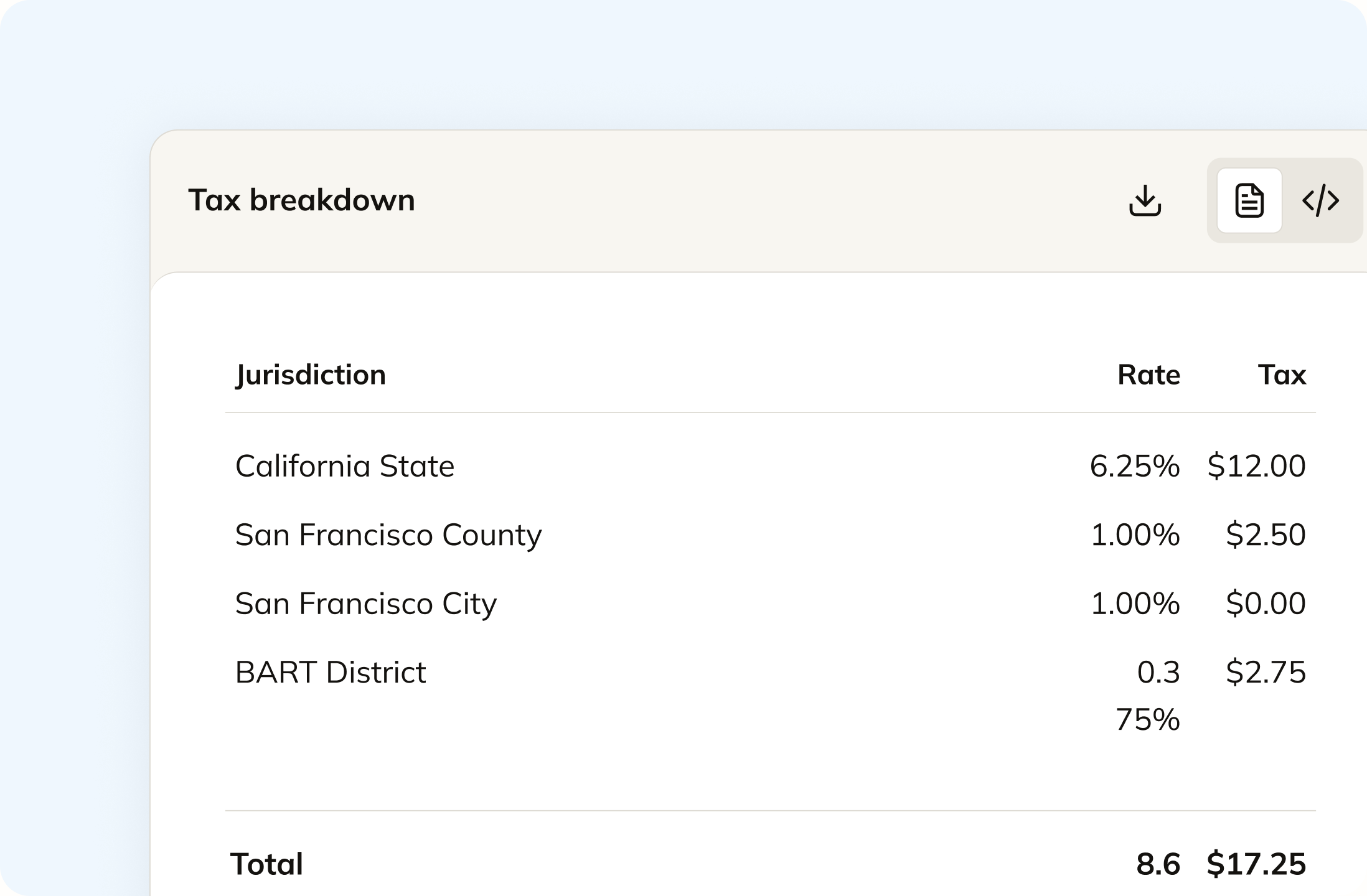
Calculate tax without typing rates
In Costpoint a tax code is a rate you enter yourself, described in Deltek's help as usually a state or province. Commenda maintains rates across 14,000+ US jurisdictions and 70+ countries.
One exposure figure across every entity
Costpoint's sales and VAT report covers the entity you are in. Commenda consolidates every entity into one exposure figure per state, with alerts at 80% of a registration threshold.
Coverage comparison
What Costpoint handles, and what it hands back
Deltek positions Costpoint as ERP for government contracting, aerospace, and defense, and its tax model is built the same way, per project and per organisation. The figures below come from Deltek's own published Costpoint 8.1 online help, on setting up sales tax for billing, the Manage Sales or Value Added Taxes screen, customer VAT information, the sales and value added tax report, and how its EU VAT lines are built, checked on July 30, 2026.
Current rates for the states you invoice in
- Deltek Costpoint
- Not handled. You enter the tax rate on the tax code yourself
- Commenda
- Maintained across 14,000+ US jurisdictions and 70+ countries
Registrations for collecting tax
- Deltek Costpoint
- Not handled. Tax codes attach to projects, not to registrations
- Commenda
- Permits in all 50 states, EU VAT with OSS and IOSS, and GST across APAC and Canada
Evidence behind an exempt government sale
- Deltek Costpoint
- A number, not a document. The tax code takes an Exempt flag and a certificate number
- Commenda
- Certificate collected, validated, stored against the customer, and applied where valid
One customer buying in two tax regimes
- Deltek Costpoint
- Not handled. Deltek says create a separate customer for each taxable location
- Commenda
- One customer record, with the treatment resolved per transaction
Filing your US sales tax returns
- Deltek Costpoint
- Not handled. You update the tax report tables and print a report
- Commenda
- Filed in all 50 states, amendments included
Filing outside the United States
- Deltek Costpoint
- Not handled. It fills EU VAT return lines that you file yourself
- Commenda
- Filed across 70+ countries from one platform
Knowing where you owe
- Deltek Costpoint
- Not handled. Nexus appears nowhere in its published help
- Commenda
- Economic and physical thresholds in 50 states and 70+ countries, with alerts before you cross
| Deltek Costpoint |  | |
|---|---|---|
| Current rates for the states you invoice in | Not handled. You enter the tax rate on the tax code yourself | Maintained across 14,000+ US jurisdictions and 70+ countries |
| Registrations for collecting tax | Not handled. Tax codes attach to projects, not to registrations | Permits in all 50 states, EU VAT with OSS and IOSS, and GST across APAC and Canada |
| Evidence behind an exempt government sale | A number, not a document. The tax code takes an Exempt flag and a certificate number | Certificate collected, validated, stored against the customer, and applied where valid |
| One customer buying in two tax regimes | Not handled. Deltek says create a separate customer for each taxable location | One customer record, with the treatment resolved per transaction |
| Filing your US sales tax returns | Not handled. You update the tax report tables and print a report | Filed in all 50 states, amendments included |
| Filing outside the United States | Not handled. It fills EU VAT return lines that you file yourself | Filed across 70+ countries from one platform |
| Knowing where you owe | Not handled. Nexus appears nowhere in its published help | Economic and physical thresholds in 50 states and 70+ countries, with alerts before you cross |
Calculate taxes globally on Costpoint using Commenda
Tax resolves per transaction against the ship-to or place-of-performance address, down to county, city, and district, with a product tax code on each line. Nobody maintains a tax code per jurisdiction and nobody types a percentage. Where a project bills a customer that is genuinely exempt, the line goes out exempt and the reason is recorded against it.
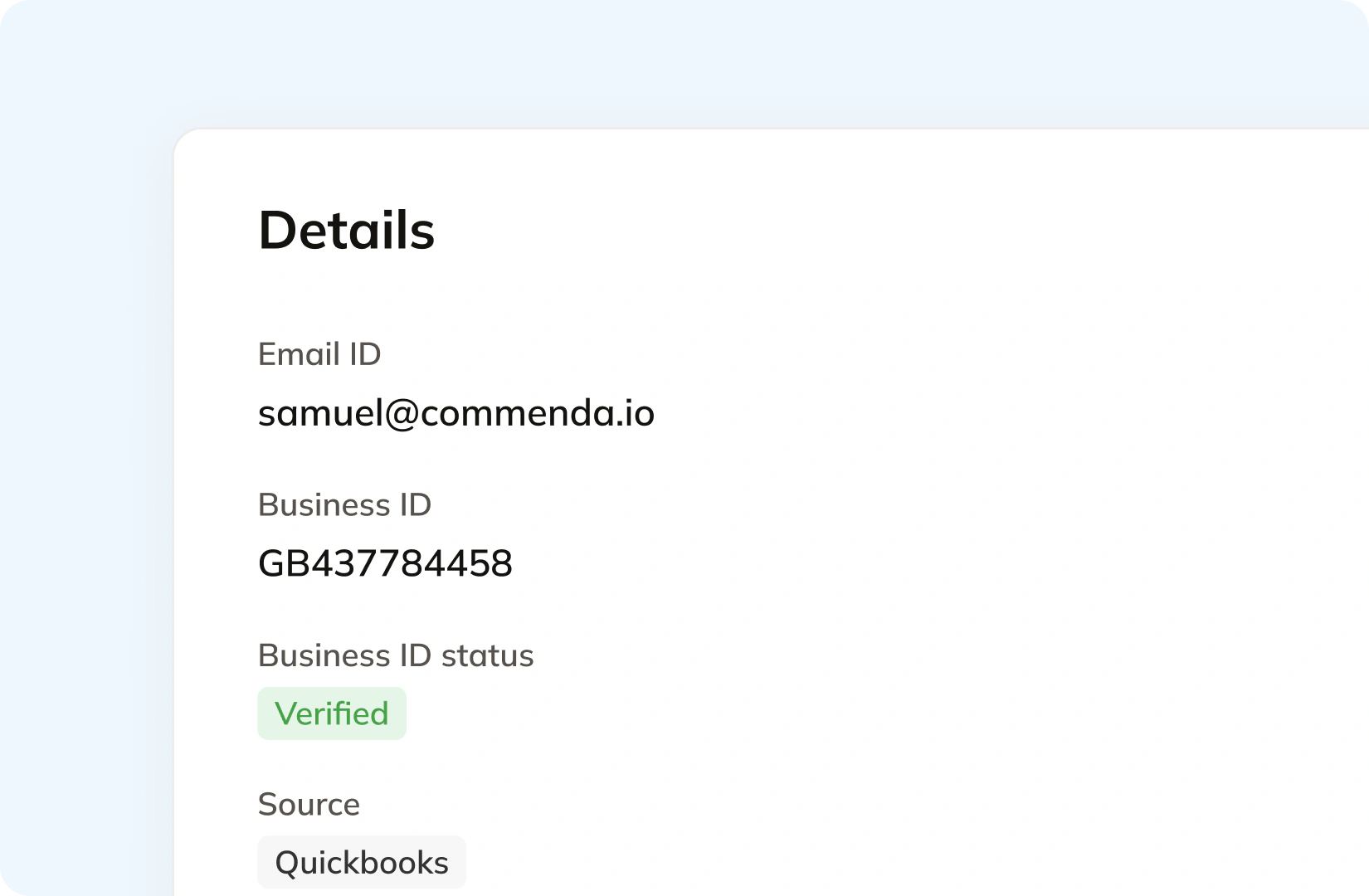
Manage your customers and exemptions in one place
An exempt government sale still needs evidence at the transaction. Texas accepts a completed exemption certificate or a purchase voucher in the government entity's name. Commenda stores that against the customer, validates it on upload, applies it automatically in the states where it holds, and keeps an audit log of when you started selling to that customer.
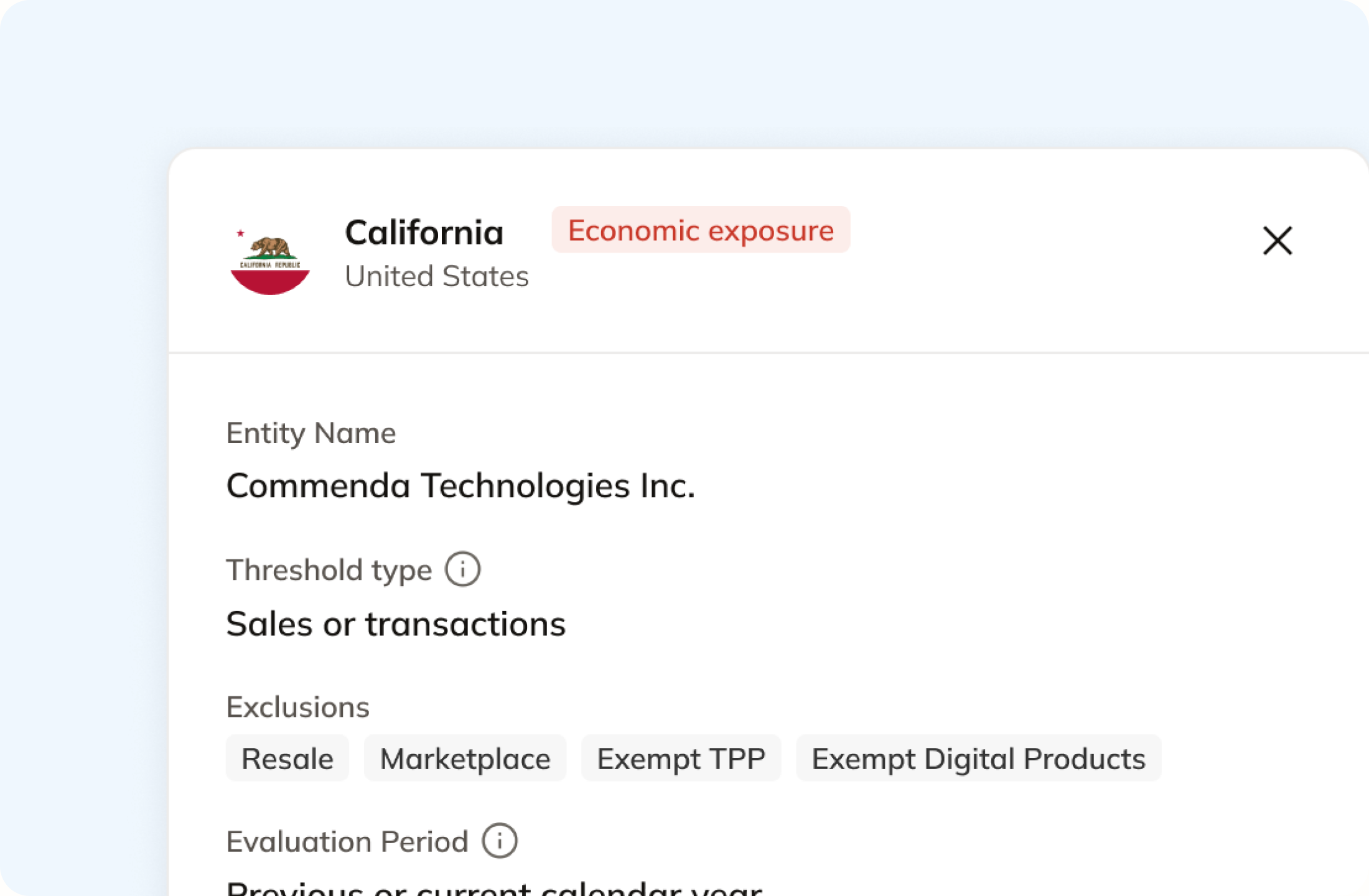
Track your global exposure from Costpoint
Costpoint links a tax code to a project. It does not tell you which states your project portfolio added up to. Commenda measures the same transactions against economic and physical thresholds in all 50 states and 70+ countries, and notifies you at 80% of a threshold. A questionnaire covers site offices and staff on customer premises, because neither shows up on an invoice.
Automatically remit transactions around the world
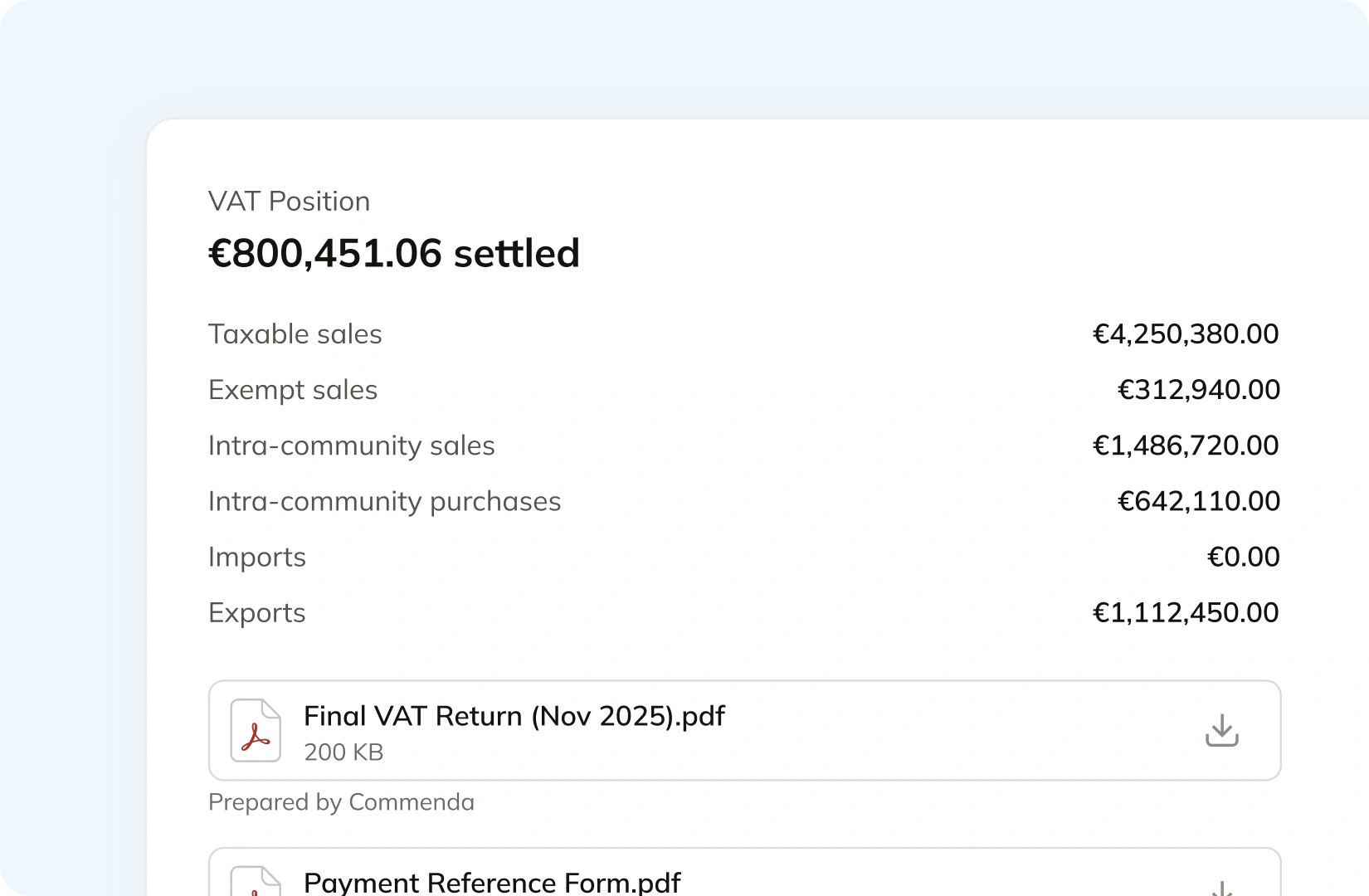
Returns are built straight from your Costpoint transactions, so nothing gets exported into a spreadsheet after the tax report tables have been updated. Filings go out across all 50 states on each state's required frequency, plus EU VAT with OSS and GST in APAC and Canada, with amendments where a period needs correcting. The liability and the filing confirmation post back to your ledger.
Consolidation
Why your customer's status decides your Costpoint tax position
For a government contractor the taxable question is rarely about the work. It is about who the customer is, which state they are in, and whether you can produce the document. Costpoint records the invoice. Commenda answers the question.
Federal, state, and local are three different answers
Texas states that federal government entities, including all agencies, departments and branches of the military, are exempt by law and are not required to apply for exemption. Texas state and local entities are exempt the same way. Government entities of other states are not. So the same contract line can be exempt for one customer and taxable for the next, and the deciding factor is who is buying rather than what you sold. That resolves per customer per state, on live data, not on a tax code you set once.
Exempt by law still means a document on the transaction
Even where the buyer never applies for exemption, the seller carries the evidence. Texas accepts a properly completed exemption certification or a purchase voucher in the government entity's name, and notes that a seller is not obliged to accept an exemption certificate at all. Costpoint gives you an Exempt check box and a certificate number field on the tax code. We store the document itself, validate it on upload, and keep the log that an auditor asks for.
Costpoint reports the entity you are standing in
Its sales and value added tax report runs after you refresh the report tables, and the VAT side fills return lines rather than a return. Deltek also documents that Costpoint does not recognize both Sales and VAT tax for one customer, so a customer trading in two regimes becomes two customer records. Splitting a customer to satisfy a tax field is exactly the kind of thing that makes a group-level exposure number wrong. We read the transactions, not the customer count.
One ledger behind every entity and every contract vehicle
Government contractors grow by acquisition, and each acquired entity brings its own registrations, its own back periods, and often its own system. Every source connects to one ledger across 100+ supported integrations, with each transaction carrying its origin. You get one exposure figure per state per entity, consolidated on one dashboard, and the registrations you are still carrying but no longer need are as visible as the ones you are missing.
What it takes
What global indirect tax takes in Costpoint
Deltek publishes no list pricing for Costpoint, so there are no dollar figures here. What Deltek does publish is its online help, and the rows below are what each capability takes according to the Costpoint 8.1 edition, which is the newest full help set Deltek makes public.
| What you need | What Costpoint requires | Source |
|---|---|---|
| A tax rate on an invoice | You enter it. Deltek's setup instruction is to establish the sales tax code on the Manage Sales or Value Added Taxes screen and enter the tax account and tax rate | Set Up Sales Tax for Billing |
| That rate reaching a project's invoices | Three screens. Establish the tax code, set up the taxable sales accounts, then link the tax code to the appropriate projects on Manage Project Sales Tax Setups | Set Up Sales Tax for Billing |
| A jurisdiction below state level | Another tax code. Deltek describes the tax code description as usually the state or province, and says it can also be another jurisdiction that has its own rate | Manage Sales or Value Added Taxes |
| Evidence for an exempt sale | An Exempt check box on the tax code with a Certificate No field beside it. Deltek documents no expiry date and no attachment on that screen | Manage Sales or Value Added Taxes |
| One customer that buys both taxable work and VAT work | A second customer record. Deltek states Costpoint does not recognize both Sales and VAT tax for one customer, so you must create a different customer for each taxable location | Manage Customers, VAT Info |
| A sales and use tax report | Run Update Tax Report Tables first, which refreshes the report tables with the latest billing, accounts payable, and purchase order information, then print the report | Print Sales/Value Added Tax Report |
| EU VAT return lines 2, 8 and 9 | EU country codes maintained on the Manage European Union Countries screen, matched against the first two characters of each voucher or bill tax ID | Value Added Tax |
| A third-party tax engine | Not documented. Avalara, Vertex, nexus, and Making Tax Digital appear nowhere in Deltek's published Costpoint 8.1 help | Costpoint 8.1 help |
A tax rate on an invoice
You enter it. Deltek's setup instruction is to establish the sales tax code on the Manage Sales or Value Added Taxes screen and enter the tax account and tax rate
Set Up Sales Tax for BillingThat rate reaching a project's invoices
Three screens. Establish the tax code, set up the taxable sales accounts, then link the tax code to the appropriate projects on Manage Project Sales Tax Setups
Set Up Sales Tax for BillingA jurisdiction below state level
Another tax code. Deltek describes the tax code description as usually the state or province, and says it can also be another jurisdiction that has its own rate
Manage Sales or Value Added TaxesEvidence for an exempt sale
An Exempt check box on the tax code with a Certificate No field beside it. Deltek documents no expiry date and no attachment on that screen
Manage Sales or Value Added TaxesOne customer that buys both taxable work and VAT work
A second customer record. Deltek states Costpoint does not recognize both Sales and VAT tax for one customer, so you must create a different customer for each taxable location
Manage Customers, VAT InfoA sales and use tax report
Run Update Tax Report Tables first, which refreshes the report tables with the latest billing, accounts payable, and purchase order information, then print the report
Print Sales/Value Added Tax ReportEU VAT return lines 2, 8 and 9
EU country codes maintained on the Manage European Union Countries screen, matched against the first two characters of each voucher or bill tax ID
Value Added TaxA third-party tax engine
Not documented. Avalara, Vertex, nexus, and Making Tax Digital appear nowhere in Deltek's published Costpoint 8.1 help
Costpoint 8.1 help
Figures verified on July 30, 2026.
From the field
Trusted by businesses across the globe


“The platform works exactly the way I need it to. I have one team member who manages all of our exemption certificates, and that functionality has been particularly efficient for us. It allows him to handle everything seamlessly, making the handoff significantly easier.”
VP of Finance, TRX






Compare Commenda sales tax software with competitors
Deltek's published Costpoint help documents no third-party tax engine, so the choice of one is yours to make. We compare the alternatives on coverage, ratings, and real pricing, and we say where each one wins.
More sales tax resources
Guides from the Commenda team on multi-state compliance, successor liability, and penalties.
Frequently asked questions
Custom integration support for your business
Every Costpoint instance is configured differently, from how projects carry tax codes to how organisations own the liability. We map how yours works, including which customers are genuinely exempt and in which states, and build the integration to match. No engineering work on your side.
Indirect Tax
Monitor nexus exposure, register, file, and remit sales tax and VAT in one platform. Commenda keeps you compliant across 100+ jurisdictions.
Explore the product
