A supplier hands you a RUT and you need to confirm one thing: is it real, active, and actually theirs before you onboard them, pay them, or claim input tax credit on their invoice? In Chile, the VAT (Value Added Tax) ID is the RUT (Rol Único Tributario), issued by the Servicio de Impuestos Internos (SII). There is no separate VAT number.
Here is the verdict up front. Chile’s tax authority offers no free public “enter a RUT, get its status” search, per org-id.guide. You verify through specific SII services plus the company registry instead. Get it wrong and both your 19% IVA (Impuesto al Valor Agregado) input credit and the acceptance of your electronic invoice are at risk. The SII confirms the standard IVA rate is 19%, set by Article 14 of the Ley sobre Impuesto a las Ventas y Servicios.
What Is a Chile Tax Registration Number (RUT)?
The RUT (Rol Único Tributario) is Chile’s universal tax ID for individuals and legal entities, issued by the SII, and it doubles as the VAT (IVA) number. There is no separate VAT registration number. Per the SII, the RUT is the registry in which every natural person, legal person, and taxable entity in Chile must be inscribed.
Who needs one: individuals with taxable activity, domestic companies, and foreign entities operating or importing in Chile. The RUT appears on facturas (invoices), customs documents, contracts, and payroll filings. The RUT format and Modulo 11 check digit validation are identical for sole proprietors and companies. Only the issuance channel differs: individuals register using their existing national ID number, while companies receive a RUT assigned directly by the SII.
What Is the Difference Between a RUT and a RUN in Chile?
The RUN (Rol Único Nacional) is the national ID number for natural persons printed on the cédula de identidad, while the RUT is the tax identifier. For an individual, they are the same number used in different contexts, because Article 1 of DFL N°3 (1969) ties a person’s RUT to their Registro Civil numbering, per the SII. Companies have no RUN; they hold a RUT only.
This distinction matters for anyone searching “RUT Chile” or “chile rut number search” and unsure which number they hold. The RUN is issued by the Servicio de Registro Civil e Identificación and appears on the ID card, per ChileAtiende. The RUT you verify for a Chilean company is always a RUT, never a RUN.
What Is the Correct RUT Format and Check Digit?
A RUT is a body of 7 or 8 digits plus one check digit (0 to 9 or the letter K), per org-id.guide. It is written with period thousands separators and a dash, for example 12.345.678-5. Machine and database formats strip punctuation and keep the check digit, as in org-id.guide’s scheme example CL-RUT-764241355.
Common formatting errors to catch before you submit a lookup:
- Omitting the dash before the check digit.
- Entering the wrong check digit (a typo).
- Using the wrong number of body digits (remember it is 7 or 8, not always 8).
- Writing a lowercase “k” instead of uppercase “K”.
- Mixing punctuated and unpunctuated formats when the system expects one.
How Does Modulo 11 RUT Validation Work?
The check digit comes from the Modulo 11 algorithm. Multiply each body digit, read right to left, by the cycling weights 2, 3, 4, 5, 6, 7, then sum the products. Take that sum modulo 11 and subtract from 11. A result of 11 means the check digit is 0, a result of 10 means K, and anything else is the digit itself. This is the same arithmetic behind SII’s “Dígito Verificador Erróneo” error, documented at rutschile.com.
Worked example for the body 12.345.678:
| Body digit (right to left) | Weight | Product |
|---|---|---|
| 8 | 2 | 16 |
| 7 | 3 | 21 |
| 6 | 4 | 24 |
| 5 | 5 | 25 |
| 4 | 6 | 24 |
| 3 | 7 | 21 |
| 2 | 2 | 4 |
| 1 | 3 | 3 |
| Sum | 138 |
138 mod 11 = 6. Then 11 minus 6 = 5. The check digit is 5, so the full RUT is 12.345.678-5. The letter K exists because a result of 10 cannot fit in a single decimal digit.
How Do You Verify a RUT in Chile Online?
The SII offers no free public “enter a RUT, get status” search, per org-id.guide. Verification instead uses specific SII services plus the Registro de Empresas y Sociedades company registry. Run a Modulo 11 check first to catch typos offline, then confirm tax status and, where needed, legal existence through the channels below.
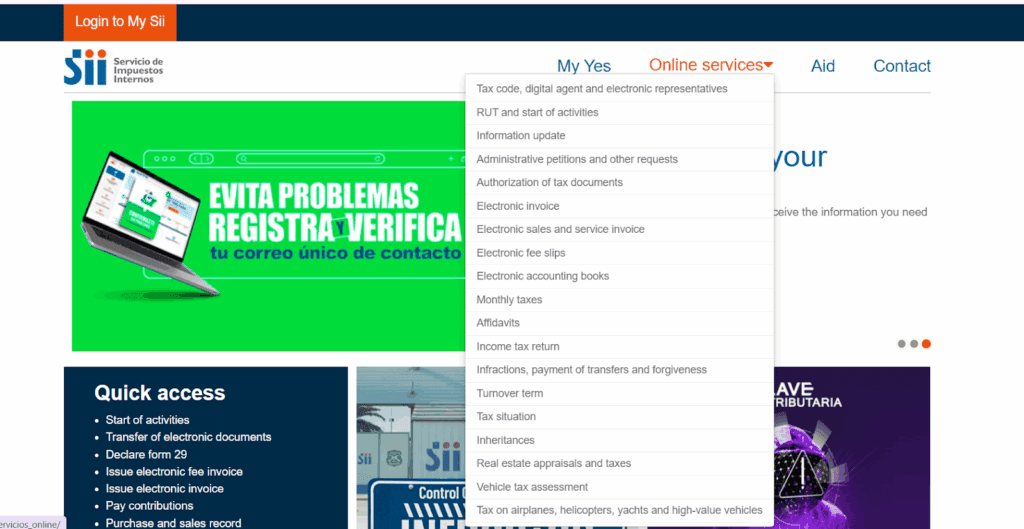
| Channel | What it confirms | Access | Source |
|---|---|---|---|
| SII Consultar Situación Tributaria de Terceros | Tax status: start of activities, authorized documents, address-verification warnings | Free, no login, 24/7 | sii.cl |
| SII Contribuyentes Autorizados para Emitir DTE | Whether the RUT can issue electronic tax documents | Free, no documents required | ChileAtiende / palena.sii.cl |
| SII Consultar validez de un documento | Authenticity of a specific electronic invoice under a RUT | Online, via Factura electrónica menu | sii.cl |
| Registro de Empresas y Sociedades (BuscarActuaciones2.aspx) | Company legal existence and registration actions | Free, login-free, registry-constituted entities only | registrodeempresasysociedades.cl |
To run the primary SII tax-status check:
- Open the SII Situación Tributaria de Terceros service.
- Enter the counterparty’s RUT (no login or clave tributaria required).
- Review the returned report: start of activities, authorized tax documents, and any warnings such as failure to verify the registered address.
- Treat the result as a support guide; the SII states it is not a certification of tax behavior.
Channel hierarchy and conflicts: SII services are authoritative for tax status, and the Registro de Empresas y Sociedades is supplementary for legal existence. If the two conflict, the SII result governs, and the discrepancy is a red flag to resolve with the counterparty before you pay.
How Do You Check If a Chilean RUT Is Active?
“Active” means the taxpayer has declared inicio de actividades with the SII and, for invoicing, is authorized to issue electronic tax documents (DTE, Documento Tributario Electrónico). Confirm both through the SII Situación Tributaria de Terceros report and the authorized e-invoice issuer check, which is free and requires no documents per ChileAtiende.
An entity can exist legally but be inactive for tax purposes. A company registered in the Registro de Empresas y Sociedades still needs a current inicio de actividades to issue valid facturas. The SII issuer tool “Contribuyentes Autorizados para Emitir Documentos Tributarios Electrónicos” needs the RUT plus its check digit and returns three registries of authorized issuers. If a supplier is absent from those registries, their electronic invoices will not support your IVA credit.
Why Should You Verify a Supplier’s RUT Before Onboarding?
Verification before onboarding confirms the vendor exists, is tax-active, and can issue valid electronic invoices, which protects your IVA credit and prevents payments to fraudulent or dissolved entities. It is the same control that keeps fake facturas, a prosecuted problem in Chile, out of your books.
The due diligence drivers are practical: fraud prevention, avoiding rejected invoices in the mandatory e-invoicing system, and confirming counterparty credibility before contracts move. Public-sector procurement adds a further reason. Bidders on Chile’s Mercado Público / ChileCompra tenders must hold a valid, active RUT, so procurement teams verify before bidding. An invalid or inactive RUT stalls the transaction rather than triggering a specific penalty you can quote with confidence, so verification is a control, not a gamble.
How Does a Valid Supplier RUT Protect Your IVA Input Credit?
Chile’s VAT (IVA) is 19%, per the SII, and buyers recover it as an input credit only on valid electronic invoices from a supplier whose RUT was registered and tax-active at transaction time. An invalid or inactive supplier RUT breaks the credit chain, so the credit is denied.
The mechanics are simple. The supplier charges IVA on the factura, and the buyer offsets it against output IVA in the monthly return (Form 29). The SII cross-checks the electronic invoice data against the issuer’s RUT. That cross-check is exactly why RUT validation and invoice validation are one control, not two. Verify the RUT and you protect the deduction.
Why Do Customs and Imports Require a Valid RUT?
Chile’s Servicio Nacional de Aduanas (National Customs Service) identifies importers and exporters by RUT on the customs declaration, so a missing or invalid RUT stops clearance before goods move. The RUT is declared under code 03 on customs declarations, per the Compendio de Normas Aduaneras, Anexo 18.
Validation happens when the import declaration is filed, typically through a customs agent. The RUT carries onto the core trade documents in that flow: the import declaration itself, the commercial invoice, and the customs mandate authorizing the agent. If the importer’s RUT does not resolve to an active taxpayer, the declaration cannot be accepted, so verify it before the shipment reaches the border.
How Do Foreign Companies Register for a RUT in Chile?
Foreign companies obtain a RUT from the SII before operating, invoicing, or importing in Chile. The pathway depends on activity type, and foreign entities without a local presence typically appoint a Chilean tax representative or SII-accredited agent to obtain the RUT and handle filings.
| Who | Pathway | What it enables | Source |
|---|---|---|---|
| Foreign or domestic entity forming a Chilean company | Tu Empresa en un Día (Registro de Empresas y Sociedades) | Same-day online company registration and RUT issuance | registrodeempresasysociedades.cl |
| Foreign investor or entity without local presence | RUT registration with the SII via a Chilean tax representative | Investments (property, shares, deposits) and operating in Chile | sii.cl |
| Foreign remote seller of digital services | SII simplified VAT regime for digital services | Registering and remitting IVA on B2C digital sales | sii.cl |
The same-day company route is backed by Ley N°20.659, published 8 February 2013 and in force 2 May 2013, per the Biblioteca del Congreso Nacional. Foreign investors making Chilean investments must register a RUT with the SII, per SII guidance for foreigners. Remote digital-services sellers should confirm current scope and mechanics on sii.cl, because the simplified regime differs from local entity registration.
What Should You Do When RUT Verification Fails or Is Delayed?
First rule out format errors, then consider timing, because a newly issued RUT can take a few days to surface in lookup channels. Recompute the Modulo 11 check digit, confirm the dash and digit count, then re-run the SII status check before you escalate.
| Result | Likely cause | Fix | Source |
|---|---|---|---|
| Invalid check digit | Typo or wrong Modulo 11 digit | Recompute with Modulo 11 and re-enter | org-id.guide |
| Wrong format | Missing dash, wrong digit count, or lowercase “k” | Reformat to 7 or 8 digits plus dash and uppercase check digit | org-id.guide |
| Not found in registry search | Entity not constituted in the electronic registry, or newly issued | Check SII Situación Tributaria de Terceros; the registry covers only constituted entities | registrodeempresasysociedades.cl |
| Inactive tax status | No inicio de actividades filed, or término de giro filed | Confirm status with the SII and request inicio de actividades proof | sii.cl |
If a new supplier’s RUT does not yet resolve, request their SII inicio de actividades proof or e-RUT document, flag the vendor for manual review, and hold first payment until verification clears. Never skip the check.
How Can You Validate RUTs in Bulk?
Bulk validation layers an offline Modulo 11 format check, which catches typos instantly, with registry and SII status checks, via CSV upload or API. That combination lets finance teams clear hundreds of vendors without manual lookups. Commenda’s Global Tax ID Verification validates tax IDs like the Chilean RUT across countries in one workflow.
Commenda supports 100+ ERP, API, and custom integrations, so RUT validation can run directly inside your onboarding, accounting, or supplier-management systems. The format check screens structurally invalid RUTs before they ever reach a lookup, and the status check confirms the supplier is tax-active, keeping your vendor master file clean.
How Commenda Helps You Verify Chilean Tax IDs at Scale
Commenda’s global indirect tax platform validates tax IDs like the Chilean RUT during vendor onboarding and keeps your VAT registrations and filings tracked across every country you operate in. It turns a fragmented, manual RUT check into a repeatable control that protects your IVA input credit before a payment goes out.
Pair it with Commenda’s Global Tax ID Verification tool for RUT and cross-border checks, a Compliance Calendar to track Chilean filing deadlines, and 100+ integrations to run validation inside your existing stack. Book a demo to see how Commenda validates supplier tax IDs across Chile and 100+ countries before you pay a single invoice.