Looking to enter South Africa’s market? This guide explains when non-resident businesses must register for VAT, how the process works, and what compliance steps follow, so you can operate legally and avoid costly setbacks.
Why Non-Resident Firms Must Register for VAT in South Africa
South Africa has long moved past outdated stereotypes. With Cape Town’s natural wonders, Johannesburg’s booming skyline, and a growing tech-savvy consumer base, it’s become a strategic entry point for businesses looking to tap into the continent’s potential.
However, if you’re looking to expand into the country, VAT registration in South Africa is a legal must for non-resident companies doing business locally. Failing to register can expose your company to serious penalties and disruptions that impact growth and operations.
Commenda helps non-resident firms navigate this process smoothly, avoiding delays, fines, and unnecessary complexity.
When Does a Foreign Business Need to Register? Key Triggers
Foreign firms must be aware of the specific circumstances that mandate VAT registration for non-resident businesses in South Africa. Even without physical presence, engaging in certain activities within the country obligates VAT registration.
Below are the most common triggers:
- Importing and selling goods locally: If you ship inventory into South Africa and sell it to domestic customers, registration is required.
- Supplying digital or electronic services: Foreign suppliers offering e‑services (e.g., media, apps, Software-as-a-Service) to South African recipients must register once activity meets thresholds.
- Installing or assembling goods: Doing so locally triggers VAT liability
- Hosting events or trade shows: Live business or consumer events held in South African territory require registration.
- Facilitating marketplace sales: Acting as an intermediary for goods or services reaching local consumers also triggers registration duties.
In each of these scenarios, once your business activities are considered to be taking place within South Africa, VAT registration becomes mandatory, regardless of whether you have a physical presence or local employees.
For smooth and legally compliant operations, VAT registration in South Africa should be treated as a priority from the start.
Registration Thresholds & Nexus Tests
Specific hard thresholds or nexus criteria must be met for VAT registration for foreign companies in South Africa. The central benchmark is a compulsory ZAR 1 million (~USD 66,500) in total taxable supplies over any consecutive 12-month period, or a reasonable expectation of exceeding that figure under written contracts.
For suppliers of digital or electronic services, the test is more nuanced. A non-resident must register once their supplies exceed ZAR 1 million, but are exempt if their service falls under the following categories:
- Educational services provided by institutions registered under the South African Schools Act or the Higher Education Act
- Telecommunication services
- Services supplied by a foreign company exclusively for use by its South African group company
Voluntary VAT registration is permitted for businesses with taxable supplies between ZAR 50,000 and ZAR 1 million, often useful for startups or B2B vendors seeking input tax recovery.
Basically, once your business activity establishes a nexus or surpasses the threshold, VAT registration in South Africa follows as both a legal imperative and operational necessity.
South Africa VAT Number Format Explained
A South African VAT number is issued by the South African Revenue Service (SARS) and follows a strict numeric format:
- Format: 10 digits, starting with a “4” (e.g., 4123456789)
- No country prefix: “ZA” (the ISO 3166-1 alpha-2 country code for South Africa) is not used in the VAT number itself
- Common errors: Adding extra digits, using incorrect prefixes, or transposing numbers
Accurate use of the VAT number is essential for invoicing, customs clearance, and compliance.
Is a Local Tax Agent or Fiscal Representative Required?
Non-resident businesses are not legally required to appoint a local tax agent or fiscal representative for VAT purposes. However, for smooth non-resident tax registration in South Africa, many foreign companies choose to work with a local advisor.
While there’s no obligation to provide a bank guarantee or deposit, navigating compliance without on-the-ground support can be challenging. Appointing a representative can help manage ongoing tax filings, communication with SARS, and local administrative tasks.
Special Schemes & Simplifications
There are several targeted schemes to simplify VAT registration in South Africa and ongoing compliance for foreign businesses:
- Import VAT deferment: Registered importers can defer VAT and customs duties for up to 30 days via a deferment account, secured by a bank guarantee or bond, streamlining cash flow.
- Bond (customs warehouse) scheme: Goods can be held in a bonded warehouse with VAT suspended until released for local consumption, a boon for non-residents managing inventory.
- Simplified e-services regime: Foreign digital service providers can avoid VAT registration if they sell solely through a registered local intermediary, which handles the tax instead.
- Small-business/voluntary registration: Businesses with sales under ZAR 1 million, and above 50,000, can opt in voluntarily.
These programs help reduce compliance friction and improve cash flow for international businesses entering the South African market.
Step-by-Step: How to Register for VAT in South Africa
This South Africa VAT registration guide outlines the process managed by SARS, which is primarily conducted online. Here’s a breakdown of what non-resident businesses can expect:
- Check the registration threshold: Determine whether your total taxable supplies exceed the ZAR 1 million compulsory registration threshold over any 12-month period, or if voluntary registration applies.
- Gather required documents: Ensure you have all the necessary details and supporting evidence for your application, including proof of business activity and corporate credentials.
- Create a SARS eFiling account and complete the VAT101 form: To register for GST/VAT online in South Africa, set up a SARS eFiling profile. This platform allows you to submit the VAT101 form and manage your tax compliance digitally.
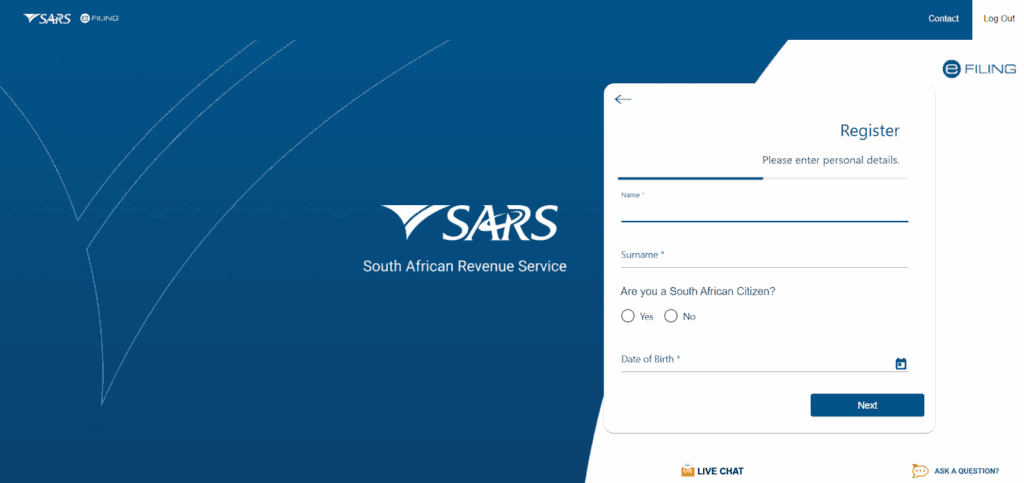
- Upload documents and submit your application: After completing the VAT101 form, upload all supporting documents through the eFiling portal. SARS may follow up with additional questions or requests.
- Pay fees if applicable: Although there’s no fixed VAT registration fee, certain scenarios (like deferment arrangements) may involve charges or guarantees.
- Receive your VAT registration number: Once approved, you’ll receive a 10-digit VAT number via your SARS eFiling account. This officially authorizes your business to charge VAT, file returns, and reclaim input tax.
Completing these steps ensures your business is properly set up for VAT registration in South Africa and compliant with local regulations.
Required Documents Checklist
To complete VAT registration in South Africa as a foreign business, have the following ready:
- Certificate of incorporation (English translated if needed)
- Certified passports/IDs of two directors
- Proof of banking (e.g., bank letter or statement)
- Proof of business address (e.g., utility bill or CRA01)
- Power of Attorney if using a representative
- Financial documents showing taxable activity (e.g., invoices, contracts)
- ID and address proof for any appointed fiscal representative
Having these documents prepared helps avoid delays or rejections during the registration process.
Processing Time & Government Fees
Registered through SARS’s eFiling system, VAT registration in South Africa typically takes 21 working days, though delays can extend processing to 12 weeks when additional verification or virtual appointments are required.
There is no direct fee for VAT registration itself, but optional services (like setting up a deferment account) may require bank guarantees or bonds. In rare cases, SARS may request physical documentation or appointments, potentially increasing administrative time and complexity.
Post-Registration Obligations
Once registered for VAT in South Africa, vendors must adhere to the following obligations:
- Charge & display VAT properly on all taxable supplies; include VAT in pricing and issue valid tax invoices.
- File returns for each tax period, typically bi‑monthly by default, with deadlines on the 25th of the month (or last business day via eFiling).
- Maintain records (invoices, import/export documents, accounting data) for at least five years.
- E-invoicing is optional, but if used, it must be secure, buyer-approved, and archived in South Africa for five years (unless SARS grants an exemption).
Non-residents should be prepared for possible virtual appointments or document requests, which may arise during audits or compliance reviews.
Claiming Input‑Tax Credits & Refunds as a Non‑Resident
Foreign businesses registered for VAT in South Africa are entitled to claim input tax on qualifying expenses, but the process demands accuracy and strict documentation.
- Eligibility: If you’re registered for VAT in South Africa, non‑resident companies can reclaim VAT on goods and services used for making taxable supplies within the country.
- Documentation: Valid tax invoices, proof of payment, and supporting records are essential. For zero-rated services, evidence of non-residency must be shown.
- Refund timeline: SARS generally processes refunds within 21 business days, though delays are possible during audits or verification.
- Common rejections: Refunds are often denied due to missing documents, invalid banking info, or unresolved tax matters.
- Reverse-charge: For imported services, non-residents may need to self-assess VAT under the reverse-charge mechanism, but input tax may be claimed to offset this liability.
Staying compliant with filing and invoice standards helps ensure a smoother refund experience.
Penalties for Late Registration or Non-Compliance
Foreign companies operating without VAT registration in South Africa risk significant consequences:
- Administrative penalties: SARS can levy monthly fines from ZAR 250 up to ZAR 16,000 per missed return, continuing for up to 35 months.
- Interest charges: Late VAT payments incur a 10% penalty plus ongoing interest at prescribed rates. Understatement penalties may be as high as 200% of the tax shortfall.
- Import blocks & garnishee orders: SARS can freeze refund payouts, seize assets, or issue garnishee orders against your bank account.
- Director liability & criminal charges: Failure may result in prosecution and personal liability.
Non-compliance isn’t just costly; it can also lead to reputational harm and legal exposure for company executives.
Deregistration & VAT Number Changes
When it’s time to deregister or update your VAT details in South Africa, here’s what to expect:
- Submit a deregistration application using form VAT123e via SARS eFiling, detailing cessation, turnover drop, or merger reasons.
- Continue filing until the effective date, including a final VAT201 return and paying output tax on remaining assets.
- Receive cancellation confirmation and a clearance certificate from SARS, marking the official deregistration date.
- Update or merge VAT numbers (e.g., after restructuring) via eFiling’s Registration Maintenance or by contacting SARS to request a merge.
Ensuring these steps are followed cleans your tax history and avoids future obligations or misunderstandings.
Conclusion
South Africa offers global companies a strategic entry point into Africa’s fast-evolving markets. But tapping into this potential requires full compliance with local VAT rules; miss a step, and the penalties can be steep.
Commenda makes VAT registration in South Africa easy for non-resident businesses. From document prep to post-registration support, our platform handles the heavy lifting, reducing risk, saving time, and ensuring you’re always compliant.
Expanding into South Africa? Book a demo and discover how Commenda simplifies VAT compliance, so you can scale confidently without getting stuck in administrative hassle.