Global Indirect Tax Software
Know your global exposure.
File everywhere.
VAT, GST, and sales tax compliance across 70+ countries — tracked, registered, and filed from one platform. Integrated with your ERP. No jurisdiction left unmonitored.
Trusted by global businesses

































Indirect tax exposure often
hides in plain sight.
Indirect tax is the compliance area most likely to catch a growing company off guard. Thresholds are low. Rules vary by product type, by customer type, by transaction volume. And the penalties for getting it wrong are specific, documented, and enforceable.
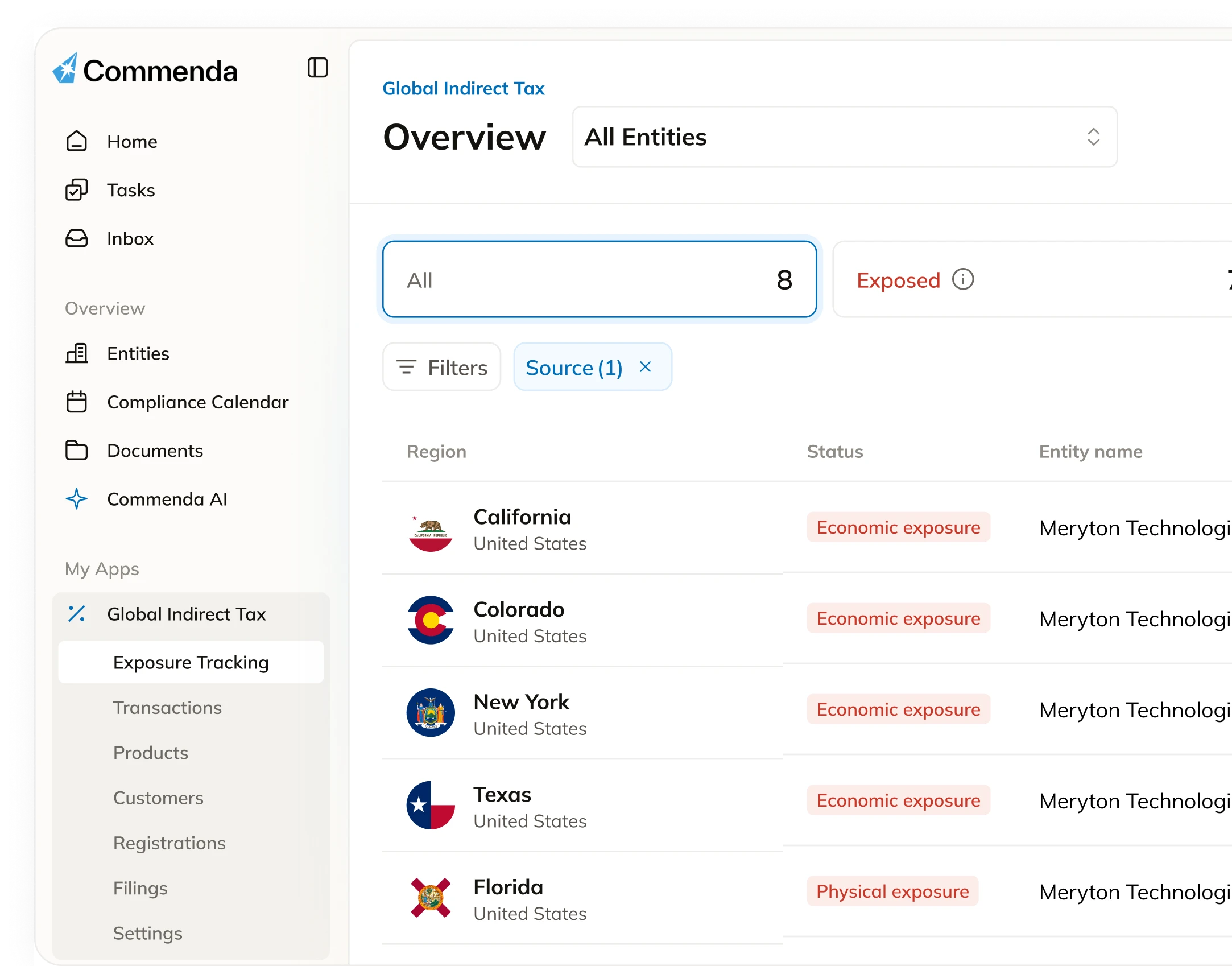
Economic nexus triggers you didn't plan for
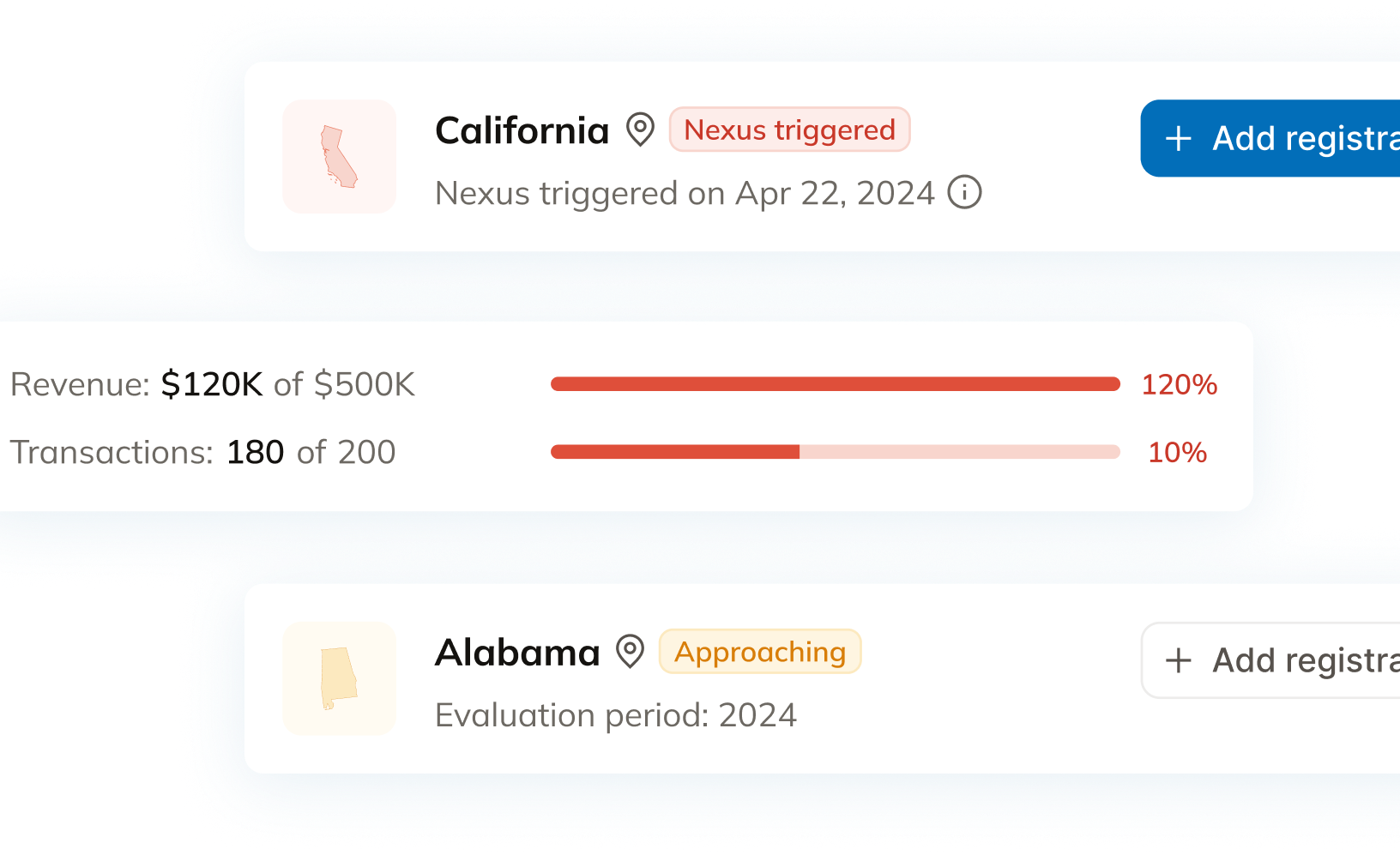
Post-Wayfair, US economic nexus thresholds kick in at $100K or 200 transactions in most states and you can cross them without knowing and owe back taxes from the day you did.
EU VAT obligations that compound quickly
Selling digital services in the EU means VAT obligations in every member state with a customer, unless you're using OSS. Most companies don't realize they should have registered until it's too late.
Point solutions that leave gaps
Anrok handles SaaS sales tax. Avalara handles product-based. Neither handles your VAT registrations in Germany and Singapore. The gaps between tools are where exposure lives.
Voluntary Disclosure Agreements nobody wants to file
VDAs are the last resort for undisclosed back-tax exposure. They take 12–18 months and cost more than staying current would have. Commenda exists so you never need one.
What Commenda does
From exposure unknown
to compliant everywhere.
Four capabilities that cover the full indirect tax lifecycle from the moment you cross a threshold to the filing confirmation landing in your inbox. Handled end-to-end, not handed off to you to coordinate.
01 — Nexus & Exposure
Know where you owe before the deadline.
Commenda monitors your transaction data against tax thresholds in every jurisdiction including 50 US states, EU member states, and 70+ countries worldwide.
- Real-time nexus monitoring against economic and physical thresholds
- All 50 US states tracked, including Wayfair economic nexus rules
- EU VAT One-Stop-Shop (OSS) threshold monitoring across member states
- Product and service taxability rules applied per jurisdiction
- Alerts triggered well before you cross and not on the day you do
02 — Tax Registration
Registered in
days, not weeks.
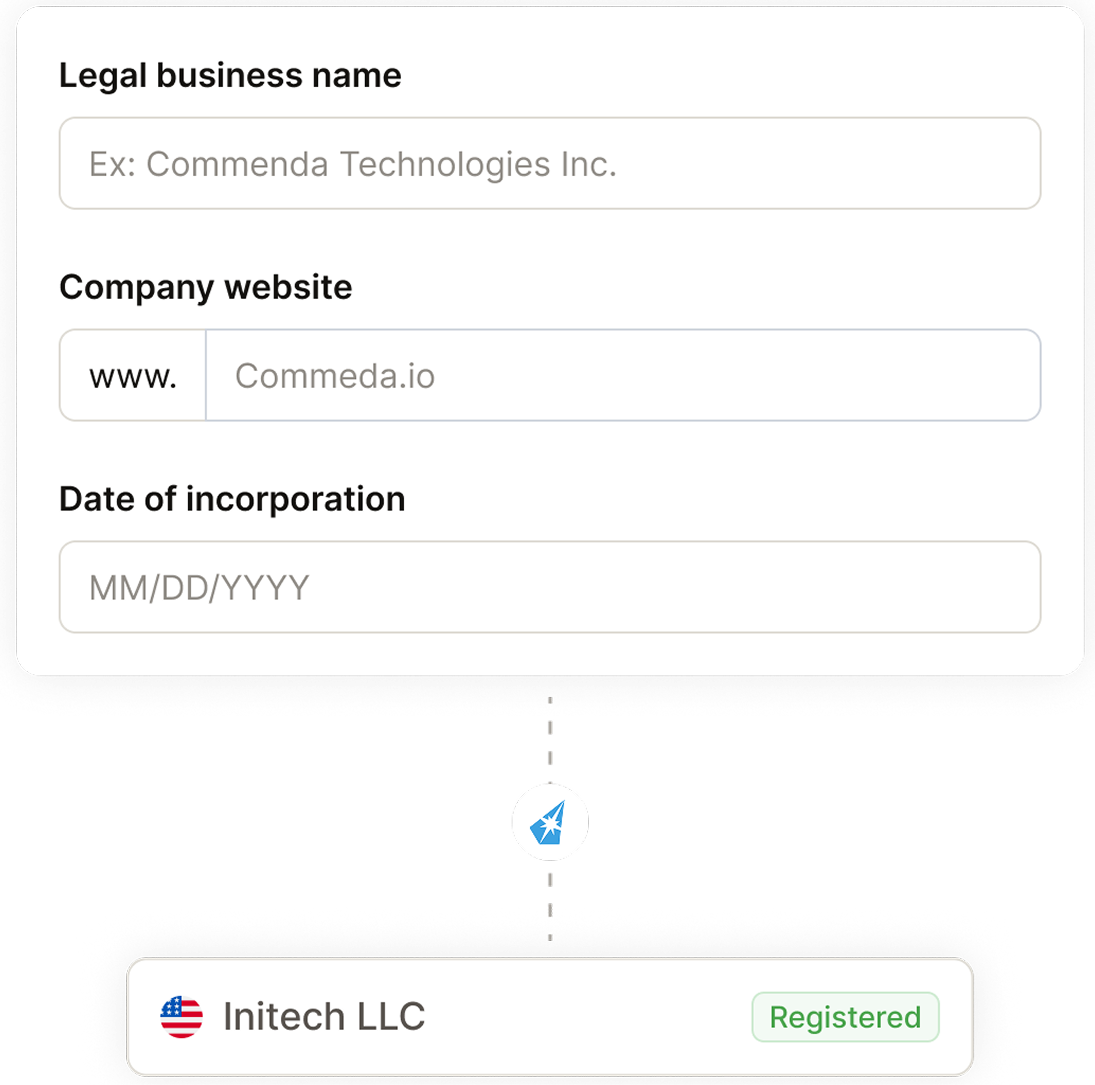
Once exposure is confirmed, Commenda handles tax registration in all the relevant jurisdictions including VAT numbers in EU countries, sales tax permits across US states, GST registrations in APAC.
- VAT registration across all EU member states
- EU One-Stop-Shop (OSS) and IOSS registration handled
- US sales tax permits in all 50 states
- GST registration in Australia, Singapore, Canada, New Zealand, and more
- Registered agent and local representation where required
03 — Filing & Remittance
Every return prepared. Every payment confirmed.
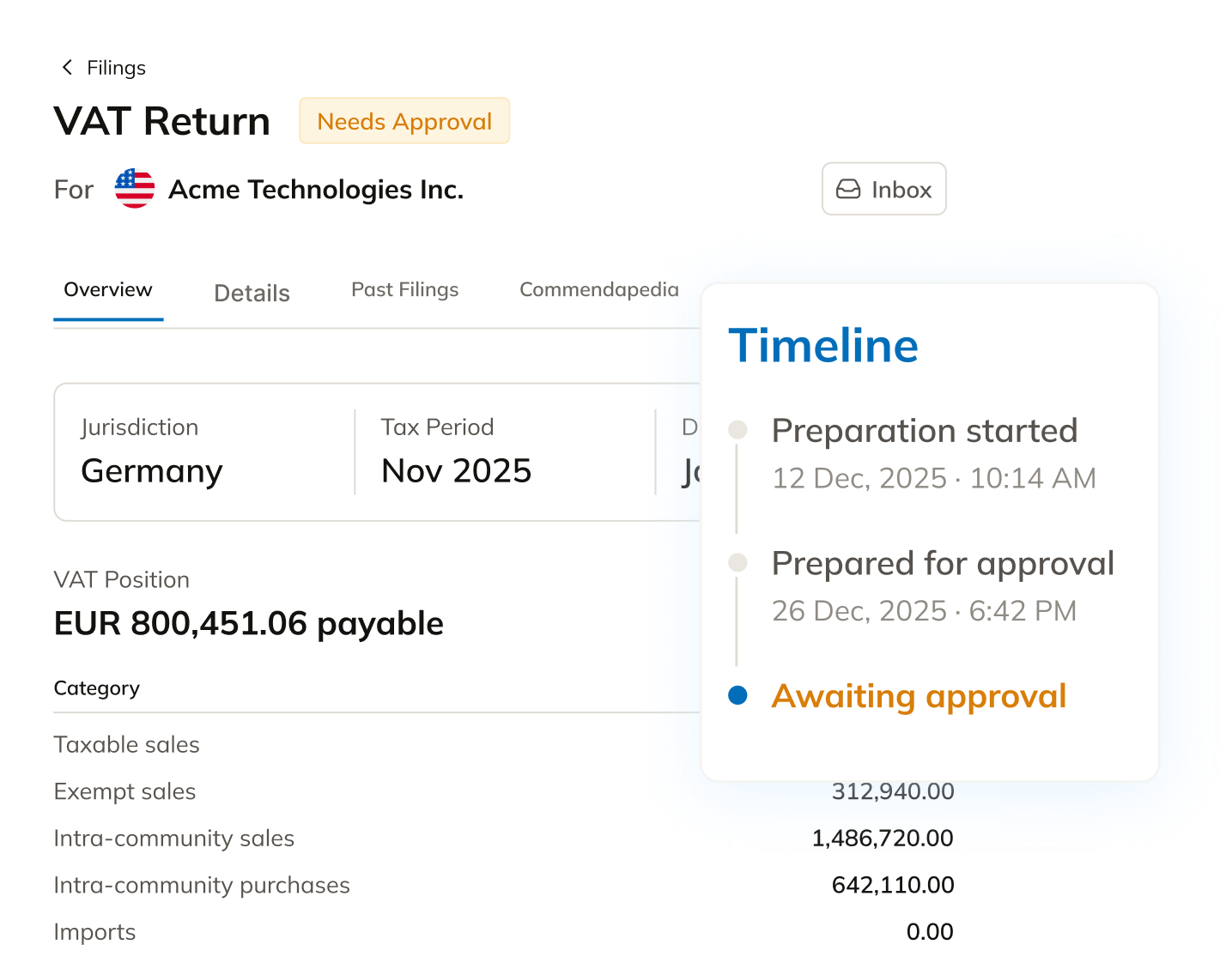
Commenda prepares and files your indirect tax returns on the required cadence in every jurisdiction — monthly, quarterly, or annually depending on local rules.
- VAT returns across all EU jurisdictions, including OSS quarterly returns
- US sales tax returns across all 50 states on the required filing frequency
- GST/HST returns in APAC and Canada
- Payment remittance tracking per jurisdiction
- Amended returns handled where errors are identified
04 — ERP Integration
Pulls from your systems. Pushes back confirmations.
Commenda integrates directly with your ERP and billing stack. Transaction data flows in automatically. Tax calculations, filing confirmations, and liability postings flow back.
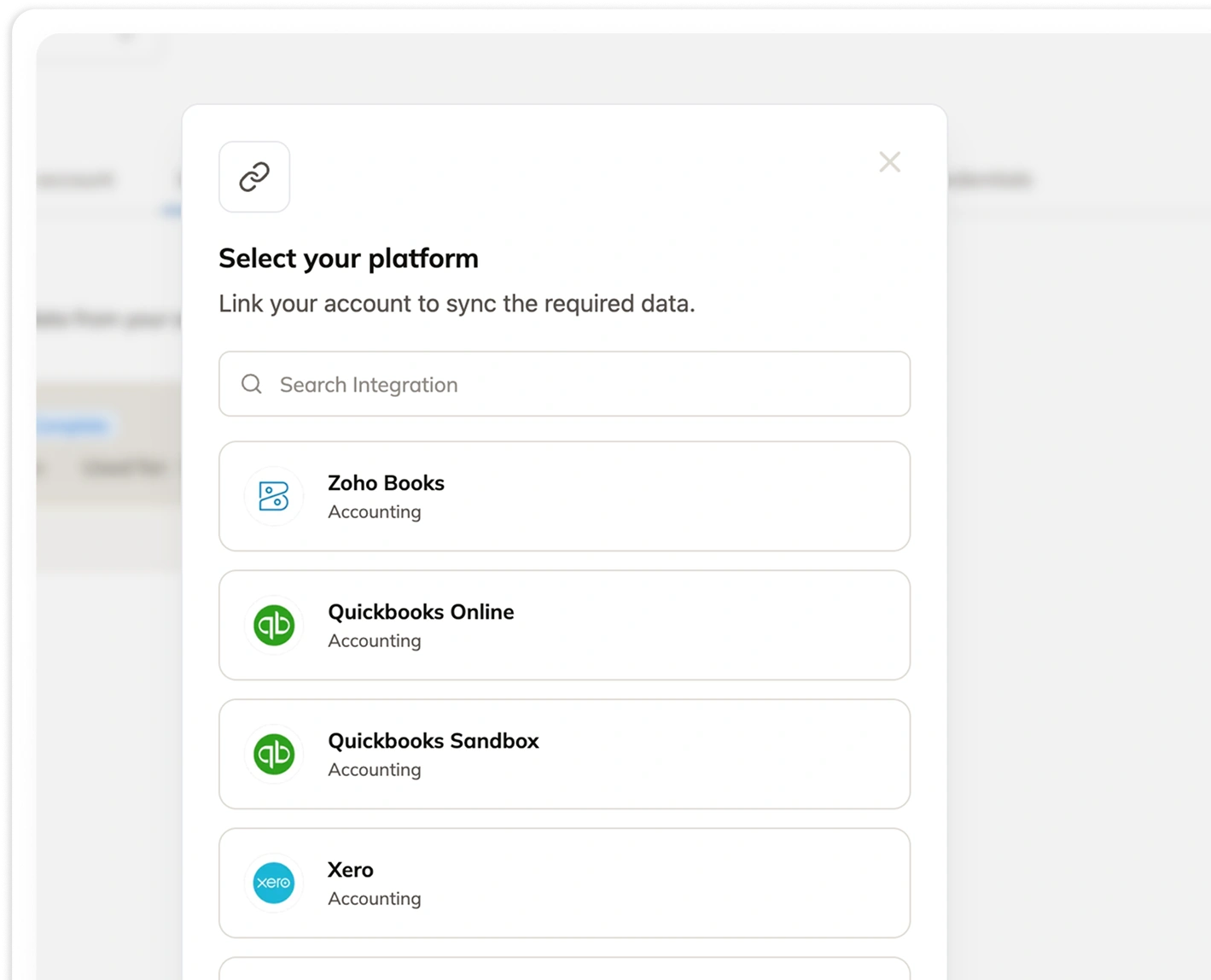
- Native integrations: NetSuite, Xero, QuickBooks, Sage Intacct
- Billing integrations: Stripe, Chargebee, Recurly, Zuora
- Transaction-level data pulls — no CSV uploads or manual extraction
- Tax liability postings sync back to your general ledger
- REST API for custom stack integrations
Commenda isn't just another point solution for one tax type.
Anrok handles SaaS sales tax well. Avalara handles product-based US compliance. Neither handles your VAT registrations in Germany, your GST in Singapore.
Point solutions (Anrok, Avalara, Loctax)
Strong in one lane.
- Good US or SaaS sales tax coverage
- Limited or no international VAT/GST
- No exemption certificate management
- Doesn't connect to entity management
- Separate relationship, separate contract
- You still need advisors for registration
Big Four / Local advisors
Expensive for routine work.
- Deep jurisdiction-specific expertise
- Advisory rates for every filing
- No platform visibility or audit trail
- Manual coordination across countries
- No ERP integration; data re-entered
- Unpredictable billing, opaque scope
Commenda
End-to-end. Everywhere you sell.
- US sales tax + VAT + GST in one platform
- Registration handled in every jurisdiction
- Exemption certificates managed end-to-end
- Connected to entity management and TP
- One relationship for all 70+ countries
- Transparent platform pricing, no hourly rates
From the field
Trusted by businesses across the globe


“The platform works exactly the way I need it to. I have one team member who manages all of our exemption certificates, and that functionality has been particularly efficient for us. It allows him to handle everything seamlessly, making the handoff significantly easier.”
VP of Finance, TRX






Integrations
Explore 100+ global indirect tax integrations
Commenda calculates sales tax, VAT, and GST the moment a sale happens, on data pulled straight from the systems you already run. Rates apply per country, per state, and per product, so a digital service in Germany and a physical good in Texas are each handled correctly.
Explore global indirect tax integrations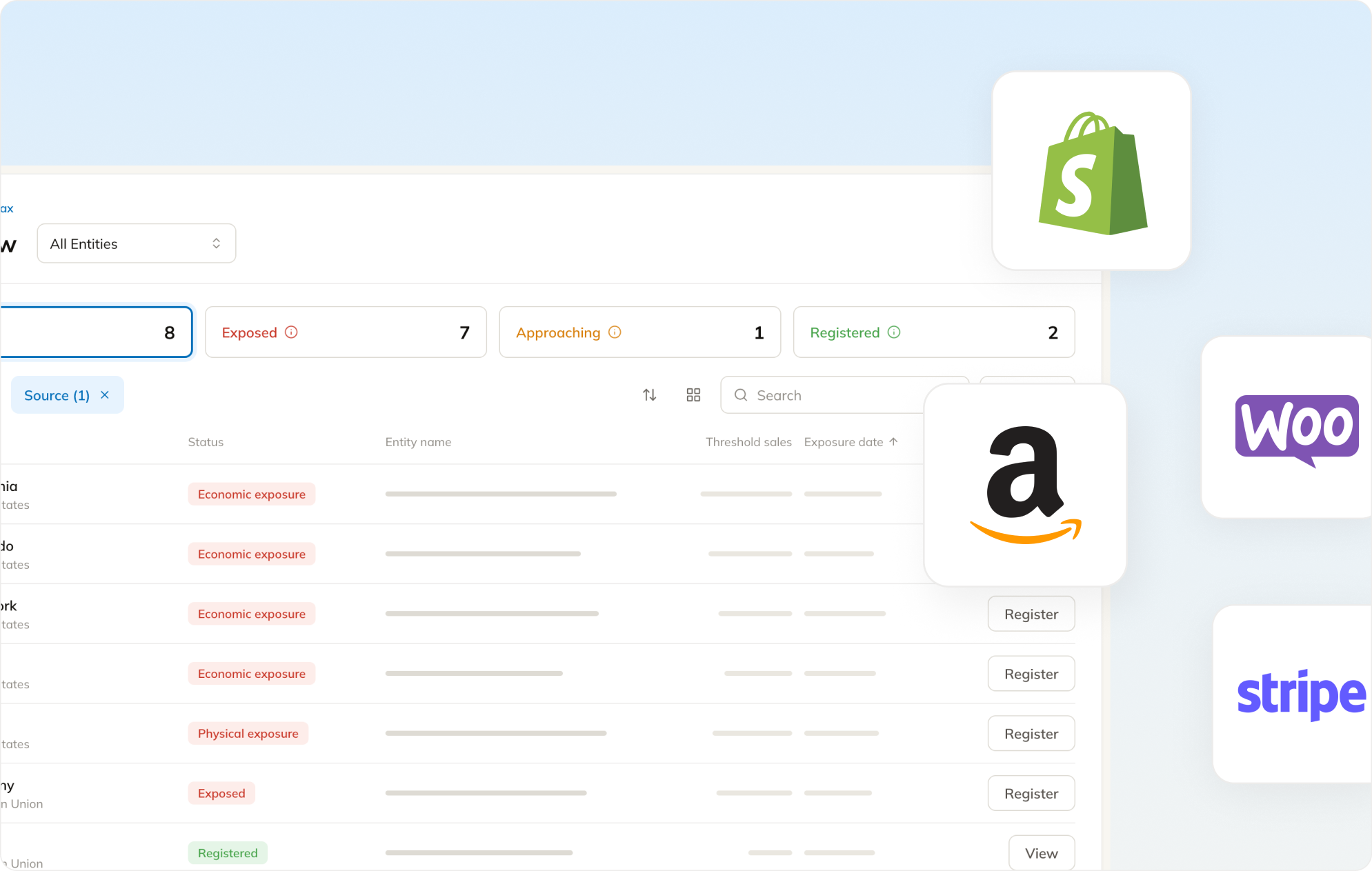
Questions indirect tax teams ask us.
This is what a nexus study answers. We connect to your revenue systems (Stripe, Shopify, NetSuite, QuickBooks, BigCommerce, ChargeBee — and CSV for anything not native) and consolidate transactions into one ledger tagged by ship-to state. Against that, we run state-by-state nexus on both economic thresholds (typically $100k in sales OR 200 transactions, with California and New York at $500k) and physical signals (employees, inventory, 3PLs). The output is a current state-by-state position plus an alerting threshold so you see new states approaching nexus before you cross — including the case where a single large invoice into a state can breach the threshold on its own.
Foreign qualification is a corporate-registration concept, not a tax-nexus concept — and the two get conflated routinely, including by some AI research tools. Physical nexus comes from offices, employees, or inventory; a foreign qualification by itself doesn't trigger it. We audit your existing registrations against actual nexus, separate the ones tied to real activity from the ones filed unnecessarily, and produce a deregistration plan for the states where you don't owe — handling trailing nexus and any open liabilities before closing each state so cleanup doesn't create a new gap.
Yes — we cover indirect tax across 70+ countries, including registration, filing, and remittance. For EU sales, OSS via the Netherlands or Ireland is usually the cleanest path for non-EU sellers; OSS doesn't cover Norway, Switzerland, or Iceland, which need separate registrations. UK MTD-compliant submission is supported through NetSuite, Xero, and QuickBooks integrations. ANZ GST, Mexico VAT, and most major EU countries are direct; we use vetted local partners for markets requiring local credentials. One portal, one calendar, one team handling filings — replacing the country-by-country email and manual currency-handling drudgery.
Stripe Tax calculates tax at Stripe checkout. It doesn't register you in states, file your returns, manage exemption certificates, handle international VAT/GST registration, or cover any revenue that doesn't flow through Stripe (NetSuite invoices, Shopify, HubSpot deals, ticketing platforms, marketplaces). We handle the full lifecycle — registration, calculation, exemption certificates, filing, remittance — across every revenue channel. Many customers actually run our integration alongside Stripe Tax during transition, then retire Stripe Tax once the lifecycle is on us. The real choice isn't calculate-vs-calculate; it's checkout-only-vs-full-compliance.
Yes — and we see this often. A default tax code meant for tangible goods applied to a software or service product can cause you to collect and remit tax that wasn't actually owed, creating false liabilities and overpayment. We review your product catalog, re-map every SKU to the correct classification (e.g. "custom B2B software downloadable" instead of TPP), and stop the bleed going forward. For prior periods, several states allow refund or credit claims within their lookback window — we identify what's recoverable and pursue it where it's worth pursuing.
Stop guessing where
you're exposed.
Book a 30-minute call. We'll run a nexus analysis on your transaction data and show you exactly where you have open obligations — at no charge, no obligation.

