Global indirect tax software for Tally.ERP 9
Tally.ERP 9 is the previous generation of Tally, on an older GST feature set. It prepares GSTR-1 and GSTR-3B and hands you a file to upload, and it cannot reach the e-invoice portal at all. It says nothing about the US sales tax or EU VAT on your export sales. Commenda registers you and files across all 50 states and 70+ countries.
Trusted by global businesses

































Read your data whatever version you run
Commenda reads the transactions out of Tally.ERP 9 the same way it reads them out of anything else. Whether you migrate to TallyPrime this year or stay put, your registrations and exposure history do not move with the software.
Tax the exports ERP 9 zero-rates
Tally.ERP 9 records an export as zero-rated under LUT or bond. The US state or EU country your customer sits in can still want its own tax. Commenda measures that against thresholds in all 50 states and 70+ countries.
Register and file abroad, no JSON to hand off
In Tally.ERP 9 every compliance output ends with you on a government portal. Commenda registers you and files across 70+ countries, so a foreign return is not another file waiting for an upload.
Coverage comparison
What Tally.ERP 9 prepares, and what it hands back to you
Tally.ERP 9 does real GST work and stops short of submitting anything. Its figures come from Tally's own Release 6.6 pages on filing GSTR-1, filing GSTR-3B, e-invoicing, e-way bills, and recording export sales, checked on July 30, 2026.
Preparing GSTR-1 and GSTR-3B
- Tally ERP9
- Handled. It builds the return data and exports JSON, Excel or CSV
- Commenda
- Left where it is. Your GST return data stays in your books
Submitting those returns to the GST portal
- Tally ERP9
- Not handled. You upload the file and file on the portal yourself
- Commenda
- Not ours either. India returns stay with your accountant, and we hold your GSTIN, PAN and TAN
Getting an IRN and QR code onto an invoice
- Tally ERP9
- Not handled. No IRP connection. Offline tool, portal upload, portal login
- Commenda
- Outside scope. We do not touch India e-invoicing, and this page does not claim to
Tax on a sale to a US or EU customer
- Tally ERP9
- Not handled. An export is recorded as zero-rated under LUT or bond
- Commenda
- Calculated to state, county, city and district, or the right EU VAT rate
Registering abroad to collect that tax
- Tally ERP9
- Not handled. Its reports run off the GSTINs on your company
- Commenda
- Permits in all 50 states, EU VAT with OSS and IOSS, and GST across APAC and Canada
Filing returns outside India
- Tally ERP9
- Not handled. Its return formats are GSTR-1, GSTR-3B, GSTR-4 and GSTR-9
- Commenda
- Filed across 70+ countries from one platform, amendments included
Staying current as rules change
- Tally ERP9
- Depends on a release. Format changes arrive as a new ERP 9 release you install
- Commenda
- Sits outside your accounting software, so a version change does not move your history
| Tally ERP9 |  | |
|---|---|---|
| Preparing GSTR-1 and GSTR-3B | Handled. It builds the return data and exports JSON, Excel or CSV | Left where it is. Your GST return data stays in your books |
| Submitting those returns to the GST portal | Not handled. You upload the file and file on the portal yourself | Not ours either. India returns stay with your accountant, and we hold your GSTIN, PAN and TAN |
| Getting an IRN and QR code onto an invoice | Not handled. No IRP connection. Offline tool, portal upload, portal login | Outside scope. We do not touch India e-invoicing, and this page does not claim to |
| Tax on a sale to a US or EU customer | Not handled. An export is recorded as zero-rated under LUT or bond | Calculated to state, county, city and district, or the right EU VAT rate |
| Registering abroad to collect that tax | Not handled. Its reports run off the GSTINs on your company | Permits in all 50 states, EU VAT with OSS and IOSS, and GST across APAC and Canada |
| Filing returns outside India | Not handled. Its return formats are GSTR-1, GSTR-3B, GSTR-4 and GSTR-9 | Filed across 70+ countries from one platform, amendments included |
| Staying current as rules change | Depends on a release. Format changes arrive as a new ERP 9 release you install | Sits outside your accounting software, so a version change does not move your history |
Calculate taxes globally on Tally.ERP 9 using Commenda
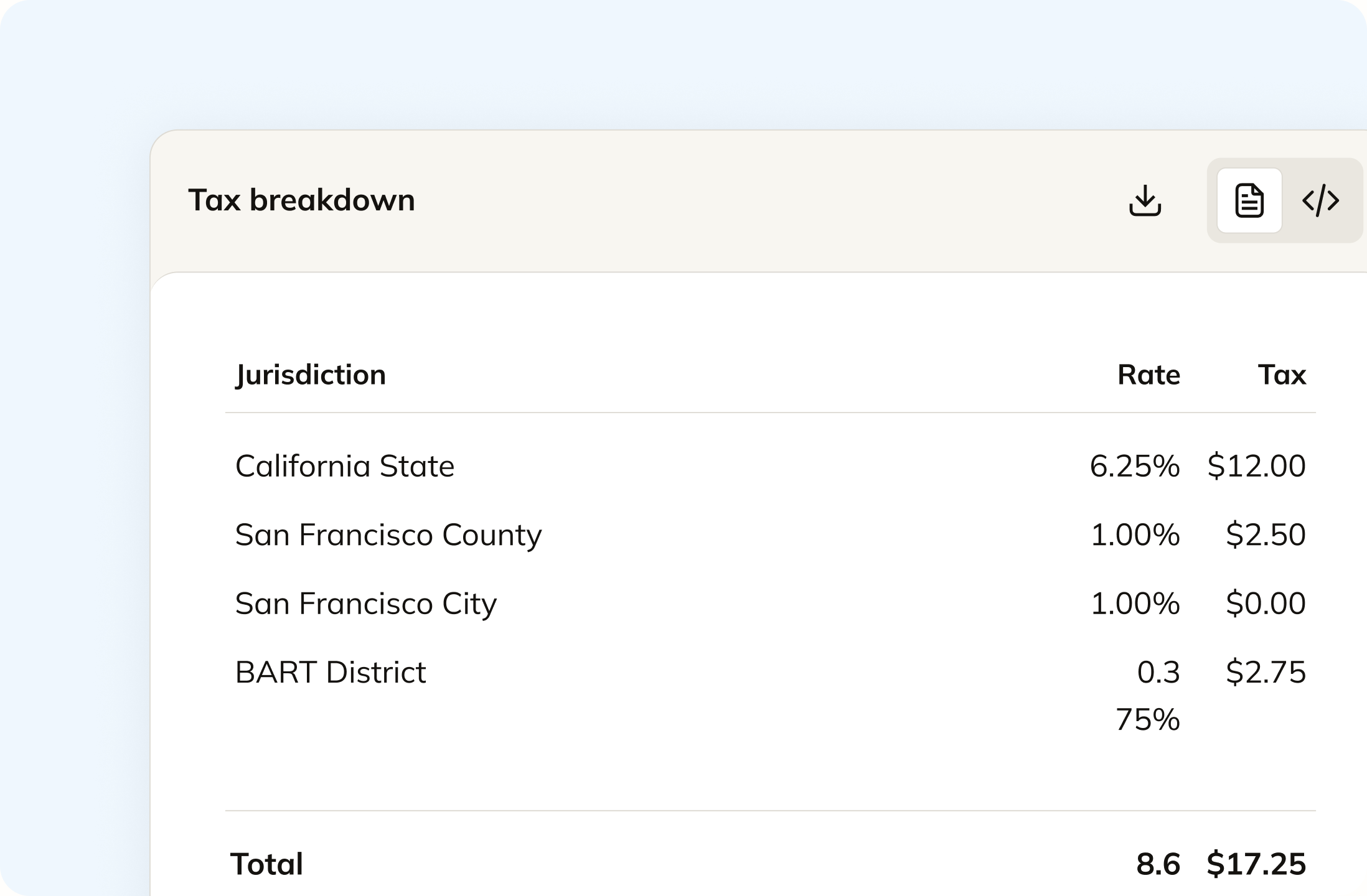
Tally.ERP 9 sets an export sale to zero tax, which is right for India and silent about everywhere else. Commenda calculates the destination tax on that same transaction: state, county, city and district for a US sale, and the correct VAT rate for an EU one. Product taxability is applied per jurisdiction, so a service and a physical good are not treated alike.
Track your global exposure from Tally.ERP 9
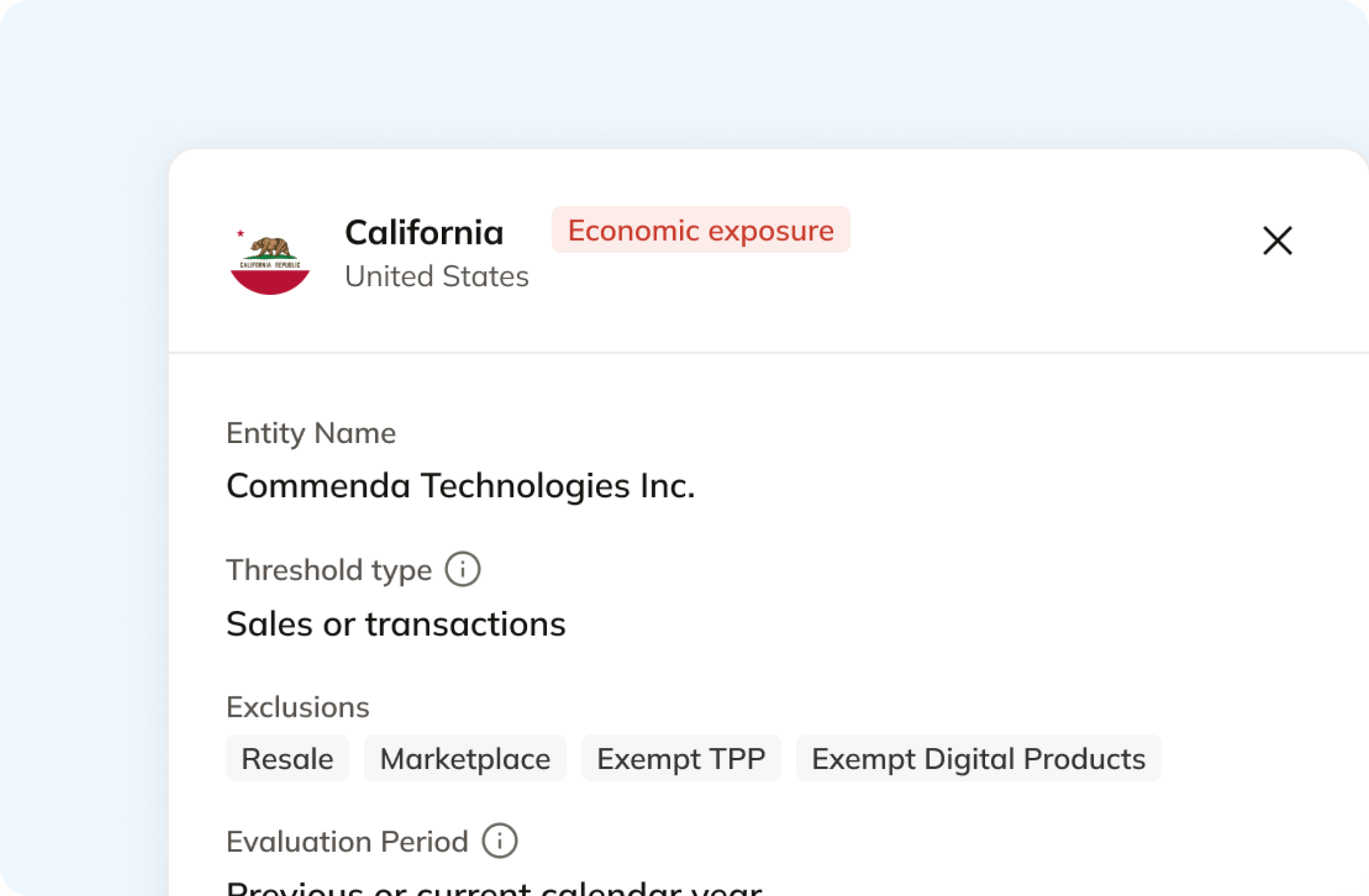
Tally.ERP 9's statutory reports are GSTR-1, GSTR-3B, GSTR-4 and GSTR-9. Every one of them measures activity under a GSTIN you already hold. Commenda reads your transaction history and measures it against economic and physical thresholds in all 50 states and 70+ countries, then notifies you at 80% of a registration threshold rather than after you have crossed it.
Automatically remit transactions around the world
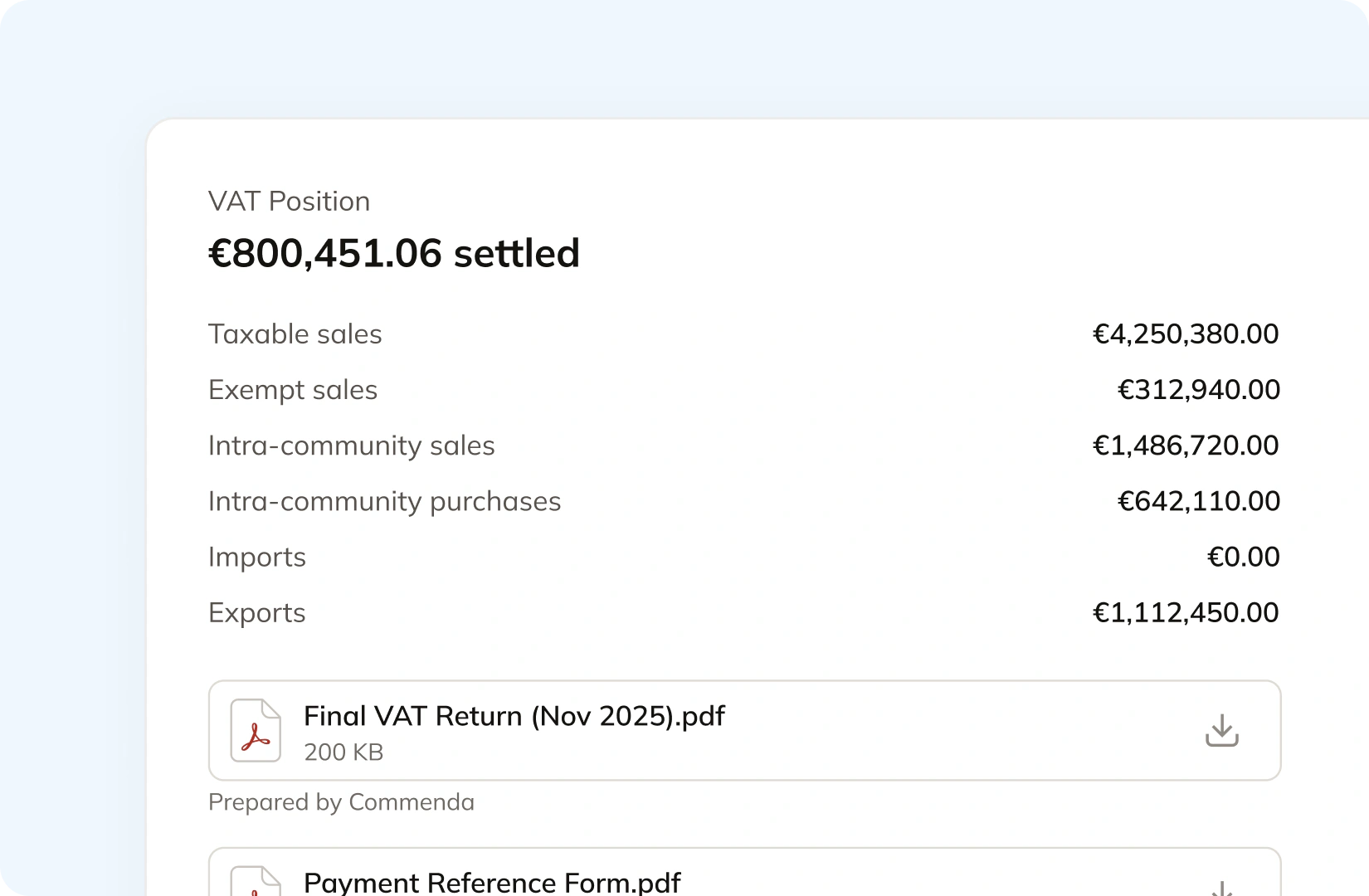
Every Tally.ERP 9 compliance route ends the same way: it makes a file and you take it to a government portal. Commenda builds and submits the foreign return itself, straight from your data. Returns go out across all 50 states, EU VAT with OSS and IOSS, and GST in APAC and Canada, with amendments where a period needs correcting.
Manage your customers and exemptions in one place
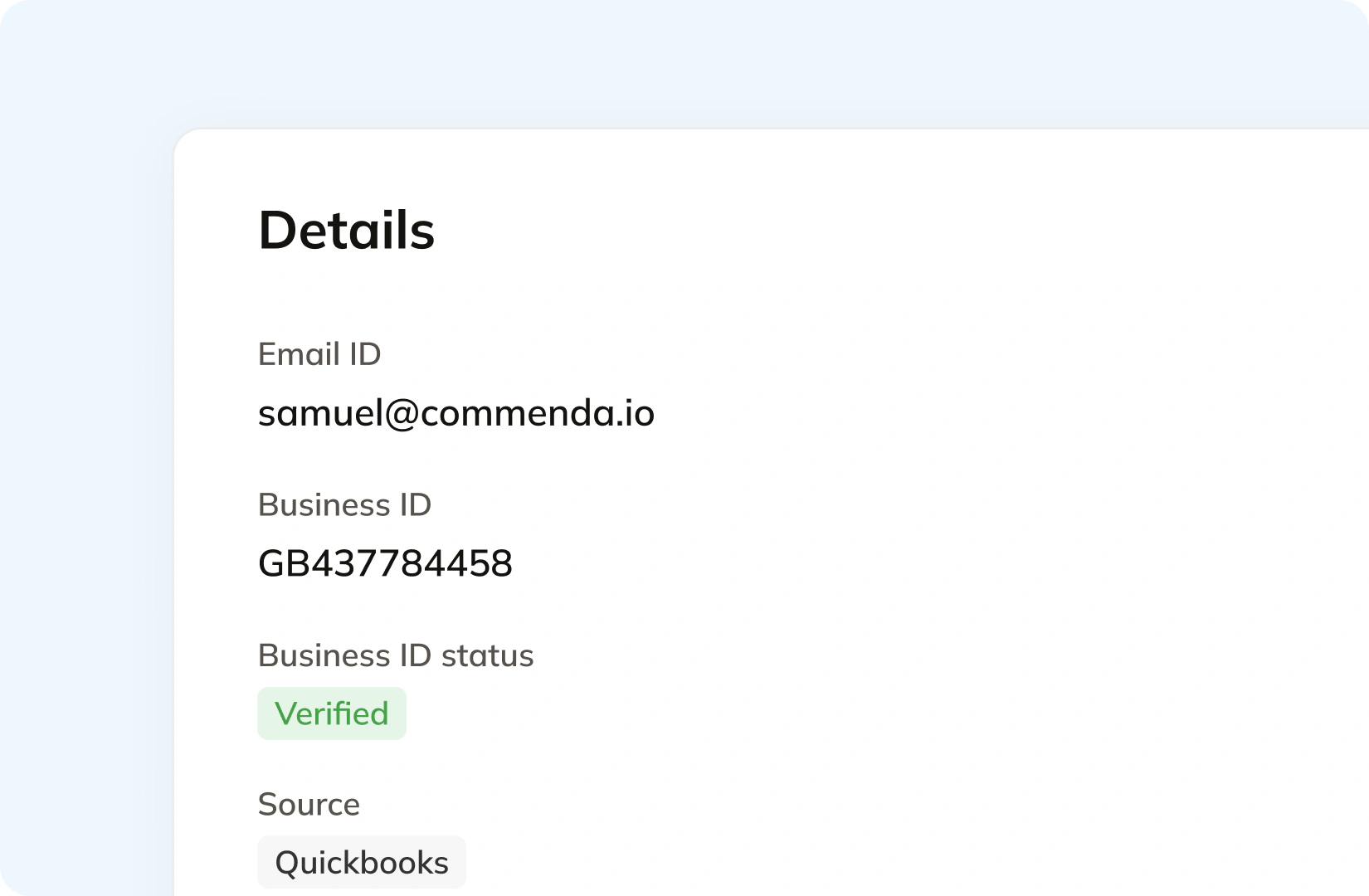
A US resale certificate and an EU VAT number are documents Tally.ERP 9 has no record type for. Commenda validates the tax ID on the customer record and shows which system it came from. Exemption certificates are collected through a portal your customers upload to, validated on upload, and applied automatically in the states where they are valid. Expiries are tracked and chased.
Consolidation
Why an older GST feature set matters, and where it does not
Two separate questions get tangled together on Tally.ERP 9. One is whether to migrate. The other is what happens to your foreign sales, which no version of Tally reports on. Commenda answers the second one and does not depend on the first.
An older GST feature set becomes a compliance question
Tally's own position is that ERP 9 users can continue using their current version, and it recommends upgrading for direct GST returns and e-invoicing. Tally has published no end-of-support date, so nobody should tell you one exists. What is true is that the current generation reaches the IRP and the GST portal directly, and ERP 9 reaches them through you. India's e-invoicing mandate gives a business over ₹10 crore of turnover thirty days from the invoice date to get an IRN, and a manual offline route has to fit inside that window. Tally documents migration from Release 5.0 onward, with masters and historical transactions retained.
Every ERP 9 compliance output is a file, and files get forgotten
GSTR-1 comes out as JSON, Excel or CSV. An e-way bill comes out as a JSON you upload to the portal. An e-invoice needs the offline tool and then a portal login to retrieve the QR code. None of that is wrong, and all of it depends on a person doing the last step on time, every period, for every registration.
Zero-rated in India does not mean untaxed at the destination
Tally.ERP 9 records an export sale with no tax, correctly, under LUT or bond. The US state your customer sits in may still tax that sale once you pass its economic nexus threshold, at a combined rate you can look up in our sales tax rate calculator. No Indian return captures that, and no ERP 9 report shows it building up.
One ledger, whichever version you are on
Tally.ERP 9 is rarely the only place revenue lands. A payment gateway, a marketplace, and a foreign subsidiary all produce sales that count toward a threshold. Every source connects to one ledger, across 100+ supported integrations. Each transaction carries its origin, its product tax code, and any tax already collected, so you get one exposure figure per jurisdiction and one return per period.
What it takes
What global indirect tax takes on Tally.ERP 9
Tally no longer publishes list pricing for Tally.ERP 9, so there are no licence figures here beyond the upgrade price Tally does publish. What Tally documents is what each compliance step depends on, and in most rows the answer is a file and a portal login.
| What you need | What Tally.ERP 9 requires | Source |
|---|---|---|
| Getting GSTR-1 to the GST portal | You. Tally documents three routes, generating JSON from Tally.ERP 9, using the GST Offline tool, or filing directly on the portal, and all three end with you uploading and filing there | File GSTR-1 |
| Getting GSTR-3B to the GST portal | The same manual route. Tally.ERP 9 produces the return data and the upload and submission happen on the portal | File GSTR-3B |
| An IRN and a signed QR code on an invoice | The offline tool plus a portal login. Tally documents exporting to an offline template, building the JSON, uploading it, then logging in to print or download the e-invoice using the Ack No or IRN | e-Invoice using Tally.ERP 9 |
| An e-way bill | A JSON file and the e-Way Bill portal. Tally's instruction is to create the JSON, then upload the JSON file to the portal to generate the e-Way Bill | e-Way Bill |
| The current GSTR-1 return format | Release 6.6.3, which Tally's notes describe as supporting the latest changes in the MS Excel, CSV and JSON formats of GSTR-1 | Release 6.6.3 notes |
| Reporting an invoice to the IRP inside the deadline | Thirty days from the invoice date if your aggregate turnover is ₹10 crore or more, effective 1 April 2025. A manual offline route has to fit inside that window | e-invoicing rules |
| Direct GST return filing and a direct IRP connection | TallyPrime. Tally's position is that ERP 9 users can continue on their current version, and it recommends upgrading for direct GST returns and e-invoicing | Upgrade page |
| That upgrade at no charge | An active TSS subscription and a move before 15 August 2026. Tally states that after that date upgrading costs 40% of your licence fee | Upgrade page |
Getting GSTR-1 to the GST portal
You. Tally documents three routes, generating JSON from Tally.ERP 9, using the GST Offline tool, or filing directly on the portal, and all three end with you uploading and filing there
File GSTR-1Getting GSTR-3B to the GST portal
The same manual route. Tally.ERP 9 produces the return data and the upload and submission happen on the portal
File GSTR-3BAn IRN and a signed QR code on an invoice
The offline tool plus a portal login. Tally documents exporting to an offline template, building the JSON, uploading it, then logging in to print or download the e-invoice using the Ack No or IRN
e-Invoice using Tally.ERP 9An e-way bill
A JSON file and the e-Way Bill portal. Tally's instruction is to create the JSON, then upload the JSON file to the portal to generate the e-Way Bill
e-Way BillThe current GSTR-1 return format
Release 6.6.3, which Tally's notes describe as supporting the latest changes in the MS Excel, CSV and JSON formats of GSTR-1
Release 6.6.3 notesReporting an invoice to the IRP inside the deadline
Thirty days from the invoice date if your aggregate turnover is ₹10 crore or more, effective 1 April 2025. A manual offline route has to fit inside that window
e-invoicing rulesDirect GST return filing and a direct IRP connection
TallyPrime. Tally's position is that ERP 9 users can continue on their current version, and it recommends upgrading for direct GST returns and e-invoicing
Upgrade pageThat upgrade at no charge
An active TSS subscription and a move before 15 August 2026. Tally states that after that date upgrading costs 40% of your licence fee
Upgrade page
Figures verified on July 30, 2026.
From the field
Trusted by businesses across the globe


“The platform works exactly the way I need it to. I have one team member who manages all of our exemption certificates, and that functionality has been particularly efficient for us. It allows him to handle everything seamlessly, making the handoff significantly easier.”
VP of Finance, TRX






Compare the GST and indirect tax options
If you are weighing an upgrade or a move, it helps to see the field. We compare the GST software Indian businesses shortlist on coverage, ratings, and real pricing, and we say where each one wins.
More sales tax resources
Guides from the Commenda team on switching software, use tax forms, audits, and APAC GST.
Frequently asked questions
Not directly. Tally.ERP 9 has no connection to the Invoice Registration Portal. Tally's documented route is to export the transaction details to an offline template, use the offline tool to build the JSON, upload that JSON to the e-invoice portal, and then log in to the portal to print or download the e-invoice with its QR code using the Ack No or IRN. The signed QR code does not come back into the voucher. TallyPrime, by contrast, sends invoices to the IRP and receives the IRN and QR back automatically. If e-invoicing is a daily volume problem for you, that difference is the reason to look at an upgrade.
Tally has published no end-of-support date for Tally.ERP 9, so treat any claim of one with suspicion. Tally's own words on its upgrade page are that ERP 9 users can continue using their current version, and that it recommends upgrading to TallyPrime for the latest improvements. There is one dated commercial deadline: with an active TSS subscription the upgrade is free until 15 August 2026, and Tally states that after that date it costs 40% of your licence fee. Nothing in the Commenda integration depends on which version you run.
Only prepare it. Tally documents three routes for GSTR-1: generate the JSON from Tally.ERP 9, use the GST Offline tool to convert an Excel or CSV export into JSON, or enter the return directly on the GST portal. All three end the same way, with you uploading the file to the portal and filing there. GSTR-3B works the same. The distinction matters when you compare quotes, because preparing a return and submitting it are different amounts of work and different points of failure.
No. Its statutory feature set is Indian GST, and a sale to a foreign customer is recorded as an export at zero tax under LUT or bond. That is the correct Indian treatment and it is the end of what the software says about the transaction. Commenda calculates the destination tax on the same sale, registers you where you have crossed a threshold, and files across all 50 US states, EU VAT with OSS and IOSS, and GST in APAC and Canada.
Yes. Commenda files GSTR-1 and GSTR-3B on your return frequency, built from the transactions read out of Tally.ERP 9, so there is no JSON to export and no portal login at the end of it. Your entity records sit alongside: GSTIN, PAN and TAN kept updated by our team, with registrations and licences by jurisdiction, and we incorporate in India. The same connection covers the sales tax and VAT an exporter owes abroad.
Yes. Commenda works from transaction data, whatever version you run, so the migration question and the compliance question are separate. Indian finance teams already run this handoff for their auditors: agreed exports of transactions and trial balances on an agreed cadence. Teams we work with export monthly trial balances, profit and loss statements, and balance sheets straight out of Tally, and raw software exports are fine rather than formatted statements. If you migrate to TallyPrime later, your registrations, exposure history, and filed returns stay where they are.
It is compliant and it is manual. Tally's instruction for Tally.ERP 9 is to create the JSON file, then upload that file to the e-Way Bill portal to generate the bill. The portal does the generating, so the number depends on somebody completing that upload before the goods move. TallyPrime generates e-way bills online, though that path needs an active TSS subscription. Either way, an e-way bill is a domestic movement document and it says nothing about a foreign tax obligation.
It depends on where the customer is and how much you have sold there. In the United States, most states set an economic nexus threshold around $100,000 or 200 transactions, and crossing it obliges you to register and collect even with no US entity. In the EU, each country sets its own registration point and OSS lets you file one return for cross-border B2C sales. Commenda measures your sales against those thresholds in all 50 states and 70+ countries, notifies you at 80% of a threshold, then registers you and files.
Custom integration support for your business
Migrating to TallyPrime is your decision and your timeline. Either way we map how your Tally.ERP 9 setup works, agree the export and the cadence, and build the integration to match. No engineering work on your side.
Indirect Tax
Monitor nexus exposure, register, file, and remit sales tax and VAT in one platform. Commenda keeps you compliant across 100+ jurisdictions.
Explore the product
