Sales tax and VAT software for Sage Intacct
Sage Intacct submits your UK VAT return to HMRC and prepares returns in five more countries. In the United States it hands you a rate table to build yourself, across roughly 8,000 taxing jurisdictions. Commenda covers both gaps from the same Sage Intacct data, across all 50 states and 70+ countries.
Trusted by global businesses

































Monitor your global exposure
Sage Intacct records the tax registrations you already hold. Commenda measures your invoices against economic and physical thresholds in all 50 states and 70+ countries, and notifies you at 80% of a threshold.
Calculate tax without maintaining rates
Sage puts roughly 8,000 taxing jurisdictions in the United States. Its own engine is a rate table you set up and keep current. Commenda applies state, county, city, and district rates on every transaction.
File the US returns Sage Intacct does not
Sage Intacct submits your UK VAT return to HMRC and prepares returns in five more countries. The United States is not one of them. Commenda files across all 50 states.
Coverage comparison
What Sage Intacct handles, and what it hands back
Which answers apply to you depends on the tax solution assigned to each entity, and Sage Intacct allows one per entity. Its figures come from Sage's help centre pages on sales tax, the Taxes application, Advanced Tax, AvaTax, and submitting taxes, checked on July 30, 2026.
Registrations for collecting tax
- Sage Intacct
- Not handled. You enter the tax registration numbers you already hold
- Commenda
- Permits in all 50 states, EU VAT with OSS and IOSS, and GST across APAC and Canada
Filing your US sales tax returns
- Sage Intacct
- Not handled. The United States has no tax submission path
- Commenda
- Filed in all 50 states, amendments included
Filing outside the United States
- Sage Intacct
- Partly. Six countries get a prepared return, three of them sent electronically
- Commenda
- Filed across 70+ countries from one platform
Remitting what you collected
- Sage Intacct
- Not handled. It records a submission date once the return has gone
- Commenda
- Tracked per jurisdiction, every filing
Knowing where you owe
- Sage Intacct
- Not handled. Nexus tracking and threshold alerts come from Avalara
- Commenda
- Economic and physical thresholds in 50 states and 70+ countries, with alerts before you cross
Keeping US rates current
- Sage Intacct
- Yours to maintain. Advanced Tax is a rate table you build by jurisdiction
- Commenda
- Maintained for you at state, county, city, and district level
Exemption certificates
- Sage Intacct
- Stored, not collected. The customer record takes a code and Avalara holds the certificate
- Commenda
- Collected, validated, stored, and applied automatically where valid
| Sage Intacct |  | |
|---|---|---|
| Registrations for collecting tax | Not handled. You enter the tax registration numbers you already hold | Permits in all 50 states, EU VAT with OSS and IOSS, and GST across APAC and Canada |
| Filing your US sales tax returns | Not handled. The United States has no tax submission path | Filed in all 50 states, amendments included |
| Filing outside the United States | Partly. Six countries get a prepared return, three of them sent electronically | Filed across 70+ countries from one platform |
| Remitting what you collected | Not handled. It records a submission date once the return has gone | Tracked per jurisdiction, every filing |
| Knowing where you owe | Not handled. Nexus tracking and threshold alerts come from Avalara | Economic and physical thresholds in 50 states and 70+ countries, with alerts before you cross |
| Keeping US rates current | Yours to maintain. Advanced Tax is a rate table you build by jurisdiction | Maintained for you at state, county, city, and district level |
| Exemption certificates | Stored, not collected. The customer record takes a code and Avalara holds the certificate | Collected, validated, stored, and applied automatically where valid |
Calculate taxes globally on Sage Intacct using Commenda
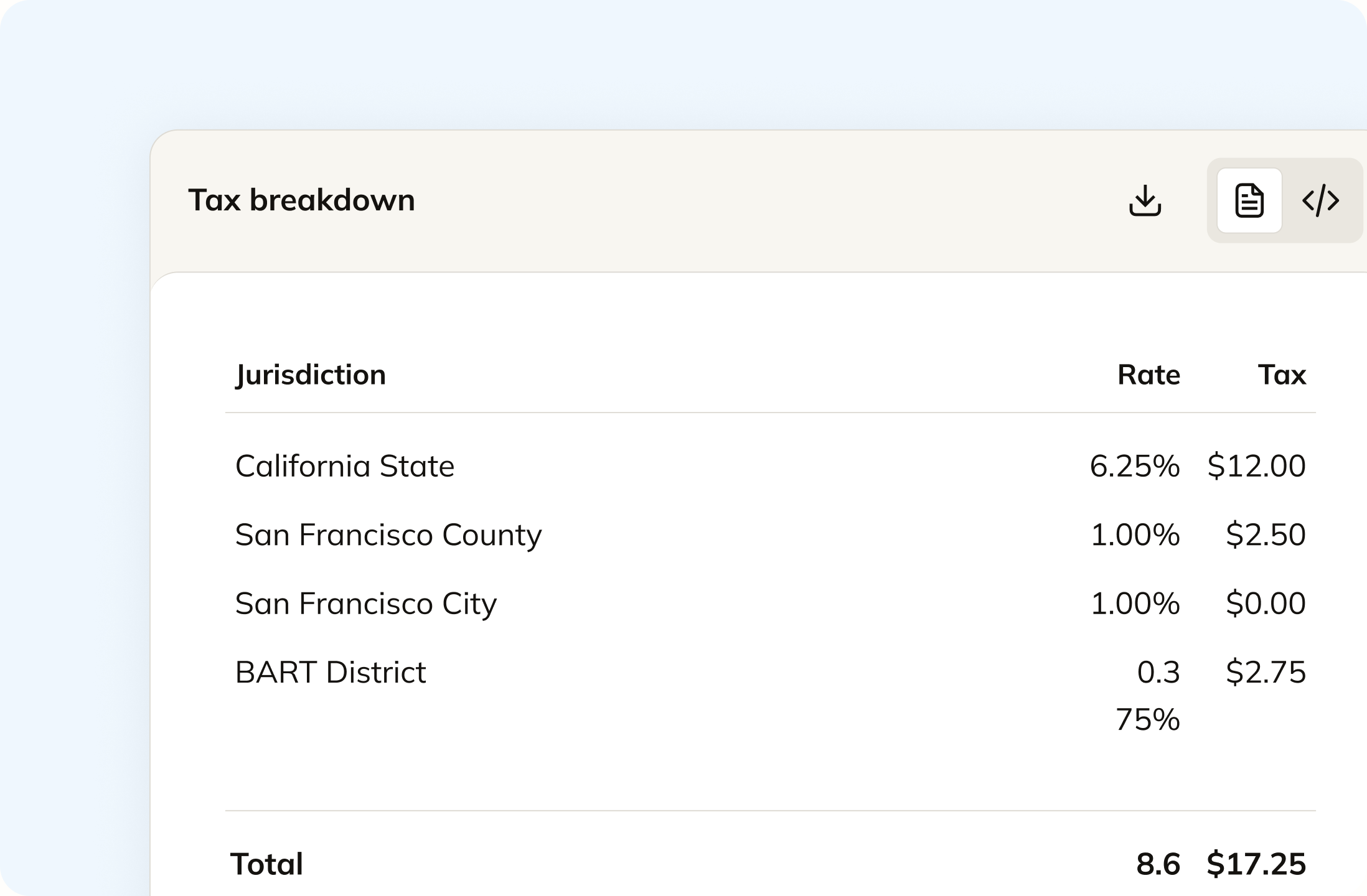
Sage Intacct's own US engine is a rate table you build and maintain, and Sage suggests it where you sell in one or two states. Commenda applies state, county, city, and district rates on every transaction and keeps them current. Calculation can be switched off where revenue arrived already taxed, so a marketplace order is never taxed twice.
Track your global exposure from Sage Intacct
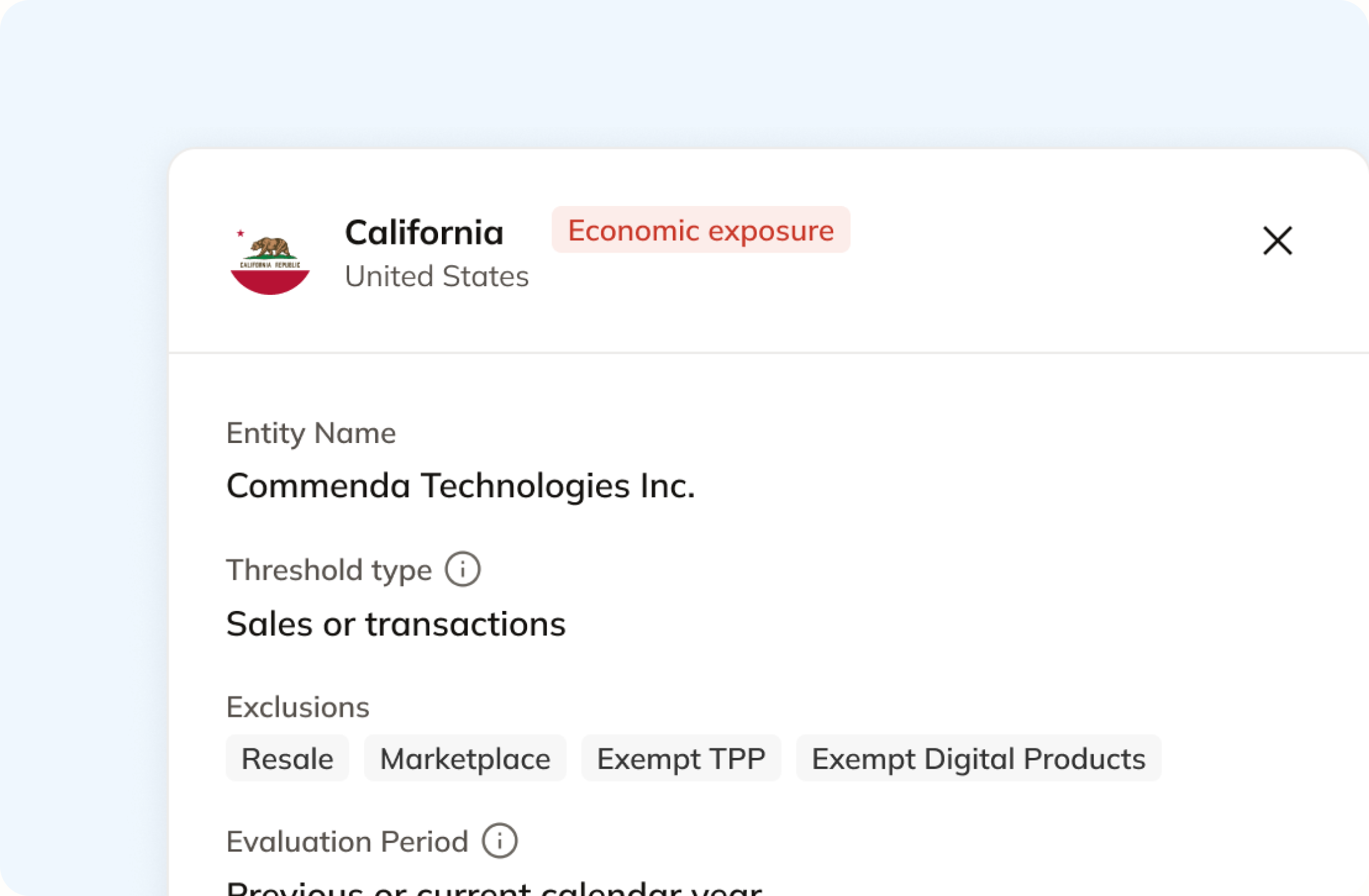
Sage Intacct holds the tax registration numbers you already have. It does not measure your sales against the thresholds that create new ones. Commenda measures the same transactions against economic and physical thresholds in all 50 states and 70+ countries, and tells you at 80%, before you cross. A short questionnaire covers physical presence too, because a warehouse or a remote employee never shows up on an invoice.
Automatically remit transactions around the world
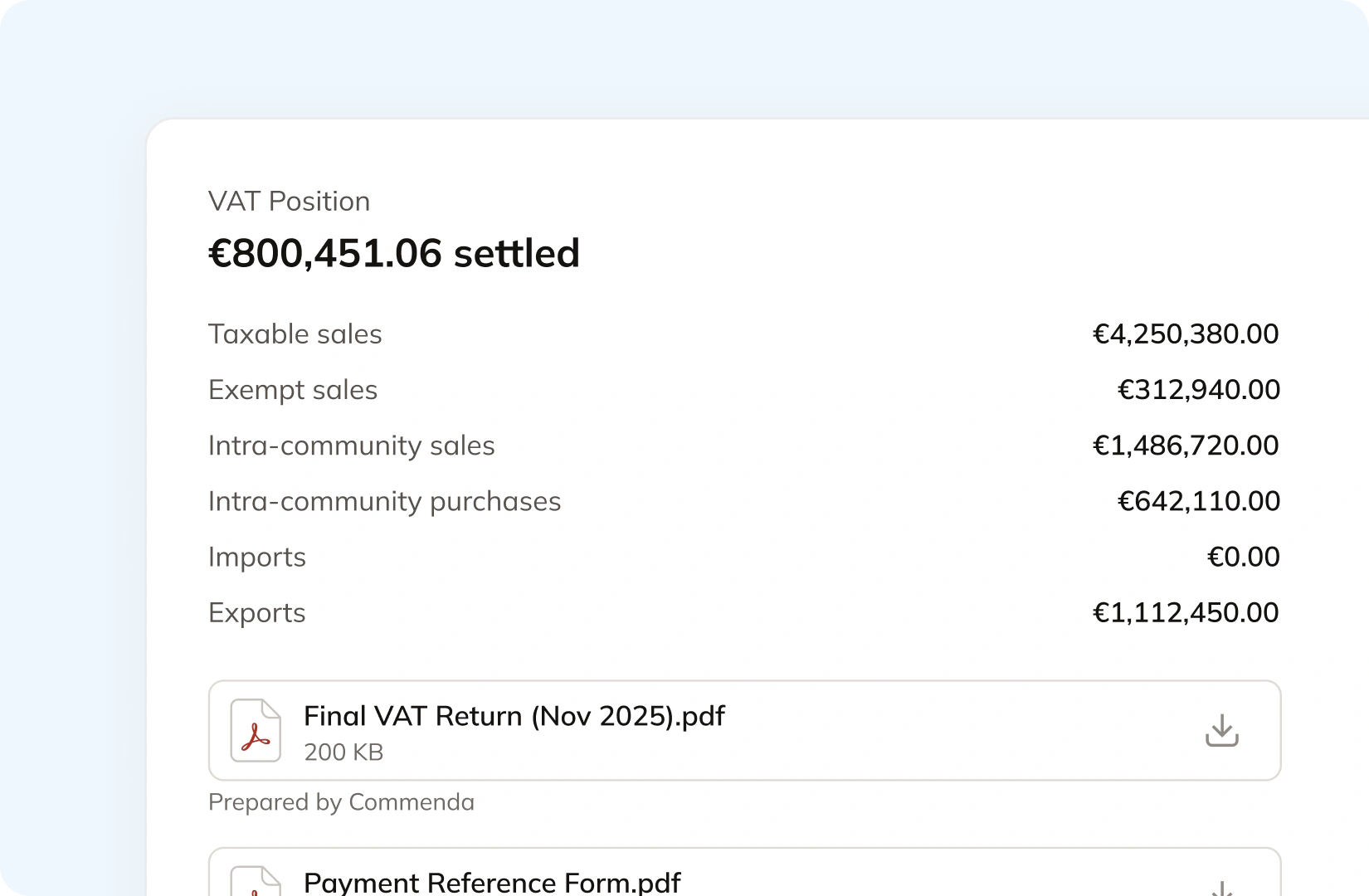
Sage Intacct prepares a return in six countries and submits three of them electronically. The United States is on neither list. Commenda builds the return straight from your Sage Intacct data, so nothing gets exported or re-keyed. Returns go out across all 50 states, plus EU VAT with OSS and GST in APAC and Canada, with amendments where a period needs correcting. Filing confirmations sync back.
Manage your customers and exemptions in one place
In Sage Intacct a customer is taxable by default, and an exemption is a code on the customer record that gets handed to Avalara. The certificate itself lives in the Avalara account. Commenda handles getting the certificate in the first place. Your customers upload through a portal that can carry your branding, each one is validated on upload, and it applies automatically in the states where it is valid. Expiries are tracked and chased.
Consolidation
Why Sage Intacct does not know your total exposure
Sage Intacct is the system of record for the business, and tax is one job inside it. Filing one return means knowing which revenue arrived already taxed, which states you actually owe, and which registrations you are still carrying. Commenda solves that.
Revenue reaches Sage Intacct from more than one place
A storefront, a marketplace, and a billing platform all feed into Sage Intacct, and the tax already collected upstream is not yours to file again. Sage documents no US filing path at all. The United States appears on neither its list of standard tax solutions nor its list of countries you can submit taxes for.
One tax solution per entity, and the US one is a table you build
Sage Intacct is strong on multi-entity, and tax is where that gets specific. You can assign only one tax solution to an entity, so a UK entity on the pre-configured VAT solution and a US entity on Advanced Tax are two separate setups. Sage states the tax objects behind Advanced Tax need to be manually created, one per jurisdiction you collect in.
Registrations drift in both directions
Missing a state is the risk everyone plans for. Carrying states you no longer sell into is the one nobody does, and each one is a return you still owe every period. Thresholds differ by state, and our nexus threshold guide lists each one. Reading the transaction history finds drift in both directions. We did exactly that for a customer carrying 50+ registrations, right-sizing them to match the entity that actually trades (read the case study).
One ledger behind every channel
Every source connects to one ledger, across 100+ supported integrations. Each transaction carries its origin, product tax code, and any tax already collected, so marketplace revenue stays separate from revenue that still needs tax. The result is one exposure figure per state, one return per period, and every line traceable back to the invoice it came from. See how global indirect tax works end to end, or check one jurisdiction's rate with the sales tax calculator.
What it takes
What global indirect tax takes in Sage Intacct
Sage does not publish a Sage Intacct list price, so there are no dollar figures here. What Sage does publish is what each capability depends on. Its own tax engine is included in the subscription. The cost of growth is rate maintenance, an Avalara account, and a setup per entity.
| What you need | What Sage Intacct requires | Source |
|---|---|---|
| US sales tax rates that stay current on their own | Avalara AvaTax, on an account you open at Avalara.com. Sage's own engine is a set of tax details, schedules, and schedule maps that you create and maintain | Sales tax overview |
| Sage's own US engine at 50-state scale | Not what Sage suggests it for. Its guidance is Advanced Tax where you sell in one or two states, and AvaTax where you sell in all 50 plus counties and cities | Sales tax overview |
| A prepared VAT or GST return | One of six standard tax solutions plus Sage Regulatory Reporting: Australia, Canada, France, Germany, South Africa, or the United Kingdom | Submit taxes |
| An electronic filing straight to the tax authority | Three of those six. HMRC under Making Tax Digital, ELSTER in Germany, and SARS in South Africa. Australia, Canada, and France give you a PDF to lodge yourself | Submit taxes |
| VAT in a country with no standard tax solution | A custom tax solution you build with the rates for that jurisdiction, where you record the submission and mark it filed yourself | Taxes application |
| Exemption certificates as a record | An Avalara account. Sage Intacct holds an exemption use code on the customer or contact, and Sage documents Avalara as providing the certificate management | AvaTax overview |
| An alert before you trigger a new registration | Avalara AvaTax. Its listing on Sage's own marketplace is where the economic nexus tracking and the alerts are described, not in the Sage Intacct tax documentation | Marketplace listing |
| Tax across a multi-entity company | One tax solution per entity, and a decision on registration numbers, because each return covers a single VAT registration number. Books must be closed before you create a submission | Multi-entity returns |
| What Sage Intacct charges you for tax | Nothing extra for its own engine. Sage states Advanced Tax is included in your subscription and that Avalara charges you for using theirs. Sage publishes no list price for the platform | Sage Intacct pricing |
US sales tax rates that stay current on their own
Avalara AvaTax, on an account you open at Avalara.com. Sage's own engine is a set of tax details, schedules, and schedule maps that you create and maintain
Sales tax overviewSage's own US engine at 50-state scale
Not what Sage suggests it for. Its guidance is Advanced Tax where you sell in one or two states, and AvaTax where you sell in all 50 plus counties and cities
Sales tax overviewA prepared VAT or GST return
One of six standard tax solutions plus Sage Regulatory Reporting: Australia, Canada, France, Germany, South Africa, or the United Kingdom
Submit taxesAn electronic filing straight to the tax authority
Three of those six. HMRC under Making Tax Digital, ELSTER in Germany, and SARS in South Africa. Australia, Canada, and France give you a PDF to lodge yourself
Submit taxesVAT in a country with no standard tax solution
A custom tax solution you build with the rates for that jurisdiction, where you record the submission and mark it filed yourself
Taxes applicationExemption certificates as a record
An Avalara account. Sage Intacct holds an exemption use code on the customer or contact, and Sage documents Avalara as providing the certificate management
AvaTax overviewAn alert before you trigger a new registration
Avalara AvaTax. Its listing on Sage's own marketplace is where the economic nexus tracking and the alerts are described, not in the Sage Intacct tax documentation
Marketplace listingTax across a multi-entity company
One tax solution per entity, and a decision on registration numbers, because each return covers a single VAT registration number. Books must be closed before you create a submission
Multi-entity returnsWhat Sage Intacct charges you for tax
Nothing extra for its own engine. Sage states Advanced Tax is included in your subscription and that Avalara charges you for using theirs. Sage publishes no list price for the platform
Sage Intacct pricing
Figures verified on July 30, 2026.
From the field
Trusted by businesses across the globe


“The platform works exactly the way I need it to. I have one team member who manages all of our exemption certificates, and that functionality has been particularly efficient for us. It allows him to handle everything seamlessly, making the handoff significantly easier.”
VP of Finance, TRX






Compare Commenda sales tax software with competitors
Sage lists Avalara AvaTax on its own marketplace as the tax path for Sage Intacct. We compare the alternatives on coverage, ratings, and real pricing, and we say where each one wins.
More sales tax resources
Guides from the Commenda team on compliance basics, thresholds, VAT, and resale certificates.
Frequently asked questions
No. Sage Intacct submits tax returns through Sage Regulatory Reporting for six countries, and the United States is not one of them. What you get in the US is calculation and capture: either Advanced Tax, where you build and maintain the jurisdictions and rates yourself, or the Avalara AvaTax integration, where Sage says you can use the reporting in AvaTax to prepare tax returns for each jurisdiction. That reporting sits in an Avalara account you open separately. Commenda files across all 50 states on each state's required frequency, tracks remittance per jurisdiction, and files amended returns where a period needs correcting.
No. Sage's own sales tax overview names economic nexus in the customer's state as one of the two things that require you to collect, and then documents no way to monitor it. The nexus tracking and the alerts are described on the Avalara AvaTax listing on Sage's marketplace rather than in the Sage Intacct tax documentation. Commenda measures the same Sage Intacct transactions against economic and physical thresholds in all 50 states, every EU member state, and 70+ countries, and notifies you at 80% of a registration threshold. Exempt sales matter here too. In states that count them toward the threshold they can still create an obligation, and we surface that per state.
Sage answers this itself, and the answer turns on how many jurisdictions you collect in. Its documentation suggests Advanced Tax where you sell in a limited area, perhaps one or two states, and AvaTax where you sell in all 50 states along with many counties and cities. Sage puts the number of state, county, and city jurisdictions that charge US sales tax at roughly 8,000. Advanced Tax is included in your subscription and Avalara bills you separately, and Sage notes that using Advanced Tax precludes using Simple Tax. With Commenda the rate table is not yours to maintain either way, and the same data drives the filing.
The UK is covered, and it is one of nine. Sage Intacct has been through HMRC's recognition process for Making Tax Digital and submits the return electronically. Germany goes to ELSTER the same way, and South Africa can go electronically to SARS. Australia, Canada, and France give you a calculated PDF that you lodge yourself. New Zealand, Ireland, and Singapore are early adopter solutions where you record a manual submission and mark it filed. Everywhere else you build a custom tax solution with your own rates and do the same. Commenda covers VAT, GST, and sales tax across 70+ countries from one platform, including EU VAT with OSS and IOSS.
It holds a code. The certificate itself sits outside Sage Intacct. Customers are taxable by default in Sage Intacct. You enter an exemption use code on the Additional Information tab of a customer or contact record, and Sage Intacct passes that code to Avalara on the transaction. Sage's own documentation says Avalara provides the exempt certificate management, and that a customer marked taxable will still be exempted if you file a tax exemption for them on the Avalara dashboard. Storing a certificate is not the same as getting one. Commenda collects them through a self-service portal, validates each one at upload on signature, dates, ID format, and state-specific fields, applies it automatically where valid, and chases expiries. Multi-state SST and MTC forms are accepted alongside single-state ones. Liability for an invalid certificate falls back on the seller, which is why validation happens at upload.
In Sage Intacct you assign one tax solution per entity, so a UK entity on the pre-configured VAT solution and a US entity on Advanced Tax are two separate setups. Whether their returns group together depends on your registration numbers, because each return covers a single VAT registration number. Two other constraints are worth knowing: the books for the reporting period must be closed before you create a submission, and the Taxes application does not support cash basis tax reporting. With Commenda you switch between entities on one dashboard, with consolidated registrations, exposure, and filings. Entities added through an acquisition join the same workspace and inherit the same monitoring and filing workflow.
Under marketplace facilitator rules the marketplace generally collects and remits tax on the sales it facilitates, and your direct sales stay yours. You still need those facilitated sales accounted for correctly. Commenda separates facilitated from direct sales and tracks the tax the platform already collected, so nothing gets filed twice and nothing gets missed. Where a platform is not collecting, which is common with non-US platforms, the liability is yours. We review the platform's settlement reporting to confirm its collection status rather than assume it.
Custom integration support for your business
Every Sage Intacct company is configured differently, and those choices exist for good reasons. We map how yours works, including your entities, the tax solution on each one, and which revenue should be calculated, and build the integration to match.
Indirect Tax
Monitor nexus exposure, register, file, and remit sales tax and VAT in one platform. Commenda keeps you compliant across 100+ jurisdictions.
Explore the product
