Sales tax and VAT software for NetSuite
NetSuite maintains tax rates across 180 countries and submits UK VAT straight to HMRC. It files nothing in the United States, and a nexus is a record you create rather than an obligation it finds. Commenda covers both gaps from the same NetSuite data, across all 50 states and 70+ countries.
Trusted by global businesses

































Monitor your global exposure
In NetSuite a nexus is a record you create. Commenda measures your vouchers against economic and physical thresholds in all 50 states and 70+ countries, and notifies you at 80% of a threshold.
Calculate tax on every voucher type
Tax is applied when a voucher is created and carries across when a sales order converts to a cash sale, so nothing is recalculated or re-rounded on the way through.
File the US returns NetSuite does not
NetSuite submits UK VAT to HMRC and produces localized returns for 14 countries. The United States is not one of them. Commenda files across all 50 states.
Coverage comparison
What NetSuite handles, and what it hands back
NetSuite runs two tax systems, legacy tax and the newer engine, and which one you have changes most of the answers below. Its figures come from Oracle's Help Center pages on the differences between the two, nexuses, country tax reports, Making Tax Digital, paying US sales tax, and exemption certificates, checked on July 29, 2026.
Registrations for collecting tax
- Oracle NetSuite
- Not handled. You add a record for each state you are already registered in
- Commenda
- Permits in all 50 states, EU VAT with OSS and IOSS, and GST across APAC and Canada
Filing your US sales tax returns
- Oracle NetSuite
- Not handled. You get reports to file from
- Commenda
- Filed in all 50 states, amendments included
Filing outside the United States
- Oracle NetSuite
- Partly. Eight countries including the UK. Elsewhere you get reports, not filings
- Commenda
- Filed across 70+ countries from one platform
Remitting what you collected
- Oracle NetSuite
- Not handled. It records the payment once you have made it
- Commenda
- Tracked per jurisdiction, every filing
Knowing where you owe
- Oracle NetSuite
- Partly. One report shows your sales per state against the threshold
- Commenda
- Economic and physical thresholds in 50 states and 70+ countries, with alerts before you cross
Exemption certificates
- Oracle NetSuite
- Stored, not collected. Its older tax engine holds only a general exemption flag
- Commenda
- Collected, validated, stored, and applied automatically where valid
Switching tax engines later
- Oracle NetSuite
- A one-way change. Oracle documents it as non-reversible once enabled
- Commenda
- Sits outside your tax engine, so your compliance record does not move with it
| Oracle NetSuite |  | |
|---|---|---|
| Registrations for collecting tax | Not handled. You add a record for each state you are already registered in | Permits in all 50 states, EU VAT with OSS and IOSS, and GST across APAC and Canada |
| Filing your US sales tax returns | Not handled. You get reports to file from | Filed in all 50 states, amendments included |
| Filing outside the United States | Partly. Eight countries including the UK. Elsewhere you get reports, not filings | Filed across 70+ countries from one platform |
| Remitting what you collected | Not handled. It records the payment once you have made it | Tracked per jurisdiction, every filing |
| Knowing where you owe | Partly. One report shows your sales per state against the threshold | Economic and physical thresholds in 50 states and 70+ countries, with alerts before you cross |
| Exemption certificates | Stored, not collected. Its older tax engine holds only a general exemption flag | Collected, validated, stored, and applied automatically where valid |
| Switching tax engines later | A one-way change. Oracle documents it as non-reversible once enabled | Sits outside your tax engine, so your compliance record does not move with it |
Setup
How to setup the NetSuite integration
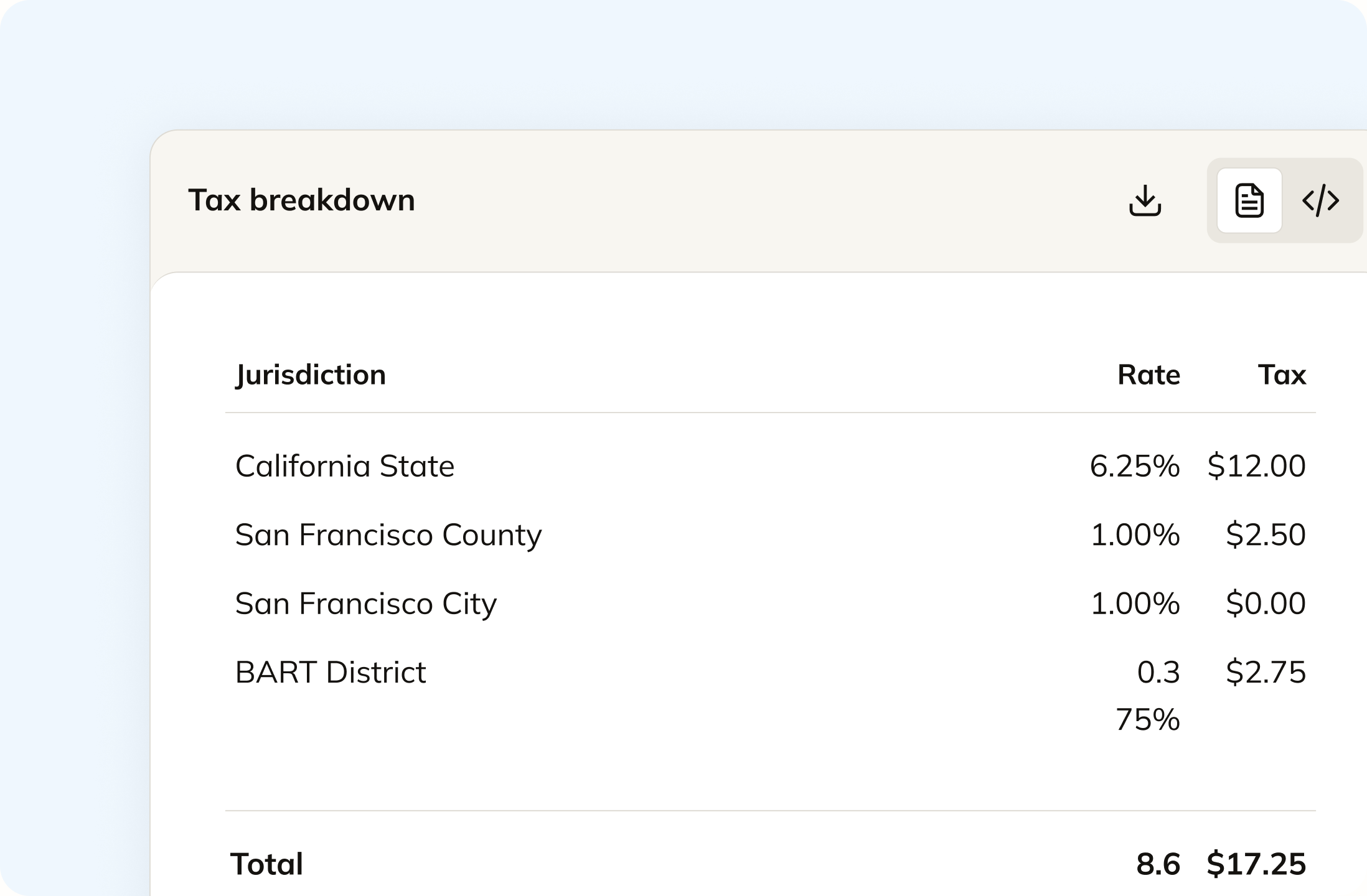
Install the Commenda bundle and connect it to your account. Commenda then appears in your NetSuite nav bar with its own configure page, where you set which voucher types and departments it calculates on and the date it starts from.
Calculate taxes globally on NetSuite using Commenda
Tax is calculated when a voucher is created, and it carries across when a sales order becomes a cash sale, so nothing is recalculated on the way through. Every voucher type is covered. You can switch calculation off by department, country, or voucher type, so revenue that arrived already taxed stays untouched.
Track your global exposure from NetSuite
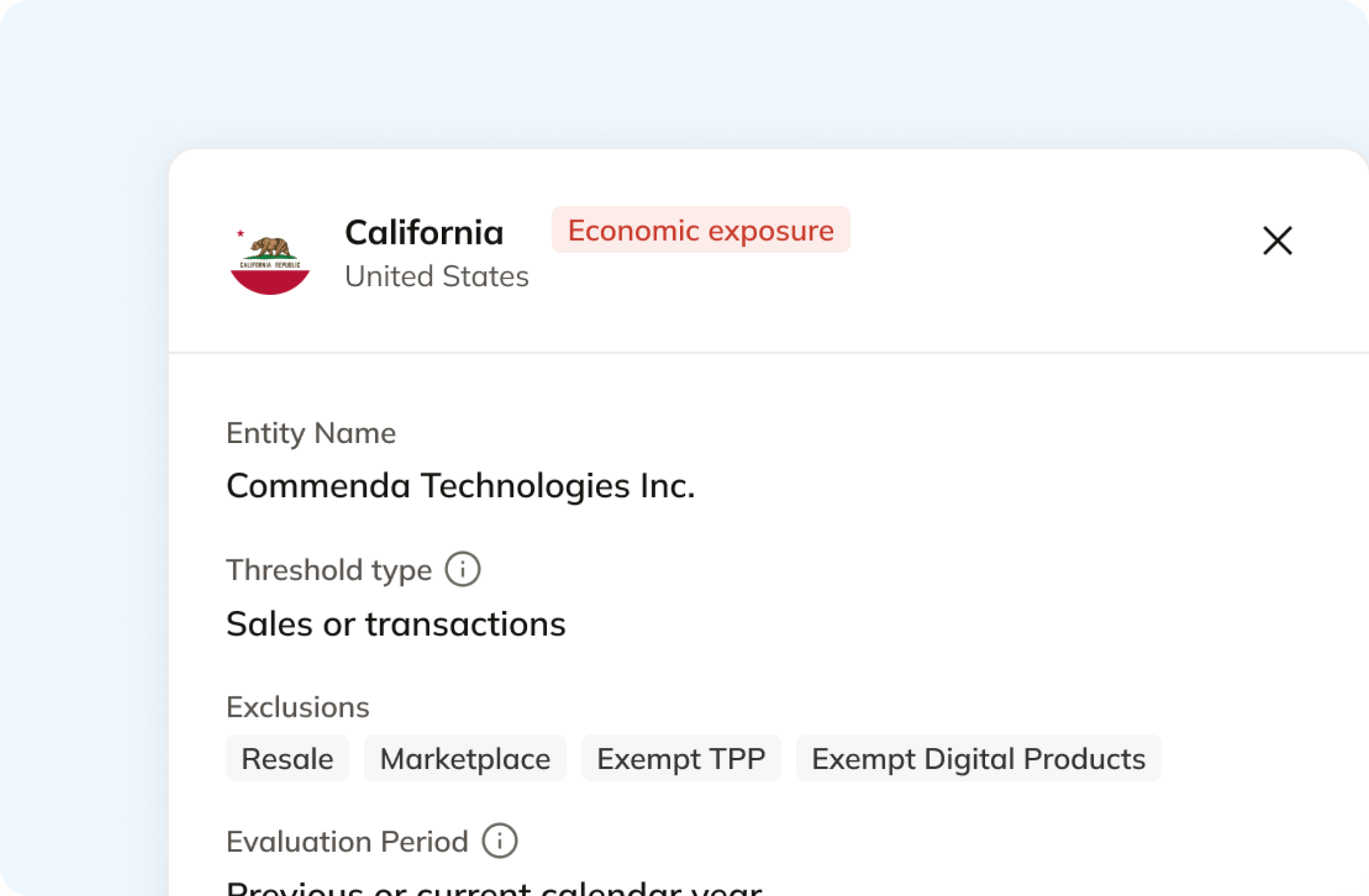
In NetSuite you add a record for each state you are already registered in, so it only tracks tax where you told it to. Commenda measures the same transactions against thresholds in all 50 states and 70+ countries and tells you at 80%, before you cross. A short questionnaire covers physical presence too, because a warehouse or a remote employee never shows up on a voucher.
Automatically remit transactions around the world
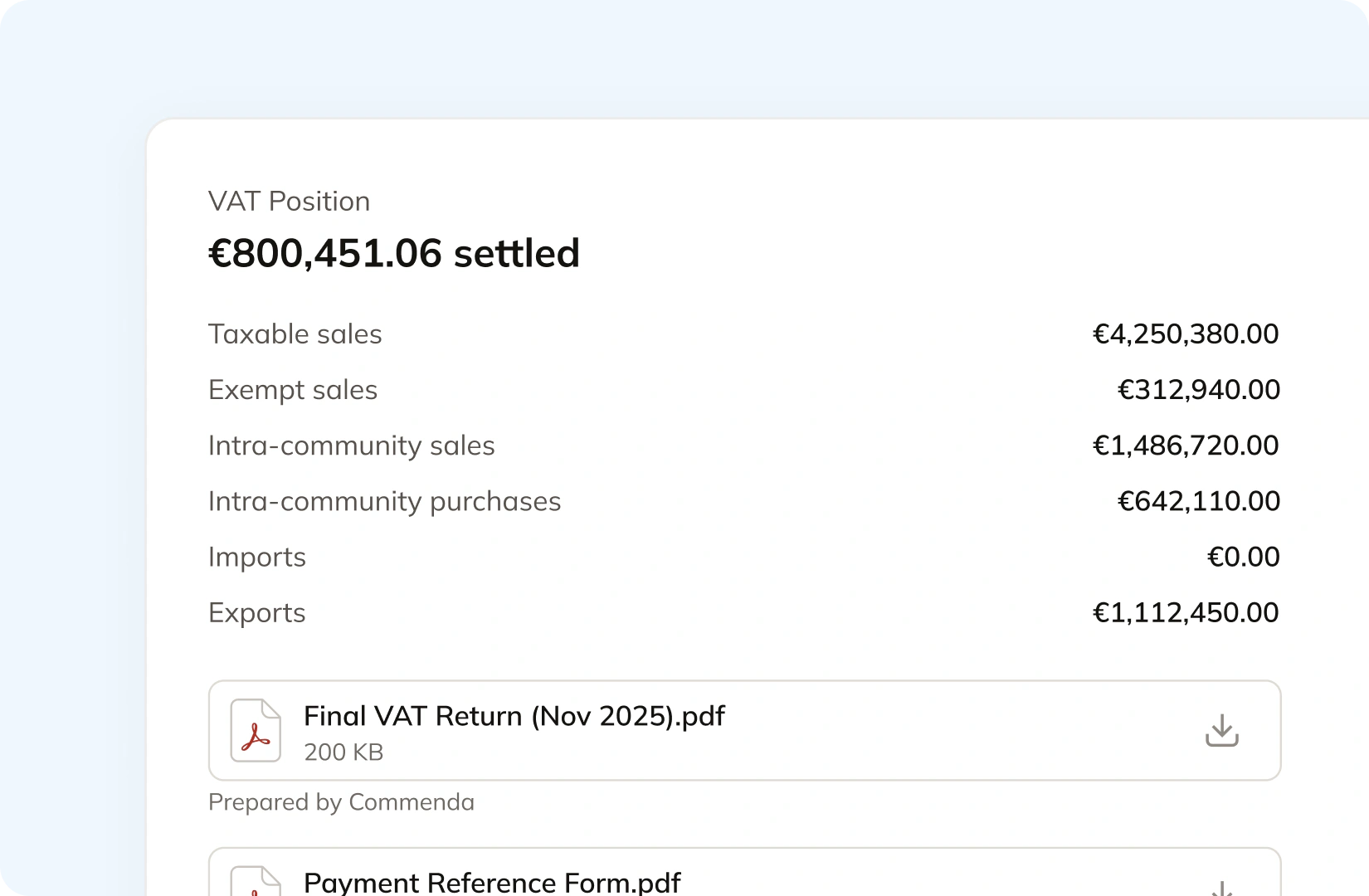
NetSuite produces country tax reports for 14 countries, and the United States is not one of them. Commenda builds the return straight from your NetSuite data, so nothing gets exported or re-keyed. Returns go out across all 50 states, plus EU VAT with OSS and GST in APAC and Canada, with amendments where a period needs correcting. The liability and the filing confirmation post back to your ledger.
Manage your customers and exemptions in one place
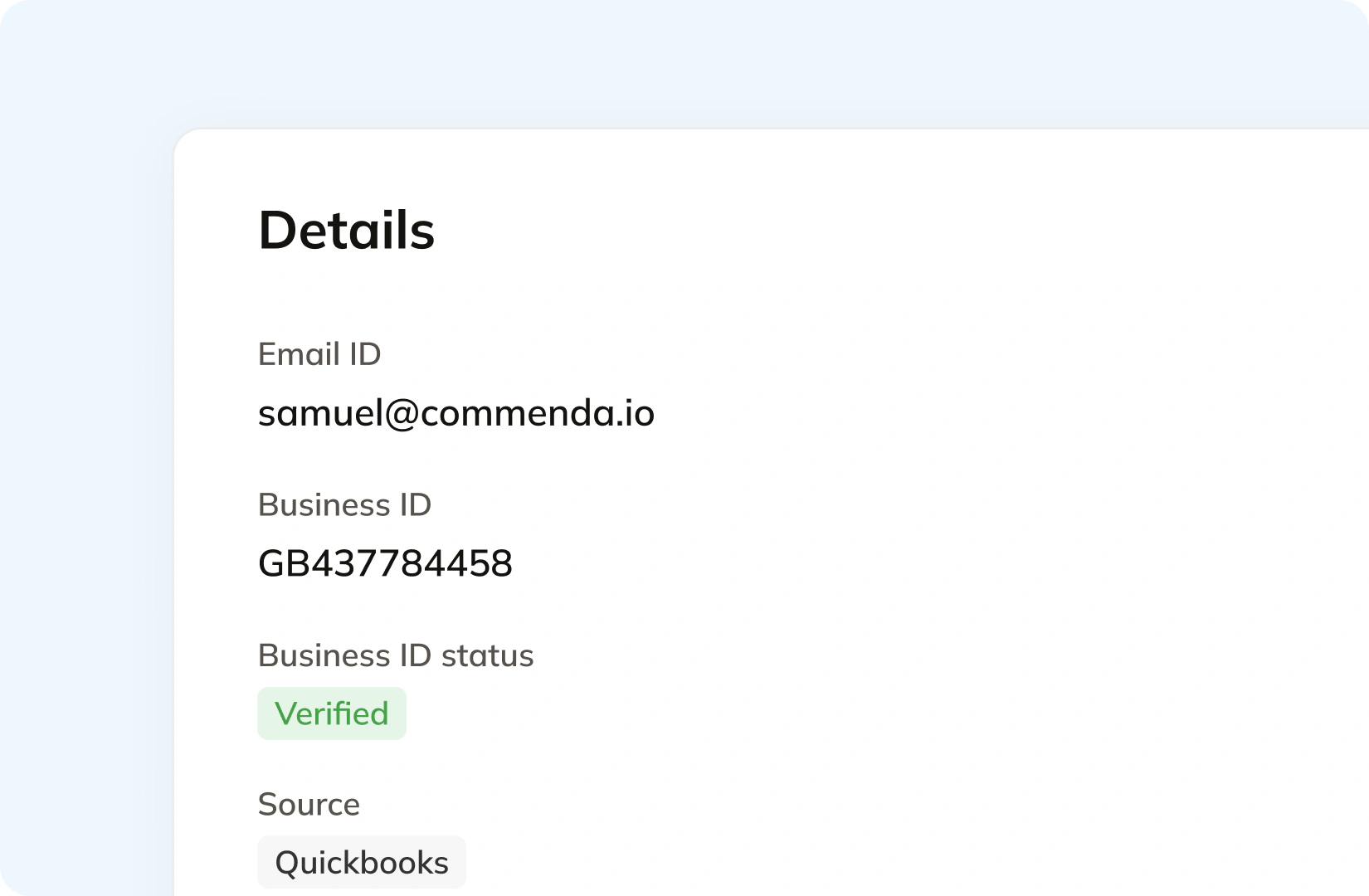
NetSuite can store a certificate against a customer and a state. Its older tax engine cannot, and holds only a general exemption flag. Commenda handles getting the certificate in the first place. Your customers upload through a portal that can carry your branding, each one is validated on upload, and it applies automatically in the states where it is valid. Expiries are tracked and chased.
Consolidation
Why NetSuite does not know your total exposure
NetSuite is the system of record for the business, and tax is one job inside it. Filing one return means knowing which revenue arrived already taxed, which states you actually owe, and which registrations you are still carrying. Commenda solves that.
Revenue reaches NetSuite from more than one place
A storefront, a marketplace, and a billing platform all feed into NetSuite, and the tax already collected upstream is not yours to file again. Oracle documents no US filing path at all: the United States appears on neither its localized country tax report list nor its electronic filing list, and its US payment flow creates a check transaction against a tax agency you set up as a vendor.
Nexus in NetSuite is something you declare
Oracle states that to determine the correct tax jurisdiction and rate, NetSuite needs to know where you are registered. One report comes close, the Sales Tax by State Analysis report, and it needs four features enabled and three SuiteApps installed before it will run. Anything you sold into a state you never declared is taxed at zero and counted nowhere.
Registrations drift in both directions
Missing a state is the risk everyone plans for. Carrying states you no longer sell into is the one nobody does, and each one is a return you still owe every period. Reading the transaction history finds both. We did exactly that for TRX, right-sizing 50+ registrations to match the entity that actually trades (read the case study).
One ledger behind every channel
Every source connects to one ledger, across 100+ supported integrations. Each transaction carries its origin, product tax code, and any tax already collected, so marketplace revenue stays separate from revenue that still needs tax. The result is one exposure figure per state, one return per period, and every line traceable back to the voucher it came from.
What it takes
What global indirect tax takes in NetSuite
Oracle does not publish NetSuite list pricing, so there are no dollar figures here. What Oracle does publish is what each capability depends on. NetSuite's own tax engines are free. The cost of growth is setup, dependency, and one switch you cannot undo.
| What you need | What NetSuite requires | Source |
|---|---|---|
| Monthly US sales tax rates without a manual job | Under its legacy tax engine you must reimport the state sales tax table on the last day of each month, and re-importing wipes any manual edits to your tax codes | Importing rates |
| Exemption certificates as a record | The newer tax engine. Legacy tax supports general-level exemption only, and a certificate needs an active customer with a US tax registration already on the entity record | SuiteTax vs legacy |
| A localized VAT or GST return | Tax Reporting Framework plus a country or regional localization SuiteApp, for each of the 14 supported countries. The United States is not one of them | Country tax reports |
| A US sales tax report per state | Four features enabled and three SuiteApps installed, which then produces SuiteAnalytics workbooks and a field for selecting your third-party filing partner | U.S. Sales Tax Reports |
| Anything past general taxation | A partner tax engine. Oracle lists eight, and states its own engine supports only general taxation use cases, with no item-specific rates for US nexuses | SuiteTax Engine |
| Moving to the newer tax engine | An account-level switch that Oracle documents as non-reversible. Incompatible SuiteApps must be uninstalled first, and all legacy tax codes are inactivated | Known limitations |
| Keeping your existing tax integrations through that switch | Your own vendor confirmation. Oracle's instruction on migration is that you must contact your vendor to check compatibility | Migration FAQ |
| What NetSuite charges you for tax | Nothing extra. Oracle states the feature is available at no cost unless you choose a partner solution. Oracle publishes no list price for the platform licence itself | SuiteTax FAQ |
Monthly US sales tax rates without a manual job
Under its legacy tax engine you must reimport the state sales tax table on the last day of each month, and re-importing wipes any manual edits to your tax codes
Importing ratesExemption certificates as a record
The newer tax engine. Legacy tax supports general-level exemption only, and a certificate needs an active customer with a US tax registration already on the entity record
SuiteTax vs legacyA localized VAT or GST return
Tax Reporting Framework plus a country or regional localization SuiteApp, for each of the 14 supported countries. The United States is not one of them
Country tax reportsA US sales tax report per state
Four features enabled and three SuiteApps installed, which then produces SuiteAnalytics workbooks and a field for selecting your third-party filing partner
U.S. Sales Tax ReportsAnything past general taxation
A partner tax engine. Oracle lists eight, and states its own engine supports only general taxation use cases, with no item-specific rates for US nexuses
SuiteTax EngineMoving to the newer tax engine
An account-level switch that Oracle documents as non-reversible. Incompatible SuiteApps must be uninstalled first, and all legacy tax codes are inactivated
Known limitationsKeeping your existing tax integrations through that switch
Your own vendor confirmation. Oracle's instruction on migration is that you must contact your vendor to check compatibility
Migration FAQWhat NetSuite charges you for tax
Nothing extra. Oracle states the feature is available at no cost unless you choose a partner solution. Oracle publishes no list price for the platform licence itself
SuiteTax FAQ
Figures verified on July 29, 2026.
From the field
Trusted by businesses across the globe


“The platform works exactly the way I need it to. I have one team member who manages all of our exemption certificates, and that functionality has been particularly efficient for us. It allows him to handle everything seamlessly, making the handoff significantly easier.”
VP of Finance, TRX






Compare Commenda sales tax software with competitors
Oracle lists eight partner tax engines for NetSuite, Avalara and Vertex among them. We compare the alternatives on coverage, ratings, and real pricing, and we say where each one wins.
More sales tax resources
Guides from the Commenda team on nexus, multi-state filing, and EU VAT.
Frequently asked questions
No. The United States does not appear on NetSuite's list of localized country tax reports, which covers 14 countries and needs a separate localization SuiteApp for each one. What NetSuite gives you in the US is reporting: the U.S. Sales Tax Reports SuiteApp generates reports as SuiteAnalytics workbooks, and its own filter page has a field for selecting your third-party tax filing partner. Paying is a bookkeeping entry, and Oracle documents the Pay Sales Tax page as creating a check transaction against a tax agency you set up as a vendor. Commenda files across all 50 states on each state's required frequency, tracks remittance per jurisdiction, and files amended returns where a period needs correcting.
Not as an alert. In NetSuite a nexus is a jurisdiction record you create and assign to a subsidiary, and Oracle states that NetSuite needs to know where you are already registered in order to determine the right jurisdiction and rate. Registration is the input. One report comes close: the Sales Tax by State Analysis report, which Oracle describes as covering each state's sales, your tax amounts by state, and their threshold amounts. It requires four features and three SuiteApps, and it is a workbook you go and run. Commenda measures the same NetSuite transactions against economic and physical thresholds in all 50 states, every EU member state, and 70+ countries, and notifies you at 80% of a registration threshold.
It changes a lot, and it is worth knowing which one you have. Oracle runs two tax systems in NetSuite. Under legacy tax, US rates come from a table you must reimport on the last day of each month, and re-importing wipes any manual edits to your tax codes. Legacy tax has no exemption certificate record at all, only general-level exemption. The newer engine updates rates monthly and gives certificates a real record. Switching is not a small decision: Oracle documents it as an account-level change that applies to the whole account rather than selected subsidiaries, and states plainly that it is non-reversible and cannot be disabled once enabled. Commenda reads your transactions either way, so your registrations and exposure history do not depend on which engine you are on.
Yes, and it does not have to be all or nothing. Calculation can be switched off by department, by country, or by PO or check number, and enabled or disabled per voucher type, so sales orders and cash sales can be treated differently. There is also a transaction-level exempt field on any voucher, and a calculation start date, before which nothing gets touched. That covers the common case: most of your revenue arrives from a storefront or a marketplace with tax already applied, and a smaller share originates directly in NetSuite and still needs calculating. Each transaction carries the system it came from, so the two never get double-counted.
Yes. Cash sales are supported, and so is the workflow behind them. A common NetSuite pattern is a sales order that auto-converts to a cash sale because the order is already paid, and invoices barely get used. Tax is calculated on voucher creation, and it carries over when a voucher converts from one type to another, so the number is not recalculated or re-rounded on the way through. All voucher types are supported. Every NetSuite instance is configured differently, so the mapping between your voucher types and what should be taxed is scoped during implementation rather than assumed.
Only up to a point. NetSuite's Tax Reporting Framework generates localized country tax reports for 14 countries, and each one requires a separate country or regional localization SuiteApp installed on top. Outside that list you get the standard tax summary and detail reports and you build the return yourself. Oracle also documents that localized reports available under legacy tax are no longer available under the newer engine. We have scoped finance teams whose NetSuite VAT return could not handle their exempt sales, so the numbers were being tweaked in Excel and re-imported as a CSV before submission. Commenda covers VAT, GST, and sales tax across 70+ countries from one platform, including EU VAT with OSS and IOSS.
It stores them, on the newer engine. Oracle's exemption certificate record takes a customer, a state, a certificate number, at least one validity date, a subsidiary on multi-entity accounts, and an optional attachment, and it applies either to all items or to a list you pick. Oracle notes you can only create one for an active customer that already has a US tax registration on its entity record. Under legacy tax there is no certificate record at all, only general-level exemption. Storing a certificate is not the same as getting one. Commenda collects them through a self-service portal, validates each one at upload, stores it against the customer, applies it automatically in the states where it is valid, and chases expiries.
Yes, and for most NetSuite shops that is the point. NetSuite is usually the system of record with a storefront, a marketplace, and a billing platform feeding into it, and the tax already collected upstream is not yours to file again. Commenda connects each source directly and consolidates everything into one ledger tagged by ship-to state, so nexus is measured once against one number per state with no double-counting and no missed channel. Every transaction carries the system it came from. Commenda supports 100+ integrations, with native connectors covering Xero, QuickBooks, and Sage Intacct alongside Stripe, Chargebee, Recurly, and Zuora, a REST API, and a mapped monthly CSV where no connector exists.
Custom integration support for your business
Every NetSuite instance is configured differently, and those choices exist for good reasons. We map how yours works, including your voucher types and which revenue should be calculated, and build the integration to match.
Indirect Tax
Monitor nexus exposure, register, file, and remit sales tax and VAT in one platform. Commenda keeps you compliant across 100+ jurisdictions.
Explore the product
