Sales tax and VAT software for FinancialForce
FinancialForce is now Certinia. Its accounting product is built natively on Salesforce, and a tax code inside it is one you create with a rate you type in. It submits UK VAT to HMRC and nothing in the United States. Commenda covers both gaps from the same Certinia data, across all 50 states and 70+ countries.
Trusted by global businesses

































Calculate tax without building rate records
Certinia's own documented example of US tax codes is one per jurisdiction: PA-State, MA-State, Philadelphia-PA-City, Boston-MA-City. Commenda maintains state, county, city, and district rates and applies them per transaction.
Monitor your global exposure
Certinia's tax setup starts from the tax codes you created. Commenda measures your transactions against economic and physical thresholds in all 50 states and 70+ countries, and notifies you at 80% of a threshold.
File the US returns Certinia does not
Certinia submits UK VAT returns to HMRC and gathers Australian BAS data. Its Tax Reporting package has no US sales tax return in it. Commenda files across all 50 states.
Coverage comparison
What FinancialForce handles, and what it hands back
FinancialForce changed its name to Certinia in May 2023, so every source below is a Certinia one. Its figures come from the help site's pages on tax codes and rates, external tax calculation, Avalara VAT Reporting, the Tax Reporting package, and Making Tax Digital, all release 2026.2 and checked on July 30, 2026.
Maintaining US sales tax rates
- FinancialForce
- Not handled. A tax code and its rate are ones you create by hand
- Commenda
- State, county, city, and district rates maintained for you in all 50 states
Registrations for collecting tax
- FinancialForce
- Not handled. A tax code is a record, not a registration
- Commenda
- Permits in all 50 states, EU VAT with OSS and IOSS, and GST across APAC and Canada
Filing your US sales tax returns
- FinancialForce
- Not handled. Its Tax Reporting package covers Forms 1099-MISC and 1099-NEC
- Commenda
- Filed in all 50 states, amendments included
Filing outside the United States
- FinancialForce
- Partly. UK VAT goes to HMRC. Elsewhere a third-party application files
- Commenda
- Filed across 70+ countries from one platform
Knowing where you owe
- FinancialForce
- Not handled. Its tax defaults come from settings, not from thresholds
- Commenda
- Economic and physical thresholds in 50 states and 70+ countries, with alerts before you cross
Exemption certificates
- FinancialForce
- Taken on trust. Without Avalara's certificate system, the number is not checked
- Commenda
- Collected, validated, stored, and applied automatically where valid
Tax you corrected with a journal
- FinancialForce
- Not reported. Avalara VAT Reporting does not support journal documents
- Commenda
- Adjustments carry through to the return, with amendments where needed
| FinancialForce |  | |
|---|---|---|
| Maintaining US sales tax rates | Not handled. A tax code and its rate are ones you create by hand | State, county, city, and district rates maintained for you in all 50 states |
| Registrations for collecting tax | Not handled. A tax code is a record, not a registration | Permits in all 50 states, EU VAT with OSS and IOSS, and GST across APAC and Canada |
| Filing your US sales tax returns | Not handled. Its Tax Reporting package covers Forms 1099-MISC and 1099-NEC | Filed in all 50 states, amendments included |
| Filing outside the United States | Partly. UK VAT goes to HMRC. Elsewhere a third-party application files | Filed across 70+ countries from one platform |
| Knowing where you owe | Not handled. Its tax defaults come from settings, not from thresholds | Economic and physical thresholds in 50 states and 70+ countries, with alerts before you cross |
| Exemption certificates | Taken on trust. Without Avalara's certificate system, the number is not checked | Collected, validated, stored, and applied automatically where valid |
| Tax you corrected with a journal | Not reported. Avalara VAT Reporting does not support journal documents | Adjustments carry through to the return, with amendments where needed |
Calculate taxes globally on FinancialForce using Commenda
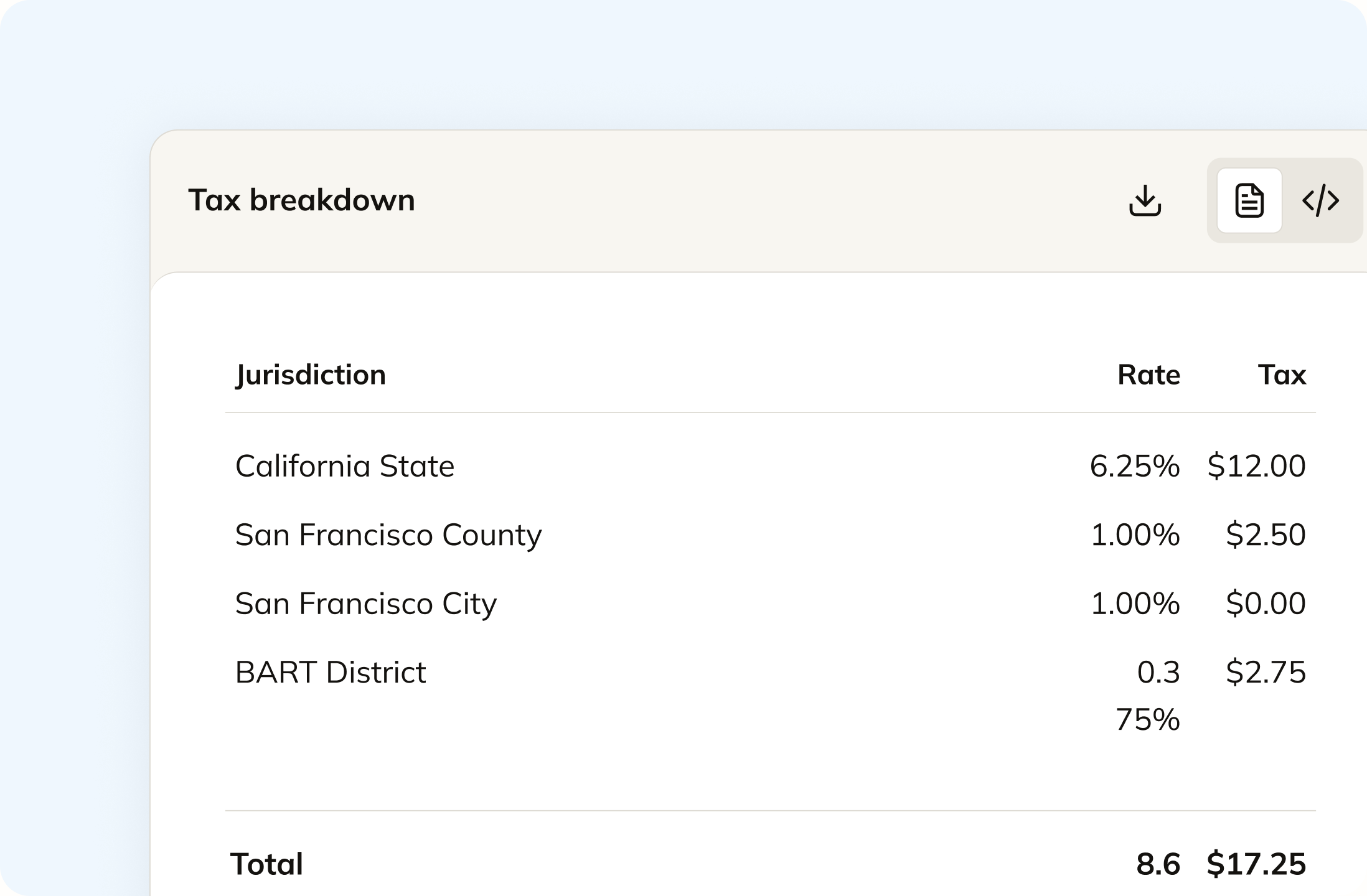
A Certinia tax code is one you create, with a rate you type in to three decimal places and a start date. Its own example set is one code per state and city. Commenda calculates from live jurisdiction rates instead, down to state, county, city, and district, and applies them to the transactions already in your ledger. The tax codes you already have stay where they are.
Track your global exposure from FinancialForce
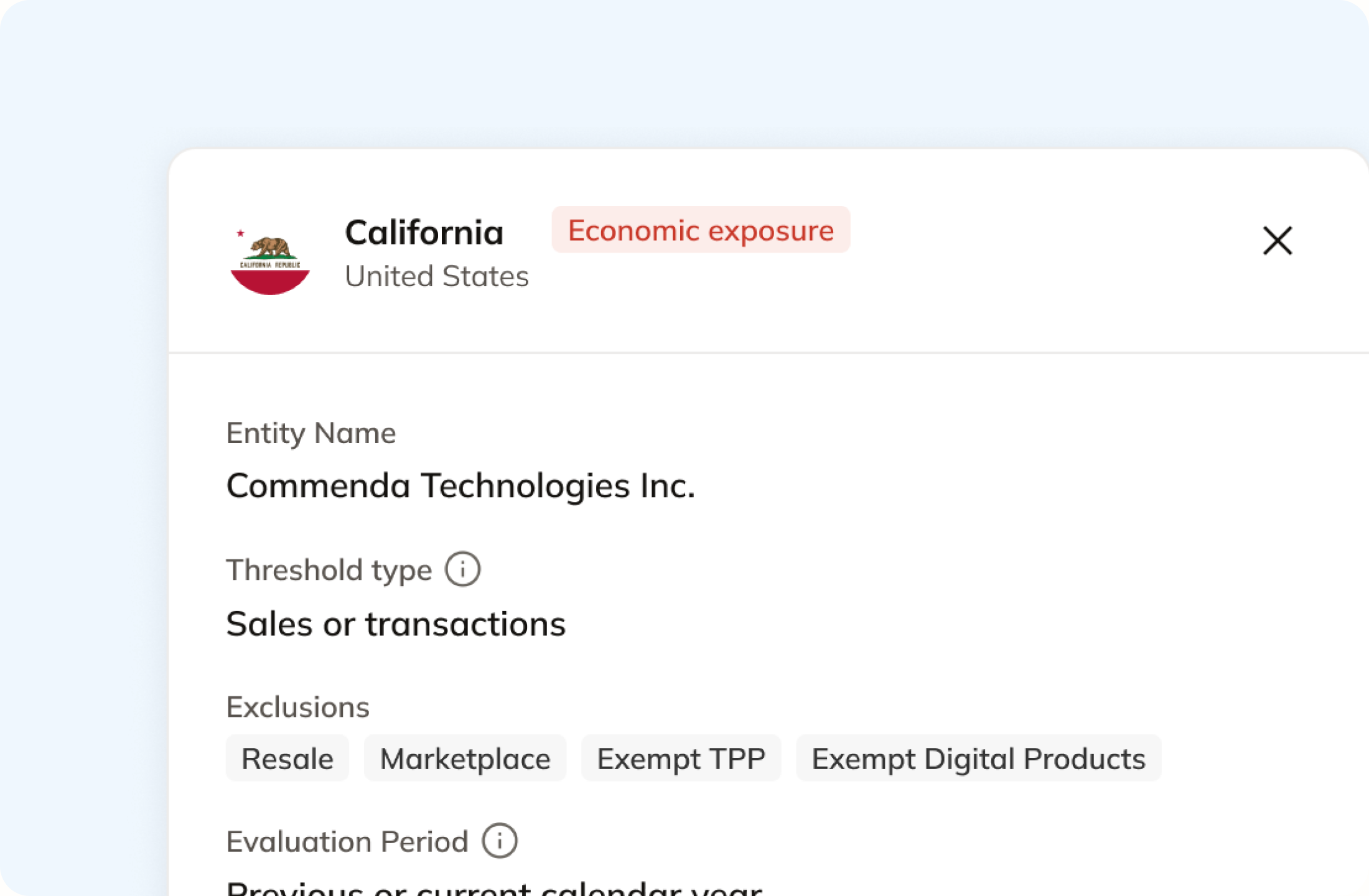
Certinia decides a default tax code from the company record type, the tax statuses on the account and the product, and whether a VAT group exists. All of those are settings, and none of them measures a threshold. Commenda measures the same transactions against thresholds in all 50 states and 70+ countries and tells you at 80%, before you cross. A short questionnaire covers physical presence too.
Automatically remit transactions around the world
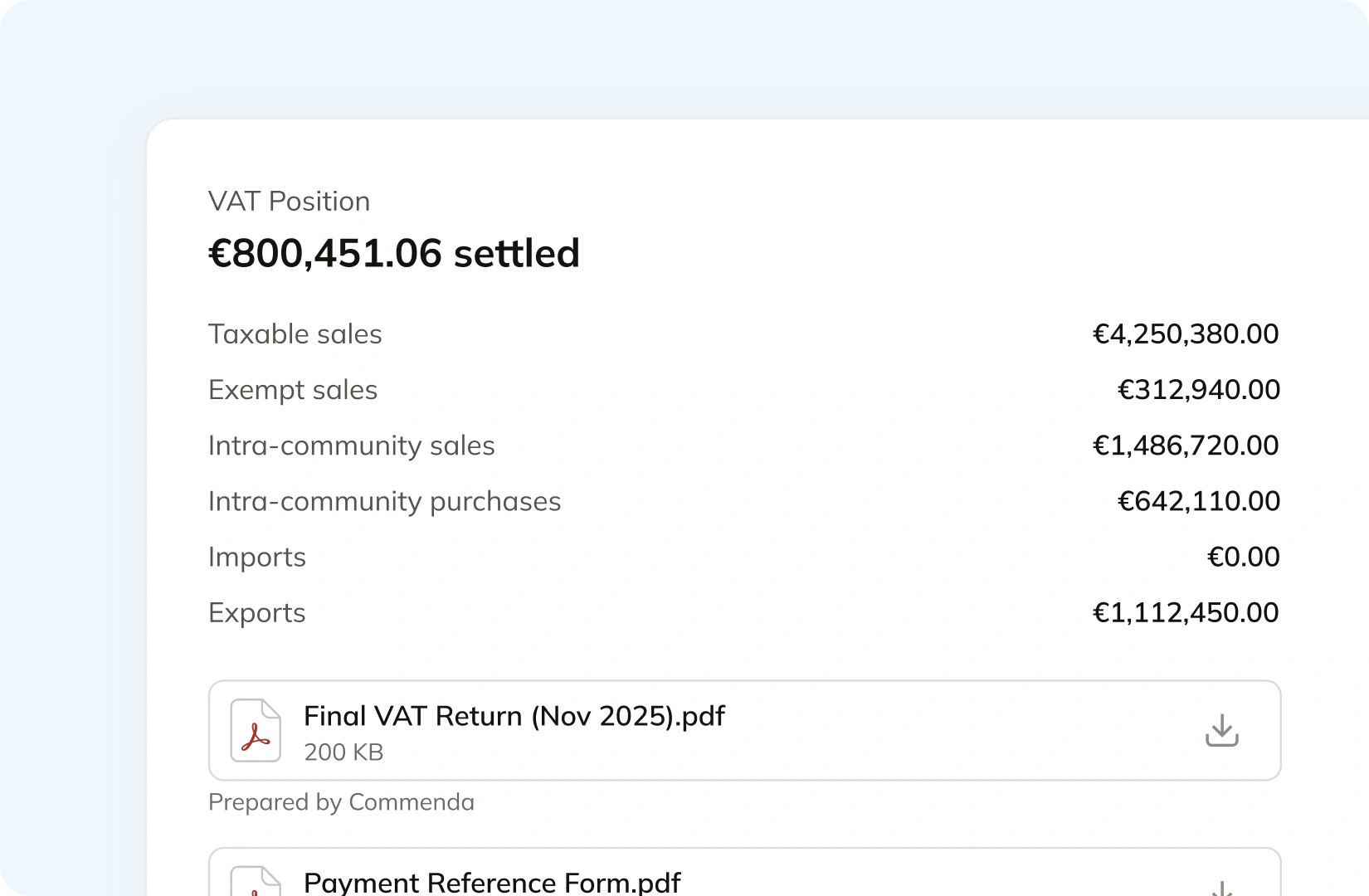
Certinia's Tax Reporting package does three things: Australian BAS data, Forms 1099-MISC and 1099-NEC, and a UK VAT return. Everywhere else it sends transaction data to a third-party filing application. Commenda builds the return straight from your Certinia transactions. Returns go out across all 50 states, plus EU VAT with OSS and GST in APAC and Canada, with amendments where a period needs correcting.
Manage your customers and exemptions in one place
Certinia is direct about this one. Without Avalara's certificate management system enabled, it states that certificate numbers from Accounting are taken on trust. Commenda collects the certificate itself. Your customers upload through a portal that can carry your branding, each one is validated on upload, and it applies automatically in the states where it is valid. Expiries are tracked and chased.
Consolidation
Why FinancialForce does not know your total exposure
Certinia puts the close, billing, and revenue recognition on the same Salesforce record as the customer. Indirect tax is the one job in that set that needs data from outside: a rate that changes by county, a threshold that changes by state, and a certificate somebody has to collect. Commenda supplies that part.
The tax code is a container, and the jurisdiction data is not in it
Certinia's own example tax codes are PA-State, MA-State, Philadelphia-PA-City, and Boston-MA-City. Every one of those is a record somebody created, with a rate typed in and a start date. Tax codes are org-level, so all companies in the org share the same set. With AvaTax switched on, Certinia's recommendation is to create a single code and set its rate to zero, because AvaTax replaces the value.
Revenue recognition is solved on the platform. Determination is not
Certinia keeps revenue aligned to delivery and billing data on the Salesforce record, which is why services businesses put their close there. Indirect tax is the part that needs outside data: a rate that changes by county, a threshold that changes by state, and a certificate that has to be collected and checked. That is why the external tax calculation page exists at all.
Services taxability is where the exposure hides
A professional services or SaaS business rarely sells one thing in one place. Whether the line is taxable depends on the state, on whether it is software, a subscription, a deliverable, or labour, and on where the customer took delivery. Certinia carries that through an AvaTax tax code on each product, and warns that with no mapping, tax is calculated from company and account addresses alone. Our nexus threshold guide lists the figure for every state.
Certinia is rarely the only place revenue lands
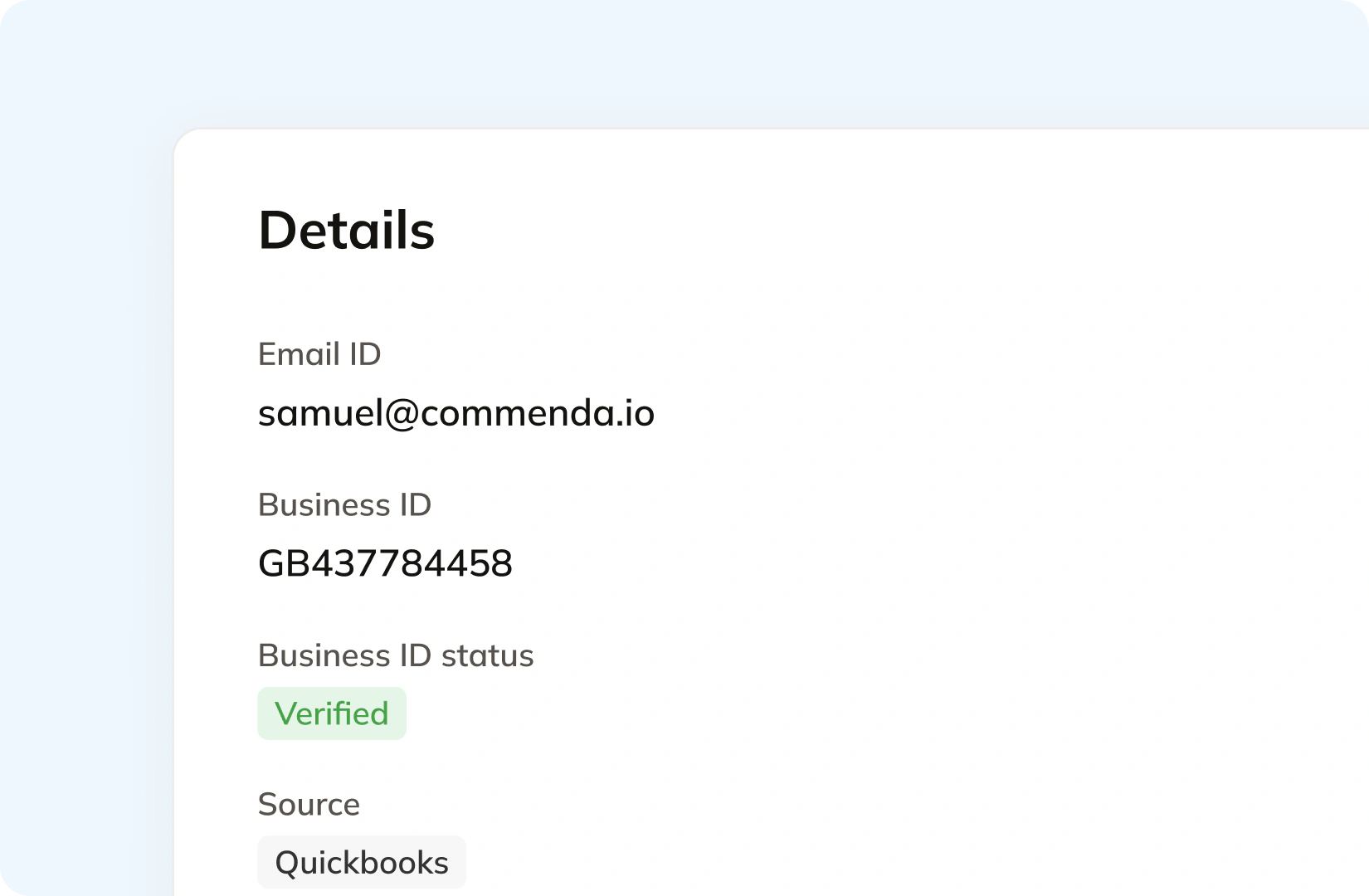
A billing platform, a storefront, and a marketplace each carry their own tax treatment, and the tax a marketplace already collected is not yours to file again. Commenda reads each source directly, across 100+ supported integrations, and consolidates to one ledger tagged by ship-to state on one global indirect tax platform. Nexus is measured once, against one number per state. You can also check a single address against our sales tax rate calculator for free.
What it takes
What global indirect tax takes in FinancialForce
Certinia does not publish list pricing, so there are no dollar figures here. What Certinia does publish is what each capability depends on. For indirect tax, the answer is usually a second subscription and a mapping exercise.
| What you need | What Certinia requires | Source |
|---|---|---|
| A US sales tax rate per jurisdiction | A tax code per jurisdiction, created by you. Certinia's own example set is PA-State, MA-State, Philadelphia-PA-City, and Boston-MA-City, and tax codes are shared by every company in the org | About Tax |
| The rate inside a tax code | A percentage you enter to three decimal places, with the date it comes into force. There is one row per rate change and you add each one | Setting Tax Rates |
| Jurisdiction-level tax on an invoice line | Avalara AvaTax, plus your own licence covering every international jurisdiction you need. Certinia recommends setting your own tax code's rate to zero, because AvaTax replaces the value | External tax calculation |
| Product-level taxability | An AvaTax tax code or item code mapped onto every product. Certinia states that without either mapping, AvaTax calculates from company and account addresses alone | External tax calculation |
| An exemption certificate that is actually checked | Avalara's Exemption Certificate Management System, enabled with every certificate registered. Certinia states that if it is disabled, certificate numbers from Accounting are taken on trust | External tax calculation |
| Canadian federal and provincial tax on one line | A parent tax code with two child codes and a tax model of HST, PST and GST, or GST and QST. You maintain the rate on each child, and the parent sums them | Combined tax |
| A VAT return outside the United Kingdom | Avalara VAT Reporting, which Certinia describes as a third-party application covering 35 countries. Nine Accounting localizations are preconfigured, and the rest may need field mapping | Avalara VAT Reporting |
| Tax you corrected with a journal to reach the return | Not supported. Certinia states that Avalara VAT Reporting does not support journal documents, so a tax adjustment made by journal is not reported in your VAT return | Avalara VAT Reporting |
| A US sales tax return | Not in the product. Certinia's Tax Reporting package covers the Australian Business Activity Statement, Forms 1099-MISC and 1099-NEC, and UK VAT return reporting | Tax Reporting |
A US sales tax rate per jurisdiction
A tax code per jurisdiction, created by you. Certinia's own example set is PA-State, MA-State, Philadelphia-PA-City, and Boston-MA-City, and tax codes are shared by every company in the org
About TaxThe rate inside a tax code
A percentage you enter to three decimal places, with the date it comes into force. There is one row per rate change and you add each one
Setting Tax RatesJurisdiction-level tax on an invoice line
Avalara AvaTax, plus your own licence covering every international jurisdiction you need. Certinia recommends setting your own tax code's rate to zero, because AvaTax replaces the value
External tax calculationProduct-level taxability
An AvaTax tax code or item code mapped onto every product. Certinia states that without either mapping, AvaTax calculates from company and account addresses alone
External tax calculationAn exemption certificate that is actually checked
Avalara's Exemption Certificate Management System, enabled with every certificate registered. Certinia states that if it is disabled, certificate numbers from Accounting are taken on trust
External tax calculationCanadian federal and provincial tax on one line
A parent tax code with two child codes and a tax model of HST, PST and GST, or GST and QST. You maintain the rate on each child, and the parent sums them
Combined taxA VAT return outside the United Kingdom
Avalara VAT Reporting, which Certinia describes as a third-party application covering 35 countries. Nine Accounting localizations are preconfigured, and the rest may need field mapping
Avalara VAT ReportingTax you corrected with a journal to reach the return
Not supported. Certinia states that Avalara VAT Reporting does not support journal documents, so a tax adjustment made by journal is not reported in your VAT return
Avalara VAT ReportingA US sales tax return
Not in the product. Certinia's Tax Reporting package covers the Australian Business Activity Statement, Forms 1099-MISC and 1099-NEC, and UK VAT return reporting
Tax Reporting
Figures verified on July 30, 2026.
From the field
Trusted by businesses across the globe


“The platform works exactly the way I need it to. I have one team member who manages all of our exemption certificates, and that functionality has been particularly efficient for us. It allows him to handle everything seamlessly, making the handoff significantly easier.”
VP of Finance, TRX






Compare Commenda sales tax software with competitors
Certinia documents Avalara for both tax calculation and VAT reporting, so Avalara is the default comparison for anyone on FinancialForce. We compare the alternatives on coverage, ratings, and real pricing, and we say where each one wins.
More sales tax resources
Guides from the Commenda team on SaaS and services taxability, exemption certificates, and audit readiness.
Frequently asked questions
Custom integration support for your business
Every Certinia org is set up differently, from company record types to how products carry taxability. We map how yours works, including your tax codes and which revenue should be calculated, and build the integration to match.
Indirect Tax
Monitor nexus exposure, register, file, and remit sales tax and VAT in one platform. Commenda keeps you compliant across 100+ jurisdictions.
Explore the product
