If you searched “VAT registration in Brazil,” here is the catch. Brazil has no single value-added tax (VAT) today. It runs five overlapping consumption taxes across federal, state, and municipal levels, each with its own authority, rules, and registration. So the honest answer is not one registration. It is several.
That is changing. A real dual VAT is phasing in from 2026 under Constitutional Amendment 132/2023, regulated by Complementary Law 214/2025. This guide walks through what you register for now, how the identifiers and representatives work, and what the reform changes. The federal authority for all of it is Receita Federal, Brazil’s tax administration.
Does Brazil have VAT? How does Brazil’s indirect tax system work?
No unified VAT exists yet. Five taxes together play the VAT role, and each carries its own registration. ICMS and ISS require separate state and municipal registrations on top of your federal tax ID. IPI is a manufacturing excise tax, not a VAT. PIS and COFINS run as revenue contributions. Here is the full stack a foreign operator meets.
| Tax | Level | What it taxes | Standard rate | Registration | Source |
|---|---|---|---|---|---|
| ICMS (tax on goods and services) | State (26 states + Federal District) | Goods, electricity, transport, communications | 17% to 23% in 2025 (SP 18%, RJ 22%, MA 23%) | Inscrição Estadual | CONFAZ |
| IPI (tax on manufactured products) | Federal | Manufactured and imported goods | 0% to 300% by product (TIPI) | Via CNPJ | Decree 11.158/2022 (Planalto) |
| ISS (tax on services) | Municipal (5,500+ municipalities) | Services | 2% to 5% | Inscrição Municipal | Municipal law |
| PIS (social integration contribution) | Federal | Revenue | 0.65% cumulative / 1.65% non-cumulative | Via CNPJ | Receita Federal |
| COFINS (social security financing contribution) | Federal | Revenue | 3% cumulative / 7.6% non-cumulative | Via CNPJ | Receita Federal |
| II (import duty) | Federal | Imports | Varies by tariff code | Via CNPJ + customs licensing | Receita Federal |
| PIS/COFINS-Importação | Federal | Imported goods and services | 9.25% combined (non-cumulative) | Via CNPJ | Receita Federal |
IPI is constitutionally “selective” by product essentiality, which is why cigarettes carry an effective 45% burden under the general regime while small passenger vehicles start near 7% (Decree 10.979/2022, Receita Federal). PIS and COFINS switch between cumulative and non-cumulative regimes depending on your corporate income tax regime, so there is no single flat rate.
When does a foreign company need to register for VAT in Brazil?
There is no registration threshold. Any taxable activity with Brazilian nexus triggers registration, and nexus follows where goods are imported or consumed. Unlike the European Union, which sets distance-selling thresholds below which you do not register, Brazil expects registration from the first taxable operation. Simples Nacional has a revenue ceiling, not a registration floor.
Common triggers:
- Importing goods, which triggers state ICMS at customs clearance.
- Selling locally held inventory, which requires ICMS registration in each relevant state.
- Supplying services to Brazilian customers, which sits under municipal ISS.
- Operating through online marketplaces.
- Participating in trade shows or onsite sales.
Digital and consulting services to Brazilian customers fall under municipal ISS today. ISS stays in force throughout the 2026 to 2032 transition and is only fully replaced by the IBS from 2033 (Constitutional Amendment 132/2023, ADCT Art. 129, Planalto). The reform adds new collection duties for non-resident platforms under Complementary Law 214/2025.
Can a foreign company register for VAT in Brazil without a local entity?
Not for operating purposes today. To collect ICMS or ISS and issue electronic invoices (notas fiscais), you need a Brazilian entity (a limited company, Ltda, or a corporation, SA) or a rare presidentially authorized branch. Pure cross-border suppliers with no Brazilian presence generally do not register, because the buyer collects the tax.
Two nuances matter. First, a foreign entity can obtain a CNPJ without a local operating company through Central Bank registration (CADEMP/RDE), but only for investment and asset ownership, not tax collection. Second, Complementary Law 214/2025 introduces a simplified non-resident registration for remote digital suppliers under the new dual VAT, phasing in from the 2026 test year (Art. 21, §2, Planalto).
One platform to simplify global tax and compliance
See why high-growth companies trust Commenda
What is Brazil’s VAT number format?
Brazil’s business tax identifier is the CNPJ (Cadastro Nacional da Pessoa Jurídica, National Registry of Legal Entities). It has 14 characters in the format XX.XXX.XXX/XXXX-XX: an 8-character company root, a 4-character establishment code (0001 is the headquarters), and 2 numeric check digits. Operating companies also need an Inscrição Estadual for ICMS and an Inscrição Municipal for ISS.
Since 31 July 2026, Brazil has used an alphanumeric CNPJ: the first 12 positions can mix letters and numbers while the final 2 check digits stay numeric, and existing numeric CNPJs stay valid with no re-registration (Serpro, the federal data service, CNPJ alfanumérico). Do not confuse the CNPJ with the CPF, which is the individual taxpayer ID.
Do foreign companies need a fiscal representative in Brazil?
Yes. A Brazil-resident legal representative holding power of attorney must act before Receita Federal, and that representative assumes joint liability for filings and penalties. A foreign shareholder in a Brazilian company must also appoint a resident attorney-in-fact.
The documentation is strict. The power of attorney and the foreign entity’s incorporation documents must be notarized, apostilled under the Hague Apostille Convention (Brazil joined in 2016), and translated into Portuguese by a sworn translator (tradutor juramentado). Missing apostilles and translations are the most common cause of delay.
How do you register for VAT in Brazil step by step?
Registration is a sequence, not a single application. You build the legal vehicle first, then layer federal, state, and municipal registrations on top. The steps run in this order:
- Form the local entity (Ltda or SA) through the state commercial board (Junta Comercial) and obtain its registration number (NIRE).
- Appoint the Brazil-resident legal representative with an apostilled, translated power of attorney.
- Obtain the CNPJ from Receita Federal through the integrated Redesim network.
- Obtain the Inscrição Estadual for ICMS in each state where you handle goods.
- Obtain the Inscrição Municipal for ISS in each municipality where you supply services.
- Obtain the digital certificate (e-CNPJ) and set up e-invoicing before trading.
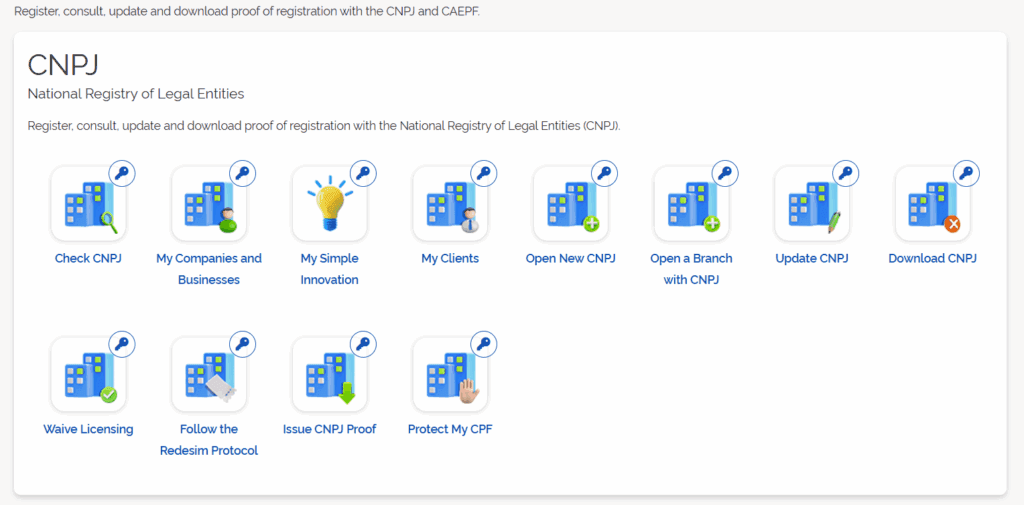
The CNPJ portal, shown below, is where the representative manages these federal registrations.
What documents are required?
Prepare a checklist before filing. Foreign companies typically need: the parent’s certificate of incorporation (apostilled and sworn-translated into Portuguese), a board resolution authorizing Brazilian operations, the power of attorney for the resident representative (apostilled and translated), passports and CPF numbers for directors and the representative, proof of a Brazilian registered address, a bank reference, and state-specific lease documents where required. Every foreign document needs sworn Portuguese translation.
How long does registration take and what does it cost?
Timelines depend on the entity and the jurisdictions involved, and entity formation runs before any tax registration. Federal CNPJ registration carries no federal fee. State and municipal registrations and fees vary by jurisdiction. Budget for the full sequence rather than the CNPJ alone.
| Step | Fee | Notes | Source |
|---|---|---|---|
| Entity formation (Junta Comercial) | State board fee, varies | Precedes tax registration | Junta Comercial |
| CNPJ (federal) | No federal fee | Issued through the Redesim integrated network | Receita Federal / Redesim |
| Inscrição Estadual (ICMS) | Varies by state | Required per state handling goods | State tax authority |
| Inscrição Municipal (ISS) | Varies by municipality | Required per municipality supplying services | Municipal authority |
Can foreign-owned companies use Simples Nacional?
No. Complementary Law 123/2006, Article 3, paragraph 4, item II, excludes a Brazilian branch or subsidiary of a company headquartered abroad from Simples Nacional, the simplified regime for micro and small businesses (Planalto). An amendment made by Complementary Law 214/2025 further excludes any small business with an owner or partner domiciled abroad. So a foreign-owned Brazilian subsidiary cannot elect Simples Nacional even under the BRL 4.8 million revenue ceiling.
How will the CBS/IBS reform change VAT registration for foreign businesses?
Brazil is replacing all five consumption taxes with a dual VAT: the federal CBS (Contribution on Goods and Services, replacing PIS, COFINS, and IPI) and the shared state and municipal IBS (Tax on Goods and Services, replacing ICMS and ISS). The system is destination-based and regulated by Complementary Law 214/2025, which requires non-resident suppliers and digital platforms to register and collect, or face withholding at the foreign-exchange settlement stage (Arts. 21 to 23, Planalto).
| Year | What changes | Rates | Source |
|---|---|---|---|
| 2026 | Mandatory test year, amounts creditable | CBS 0.9%, IBS 0.1% | EC 132/2023, ADCT Art. 125 (Planalto) |
| 2027 | CBS replaces PIS/COFINS; IPI zeroed except Manaus Free Trade Zone | CBS at full rate | EC 132/2023, ADCT Art. 126 (Planalto) |
| 2029 to 2032 | ICMS/ISS phase down to 9/10, 8/10, 7/10, 6/10 of rates | IBS phases in | EC 132/2023, ADCT Art. 128 (Planalto) |
| 2033 | ICMS and ISS extinguished; dual VAT only | Full CBS + IBS | EC 132/2023, ADCT Art. 129 (Planalto) |
Complementary Law 214/2025 caps the combined CBS plus IBS reference rate at 26.5%. The IBS Management Committee (CGIBS) already projected a combined 27.91% (IBS 18.70% plus CBS 9.21%) for 2027 in Resolution No. 14 of 29 July 2026, above the ceiling, which triggers the law’s correction mechanism. That places Brazil’s standard rate among the world’s highest.
Who pays Brazilian tax on cross-border B2B services?
The Brazilian buyer, in most pure cross-border cases. Brazil has no European Union-style general reverse charge. Instead, the Brazilian service importer withholds municipal ISS where local law requires and self-assesses PIS/COFINS-Importação at 9.25% combined under the non-cumulative regime, alongside income-tax withholdings outside VAT scope.
This buyer-side collection is why a foreign supplier with no Brazilian presence generally does not register. Registration becomes mandatory the moment the company imports goods, holds local inventory, or forms an establishment.
How does import tax work for low-value e-commerce shipments?
Brazil now runs a formal low-value import regime, the Remessa Conforme Program (Programa Remessa Conforme), created by Receita Federal Normative Instruction 2,146/2023, which gives compliant e-commerce platforms expedited customs clearance. Compliance determines how fast consumer parcels clear.
Since 1 August 2024, Law 14.902/2024 applies a 20% import duty to consumer shipments up to USD 50 and 60% from USD 50.01 to USD 3,000, with a USD 20 deduction, plus 17% ICMS under the CONFAZ agreement (Receita Federal). This replaces the old position that Brazil had no low-value import scheme.
What are the compliance obligations after VAT registration in Brazil?
Compliance is monthly, digital, and real-time. Every transaction generates a government-validated electronic invoice, and filings flow through SPED (Sistema Público de Escrituração Digital, the Public Digital Bookkeeping System). You report in Brazilian reais at official exchange rates and archive invoice XML for five years.
| Obligation | System | Frequency | Source |
|---|---|---|---|
| PIS/COFINS filing | EFD-Contribuições (SPED) | Monthly | Receita Federal |
| ICMS and IPI filing | EFD-ICMS/IPI (SPED) plus state returns | Monthly | Receita Federal / state authority |
| ISS filing | Municipal NFS-e systems | Monthly | Municipal authority |
| E-invoicing | NF-e, NFS-e, CT-e | Per transaction | Receita Federal |
| Invoice archiving | XML storage | 5-year retention | Receita Federal |
Can non-residents claim input tax credits?
ICMS credits are declared and offset in monthly EFD-ICMS/IPI filings, not refunded as standalone claims. Credits arise from ICMS paid on goods bought or imported for resale or manufacturing, and unused credits roll forward against future liability. You need a local entity and a resident representative to file and claim, and invoices must match SPED records exactly.
What are the penalties for late registration or non-compliance in Brazil?
Penalties stack across federal, state, and municipal levels, and the real-time e-invoicing system detects gaps quickly. The core federal figures are set by Law 9,430/1996.
| Penalty | Rate | Source |
|---|---|---|
| Late-payment fine | 0.33% per day, capped at 20% | Law 9,430/1996 |
| Standard assessment penalty | 75% of tax due | Law 9,430/1996, Art. 44 |
| Fraud penalty | Up to 150% | Law 9,430/1996, Art. 44 |
| Interest on arrears | SELIC benchmark rate | Law 9,430/1996 |
Beyond fines, goods can be held or seized at customs, marketplace accounts can be suspended for unregistered sellers, and directors or representatives can bear personal liability for serious violations.
How do you deregister from Brazilian tax registrations?
Deregistration is a clearance sequence. File final returns, obtain clearance certificates (Certidões Negativas de Débitos, CNDs) at federal, state, municipal, social security (INSS), and severance fund (FGTS) level, then cancel the CNPJ through the DBE form (Documento Básico de Entrada) and notify the state tax authority (Secretaria da Fazenda) and the municipality. Retain financial and tax records for at least five years for audit purposes.
How we help with VAT registration in Brazil
Brazil’s five-tax patchwork and the incoming dual VAT make certainty hard to hold with spreadsheets and calendar reminders. Commenda’s global indirect tax software tracks your registration obligations and filing deadlines across Brazil’s federal, state, and municipal layers, and the team handles the work from entity setup through ongoing compliance, including fiscal representation.
Because every Brazilian transaction generates a government-validated e-invoice, the connection to your systems matters. Commenda supports 100+ ERP, API, and custom integrations so SPED and e-invoicing data flow without manual rekeying.
Book a demo to get a free assessment of your Brazilian registration exposure before the CBS/IBS transition starts in 2026.
About the author

Sam is a seasoned expert in sales tax, leading Commenda's effort to build the worlds most comprehensive database of global tax rules and business regulations. At Silverhaze Partners, he worked in early-stage venture capital, where he saw firsthand how tax complexity and regulatory friction hold back startups from scaling internationally. That experience now powers his work at Commenda-bringing clarity, precision, and real-world insight to one of the most frustrating parts of doing business globally.
Disclaimer: Commenda and its affiliates do not provide tax, accounting, or legal advice. This material has been prepared for informational purposes only, and is not intended to provide or be relied on for tax, accounting, or legal advice. You should consult your own tax, accounting, and legal advisors before engaging in any related activities or transactions.