An invalid or inactive Vietnamese supplier tax code costs you input Value-Added Tax (VAT) credits, blocks your e-invoices, and draws administrative penalties under Decree 125/2020/ND-CP. The fix is free: verify the supplier tax code at tracuunnt.gdt.gov.vn before you pay, accept an e-invoice, or claim input VAT.
This guide covers what a Vietnam VAT ID is, which official portals check it, the number format, foreign suppliers, input VAT reclaim, penalties, and bulk verification. It does not cover third-party lookup data-privacy policies or when to engage a licensed tax agent.
What Is a VAT ID in Vietnam?
Vietnam’s VAT ID is the tax code (Mã số thuế, MST), the same identifier as the tax identification number (TIN). It is 10 digits for main entities and 13 digits for branches. Under Decree 168/2025/ND-CP, Article 8 (effective 1 July 2025), the enterprise code is simultaneously the tax code, so the business registration number and VAT ID are usually the same number.
That equivalence is settled law. Decree 168/2025/ND-CP, Article 8 states each enterprise gets one code that is at once its enterprise code and its tax code, replacing the expired Decree 01/2021/ND-CP. The issuing body changed too: under Decision 381/QD-BTC (effective 1 March 2025), the General Department of Taxation (GDT) was reorganized into the Tax Department (Cục Thuế) under the Ministry of Finance (MOF). Searchers still use “GDT,” so both names appear here.
How Do You Verify a Vietnam VAT ID Online?
Use the tax authority’s taxpayer lookup at tracuunnt.gdt.gov.vn, now branded “Cục Thuế – Bộ Tài Chính” (Tax Department, Ministry of Finance), not the business registration portal, to check a tax code’s status. Enter the tax code or company name, complete the CAPTCHA, and read the result. This is the core verification step and it costs nothing.
| Question you are answering | Portal to use | What it returns | Source |
|---|---|---|---|
| Is this tax code active? | Taxpayer lookup, tracuunnt.gdt.gov.vn | Name, managing tax office, address, issue date, operating status | Tax Department (Cục Thuế), MOF (tracuunnt.gdt.gov.vn) |
| Who is the legal representative and what are the business lines? | National Business Registration Portal, dangkykinhdoanh.gov.vn | Enterprise name, enterprise code, legal representative, address, business lines, registration date | National Business Registration Portal (dangkykinhdoanh.gov.vn) |
Follow these four steps for the tax-code check:
- Open tracuunnt.gdt.gov.vn.
- Enter the tax code, or the company name.
- Complete the CAPTCHA and search.
- Read the result: taxpayer name, tax code, managing tax office, address, date of issue, and operating status.
Status values decide the outcome. “Đang hoạt động” means active. “Ngừng hoạt động” or “đã đóng MST” means the taxpayer has ceased or the tax code is closed. Treat anything other than active as a stop signal before you transact.
When Should You Use the National Business Registration Portal Instead?
Use dangkykinhdoanh.gov.vn to confirm enterprise details, such as the legal representative, registered address, business lines, and registration date, not tax-code operating status. Run it as the second check in vendor due diligence, after you confirm the tax code is active on the tax authority lookup. The order matters: status first, details second.
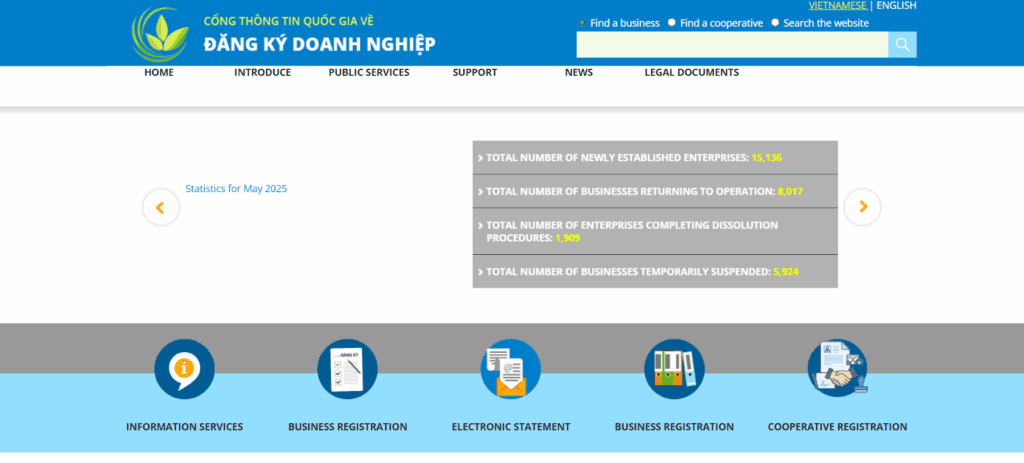
The portal runs on the system defined by the Law on Enterprises 2020 (Law No. 59/2020/QH14, effective 1 January 2021). Custody moved in the 2025 reorganization: per Decree 29/2025/ND-CP (effective 1 March 2025) and Decision 377/QD-BTC, business-registration management now sits under the Ministry of Finance, previously the Ministry of Planning and Investment (MPI).
Simplify global indirect tax compliance across every market
Book a demo to automate your filings
What Is the Vietnam VAT Number Format?
A Vietnam tax code is 10 digits for main entities and 13 digits (10 digits, a hyphen, then a 3-digit suffix from 001 to 999) for branches and dependent units, per Circular 105/2020/TT-BTC, Article 5. The 10th digit is a check digit, which enables offline format validation before you hit any portal.
| Entity type | Format | Example (illustrative only) | Source |
|---|---|---|---|
| Main entity or independent unit | 10 digits | 0123456789 | Circular 105/2020/TT-BTC, Art. 5 |
| Branch or dependent unit | 10 digits + hyphen + 3-digit suffix (13 total) | 0123456789-001 | Circular 105/2020/TT-BTC, Art. 5 |
The samples above are illustrative and do not identify a real entity. Common entry errors are transposed digits, a missing branch suffix, the letter O read as the digit 0, and stray spaces. If a 13-digit branch code returns nothing, search the base 10-digit parent code.
How Do You Verify a Foreign Supplier’s VAT ID in Vietnam?
Foreign suppliers without a permanent establishment in Vietnam register directly with the tax authority through the dedicated e-portal, eTaxVN at etaxvn.gdt.gov.vn, launched 31 March 2022. Check whether a cross-border digital provider is registered there before you assume who remits the VAT. Registration status drives who carries the tax.
This matters for cross-border digital services, reverse-charge exposure, and Foreign Contractor Tax (FCT) on many B2B service arrangements, where the withholding and VAT mechanics differ from domestic VAT. If you are on the other side, standing up a registration, our guide to VAT registration in Vietnam for foreign companies walks through it.
What Are the Input VAT Reclaim Requirements in Vietnam?
To reclaim input VAT you need three things: a valid VAT e-invoice from a supplier whose tax code was active on the invoice date, non-cash payment evidence, and documentation that the purchase served VAT-taxable business activity. A cancelled or inactive supplier tax code on the invoice date kills the credit, which is why verification before payment matters.
Vietnam’s standard VAT rate is 10%, with reduced rates for some goods and services.
| Requirement | Detail | Source |
|---|---|---|
| Valid VAT e-invoice | Supplier tax code active on the invoice date | Circular 105/2020/TT-BTC; status check at tracuunnt.gdt.gov.vn |
| Non-cash payment evidence | Required for deduction; historically applied at or above VND 20 million, tightened under the 2024 VAT Law | Vietnam 2024 VAT Law (effective 1 July 2025) |
| Taxable-use documentation | Purchase used for VAT-taxable business activity, records retained | Vietnam 2024 VAT Law (effective 1 July 2025) |
What Are the Penalties for Using an Invalid VAT ID in Vietnam?
Administrative penalties for tax-registration and invoice violations are set by Decree 125/2020/ND-CP (amended by Decree 102/2021/ND-CP), with fines capped at VND 100 million for organizations and VND 50 million for individuals. They run from small registration fines to invoice fines, 20% underpayment surcharges, and 1x to 3x evasion multiples. A single narrow band does not capture the exposure.
| Violation | Penalty | Source |
|---|---|---|
| Late or incorrect taxpayer registration, or failure to notify changes | Tiered fines, roughly VND 1 million to VND 10 million and above | Decree 125/2020/ND-CP |
| Invoice violations (illegal invoices, invoices from a non-operating entity) | Fines up to VND 20 million to 50 million, plus disallowed deductions | Decree 125/2020/ND-CP |
| False declaration causing underpaid tax | 20% of the under-declared amount, plus late-payment interest | Decree 125/2020/ND-CP |
| Tax evasion | 1x to 3x the evaded tax, with possible criminal liability | Decree 125/2020/ND-CP |
How Does VAT ID Verification Fit Vietnam’s E-Invoicing Rules?
Vietnam has mandated electronic invoices (e-invoices) nationwide since 1 July 2022 under Decree 123/2020/ND-CP. Every e-invoice must carry valid buyer and seller tax codes, so an inactive supplier code surfaces immediately as a rejected or flagged invoice. Verifying the code first prevents e-invoices you cannot deduct.
Requirements have since tightened under Decree 70/2025/ND-CP (effective 1 June 2025). Checking a supplier’s tax code against the tax authority lookup before you accept an e-invoice is the cheapest way to stay inside these rules.
What If a Vietnam VAT ID Lookup Returns No Results or Shows Inactive?
Most failures come down to typos, a branch-suffix mismatch, a genuinely ceased taxpayer, or a newly issued code not yet visible in the lookup. Recheck the digits first, then confirm status with the supplier and the managing tax office shown in the tax authority lookup before you treat an empty result as proof the code is invalid.
| Result | Likely cause | What to do |
|---|---|---|
| No results found | Typo, extra spaces, or wrong branch suffix | Recheck digits, remove spaces, search the base 10-digit code |
| Inactive or closed (ngừng hoạt động, đã đóng MST) | Supplier ceased or tax code closed | Confirm with the supplier and the managing tax office |
| Recently issued code | Not yet visible in the lookup | Allow processing time and retry |
| Dissolved | Company ceased operation | Do not transact; confirm via the tax authority |
How Do You Bulk-Verify Vietnam VAT IDs for Hundreds of Suppliers?
Manual portal checks do not scale past a handful of vendors. Finance teams use CSV (comma-separated values) batch validation or an Application Programming Interface (API) that checks tax codes in real time and monitors status changes. The right choice depends on how often you onboard suppliers.
| Method | Best for | Trade-off |
|---|---|---|
| Manual portal check | A handful of one-off vendors | Slow, a CAPTCHA per code, no monitoring |
| CSV batch upload | Periodic supplier-list validation | Point-in-time only, needs re-running |
| API real-time validation | Continuous onboarding and monitoring | Requires integration with your systems |
Commenda covers all three at scale: real-time validation, bulk checks, and ongoing status monitoring, through an API that plugs into your Enterprise Resource Planning (ERP) and accounts-payable systems. It connects to 100+ ERPs, APIs, and custom integrations.
How We Help With Vietnam VAT ID Verification
Commenda’s indirect tax platform validates your suppliers’ Vietnam tax IDs in bulk, monitors status changes, and keeps your VAT compliance evidence in one place. It runs inside your existing onboarding and invoice workflows through 100+ ERPs, APIs, and accounting integrations, so a check happens before you pay, not after an audit. For cross-border cases, pair it with our guide to VAT registration in Vietnam for foreign companies and the global tax ID verification tool.
Book a demo to see your Vietnam supplier tax IDs verified in one pass.
About the author

Sam is a seasoned expert in sales tax, leading Commenda's effort to build the worlds most comprehensive database of global tax rules and business regulations. At Silverhaze Partners, he worked in early-stage venture capital, where he saw firsthand how tax complexity and regulatory friction hold back startups from scaling internationally. That experience now powers his work at Commenda-bringing clarity, precision, and real-world insight to one of the most frustrating parts of doing business globally.
Disclaimer: Commenda and its affiliates do not provide tax, accounting, or legal advice. This material has been prepared for informational purposes only, and is not intended to provide or be relied on for tax, accounting, or legal advice. You should consult your own tax, accounting, and legal advisors before engaging in any related activities or transactions.