
U.S. persons who own stock in foreign corporations file Form 5471, the Information Return of U.S. Persons With Respect to Certain Foreign Corporations, as an attachment to their income tax return. Missing it costs $10,000 per form per year before continuation penalties, according to the IRS Form 5471 instructions (Rev. December 2025).
This guide follows the current-year instructions. It covers who files, the five filer categories, the schedules each category attaches, deadlines, penalties, and how Form 5471 feeds anti-deferral rules. Verify every fact against the live IRS instructions before you file.
What Is Form 5471 and What Is It Used For?
Form 5471 is an information return, not a tax-payment return. No tax is computed on the form. It gives the IRS visibility into U.S. ownership of foreign corporations to enforce anti-deferral rules like Subpart F and global intangible low-taxed income (GILTI). It satisfies the reporting requirements of Internal Revenue Code (IRC) sections 6038 and 6046, per the IRS About Form 5471 page.
You file it as an attachment to your income tax return: Form 1040, 1120, 1065, or 1041. IRC section 6038(a)(1) requires every U.S. person to furnish information about any foreign business entity that person controls, per 26 U.S.C. §6038.
Who Needs to File Form 5471?
U.S. persons who are officers, directors, or 10%-or-greater shareholders of certain foreign corporations file Form 5471. The obligation splits across five categories set by IRC sections 6038 and 6046. One filer can land in several categories at once. Ownership counts direct, indirect, and constructive stock under section 958, per the IRS Form 5471 instructions.
What Counts as a U.S. Person and a 10% U.S. Shareholder?
A U.S. person is a U.S. citizen, a resident (green card or substantial presence), a domestic corporation, a domestic partnership, or certain estates and trusts. A U.S. shareholder owns 10% or more of the total combined voting power OR value of a foreign corporation’s stock. IRC section 951(b) added the value prong through the Tax Cuts and Jobs Act (TCJA) of 2017, per 26 U.S.C. §951.
What Is a Controlled Foreign Corporation (CFC)?
A controlled foreign corporation (CFC) is a foreign corporation where 10%-or-greater U.S. shareholders together own more than 50% of the vote or value of its stock on any day of the tax year. IRC section 957(a) sets this more-than-50% test, per 26 U.S.C. §957. Ownership counts direct, indirect, and constructive stock under section 958.
How Do Attribution Rules Pull You Into Filing?
Attribution rules count stock owned by your family, partnerships, trusts, and related entities as yours. Constructive ownership under section 318, as modified by section 958(b), decides whether you cross 10%. This is the most common surprise trigger for a Form 5471 obligation.
Say you own 6% of a foreign corporation directly and your spouse owns 5%. Attribution treats you as an 11% U.S. shareholder, which can trigger Category 5. The TCJA repealed section 958(b)(4) in 2017, creating “downward attribution” that pulled many more taxpayers into filing; Rev. Proc. 2019-40 later gave unrelated minority shareholders limited relief.
What Are the Form 5471 Categories of Filers?
Five categories define who files Form 5471, and one filer can fall into several at once, which stacks the required schedules. Categories 1 and 5 split into subcategories. The table below gives each category, who files, and the trigger, based on the IRS Form 5471 instructions (Rev. December 2025).
| Category | Who files | Trigger |
|---|---|---|
| 1a | U.S. shareholder of a Section 965 Specified Foreign Corporation (SFC), general | Owns 10%+ vote or value of an SFC on the last day it was an SFC |
| 1b | Unrelated section 958(a) U.S. shareholder of a foreign-controlled SFC | Direct 10%+ owner, unrelated to the controlling person |
| 1c | Related constructive U.S. shareholder of a foreign-controlled SFC | 10%+ owner by constructive ownership, related to the filer |
| 2 | U.S. citizen or resident who is an officer or director of the foreign corporation | A U.S. person acquires stock meeting the 10% threshold, or an additional 10% |
| 3 | U.S. person with an acquisition or disposition event | Acquires stock reaching 10%, acquires another 10%, becomes a U.S. person while holding 10%+, or disposes below 10% |
| 4 | U.S. person who controlled the foreign corporation | More than 50% of vote or value for an uninterrupted 30+ days during the annual accounting period |
| 5a | U.S. shareholder (10%+) who owns stock in a CFC, general | Owns the CFC stock on the last day of the year it was a CFC |
| 5b | Unrelated section 958(a) U.S. shareholder of a foreign-controlled CFC | Direct 10%+ owner, unrelated to the controlling person |
| 5c | Related constructive U.S. shareholder of a foreign-controlled CFC | 10%+ owner by constructive ownership, related to the filer |
Source: IRS Form 5471 instructions (Rev. December 2025). Category 3 filers also attach a statement showing the acquisition or disposition and amounts paid.
Which Form 5471 Schedules Does Each Category File?
Your category determines your schedules, and multiple categories stack. Category 4 and 5a filers carry the heaviest load; Category 2 and 3 center on Schedule O. The matrix below maps each category to its required schedules, from the IRS filing-requirements chart.
| Category | Required schedules | Source |
|---|---|---|
| 1a | Identifying info; Sch B Part II; separate Sch E and E-1; J; P | IRS i5471 chart |
| 1b | Identifying info; Sch B Part II; separate Sch E/E-1 (only if claiming section 960 credits); P | IRS i5471 chart |
| 1c | Identifying info; Sch B Part II; separate Sch E; P | IRS i5471 chart |
| 2 | Identifying info; separate Schedule O Part I only | IRS i5471 chart |
| 3 | Identifying info; Sch A; B Parts I and II; C; F; G; separate Sch E; O Part II; plus acquisition/disposition statement | IRS i5471 chart |
| 4 | Identifying info; Sch A; B Parts I and II; C; F; G; separate Sch E and E-1; H; I; J; M; R | IRS i5471 chart |
| 5a | Identifying info; Sch B Part II; separate Sch E and E-1; G; H; I; I-1; J; P; Q; R | IRS i5471 chart |
| 5b | Identifying info; Sch B Part II; separate Sch E/E-1 (if claiming section 960 credits); P | IRS i5471 chart |
| 5c | Identifying info; Sch B Part II; separate Sch E; I-1; P | IRS i5471 chart |
The key schedules break down as follows.
| Schedule | What it reports |
|---|---|
| A | Stock of the foreign corporation |
| B | U.S. shareholders (Part I) and direct shareholders (Part II) |
| C | Income statement in functional currency and USD |
| E / E-1 | Foreign income taxes paid or accrued |
| F | Balance sheet |
| G | Other information (yes/no questions) |
| H | Current earnings and profits (E&P) |
| I | Shareholder’s Subpart F income |
| I-1 | GILTI inputs |
| J | Accumulated E&P of the CFC |
| M | Related-party transactions |
| O | Organizations, acquisitions, and dispositions |
| P | Previously taxed E&P |
| Q | CFC income by income groups |
| R | Distributions |
When Is Form 5471 Due?
Form 5471 is due with your income tax return, including extensions. There is no separate deadline and no standalone mailing. The due date follows your return type, as shown below. Fiscal-year filers follow their return’s due date.
| Filer type | Return | Due date | Extended date |
|---|---|---|---|
| Individuals | Form 1040 | April 15 | Oct 15 |
| C corporations | Form 1120 | April 15 | Oct 15 |
| Partnerships | Form 1065 | March 15 | Sept 15 |
| S corporations | Form 1120-S | March 15 | Sept 15 |
Source: IRS return filing deadlines. Form 5471 e-files as an attachment to an e-filed return through the IRS Modernized e-File (MeF) system. It cannot be e-filed standalone.
Does a Partnership File Form 5471?
Yes. A domestic partnership is a U.S. person and can be a Form 5471 filer itself. When the partnership files, its 10%-or-greater partners may rely on that filing through the multiple-filer exception instead of filing their own. Partners can also carry their own obligation through attribution when the partnership does not file.
Do You Have to File Form 5471 Every Year?
Yes, every year you meet a category’s requirements. The obligation retests annually, so it can stop when your ownership or role changes and restart when a new trigger occurs. Category 3 is event-driven, so you may skip a year with no acquisition or disposition even while a Category 4 or 5 obligation continues.
What Are the Form 5471 Exemptions?
Form 5471 offers four main relief paths: the multiple-filer exception, the filed-on-behalf statement, the dormant corporation summary procedure, and the constructive-owner exception. None is a blanket exemption. Each shifts or shrinks the filing, and each carries conditions in the IRS Form 5471 instructions.
- Multiple-filer exception: one U.S. person files the shared information for a foreign corporation covered by several filers.
- Filed-on-behalf statement: each person relying on another’s filing attaches an identifying statement to their own return.
- Dormant corporation summary procedure: a reduced page-one filing under Rev. Proc. 92-70.
- Constructive-owner exception: certain related constructive owners rely on a related person’s filing.
When Can Someone File Form 5471 on Your Behalf?
Another person with the same or greater filing requirement can file one Form 5471 that covers you, under the “Multiple filers of same information” rule in the IRS Form 5471 instructions. Each person relying on it attaches a statement to their own return naming the filer, the filer’s category, and the return where Form 5471 was filed. This is not a separate revenue procedure.
What Is the Dormant Corporation Exemption?
Revenue Procedure 92-70 lets you file a summary version of Form 5471 for a dormant foreign corporation. You file only page one, labeled “Filed Pursuant to Rev. Proc. 92-70 for Dormant Foreign Corporation.” The corporation must have no business activity and de minimis assets and income under the Rev. Proc. tests. It is a reduced filing, not a full exemption.
What Are the Penalties for Not Filing Form 5471?
Failing to file Form 5471 costs $10,000 per foreign corporation per year automatically, before continuation penalties, under IRC section 6038(b). Continuation penalties, foreign tax credit reductions, an open statute of limitations, and criminal exposure can follow. The table below lays out each consequence and its source.
| Failure | Penalty | Source |
|---|---|---|
| Initial failure to file | $10,000 per foreign corporation per annual accounting period | IRC §6038(b)(1); IRS i5471 |
| Continuation penalty | $10,000 per 30-day period (or fraction) starting 90 days after IRS notice, capped at $50,000 (so $60,000 max per form per year) | IRC §6038(b)(2); IRS i5471 |
| Foreign tax credit reduction | 10% of foreign taxes available for credit, plus 5% more per 3-month period after the notice window | IRC §6038(c) |
| Category 2/3 reportable-event failures | $10,000 per failure, plus continuation up to $50,000 | IRC §6679 |
| Willful failure | Criminal exposure (fines or imprisonment) | IRC §6038; IRS |
How Does a Missing Form 5471 Affect the Statute of Limitations?
A missing Form 5471 keeps the assessment statute of limitations on your ENTIRE income tax return open indefinitely, under IRC section 6501(c)(8), per 26 U.S.C. §6501. The clock starts only when you file the form, and then runs three years. If the failure is due to reasonable cause, the extension is limited to the items related to the missed form, not the whole return.
How Do You Avoid Form 5471 Penalties?
File on time with your extended return. If you are already delinquent, use an IRS relief path before the IRS contacts you. Three named paths apply: a reasonable cause statement, the Delinquent International Information Return Submission Procedures (DIISP), and the Streamlined Filing Compliance Procedures.
Reasonable cause statement. Facts showing ordinary business care and prudence support this defense: serious illness, a natural disaster, or reasonable reliance on a professional despite diligence. You must show it affirmatively.
Delinquent International Information Return Submission Procedures (DIISP). These fit taxpayers who missed information returns, have reasonable cause, are not under IRS examination or criminal investigation, and have not been contacted about the delinquent forms. You file the delinquent Forms 5471 with an amended return and an attached reasonable cause statement. Penalties are not automatically waived, but the statement is considered.
Streamlined Filing Compliance Procedures. These fit non-willful failures. They include 3 years of amended returns and 6 years of FBARs (Report of Foreign Bank and Financial Accounts). The offshore, foreign-resident track carries a 0% penalty; the domestic track carries 5% of covered assets.
How Does Form 5471 Report GILTI and Subpart F Income?
Form 5471 is the data source; the tax is computed on other forms. Schedule I-1 reports the CFC’s tested income or loss, qualified business asset investment (QBAI), and tested interest. Those amounts flow to Form 8992, where the shareholder computes the GILTI inclusion. Subpart F income flows through Worksheet A to Schedule I as the shareholder’s pro rata inclusion.
Subpart F income taxes a CFC’s passive and mobile income to its U.S. shareholders currently, even without a distribution. GILTI taxes most CFC income above a routine return on tangible assets. Form 5471 captures the inputs for both.
How Does Form 5471 Affect Foreign Tax Credits?
Schedules E and E-1 document the foreign income taxes a CFC paid or accrued. Those taxes support section 960 deemed-paid credits on GILTI and Subpart F inclusions. Failing to file triggers the escalating foreign tax credit (FTC) reduction under IRC section 6038(c), starting at 10%. Without the credit, the same income gets taxed twice.
Form 5471 vs Form 5472: What Is the Difference?
Form 5471 covers U.S. persons reporting ownership of foreign corporations. Form 5472 covers 25%-foreign-owned U.S. corporations, and foreign corporations engaged in a U.S. trade or business, reporting related-party transactions. The two are not mutually exclusive. A common mistake is a foreign-owned U.S. subsidiary filing Form 5471 instead of Form 5472.
| Dimension | Form 5471 | Form 5472 |
|---|---|---|
| Who files | U.S. persons who own or control foreign corporations | 25%-foreign-owned U.S. corporations and foreign corporations in a U.S. trade or business |
| Direction of ownership | Outbound (U.S. owner to foreign entity) | Inbound (foreign owner to U.S. entity) |
| Trigger threshold | 10% vote or value | 25% foreign ownership |
| Penalty | $10,000 per form (IRC §6038) | $25,000 per form (IRC §6038A) |
How Do You File Form 5471 for the First Time?
File Form 5471 in four steps: identify your category, gather the required information, complete your category’s schedules, and attach the form to your return by the extended due date. First-time filers must reconstruct accurate historical ownership and earnings and profits (E&P) data.
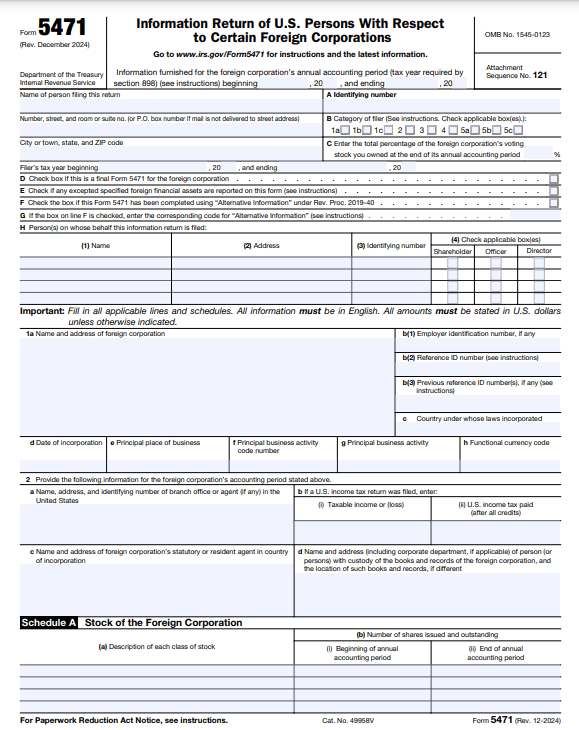
Step 1: Identify your filing category. Your category (or categories) decides everything downstream. Officer or director status is Category 2; more-than-50% control for 30+ days is Category 4; owning 10%+ of a CFC on the last CFC day is Category 5.
Step 2: Gather required information. Collect the corporation name, Employer Identification Number (EIN) or a reference ID number, country of incorporation, shareholder details, and functional-currency financial statements. First-time filers must reconstruct historical ownership and E&P records.
Step 3: Complete the schedules your category requires. Use the schedule matrix above to pull only the schedules tied to your category, since multiple categories stack the load.
Step 4: Attach Form 5471 to your return and file by the extended due date. E-file through MeF as an attachment to your income tax return. File a separate Form 5471 for each foreign corporation.
Two pitfalls catch first-timers. Currency translation errors distort Schedule C and E&P when average and spot rates are mixed up. Missed related-party transactions on Schedule M understate dealings between the CFC and its owners.
How Commenda Helps With Form 5471 Compliance
Commenda’s corporate tax and bookkeeping service prepares and tracks international filings like Form 5471 alongside your entity’s books, so every required schedule is filed with the return on time. Because multi-entity structures drive most Form 5471 obligations, Commenda’s entity management platform keeps ownership, financials, and filing calendars in one place across every jurisdiction.
You get certainty of compliance: what must be filed, when it is due, and confirmation that it got done. Book a demo to get a free assessment of which Form 5471 categories and schedules apply to your structure.










