An invalid Finnish Value Added Tax (VAT) number on an invoice kills your zero-rating and invites penalties from Vero, Finland’s Tax Administration. Verify the number before you invoice or claim a deduction. Use VIES for intra-EU validity, and use YTJ for domestic register status. MyTax is for your own taxes only.
VIES is the EU’s VAT Information Exchange System, which confirms whether a VAT number is valid for cross-border trade. YTJ is Finland’s national Business Information System. Vero itself directs businesses to validate EU VAT numbers on VIES.
What Is a Finnish VAT Number (ALV-numero)?
A Finnish VAT number, called the arvonlisäveronumero or ALV-numero, identifies a business registered for VAT. Vero, Finland’s Tax Administration, issues it. The format is “FI” plus eight digits taken from the company’s Business ID. It appears on invoices, VAT returns, and intra-EU trade documents, per Vero. It is not a general contact ID.
What Is the Difference Between a Business ID (Y-tunnus) and a VAT Number?
Every registered Finnish business has a Business ID (Y-tunnus), but a valid Y-tunnus does not mean the company is VAT-registered. The Y-tunnus is seven digits, a hyphen, and one check digit (format 1234567-1), per the Finnish Patent and Registration Office (PRH). Only membership in Finland’s VAT register turns “FI” plus those digits into a live, VIES-checkable number, per Vero. Always confirm the VAT register entry.
What Is the Format of a Finnish VAT ID?
A Finnish VAT ID is “FI” plus eight digits, which are the Y-tunnus with the hyphen removed. Vero confirms that Business ID 0765432-1 becomes VAT number FI07654321. The last digit is the Y-tunnus modulus-11 check digit, so it validates the underlying Business ID, not just the visible format.
| Element | Description | Source |
|---|---|---|
| Country code | FI, the ISO code for Finland | Vero |
| Numeric part | 8 digits from the Business ID (Y-tunnus), hyphen removed | Vero |
| Check digit | Last digit is the Y-tunnus modulus-11 check digit; validates the Business ID | Vero |
Example: Business ID 1234567-8 becomes VAT number FI12345678, per Vero. All Finnish businesses use this same format regardless of entity type.
How does the check digit work?
The check digit uses a modulus-11 algorithm. Finland weights the seven Business ID digits by 7, 9, 10, 5, 8, 4, and 2, sums the products, and divides by 11. A remainder of 0 gives check digit 0; any other remainder gives a check digit of 11 minus the remainder. A remainder of 1 is never issued, per Finnish check-digit references (tarkistusmerkit.teppovuori.fi).
What are common typos in Finnish VAT numbers?
The most common Finnish VAT number errors are missing digits, an included hyphen, the wrong country prefix, and extra characters, per Vero’s format guidance. FI needs exactly eight digits after the prefix.
- Missing digits: FI1234567 is too short.
- Hyphen included: FI1234567-8 wrongly keeps the Business ID hyphen.
- Wrong prefix: any non-FI prefix points to another country.
- Extra characters: added letters or trailing zeros break the number.
Which Tools Verify a Finnish VAT Number: VIES, YTJ, or MyTax?
Use VIES to confirm an EU VAT number is valid for cross-border trade. Use YTJ, Finland’s Business Information System, to confirm a company’s domestic register status by Business ID. MyTax (OmaVero) manages your own tax affairs and is not a third-party lookup tool, per Vero. The table shows when to use each.
| Tool | Input | What it proves | Best for | Source |
|---|---|---|---|---|
| VIES (VAT Information Exchange System) | Country FI + 8 digits | Number valid and active for intra-EU trade | Cross-border B2B sellers | EU Commission |
| YTJ (Business Information System) | Business ID or company name | Domestic register status, including VAT register | Checking a Finnish counterparty | YTJ |
| MyTax (OmaVero) | Your own credentials | Your own tax account and filings | Managing your own VAT | Vero |
When VIES is inconclusive, contact Vero directly to confirm a company’s registration status.
Simplify global indirect tax compliance across every market
Book a demo to automate your filings
How Do You Verify a Finnish VAT Number on VIES?
Open the VIES tool, select FI as the member state, enter the eight digits with no hyphen and no “FI” in the number field, and read the valid or invalid result. Vero directs businesses to VIES for EU VAT validation. For a valid number, VIES may also return the registered name and address where Finland supplies them.
- Open the VIES VAT number validation tool.
- Select Finland (FI), then enter the eight digits only. Do not include the hyphen or repeat “FI” in the number field.
- Read the result. VIES shows “valid” or “invalid for cross border transactions within the EU.”
- Request the consultation number. VIES generates a dated reference that proves you checked the number, which is valuable audit evidence, per the EU Commission.
A “member state database not responding” message is a VIES service error, not proof the number is invalid. Retry later, or fall back to YTJ or Vero.
What does VIES not tell you?
VIES confirms validity, but it does not always return the trader’s name and address. Some member states block that disclosure for data-protection reasons, so a valid result can show the details as “—“, per the EU Commission’s VIES guidance. VIES also cannot confirm that the person quoting the number actually represents that company.
How Do You Check a Finnish Company in the YTJ Business Information System?
Open the YTJ company search, search by company name or Business ID, open the company profile, and read the register entries. YTJ is free and jointly run by Vero and the Patent and Registration Office (PRH). The VAT register line is the real answer to whether the company is VAT-registered.
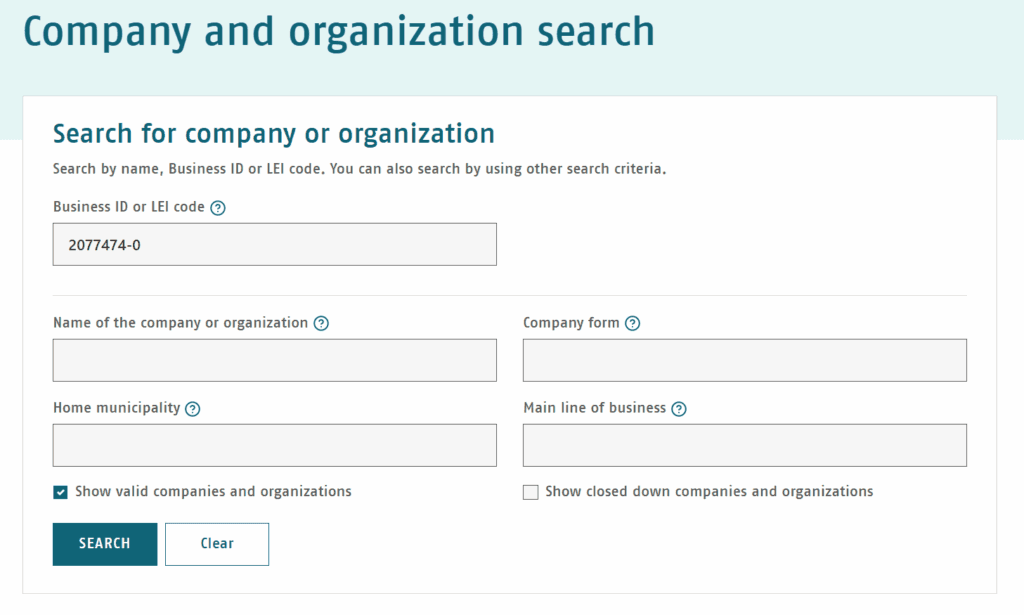
YTJ data appears in Finnish, Swedish, and English, so the register label matters. Look for the VAT Register line, shown as “Arvonlisäverovelvollisten rekisteri” in Finnish, per YTJ. That entry, not the Business ID alone, confirms VAT registration.
- Open the YTJ company search.
- Search by the company’s Business ID or name.
- Open the company’s public profile.
- Read the register entries and confirm the VAT Register line is in force.
Why Verify a VAT ID Before Invoicing or Zero-Rating?
Verification legally supports charging 0% VAT on intra-EU business-to-business (B2B) sales. A valid buyer VAT number lets you zero-rate the supply; the buyer then self-accounts through the reverse charge. If the number is invalid, Vero can deny zero-rating and bill you for the VAT plus interest. The 0% row below is exactly what verification protects.
To zero-rate an intra-EU sale, you verify the buyer’s number on VIES, report the sale on the EC Sales List (the recapitulative statement, or yhteenvetoilmoitus), and hold evidence the goods left Finland. On the purchase side, per Vero guidance, an input VAT deduction rests on the supplier being VAT-registered at the time of supply. A later cancellation does not undo a past valid transaction.
| VAT rate | Applies to | Since | Source |
|---|---|---|---|
| 25.5% (standard) | Most goods and services | 1 Sep 2024 (raised from 24%) | Vero rates of VAT |
| 13.5% (reduced) | Groceries, restaurant and catering meals | 1 Jan 2026 (lowered from 14%) | Vero |
| 10% (reduced) | Newspapers and magazines | Current | Vero |
| 0% | Exports outside the EU, intra-EU B2B sales | Current | Vero |
What Happens If You Use an Invalid VAT ID in Finland?
You lose zero-rating, risk denied input VAT deductions, and face penalties from Vero. The seller becomes liable for the VAT that should have been charged, plus interest. Penalties for filing self-assessed VAT returns late follow a fixed daily-then-percentage structure, shown below, per Vero.
| Situation | Penalty or consequence | Source |
|---|---|---|
| VAT return filed late, within 45 days | €3 per day, capped at €135 | Vero late-penalty charges |
| VAT return filed late, over 45 days | €135 plus 2% of the tax filed late, capped at €15,000 per tax | Vero |
| Invalid buyer VAT number at invoicing | Zero-rating denied; seller liable for the VAT plus interest | Vero |
Many vendors run due diligence and will validate your VAT number against the VAT register before trading, so a bad number also costs you deals.
When Does a Business Need a Finnish VAT Number?
A Finnish business must register once turnover exceeds €20,000 in a calendar year, effective 1 January 2025, up from €15,000, per Vero’s small-business VAT guidance. Vero assesses the €20,000 against both the current and the previous calendar year. Foreign companies without a fixed establishment generally register from their first taxable supply. Below the threshold, registration is voluntary.
| Threshold | Effective | Assessment basis | Source |
|---|---|---|---|
| €10,000 | Until 31 Dec 2020 | Accounting period | Vero |
| €15,000 | 1 Jan 2021 | 12-month accounting period | Vero |
| €20,000 | 1 Jan 2025 | Current and previous calendar year | Vero |
The 2025 rise follows the EU’s reformed small-business VAT scheme in Council Directive (EU) 2020/285, applicable across member states from 1 January 2025. Finland also abolished its separate VAT relief scheme, which ran up to €30,000 turnover, for accounting periods starting on or after 1 January 2025, per Vero.
What If a Finnish VAT Number Shows as Invalid or Inactive?
A Finnish VAT number can show invalid because of a typo, a newly issued number not yet propagated, a Business ID absent from the VAT register, a deregistered business, or a VIES outage. A “member state database not responding” message is a VIES service outage, not proof the number is invalid. The table below matches each result to a fix.
| Result | Likely cause | Quick fix | Source |
|---|---|---|---|
| “Invalid” on VIES | Typo, included hyphen, or wrong prefix | Re-enter 8 digits, no hyphen, FI selected separately | Vero |
| Valid Y-tunnus but no VAT status | Business ID valid but not in the VAT register | Confirm the VAT register line on YTJ | YTJ |
| “Inactive” or no record | Newly issued number not yet propagated | Wait a few days, then recheck VIES and YTJ | Vero |
| No record for a known trader | Business deregistered from VAT | Request a current number from the counterparty | Vero |
| “Member state database not responding” | VIES service outage, not an invalid number | Retry later, or check YTJ and contact Vero | EU Commission |
How Do You Verify Finnish VAT Numbers in Bulk?
VIES suits single checks and offers a batch upload for a handful of numbers. Finance teams verifying hundreds of counterparties need API or CSV-based validation. The EU Commission also publishes a VIES API for programmatic checks, though it inherits VIES reliability caveats and per-member-state availability.
For high-volume onboarding and invoicing, Commenda’s global tax ID verification validates VAT and other tax IDs across countries from one place, so you stop pasting numbers into VIES one at a time.
How We Help With Finnish VAT Verification
Verifying a Finnish VAT number is one check. Keeping every counterparty valid across every jurisdiction is a system. Commenda’s indirect tax platform handles ongoing VAT ID validation, registration, and filing support across countries, with 100+ ERP, API, and custom integrations feeding it your live vendor and customer data.
Pair it with Commenda’s tax ID verification tool for cross-border onboarding checks, and the Commenda compliance calendar to track VAT filing deadlines by country and entity. That is certainty of compliance: if it is required, it is tracked; if it is tracked, it is handled.
Book a demo for a walkthrough of automated VAT ID checks across your vendor list.
About the author

Sam is a seasoned expert in sales tax, leading Commenda's effort to build the worlds most comprehensive database of global tax rules and business regulations. At Silverhaze Partners, he worked in early-stage venture capital, where he saw firsthand how tax complexity and regulatory friction hold back startups from scaling internationally. That experience now powers his work at Commenda-bringing clarity, precision, and real-world insight to one of the most frustrating parts of doing business globally.
Disclaimer: Commenda and its affiliates do not provide tax, accounting, or legal advice. This material has been prepared for informational purposes only, and is not intended to provide or be relied on for tax, accounting, or legal advice. You should consult your own tax, accounting, and legal advisors before engaging in any related activities or transactions.