Compliance obligations sprawl across frameworks, agencies, and jurisdictions. Most teams still track them in spreadsheets and calendar reminders. That approach breaks the moment a company adds an entity or enters a new state or country.
The obligations are not simple. One framework alone, SOC 2 (System and Organization Controls 2), runs on the 2017 Trust Services Criteria set by the American Institute of Certified Public Accountants (AICPA). Sales tax adds a different rule in every US state. This post explains what a compliance platform is, its key features, its business benefits, and how to choose one in 2026.
What Is a Compliance Platform?
A compliance platform is a centralized system of record for a company’s compliance obligations. It automates tracking, evidence collection, monitoring, reporting, and filing. It integrates with existing business systems like accounting, HR, and cloud tools. It gives finance and compliance teams real-time visibility across frameworks and jurisdictions.
The term is an umbrella. Platforms differ by the type of compliance they manage, which is the split the next section resolves.
Security Compliance vs. Regulatory Compliance: Which Type of Platform Do You Need?
Two different product categories share the name. Security and Governance, Risk, and Compliance (GRC) platforms manage information-security frameworks and audit prep. Regulatory compliance platforms manage tax, entity filings, and jurisdiction-specific obligations for finance teams. Match the category to the obligations you actually carry.
Security frameworks include SOC 2, ISO 27001, HIPAA (Health Insurance Portability and Accountability Act), PCI DSS (Payment Card Industry Data Security Standard), GDPR (General Data Protection Regulation), NIST (National Institute of Standards and Technology), DORA (Digital Operational Resilience Act), and NIS2 (Network and Information Security Directive 2). Regulatory obligations include sales tax, value-added tax (VAT), goods and services tax (GST), and entity filings.
| Platform category | What it manages | Core job | Example vendors | Best-fit buyer | Source |
|---|---|---|---|---|---|
| Security / GRC | SOC 2, ISO 27001, HIPAA, PCI DSS, GDPR, NIST, DORA, NIS2 | Automated evidence collection and audit prep | Vanta, Hyperproof, Comp AI | Security, IT, and GRC teams | Hyperproof framework library (140+ frameworks) |
| Regulatory / multi-jurisdiction | Sales tax, VAT/GST, entity filings, transfer pricing, corporate governance | Track and file jurisdiction-specific obligations | Commenda | Controllers and finance teams | Commenda |
What Are the Key Features of a Compliance Platform?
A compliance platform should deliver eight features: automation and data integration, reporting and analytics, monitoring and investigation, a real-time dashboard, global multi-jurisdiction coverage, data security and privacy, an intuitive interface, and implementation support. Together they turn scattered obligations into one tracked, filed, and auditable workflow.
| Feature | What it does | Source |
|---|---|---|
| Automation and data integration | Pulls compliance data automatically from connected tools | Vanta integrations page (400+ tools) |
| Reporting and analytics | Produces audit-ready reports and status by jurisdiction | Commenda |
| Monitoring and investigation | Flags gaps continuously and traces issues to root cause | Commenda Compliance Monitor |
| Real-time dashboard | Shows every obligation, deadline, status, and owner | Commenda Compliance Monitor |
| Global / multi-jurisdiction coverage | Tracks obligations across countries and US states | Hyperproof framework library (140+ frameworks); Commenda |
| Data security and privacy | Encryption, access controls, and platform certifications | AICPA Trust Services Criteria |
| Intuitive interface | Lets non-experts operate the platform | Commenda |
| Implementation support | Onboarding, training, migration, and fast time-to-live | Comp AI (trycomp.ai) |
How Does Compliance Automation and Data Integration Work?
Compliance automation connects the platform to your systems and pulls compliance data automatically. It replaces manual screenshots and spreadsheets. Platforms link to cloud providers, identity providers, HR systems, and accounting or ERP (enterprise resource planning) systems, then collect evidence and file on schedule. Vanta pulls data from 400+ tools, per its integrations page. That count includes 40+ Amazon Web Services (AWS) resources and 30+ Microsoft Azure resources, per the same page.
Commenda supports 100+ ERPs, APIs (application programming interfaces), and custom integrations across its integrations catalog. Automated connections also ease periodic filings with regulatory bodies.
What Should Compliance Reporting Capabilities Include?
Compliance reporting should produce audit-ready reports on demand. It should show status by obligation and jurisdiction, export evidence for auditors and regulators, and generate custom reports for boards and leadership. The goal is one export that answers an auditor’s request without a manual scramble.
What Do Compliance Monitoring and Investigation Tools Do?
Compliance monitoring flags gaps and missed obligations as they appear. Investigation tools then trace each issue to its root cause: which entity, which filing, or which rule change caused it. A compliance monitor is the generic capability that watches obligations continuously so teams fix causes, not symptoms.
What Does a Real-Time Compliance Dashboard Show?
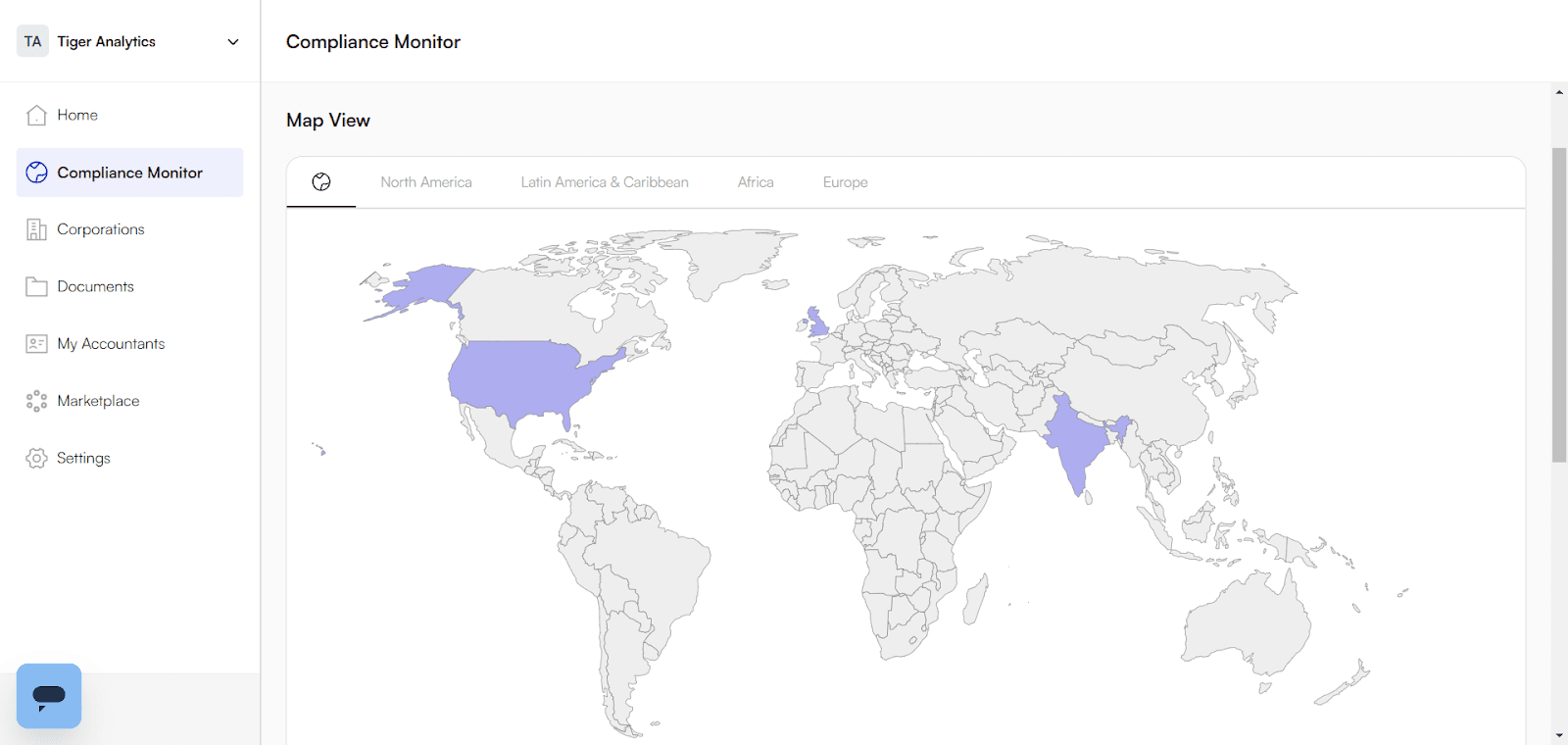
A real-time compliance dashboard shows every obligation, its deadline, its status, and who owns it, across all entities and jurisdictions, updated as data changes. It replaces scattered trackers with a single source of truth. Commenda’s Compliance Monitor is one implementation of this view.
How Does Global Compliance Coverage Work Across Jurisdictions?
Global compliance coverage means one platform tracks obligations across countries and US states. That spans sales tax, VAT/GST, entity filings, and local frameworks in each jurisdiction. Hyperproof supports 140+ frameworks, per its framework library. Commenda tracks multi-jurisdiction tax and entity obligations for cross-border finance teams.
Economic nexus thresholds differ in every US state. Check exposure with Commenda’s US nexus exposure guide.
How Does a Compliance Platform Handle Data Security and Privacy?
A compliance platform protects data with encryption, granular access controls, and its own certifications. SOC 2 examinations run under the AICPA’s SSAE 18 (Statement on Standards for Attestation Engagements No. 18). Ask any vendor which certifications it holds and which access controls it enforces before you trust it with entity and tax data.
Why Do Interface and Ease of Implementation Matter?
Adoption fails when only specialists can use the tool, so evaluate the interface for non-experts and the vendor’s implementation support: onboarding, training, data migration, and time-to-live. Buyers now expect fast setup. Comp AI claims it compresses SOC 2 prep from 6 months to 24 hours, per trycomp.ai (2025).
Deadlines Don't Wait. Neither Should You.
Annual filings, tax reports, entity upkeep — our local experts handle it all with precision. Eliminate risk and regain your time.
What Are the Business Benefits of a Compliance Platform?
A compliance platform lowers cost, cuts errors, reduces risk exposure, speeds audits, and lets you scale into new jurisdictions without proportional headcount. Non-compliance is expensive: missing IRS (Internal Revenue Service) Form 5472 for a foreign-owned US entity triggers a $25,000 penalty, per the IRS instructions for Form 5472. The table below maps each benefit to a mechanism and a sourced proof point.
| Benefit | Mechanism | Quantified proof point | Source |
|---|---|---|---|
| Faster audits | Evidence is collected and mapped continuously | Acuity International cut audit prep time by over 70%, from a ~4,000-hour annual baseline | Hyperproof case study |
| Fewer manual processes | Automation replaces spreadsheets and SharePoint | Acuity cut manual processes 60%; System Security Plan creation fell from 30 hours to 3 | Hyperproof case study |
| Lower audit cost | One platform replaces per-framework tooling | Appian saved roughly $100,000 per audit | Hyperproof case study |
| Scale frameworks without headcount | New frameworks reuse existing controls | Appian runs 28 frameworks and 600+ controls on one platform | Hyperproof case study |
| Less evidence-collection effort | Data connectors auto-pull evidence | Appian saved 100+ hours on evidence collection | Hyperproof case study |
| Trust with customers, investors, regulators | Audit-ready reports prove posture on demand | SOC 2 rests on five Trust Services Categories, with Security mandatory | AICPA Trust Services Criteria |
Scalability without added cost matters most for growing companies. The platform absorbs new entities, states, and frameworks, so cost grows slower than obligations. That also sharpens decision-making, because leadership sees risk exposure in one place.
Why Do Finance Teams Need Multi-Jurisdiction Compliance Software?
Finance teams need multi-jurisdiction compliance software because controllers and finance leads own sales tax, VAT/GST, entity filings, and transfer pricing across borders. Security-focused platforms track none of it. The buyer is whoever got handed cross-border compliance without the infrastructure to handle it.
These obligations scale with expansion. Each new state creates fresh sales tax compliance exposure, and each new subsidiary is another legal entity with its own filings. A finance-oriented platform tracks all of it in one record.
How Do You Choose the Right Compliance Platform?
Match the platform category to your obligations first: security frameworks, or regulatory and tax. Then evaluate integrations, jurisdiction coverage, reporting, implementation support, and total cost of ownership. The table below compares the main vendors on facts, strengths, and limitations.
| Vendor | Category | Focus | Notable facts | Real strengths | Real limitations | Source |
|---|---|---|---|---|---|---|
| Vanta | Security / GRC | Automated evidence and trust | 400+ integrations | Deep automation, large integration library | Security frameworks only, not tax or entity | Vanta integrations page |
| Hyperproof | Security / GRC | Continuous GRC and audit | 140+ frameworks; Appian runs 28 frameworks | Broad framework library, strong case studies | Security/GRC focus, not multi-jurisdiction tax | Hyperproof framework library and case studies |
| Comp AI | Security / GRC | Fast SOC 2 automation | Claims 6 months to 24 hours; published case studies cluster in days to weeks | Fast setup for security-mature teams | Type II still needs a roughly 3-month observation period | Comp AI (trycomp.ai); CBH |
| Commenda | Regulatory / multi-jurisdiction | Tax, entity, and filings for finance teams | 100+ integrations; multi-jurisdiction tax and entity coverage | Owns finance, tax, and entity obligations across borders | A US-only seller with a single sales channel may be served by a point solution | Commenda |
If you are ready to compare tools in depth, see Commenda’s guide to the best corporate compliance software.
How Commenda’s Compliance Platform Gives You Certainty
Commenda’s Compliance Monitor tracks every obligation, deadline, and filing across your entities and jurisdictions in one real-time dashboard. For sales tax, VAT, and GST obligations, Commenda’s indirect tax software handles registration, monitoring, and filing. For entity compliance, entity management tracks each legal entity and its filings. It all connects through 100+ integrations.
Start by checking your exposure with the US nexus exposure guide. Then book a demo to see every compliance obligation across your jurisdictions in one dashboard.
About the author

Logan leads Commenda’s Services and Operations team, helping controllers, heads of tax, and finance leaders navigate international expansion. He built a global expert network across 70 countries and previously worked in management consulting across the Middle East and Southeast Asia.
Disclaimer: Commenda and its affiliates do not provide tax, accounting, or legal advice. This material has been prepared for informational purposes only, and is not intended to provide or be relied on for tax, accounting, or legal advice. You should consult your own tax, accounting, and legal advisors before engaging in any related activities or transactions.