VAT registration in Luxembourg is crucial for foreign companies to ensure compliance with Luxembourg tax laws, avoid penalties, and conduct business smoothly in the Luxembourg market. The guide outlines the essential steps and requirements for GST/VAT/HST/CST registration in Luxembourg, so you can comply with local laws and avoid penalties.
Why Non-Resident Firms Must Register for VAT/GST in Luxembourg
Foreign businesses face severe consequences for failing to register for GST/VAT/HST/CST registration in Luxembourg when required. Penalties can range from €250 to €10,000 for late registration. Additionally, customs authorities may block imports, and marketplaces can suspend sales until proper registration is obtained. Non-compliance also leads to loss of input VAT recovery rights and potential director liability for tax obligations. Commenda simplifies this complex registration process by providing expert guidance and automated compliance solutions for businesses expanding into Luxembourg markets.
When Does a Foreign Business Need to Register? Key Triggers
Foreign companies must register for VAT/GST in Luxembourg when their activities establish a taxable presence or involve specific transactions that trigger VAT obligations. Key scenarios include:
- Local inventory or warehouse: Storing goods, even through fulfillment centers, often creates a physical presence that triggers registration.
- Remote services to consumers: Providing services remotely, especially through local employees, can establish a sufficient nexus to require registration.
- Import & local sale: Selling imported goods locally, even without a physical office, can mandate registration when the activity becomes regular.
- Marketplace facilitation: Utilizing third-party platforms to facilitate local sales may still create a nexus, depending on the volume and visibility.
- Trade shows/events: Participating in recurring, organized trade shows or pop-up events in-state may be considered doing business, especially if it is continuous over time.
Country-Specific Examples:
- A German e-commerce seller storing inventory in Luxembourg warehouses must register immediately upon establishing local stock presence.
- A US software company providing SaaS services directly to Luxembourg consumers triggers registration under digital services rules.
Unlike resident businesses, foreign companies face no registration thresholds, meaning even a single transaction can trigger mandatory registration obligations. This strict approach ensures tax compliance across all non-resident commercial activities.
Registration Thresholds & Nexus Tests
Luxembourg operates a nil threshold system for non-resident businesses, making GST/VAT registration for non-resident businesses in Luxembourg mandatory from the first taxable transaction. As of 2025, Luxembourg resident companies benefit from an annual threshold of €35,000 to €50,000, while foreign entities must register immediately upon commencing any taxable activity within Luxembourg territory. Special rules apply for EU-wide distance selling, where the €10,000 threshold triggers registration obligations. Digital services providers must closely monitor these thresholds, as exceeding the limits requires immediate compliance action.
Luxembourg VAT/GST Number Format Explained
Understanding the format of the VAT number is essential before registering for GST/VAT online in Luxembourg. Luxembourg VAT numbers follow a standardized 8-digit format preceded by the country code “LU”. The complete structure appears as LU12345678, where the eight digits represent the taxpayer’s unique identification number assigned by the Luxembourg tax authorities.
| Component | Description |
| LU | Country code prefix (European Union standard for Luxembourg) |
| 12345678 | 8-digit unique taxpayer identifier assigned by the Luxembourg tax authorities. |
Common Registration Mistakes:
- Omitting the country code prefix: Some businesses mistakenly omit the “LU” prefix, which can result in the application being rejected, as Luxembourg specifically requires the “LU” prefix for VAT identification.
- Incorrect digit sequences: Another common mistake is submitting an incorrect sequence of digits that fails the checksum validation, resulting in the system rejecting the application.
To verify the validity of a Luxembourg VAT number, businesses can use the EU’s VIES (VAT Information Exchange System) database, which provides real-time validation of VAT numbers across EU member states.
One platform to simplify global tax and compliance
See why high-growth companies trust Commenda
Is a Local Tax Agent or Fiscal Representative Required?
Luxembourg does not require non-resident businesses to appoint fiscal representatives for GST/VAT registration for foreign companies in Luxembourg. This distinguishes Luxembourg from other EU jurisdictions with mandatory representation requirements. However, tax authorities retain discretionary power to demand bank guarantees or cash deposits from non-EU companies to secure VAT obligations. While optional, many foreign businesses opt for local tax agents to streamline communication and ensure accurate compliance. Such arrangements operate under agency principles rather than joint liability structures common elsewhere.
Special Schemes & Simplifications
Luxembourg offers several specialized programs to ease compliance burdens for qualifying businesses, particularly those engaged in cross-border operations or specific sectors. Key options include:
- Small Enterprise Scheme: Domestic threshold raised to €50,000 for Luxembourg-established businesses, with optional VAT exemption but no input deduction rights.
- EU Cross-Border Scheme: New 2025 program allowing businesses with EU-wide turnover under €100,000 to operate VAT-exempt across member states.
- Import VAT Deferment: Automatic postponement of import VAT without special licensing requirements.
- One Stop Shop (OSS): Simplified digital services VAT reporting for businesses exceeding €10,000 EU-wide threshold.
- Art Sector Provisions: Reduced 8% VAT rate covering all art transactions, including imports and intra-EU acquisitions.
These simplified schemes reduce administrative complexity while maintaining compliance standards.
Step-by-Step: How to Register for VAT/GST in Luxembourg
GST/VAT/HST/CST registration in Luxembourg is a crucial step for non-resident businesses engaging in taxable activities within the country. Here’s a step-by-step guide to help you through the VAT registration in Luxembourg:
- Check registration thresholds: Verify whether your business activities trigger mandatory registration requirements under current Luxembourg legislation.
- Gather required documents: Collect incorporation certificates, director identification, business activity descriptions, and banking details.
- Complete VAT registration form: Access the online registration form through the designated tax portal for foreign suppliers.
- Create Government Gateway Account: To submit your application electronically, register on MyGuichet.lu.
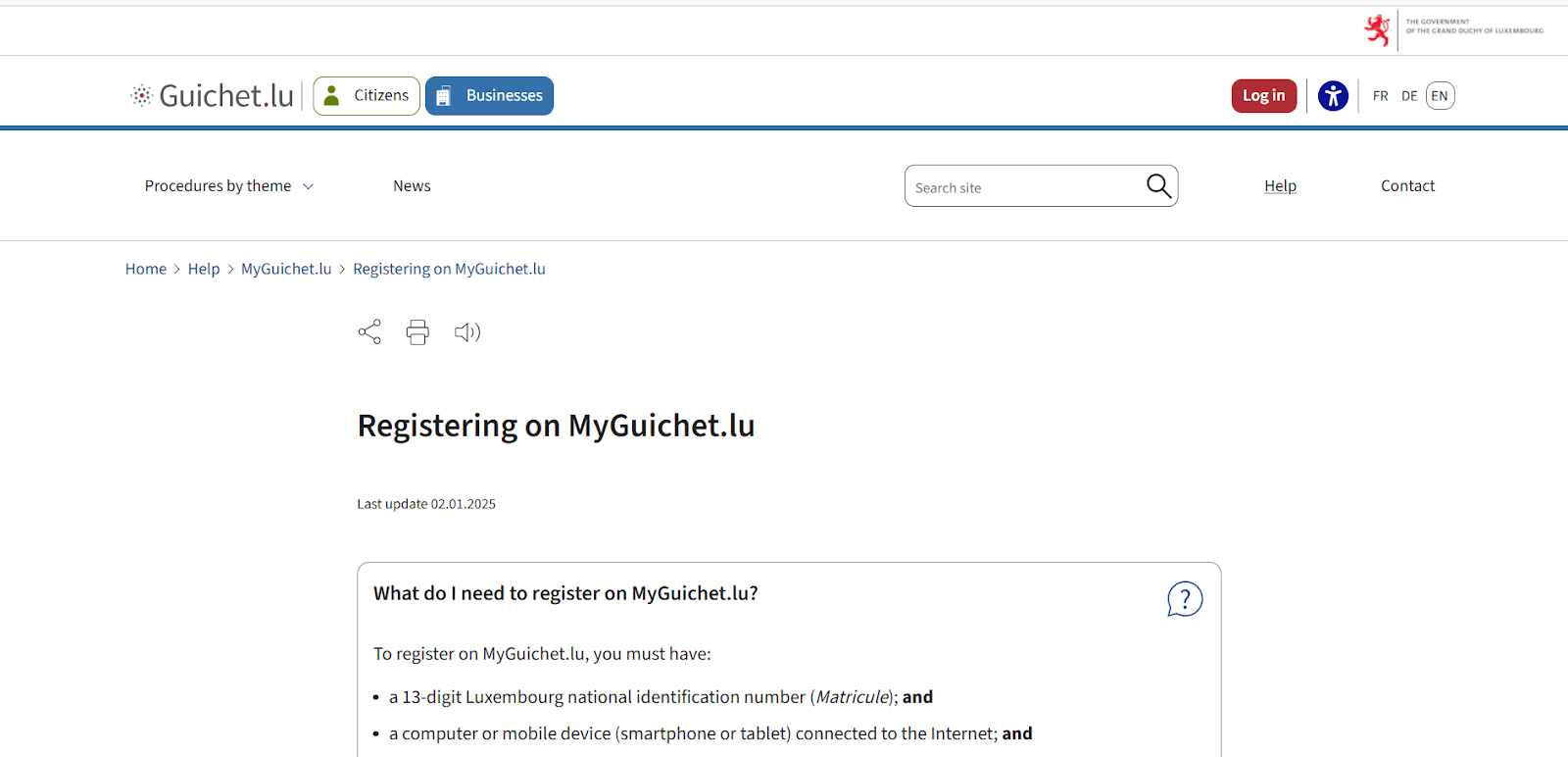
- Submit application electronically: Upload completed forms and supporting documentation through the secure government platform.
- Pay applicable fees: Process any required registration fees or security deposits as determined by tax authorities.
- Receive VAT number confirmation: Await official issuance of Luxembourg VAT identifier, typically within three weeks of complete application submission.
GST/VAT/HST/CST registration in Luxembourg is a straightforward process when you follow these steps and ensure all documentation is complete and accurate.
Required Documents Checklist
Proper documentation ensures smooth processing of your Luxembourg VAT/GST registration guide application without unnecessary delays or rejection risks.
- Certificate of incorporation: Official company formation documents translated into French or German if issued initially in other languages.
- Director identification documents: Valid passports or national identity cards for all company officers and authorized representatives.
- Business activity description: Detailed explanation of intended Luxembourg operations, including anticipated turnover estimates.
- Banking details: Luxembourg or foreign bank account information, including IBAN and BIC codes, for VAT payment processing.
- Power of attorney documentation: Signed authorization forms if using third-party agents or representatives for the registration process.
Depending on specific business circumstances or the complexity of cross-border transactions, additional documentation may be required. Ensuring completeness before submission prevents processing delays that could affect business launch timelines.
Processing Time & Government Fees
Standard VAT registration applications typically process within three weeks of complete submission. Complex cases involving multiple jurisdictions or unusual business structures may require additional processing time for thorough review. Luxembourg generally does not impose registration fees for standard VAT applications; however, non-EU businesses may face security deposit requirements at the discretion of the authorities. Bank guarantee amounts vary based on anticipated turnover and risk assessment by tax authorities.
Post-Registration Obligations
After completing GST/VAT/HST/CST registration in Luxembourg, businesses must adhere to specific ongoing obligations to ensure compliance and avoid penalties. Below is a detailed overview of these requirements:
- Filing frequency requirements: Monthly returns for turnover exceeding €620,000, quarterly for €112,000-€620,000 range, annual for lower amounts.
- Payment deadlines: VAT payments and returns are due by the 15th of the month following the reporting period, with annual returns by May 1st of the following year.
- Electronic submission mandatory: All VAT returns must be filed through the eTVA portal system since January 2020.
- Record retention periods: Maintain complete VAT documentation for a minimum of 10 years, with Luxembourg storage requirements for paper invoices.
- Invoice compliance standards: Issue VAT invoices within 15 days of supply, containing all mandatory information, including customer VAT numbers for intra-Community transactions.
- Currency conversion rules: Convert foreign currency transactions using European Central Bank, commercial bank, or Luxembourg Central Bank exchange rates.
These ongoing obligations require systematic compliance management to avoid penalties and maintain good standing with Luxembourg tax authorities.
Claiming Input-Tax Credits & Refunds as a Non-Resident
Non-resident tax registration in Luxembourg businesses can recover VAT paid on business-related purchases through established refund mechanisms. EU companies apply through their home country electronic portals under the 8th Directive procedures, while non-EU entities submit direct applications to Luxembourg authorities annually. Refund eligibility requires demonstrating business necessity and proper invoice documentation with mandatory VAT number information. Standard processing allows quarterly claims above €400 for EU businesses, with final year claims above €50 permitted. Non-EU refunds operate without fiscal representative requirements since reciprocity obligations were abolished in 1999.
Penalties for Late Registration or Non-Compliance
After completing GST/VAT/HST/CST registration in Luxembourg, businesses must adhere to specific ongoing obligations to ensure compliance and avoid penalties. Below is a detailed overview of these requirements:
- Late registration penalties: Fines ranging from €250 to €10,000 depending on violation severity and duration.
- Fraud penalties: Additional charges of 10% to 50% of evaded VAT amounts for deliberate non-compliance.
- Late filing consequences: Monthly penalties from €250 to €10,000 for missed return deadlines.
- Import blocking powers: Customs authorities can halt goods clearance pending proper VAT registration.
- Director liability exposure: Personal responsibility for company VAT obligations in cases of serious non-compliance.
Recent enforcement examples demonstrate Luxembourg’s commitment to compliance, with significant fines imposed on businesses attempting to circumvent registration requirements through improper structuring.
Deregistration & VAT/GST Number Changes
Businesses ceasing operations in Luxembourg must formally deregister within 15 days of the termination of their activity. The process requires submitting cessation declarations through the MyGuichet.lu portal or sending postal notifications to the tax authorities. Final VAT returns must account for all outstanding obligations, including asset disposals subject to VAT charges. Clearance certificates confirm completion of all tax responsibilities before formal deregistration approval. Businesses may also modify existing registrations for ownership changes or structural reorganizations through similar electronic procedures.
Conclusion
Foreign companies entering the Luxembourg markets must prioritize proper VAT registration to avoid costly penalties and operational disruptions. The nil registration threshold for non-residents means immediate compliance upon commencing any taxable activity within Luxembourg territory. While the registration process involves detailed documentation and ongoing obligations, proper planning ensures smooth market entry.
Commenda provides comprehensive VAT compliance solutions, automating registration processes and maintaining ongoing obligations for international businesses. Companies seeking expert guidance can book a free demo with Commenda to explore customized compliance strategies for Luxembourg expansion.
About the author

Sam is a seasoned expert in sales tax, leading Commenda's effort to build the worlds most comprehensive database of global tax rules and business regulations. At Silverhaze Partners, he worked in early-stage venture capital, where he saw firsthand how tax complexity and regulatory friction hold back startups from scaling internationally. That experience now powers his work at Commenda-bringing clarity, precision, and real-world insight to one of the most frustrating parts of doing business globally.
Disclaimer: Commenda and its affiliates do not provide tax, accounting, or legal advice. This material has been prepared for informational purposes only, and is not intended to provide or be relied on for tax, accounting, or legal advice. You should consult your own tax, accounting, and legal advisors before engaging in any related activities or transactions.