VAT registration in Greece is crucial for foreign companies to ensure compliance with Greek tax laws, avoid penalties, and conduct business smoothly in the Greek market. This guide explains the complete process of GST/VAT/HST/CST registration in Greece for non-resident businesses, covering requirements, procedures, and compliance obligations.
Why Non-Resident Firms Must Register for VAT/GST in Greece
Foreign companies face severe penalties for non-compliance with Greek VAT registration requirements. Businesses risk fines ranging from €2,500 for non-registration to 50% of unpaid VAT amounts if violations are discovered during tax audits. Additionally, failure to register can result in customs holds on imports, blocked marketplace sales, and director liability issues that can cripple business operations. These enforcement measures make timely registration crucial for maintaining smooth cross-border commerce. Companies like Commenda understand these challenges and provide specialized support to help businesses navigate Greek VAT obligations efficiently while avoiding costly penalties that could impact their European expansion plans.
When Does a Foreign Business Need to Register? Key Triggers
Foreign businesses must register for VAT/GST in Greece when their activities establish a taxable presence or involve specific transactions that trigger VAT obligations. Key scenarios include:
- Local inventory or warehouse storage: Any goods stored in Greek facilities, including Amazon FBA programs.
- Remote services to consumers: Digital services provided directly to Greek individuals (B2C transactions)
- Import and local sale activities: Importing goods into Greece for subsequent domestic distribution.
- Trade shows and events: Participating in exhibitions or conferences that generate taxable supplies.
- Distance selling threshold: EU businesses exceeding €35,000 annual sales to Greek consumers.
Country-Specific Examples:
- UK software companies providing SaaS services to Greek consumers need immediate registration due to the nil threshold.
- German manufacturers participating in the Athens trade fairs require registration for any taxable transactions during events.
The general rule requires registration before commencing any taxable activity in Greece, regardless of revenue levels. This differs from many countries that offer minimum thresholds for small businesses.
Registration Thresholds & Nexus Tests
Greece operates under a nil threshold system for VAT registration, meaning foreign businesses must register immediately upon conducting any taxable economic activity within the country. Unlike many EU jurisdictions that provide small business exemptions, Greece requires mandatory registration regardless of turnover levels for domestic operations.
Special thresholds apply to specific scenarios: EU companies engaged in distance selling to Greek consumers face an annual threshold of € 35,000, while the previous €10,000 limit has been replaced under updated EU regulations. For digital services provided to Greek consumers, registration becomes mandatory from the first transaction, with no minimum revenue requirement.
Greece VAT/GST Number Format Explained
You must understand the format of the VAT number before registering for GST/VAT online in Greece. Greek VAT numbers follow a standardized 9-digit format preceded by the country code “EL”. The complete structure appears as EL123456789, where the nine digits represent the taxpayer’s unique identification number assigned by the Independent Authority for Public Revenue (AADE).
| Component | Description |
| EL | Country code prefix (European Union standard for Greece) |
| N1N2N3N4N5N6N7N8N9 | 9 digit unique taxpayer identifier assigned by AADE |
| Check digit | Final digit(s) calculated using mathematical validation algorithms. |
Sample valid numbers include:
- EL999123456 (standard business format)
- EL876543210 (alternative valid structure)
Common Registration Mistakes:
- Using “GR” Instead of “EL”: Some businesses mistakenly use “GR” instead of “EL” as the country code, which can result in the application being rejected, as Greece specifically uses “EL” for VAT identification.
- Incorrect Digit Sequences: Another common mistake is submitting an incorrect sequence of digits that fails the checksum validation, causing the system to reject the application.
Is a Local Tax Agent or Fiscal Representative Required?
When pursuing GST/VAT registration for foreign companies in Greece, non-EU businesses are required to appoint a fiscal representative. The representative assumes joint liability for all VAT obligations, including filing returns, meeting payment deadlines, and compliance with Greek tax regulations.
The fiscal representative must be a Greek tax resident with permanent establishment, capable of handling AADE communications in the Greek language. They become legally responsible for VAT payments and face personal liability for unpaid obligations. No bank guarantee is typically required; however, credentials must be verified through certified power of attorney documentation. EU businesses can register directly without fiscal representation, significantly reducing compliance costs compared to non-EU entities.
Special Schemes & Simplifications
Greece offers several streamlined VAT programs to reduce compliance burdens for eligible businesses. Available simplification schemes include:
- Import VAT deferment: Allows businesses to defer VAT payments from the time of import to periodic returns, eliminating upfront cash flow requirements.
- Reverse charge mechanism: Shifts VAT liability from suppliers to recipients for qualifying B2B transactions, reducing administrative complexity.
- E-services simplified reporting: B2B digital sales of products and services must be charged and collected by the nonresident and remitted to the local Greek tax authority at a rate of 24%.
- Small business support: While no registration threshold exists, simplified filing frequencies apply to smaller operations.
The import deferment system proves particularly valuable for companies with significant inventory flows, as it eliminates immediate VAT payments during customs clearance while allowing credits on subsequent returns. These schemes require specific applications and ongoing compliance with program conditions, but can substantially reduce operational costs for qualifying businesses.
Step-by-Step: How to Register for VAT/GST in Greece
GST/VAT/HST/CST registration in Greece is a crucial step for non-resident businesses engaging in taxable activities within the country. Here’s a step-by-step guide to help you through the VAT registration in Greece:
- Check threshold requirements: Verify if business activities trigger mandatory registration obligations
- Gather required documents: Collect incorporation certificates, director identification, and proof of activity documentation.
- Complete application forms: Fill out Greek VAT registration forms in the required language.
- Create a government gateway account: To register for VAT, an application should be filed at the Greek tax office.
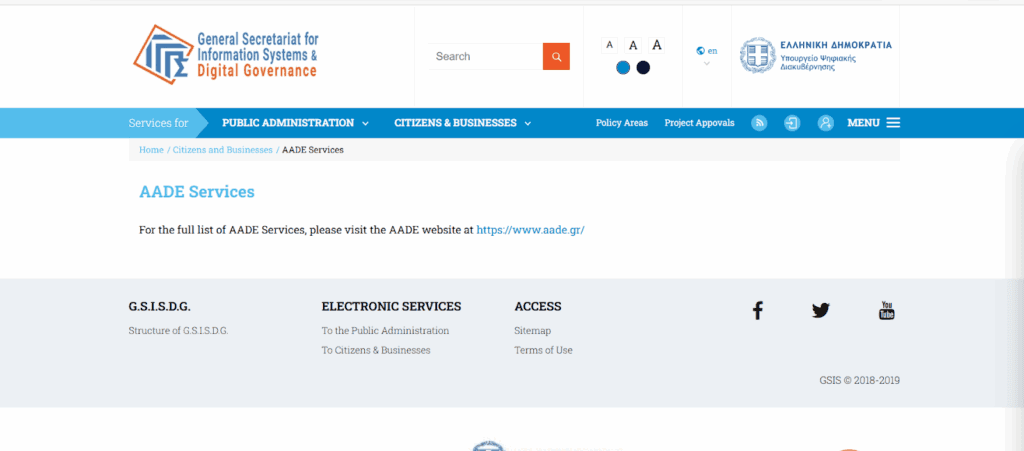
- Submit application package: File forms and supporting documents via email or in-person delivery.
- Pay applicable fees: Process any required registration or administrative charges
- Receive VAT number confirmation: Obtain official EL-prefixed identification within 1-2 weeks.
GST/VAT/HST/CST registration in Greece is a straightforward process when you follow these steps and ensure all documentation is complete and accurate. The entire process typically requires 2-3 weeks for completion, though complex cases or missing documentation can extend timeframes.
Required Documents Checklist
Foreign companies need a comprehensive documentation for the Greece VAT/GST registration guide compliance:
- Certificate of incorporation – Official company formation document from the country of establishment
- Directors’ identification – Passports or national ID cards for all company officers and authorized representatives
- Proof of business activity – Contracts, order forms, or commercial agreements demonstrating Greek market engagement
- Bank confirmation letter – Financial institution verification of company accounts and standing
- Power of attorney – Notarized authorization if using fiscal representative services, certified by Greek consular services
- Articles of association – Complete company constitutional documents translated into the Greek language
- VAT certificate – Confirmation of tax registration status from home country authorities
All foreign-language documents require certified Greek translations, unless they are submitted in English to specific tax offices.
Processing Time & Government Fees
The VAT registration process in Greece typically takes 1 week for foreign companies, provided all required documentation is complete and accurate. For non-EU businesses, the appointment of a fiscal representative is mandatory, which may slightly extend the processing time.
Regarding fees, while there is no standard registration fee, some businesses may be required to pay a security deposit or guarantee for their fiscal representative. These costs can vary depending on the representative’s fees and the specific services provided.
Post-Registration Obligations
After completing GST/VAT/HST/CST registration in Greece, businesses must adhere to specific ongoing obligations to ensure compliance and avoid penalties. Below is a detailed overview of these requirements:
- Monthly returns: Required for businesses with annual turnover exceeding €1,500,000.
- Electronic filing mandatory: All returns must be submitted through the TAXISnet online platform.
- Payment deadlines: VAT payments are due by the 25th of the month following the reporting period.
- MyDATA reporting: Electronic invoice data transmission is required by the 20th of the following month.
- Record keeping: Maintain detailed documentation for 5-year periods, extendable to 20 years for deliberate violations.
Recent enforcement examples include significant penalties imposed on foreign digital platforms for delayed registration, highlighting authorities’ increased focus on cross-border tax compliance. To avoid these severe penalties, businesses must ensure timely and accurate GST/VAT/HST/CST registration in Greece and adhere to all filing requirements.
Claiming Input-Tax Credits & Refunds as a Non-Resident
GST/VAT registration for Non-resident businesses in Greece can reclaim VAT paid on eligible expenses through the 13th Directive refund process. A fiscal representative in Greece is required, along with original invoices and proof of business activity. Refund claims must be submitted by September 30 of the year following the refund period. Reclaiming VAT is possible in Greece with nations like Norway, Switzerland, and the United Kingdom. The processing time can vary, typically from several months to over a year, depending on the complexity of the claim.
Penalties for Late Registration or Non-Compliance
Greek authorities impose significant penalties for VAT non-compliance that escalate based on violation severity. Failure to register for VAT, referred to as GST/VAT/HST/CST registration in Greece, can lead to significant financial consequences. Key penalties include:
- Late voluntary registration: €102.40 minimum penalty (€100 plus €2.40 surcharge) for self-reported delays.
- Non-registration discovery: €2,500 fixed penalty when authorities identify unregistered businesses.
- Audit-discovered violations: Additional penalty equal to 50% of unpaid VAT amounts.
- Monthly delay charges: 1.5% of VAT due per month for voluntary disclosure, capped at 100% of total liability.
- Authority-discovered delays: 3.5% monthly penalty reaching 200% maximum for tax office discoveries.
- Late filing: Late filings incur a fine between €100 and €500, and misdeclarations incur a fine of 50%.
Recent enforcement examples demonstrate the application of aggressive penalties, with authorities pursuing director liability and imposing restrictions on business operations for serious violations.
Deregistration & VAT/GST Number Changes
Businesses may cancel Greek VAT registration when ceasing operations or falling below registration requirements. Deregistration procedures require submitting formal applications to AADE with supporting documentation proving business closure or activity changes.
The process involves filing final VAT returns, settling outstanding liabilities, and obtaining clearance certificates confirming tax compliance. Mandatory waiting periods may apply before approval for deregistration, during which normal filing obligations continue.
Conclusion
GST/VAT/HST/CST registration in Greece demands careful attention to mandatory requirements, document preparation, and ongoing compliance obligations for foreign businesses. The nil threshold system, fiscal representative requirements for non-EU companies, and substantial penalties for non-compliance create significant operational considerations that require professional guidance.
Successful registration enables access to the Greek market while ensuring legal compliance with European tax regulations. Commenda specializes in helping international businesses navigate Greek tax compliance efficiently. For comprehensive support with your Greece VAT registration and ongoing obligations, book a free demo with Commenda to explore tailored solutions for your business needs.