Foreign companies selling goods or services in the Czech Republic may be required to register for VAT, even without a local presence. Understanding when and how to register for VAT registration in Czech Republic is essential to avoid penalties, blocked shipments, or marketplace restrictions. In this Czech Republic VAT registration guide, let’s find out the step-by-step guide for VAT registration.
Why Non-Resident Firms Must Register for VAT in the Czech Republic?
Failing to register for VAT when required can result in hefty penalties, blocked marketplace sales, and even customs clearance issues that delay your shipments. To keep your business compliant and avoid operational disruptions, timely VAT registration is critical and with solutions like Commenda, the process becomes much easier.
When Does a Foreign Business Need to Register? Key Triggers
VAT registration for non-resident businesses in Czech Republic must occur in the following situations:
- Distance Sales to Czech Consumers: If your total cross-border B2C sales across the EU exceed the €10,000 One Stop Shop (OSS) threshold, you must register for VAT (either via the OSS or locally).
- Storing Goods in the Czech Republic: Holding inventory in a local warehouse or using fulfillment centers (such as Amazon FBA) creates a VAT obligation from day one.
- Importing Goods into the EU via Czech Republic: Import VAT registration is often required to clear goods through Czech customs.
- Organizing Local Events or Services: Participation in trade fairs or delivering taxable services locally triggers VAT registration.
- B2B Reverse Charge Exceptions: If you supply services where the reverse charge mechanism doesn’t apply, registration may be needed.
Registration Thresholds & Nexus Tests
Understanding these thresholds is essential for determining when your business must register for VAT in the Czech Republic, as compliance obligations can start sooner than expected.
- Non-Resident Businesses: There is a nil threshold for non-resident businesses in the Czech Republic. Any taxable activity, including imports, local supplies, or digital sales, triggers VAT registration from the first transaction.
- EU Distance Sales & Special Digital Services: EU businesses supplying goods or digital B2C services to Czech consumers must register if their EU-wide sales is €10,150.
- Resident Businesses: Starting January 1, 2025, Czech businesses must register for VAT once their calendar-year turnover exceeds CZK 2,536,500 (approx. €100,000). A secondary threshold at CZK 2,000,000 allows accelerated registration, a business may optionally register within 10 working days, otherwise it becomes a VAT payer the next year.
- Low-Value Imports (IOSS): Imports valued at €150 or less can be reported via the Import One-Stop Shop (IOSS), which may eliminate the need for local VAT registration.
Czech Republic VAT Number Format Explained
The Czech VAT identification number, known locally as Daňové identifikační číslo (DIČ), follows a specific and standardized format:
Structure & Format
- Always begins with the country code “CZ”, followed by 8 to 10 digits.
- Examples include:
- CZ12345678 (8 digits)
- CZ123456789 (9 digits)
- CZ1234567890 (10 digits)
Checksum & Logic
- The last digit in the DIČ typically serves as a check digit, used for validation purposes.
- The numeric portion often mirrors the company’s national identifier (IČO) or, for individuals, their birth number.
Sample VAT IDs
- Standard Format: CZ8163295218 (10 digits)
- Common Variants:
- CZ12345678
- CZ123456789
Is a Local Tax Agent or Fiscal Representative Required?
For non-resident businesses registering for VAT in the Czech Republic, the rules for appointing a tax representative depend on the company’s location. A fiscal representative is not mandatory if your business is established in an EU member state. You can register and manage VAT compliance directly through the Czech tax authority However, a fiscal representative is mandatory for companies established outside the EU.
Special Schemes & Simplifications
The Czech VAT system offers certain simplified schemes and sector-specific programs to ease compliance for foreign businesses:
- Import VAT Deferment: Businesses importing goods into the Czech Republic can defer payment of import VAT if they are VAT-registered. Instead of paying VAT at customs, it can be reported and offset in the VAT return under the reverse charge mechanism.
- Simplified OSS Scheme for E-Services and Distance Sales: Non-resident sellers of digital services or cross-border goods to EU consumers can use the OSS scheme for reporting and paying VAT for all EU countries.
- Small Business Exemption: Businesses with annual domestic turnover under CZK 2,000,000 may qualify for a small business exemption, allowing them to avoid VAT registration and related obligations for that year.
- Warehouse Programs: Businesses using customs or bonded warehouses may benefit from VAT suspension until goods are released into free circulation.
Step-by-Step: How to Register for VAT in the Czech Republic?
Follow these steps to complete your VAT registration for foreign companies in Czech Republic:
1. Check Threshold: Confirm if your business is required to register. For non-residents, the threshold is nil, meaning registration is mandatory from the first taxable transaction.
2. Gather Documents: Prepare the necessary documents, such as certificate of incorporation, trade license or proof of business activity, articles of association, ID of company director(s), and power of attorney.
3. Create Tax-Portal Account / Complete Form: Register on the Czech Financial Administration Portal or submit the form electronically.
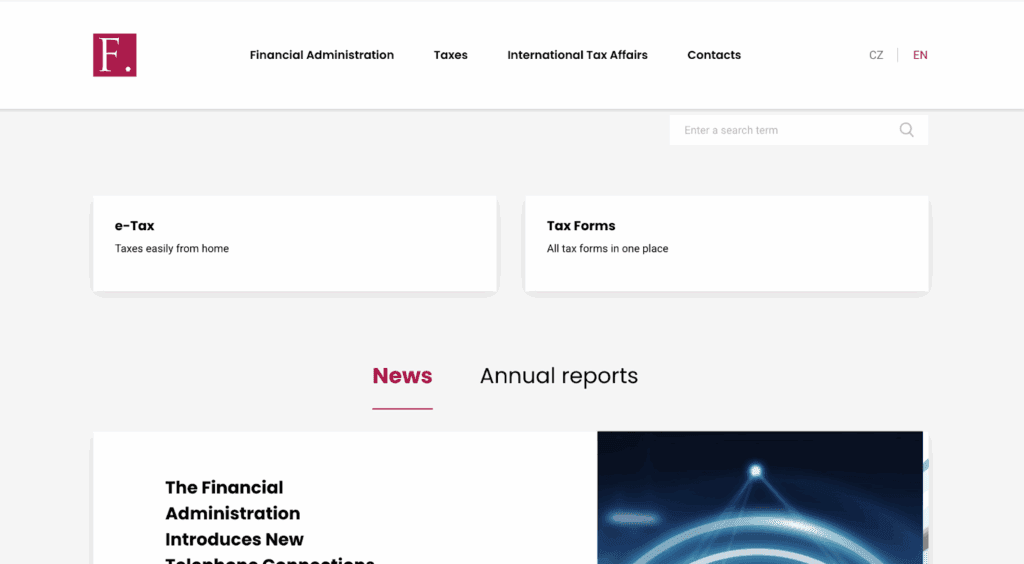
4. Upload Documents & Submit: Attach all supporting documents in PDF format, review your application, and submit online.
5. Pay Fee if Required: Generally, VAT registration in the Czech Republic is free of charge, but check if any administrative charges apply for specific cases (e.g., fiscal representative verification).
6. Receive Tax-ID: Once approved, you’ll receive your Czech VAT Identification Number (DIČ), typically within 15–30 days.
Required Documents Checklist
To register for VAT in the Czech Republic as a foreign business, you’ll need the following:
- Certificate of Incorporation
- Directors’ IDs or Passports
- Proof of Business Activity
- Bank Letter
- Signed Power of Attorney
Processing Time & Government Fees
Knowing how long it takes to register for VAT online in Czech Republic any fees or deposits apply helps businesses plan their compliance timeline and cash flow effectively.
- Processing Time: VAT registration in the Czech Republic typically takes 3 to 6 weeks after submission of complete documentation. Delays can occur if additional clarifications are requested by the tax office.
- Government Fees: There is no government fee for VAT registration itself.
- Security Deposit / Guarantee: In some cases (e.g., high-risk sectors or new businesses), the tax authority may request a financial security deposit. This amount varies.
Post-Registration Obligations
Staying compliant post-registration is just as important. Here’s what foreign businesses must manage regularly once VAT registration is complete in the Czech Republic.
- Filing Frequency: Most non-resident businesses must file monthly VAT returns. The filing deadline is usually the 25th day of the following month.
- Payment Deadlines: VAT payment is due on the same day as the return filing deadline.
- E-Invoicing / SAF-T / e-Waybill Rules: E-invoicing is not yet mandatory for B2B transactions but is encouraged. A Control Statement (Kontrolní hlášení) is mandatory for most taxpayers, including non-residents, and must be submitted monthly.
- Currency Conversion: VAT must be reported in Czech koruna (CZK) using the Czech National Bank (CNB) exchange rate applicable on the transaction date or the last day of the tax period.
- Record-Keeping: Businesses must keep VAT records for at least 10 years.
Claiming Input-Tax Credits & Refunds as a Non-Resident
Once you’ve met your ongoing filing and payment obligations, the next key aspect is understanding how to recover VAT through input-tax credits or refunds, especially if you’re a non-resident business.
- Eligibility: Non-resident businesses registered for Czech VAT can generally claim input tax on local business expenses. If not registered, refunds may be claimed under the EU VAT refund scheme (for EU businesses) or the 13th Directive procedure (for non-EU businesses).
- Documentation Standards: Original invoices showing the supplier’s VAT number and correct VAT amount.
- Import documentation (if applicable).
- Proof of payment may be required for certain claims.
- Refund Timelines:
- EU businesses: Refund applications typically processed within 4 months of submission (maximum 8 months if additional information is requested).
- Non-EU businesses: Processing can take 6–12 months under the 13th Directive procedure.
Penalties for Non-Registration or Non-Compliance
Failing to meet VAT obligations in the Czech Republic can lead to serious penalties, including fines, interest charges, and even criminal liability.
- Late Registration or Failure to Register: Tax code allows fines up to CZK 500,000 for failing to register or notify changes upon entering taxable activities.
- Late or Incorrect VAT Returns: Filing a VAT return late (beyond 5 days after the deadline) may incur a CZK 500 penalty plus 0.05% per day on the VAT due, capped at 5% or CZK 300,000.
- Late VAT Payments (Interest): Late VAT payments accrue interest calculated at the Czech National Bank repo rate + 14% per annum, applied from the 5th working day after the due date.
Deregistration and VAT Number Changes
Foreign businesses that no longer have VAT obligations in the Czech Republic need to follow a formal process to deregister or update their VAT registration. Here’s how to proceed:
When to Deregister
- You have ceased making taxable supplies in the Czech Republic (e.g., stopped trading or reached exemption thresholds).
- Your annual turnover has dropped below CZK 2 million, making deregistration possible under new small business provisions.
How to Deregister or Transfer VAT Registration
- Submit a VAT cancellation request via the official Czech e-Government portal or at your tax office.
- Ensure all VAT liabilities are settled and file a final VAT return up to the deregistration date.
- Adjust VAT deductions for fixed assets still held beyond the allowed depreciation period, especially if VAT was previously claimed.
- Receive official confirmation of deregistration; VAT obligations cease from the next day, assuming clearance of all dues.
VAT Number Changes & Transfers
- If your legal entity changes form without dissolution (e.g., reclassification), your VAT number remains valid. No new registration is needed.
- If your business is transferred or split, the new entity becomes a VAT payer and must register within 15 days of transfer or reorganization.
- In case of succession, e.g., inheritance, the heir continues VAT registration and must notify the tax authority within 15 days.
Deregistration and VAT number updates in the Czech Republic require timely action and compliance with local tax rules. Failure to notify the tax authority, settle outstanding liabilities, or adjust input tax can lead to penalties and legal complications.
Conclusion
Non-resident tax registration in Czech Republic is a legal requirement for businesses making taxable supplies in the country. Understanding thresholds, nexus rules, compliance timelines, and filing obligations helps avoid penalties and operational disruptions. While the process is straightforward, complexities such as financial guarantees, control statements, and post-registration duties make it essential to stay compliant.
If you’re looking to simplify VAT registration, filing, and compliance across Europe, partnering with an expert service like Commenda ensures timely registrations, accurate filings, and peace of mind. Book a demo now.