An invalid supplier VAT number in the Gulf Cooperation Council (GCC) costs you money. Denied input Value Added Tax (VAT) recovery and penalties for incorrect returns follow fast. The fix is simple: every live GCC VAT regime runs a free official lookup, and this guide covers all of them. The six GCC states agreed a Common VAT Agreement in 2016 setting a 5% standard rate, but only four run VAT today.
Use this guide to verify a GCC tax registration number in the country that issued it, check the format, and know when a missing number is legitimate.
How Do You Verify a GCC VAT Number Online?
Use the official national tax authority portal for the country that issued the number. All four live GCC VAT systems offer a free public lookup, and none require an account or a paid agent. There is no single GCC-wide portal, so you check each number on its home country’s site.
| Country | Authority | Portal | What you enter | What it returns | Source |
|---|---|---|---|---|---|
| UAE | Federal Tax Authority (FTA) | TRN Verification / Status Check | 15-digit TRN + security code | Registered legal name (English + Arabic) | FTA |
| Saudi Arabia | ZATCA | VAT Registration Verification e-service | VAT / CR / certificate number | Registration status + entity name | ZATCA |
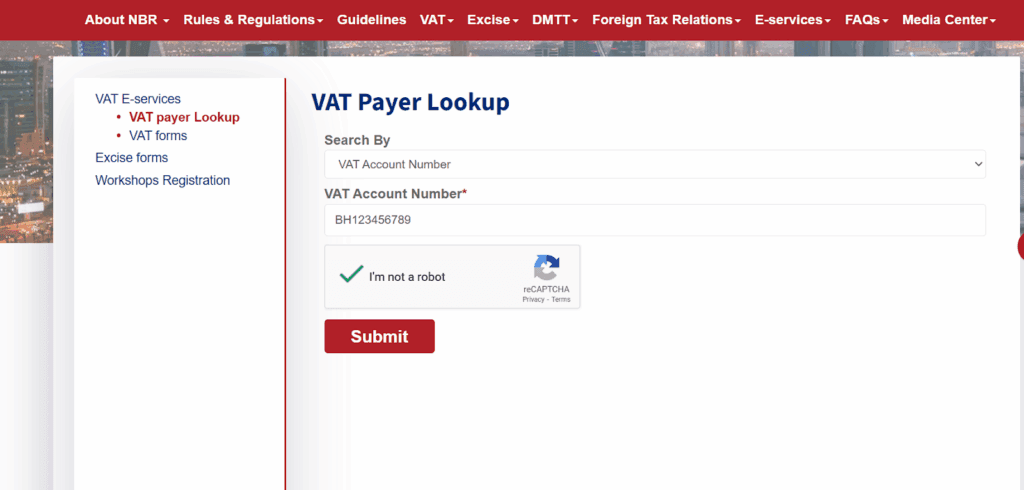
| Bahrain | National Bureau for Revenue (NBR) | VAT Payer Lookup | 15-digit VAT account number | VAT payer status | NBR |
| Oman | Oman Tax Authority | VATIN lookup | VATIN or Tax Card Number | Registration status | Oman Tax Authority |
| Qatar | General Tax Authority (GTA) | Dhareeba portal (no VAT) | Contact only | No VAT verification | GTA |
| Kuwait | Ministry of Finance | Ministry of Finance (no VAT) | No public tool | No VAT verification | Kuwait MoF |
What Is a VAT ID in the GCC?
A VAT ID in the GCC is the tax registration number that each national tax authority issues to a registered taxable person. The name changes by country: the UAE calls it a TRN (Tax Registration Number), Saudi Arabia a VAT number or TIN (Tax Identification Number), Bahrain a VAT account number, and Oman a VATIN (VAT Identification Number). It is the same tool under four labels.
Only four of the six GCC states run live VAT systems: the UAE, Saudi Arabia, Bahrain, and Oman. Qatar and Kuwait have not implemented VAT. The legal basis for each ID is the GCC Common VAT Agreement, which requires each state to assign a Tax Identification Number on registration (Article 53). The number appears on tax invoices, VAT returns, and authority communications.
How Do You Verify a UAE TRN Online With the FTA?
Enter the 15-digit TRN plus the on-screen security code on the FTA’s TRN verification tool and click Submit. A valid TRN returns the registered legal name in English and Arabic. The FTA offers this lookup free with no login required, separate from its authenticated services.
The tool now sits within the FTA’s EmaraTax platform, which launched on 5 December 2022. The FTA confirmed its e-services address stayed the same through that migration. UAE TRNs are issued under Federal Decree-Law No. 8 of 2017, effective 1 January 2018. For a step-by-step walkthrough, see Commenda’s UAE TRN verification guide.
How Do You Check a Saudi Arabia VAT Number With ZATCA?
Use ZATCA’s VAT Registration Verification e-service at zatca.gov.sa, enter the VAT account number, and the tool returns the registration status and entity name. The ZATCA e-service is free and also accepts a Commercial Registration number or VAT certificate number. ZATCA stands for the Zakat, Tax and Customs Authority.
Saudi Arabia raised its standard VAT rate to 15% in July 2020, so a Saudi VAT number carries the highest rate in the region. Verify the counterparty before you accept a 15% input claim.
How Do You Verify VAT Numbers in Bahrain and Oman?
Bahrain uses the National Bureau for Revenue (NBR) VAT Payer Lookup: enter the 15-digit VAT account number and search. Oman uses the Oman Tax Authority portal’s VATIN lookup, searchable by VATIN or Tax Card Number. Both are free public tools with no agent required.
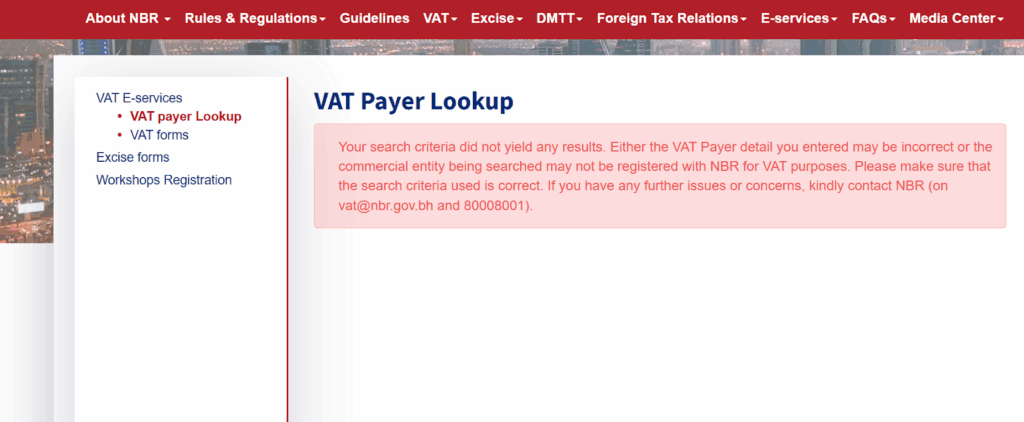
Bahrain’s NBR VAT Payer Lookup confirms whether a business is registered. Oman’s Oman Tax Authority VAT portal returns the VATIN registration status. A “no results” response means the detail is wrong or the entity is not registered.
Do Qatar and Kuwait Have VAT Numbers to Verify?
No. Neither Qatar nor Kuwait has implemented VAT, so there is no VAT number to verify in either country. Both signed the 2016 GCC Common VAT Agreement, which only binds a state once it enacts its own local law (Article 78), and neither has done so.
Qatar’s General Tax Authority (GTA) runs the Dhareeba portal for other taxes, but it holds no VAT register. Kuwait’s Ministry of Finance offers no public verification tool. If a Qatari or Kuwaiti supplier has no VAT number, that is expected, not a red flag.
What Is the VAT ID Number Format in Each GCC Country?
GCC VAT numbers are 15-digit numeric strings with no alphabetic country-code prefix. The EU-style “AE” or “SA” letter prefix does not apply in the GCC. Each authority sets its own internal structure, but the length is consistent across the four live regimes.
| Country | Length | Structure notes | Source |
|---|---|---|---|
| UAE (TRN) | 15 digits | Numeric only, commonly starts with “100” | FTA VAT User Guide |
| Saudi Arabia | 15 digits | Numeric only, begins with 3 | ZATCA |
| Bahrain | 15 digits | Numeric account number | NBR |
| Oman | VATIN | VATIN or Tax Card Number | Oman Tax Authority |
The FTA VAT User Guide shows example TRNs like 100511614800003, all 15 digits starting with 100.
What Are Common Typos in GCC VAT Numbers?
The most common errors are missing digits, transposed digits, and added spaces. Because GCC numbers are all-numeric and 15 digits long, a 14-digit entry or a stray space breaks the lookup. Copying a number from a scanned invoice often drops a digit or reads a 1 as a 7. Always count to 15 and remove spaces before you submit.
What Are the VAT Registration Thresholds in the GCC?
Each implementing state sets a mandatory and a voluntary registration threshold in local currency. A counterparty below the mandatory threshold may legitimately have no VAT number. The GCC Common VAT Agreement fixes the mandatory threshold at SAR 375,000 or its local equivalent (Article 50), with voluntary registration at half that figure.
| Country | Mandatory | Voluntary | Standard rate | Effective | Source |
|---|---|---|---|---|---|
| UAE | AED 375,000 | AED 187,500 | 5% | Jan 2018 | FTA |
| Saudi Arabia | SAR 375,000 | SAR 187,500 | 15% (from 5%, Jul 2020) | Jan 2018 | ZATCA |
| Bahrain | BHD 37,500 | BHD 18,750 | 10% (from 5%, Jan 2022) | Jan 2019 | Bahrain National Portal |
| Oman | OMR 38,500 | OMR 19,250 | 5% | Apr 2021 | Oman Tax Authority |
The UAE reconfirms its AED 375,000 mandatory and AED 187,500 voluntary thresholds in current FTA guidance, and a liable business has 30 days to register.
Why Should You Verify a Supplier’s VAT ID Before Payment?
An invalid supplier VAT number puts your input VAT recovery at risk and exposes you to penalties for incorrect returns. Verification belongs in vendor onboarding and every pre-payment check. If the number does not resolve on the issuing authority’s portal, you cannot safely reclaim the VAT the supplier charged.
Beyond recovery, verification protects you from fraud and supports counterparty due diligence. Many GCC buyers require a valid VAT number before they onboard a vendor. Free-zone entities and cross-border suppliers add complexity, because registration status varies by activity and location. A quick lookup before payment settles it.
What Penalties Apply for VAT Non-Compliance in the GCC?
Penalty regimes differ sharply by country, and Bahrain carries criminal exposure for evasion. Fines attach to late registration, incorrect returns, and poor record-keeping. Verifying supplier numbers reduces the incorrect-return risk that triggers many of these penalties.
| Country | Violation | Penalty | Source |
|---|---|---|---|
| UAE | Late VAT registration | Fixed AED 10,000 administrative penalty | FTA VAT User Guide |
| Saudi Arabia | VAT violations / late payment | Fines up to SAR 50,000, plus up to 25% of tax due | ZATCA |
| Bahrain | Serious VAT evasion | Fines up to BHD 10,000 and imprisonment | NBR |
| Oman | VAT evasion | Fines and potential imprisonment | Oman Tax Authority |
The FTA sets a fixed AED 10,000 penalty for failing to register within the legal timeframe.
What Should You Do if a VAT Number Shows as Invalid?
Recheck the digits against the invoice, confirm the format matches the issuing country, then re-run the lookup. If it still fails, ask the supplier for their registration certificate and confirm directly with the tax authority. Most failures are entry errors, not fraud, so start with the number itself.
| Result | Likely cause | Fix |
|---|---|---|
| Invalid / not recognized | Wrong or unregistered number | Re-enter, count to 15 digits |
| Inactive | Deregistered or newly issued | Confirm activation with the authority |
| No record found | Wrong country’s portal, or not activated | Use the issuing country’s portal |
| Mismatch with records | Name or detail differs | Confirm details against the certificate |
Newly issued numbers can take several days to appear in the public lookup tools, so a brand-new registration may not resolve immediately.
How Can You Verify VAT Numbers in Bulk?
Official GCC portals only support one lookup at a time, so finance teams with hundreds of vendors need automated validation. Commenda validates VAT numbers through CSV upload and API, turning a manual portal-by-portal chore into one workflow. Manual lookups are a real cost of VAT compliance at scale.
Commenda connects to your stack through 100+ ERP, API, and custom integrations, so validation runs against your existing vendor master. Instead of visiting four national portals per supplier, your team checks the full ledger in one place.
How Commenda Helps With GCC VAT Compliance
Commenda’s global indirect tax software handles VAT registration, validation, filing, and ongoing compliance across the GCC and beyond, so finance teams get certainty that supplier numbers are checked and filings are tracked. Its tax ID verification tool covers the four live GCC regimes, and its compliance calendar tracks filing deadlines by country and entity. For UAE-specific detail, start with the UAE TRN verification guide.
Book a demo to see bulk VAT number validation run on your own vendor list.