VAT registration in Austria is important for foreign companies to ensure compliance with Austrian tax laws, avoid penalties, and seamlessly conduct business in the Austrian market. This blog explains VAT registration in Austria, including eligibility, process, and compliance.
Why Non-Resident Firms Must Register for VAT in Austria
VAT registration in Austria is mandatory for foreign businesses to meet local tax obligations, avoid significant fines, and maintain smooth customs and cross-border operations. For non-EU firms, VAT registration for non-resident businesses in Austria is required from the very first taxable transaction, ensuring legal compliance, access to input tax deductions, and unhindered trade with Austrian customers.
Regardless of turnover, non-resident (especially non-EU) businesses must register for VAT before their initial taxable supply in Austria. Registered non-resident businesses can claim input tax credits, avoid customs delays, and ensure invoicing and logistics proceed without interruption.
When Does a Foreign Business Need to Register? Key Triggers
Foreign entities must consider VAT registration in Austria well before initiating operations, as missing this step risks fines, shipping delays, or blocked sales. Here are the primary situations that trigger mandatory registration:
- Storing Goods in Austria: If you hold inventory within Austria, whether for sale, distribution, or consignment, you must register for VAT, even if goods originate from another EU country.
- Selling Goods to Austrian Customers: Any direct sale of goods to Austrian consumers or businesses requires VAT registration, unless using the EU OSS scheme for distance sales.
- Importing Goods into Austria: Imports from non-EU countries into Austria always necessitate VAT registration and payment.
- Intra-Community Transactions:
- Acquisitions: If Austria-based buyers receive goods from your EU-based business, and you’re not part of the OSS, VAT registration may be needed.
- Supplies: Selling goods from your business (within the EU) to Austrian recipients often requires VAT registration if the reverse charge doesn’t apply.
- Providing Services Subject to Austrian VAT: If you supply services to Austrian recipients on which Austrian VAT is due (i.e., reverse charges do not apply), you must register before delivery.
Country-Specific Examples
These illustrate common real-world scenarios prompting VAT registration in Austria:
- UK: A UK retailer storing stock in an Austrian fulfillment center triggers a VAT registration obligation for VAT registration in Austria, regardless of turnover.
- USA: For a US manufacturer importing electronics into Austria for local sale, each import requires VAT registration, even if the import volume is small.
Note: For a complete procedural walkthrough, refer to the VAT registration guide from the Austrian government, which outlines each step with timelines and documentation needs.
Registration Thresholds & Nexus Tests
VAT registration in Austria doesn’t follow a one-size-fits-all rule. Resident companies must register if their taxable turnover exceeds €55,000 per year. There is a nil threshold for non-resident or foreign businesses; VAT registration for foreign companies in Austria is mandatory from the outset.
Digital Services
Foreign businesses supplying digital services (e-books, software, streaming, etc.) directly to Austrian consumers (B2C) must register for VAT regardless of their revenue size in Austria. The only exception to this rule is if they use the EU OSS scheme and stay below the €10,000 threshold.
Low-Value Imports
While Austria no longer supports a low-value import exemption (goods above minimal values are subject to VAT and duty), sellers using the Import One-Stop Shop (IOSS) can simplify VAT handling on imports valued up to €150.
Austria VAT Number Format Explained
While looking at VAT registration in Austria, it is important to understand the format of the VAT ID number. The following table gives a breakdown of the VAT ID structure in Austria:
| Component | Description |
| Country Prefix | AT (Austria’s ISO code) |
| VAT Indicator | U (denoting Umsatzsteuer) |
| Identifier | 8 unique digits |
Sample VAT ID numbers include:
- Standard Business: ATU12345678
- Large Enterprise: ATU87654321
- Branch of Foreign Entity: ATU11223344
Common typos to watch out for include missing the leading AT, omitting the U, or miscounting digits. Accurate formatting is vital for VIES validation and ensures uninterrupted invoicing and compliance across the EU.
One platform to simplify global tax and compliance
See why high-growth companies trust Commenda
Is a Local Tax Agent or Fiscal Representative Required?
Non-resident businesses do not always need to appoint a local tax agent or fiscal representative for VAT registration in Austria. However, they may choose to do so for ease of compliance. If appointed, the representative may assume joint liability for VAT obligations. Some jurisdictions may require a bank guarantee or bond to secure tax payments, though this varies by country.
Special Schemes & Simplifications
Austria offers several simplifications to make compliance easier for businesses undergoing VAT registration in Austria. These schemes are particularly useful for small firms, e-commerce sellers, and cross-border traders. Key options include:
- Import VAT Deferment: Registered businesses can defer import VAT by declaring it in their VAT return instead of paying at customs.
- OSS & IOSS (Simplified E-Services Scheme): Digital service providers and distance sellers can use the EU’s OSS or IOSS for simplified VAT collection across borders.
- Small-Business Exemption: Businesses with a turnover below €55,000 annually are exempt from charging VAT, though this does not apply to non-resident firms.
- Consignment & Warehousing: EU simplifications allow VAT-registered businesses holding stock in Austrian warehouses to use streamlined reporting mechanisms.
Step-by-Step: How to Register for VAT in Austria
VAT registration in Austria is managed by the Austrian tax authorities (Finanzamt). The process is straightforward but requires accurate documentation to ensure compliance. Here’s a step-by-step guide to help you through the VAT registration in Austria:
- Check VAT Threshold: Register if turnover exceeds €55,000; non-residents may need immediate registration.
- Gather Required Documents: Company registration, proof of activity, articles of association, and bank details.
- Create a Government Gateway Account: Register an account via the FinanzOnline portal.
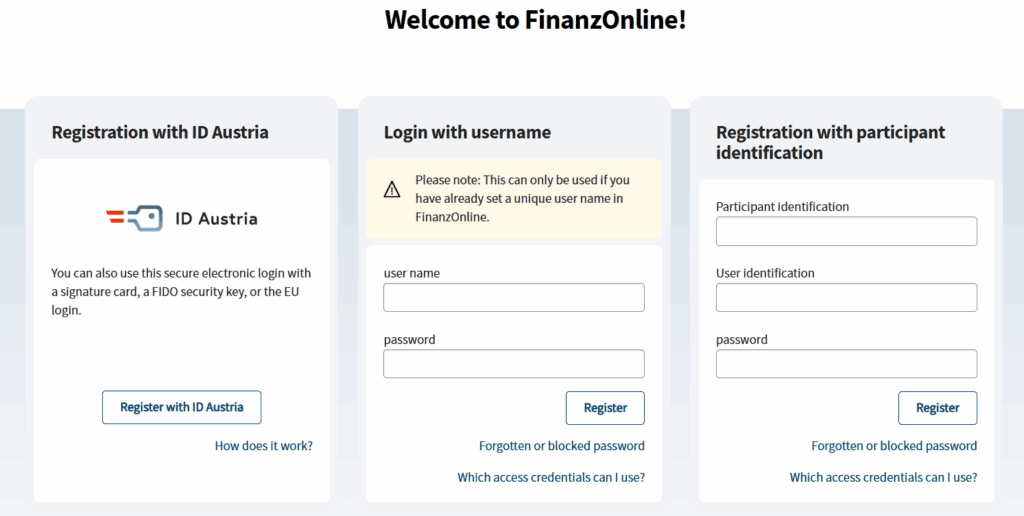
- Submit Application: Complete Form U15 for non-residents and upload documents.
- Pay Any Applicable Fees: Usually, no fee, but confirm with the tax office.
- Receive VAT Registration Number: Wait for the Austrian tax authority to process your application and send you your VAT ID.
Required Documents Checklist
When applying for VAT registration in Austria, businesses must provide specific documents to verify their legal status and business activities. Preparing these in advance will help ensure a smooth registration process with the Austrian tax authority.
- Certificate of Incorporation/Trade Register Extract: Proof of company formation and legal existence.
- Directors’ IDs/Passports: Valid identification for company directors or legal representatives.
- Proof of Business Activity: Contracts, invoices, or sales records demonstrating taxable operations in Austria.
- Bank Account Details: Documentation of a business bank account used for transactions.
- Signed Power of Attorney (if using an agent): Required if a tax representative submits the application on your behalf.
Processing Time & Government Fees
If you choose to register for VAT online in Austria, it’s important to understand the expected timelines and potential costs involved. A straightforward VAT registration usually takes 1-2 weeks, although more complex cases may stretch to 2–3 months depending on documentation quality and tax authority workload.
There is no standard fee charged by Austrian authorities for processing VAT registrations. However, non-EU businesses may incur additional costs if a fiscal representative is required, or if a bank guarantee is requested to secure VAT liabilities.
Post-Registration Obligations
Once you’ve completed VAT registration in Austria, you must meet several ongoing obligations to remain compliant and avoid penalties. Below is a list of these requirements you should always keep track of:
- Periodic VAT Returns: Businesses with annual turnover above €100,000 must file monthly returns; those between €30,000–100,000 may file quarterly.
- Annual VAT Return: Due June 30 for electronic and April 30 for paper declarations.
- Intra-EU Declarations (ESL / Intrastat): If you’re trading with other EU countries, an ESL should be filed monthly or quarterly. Intrastat required if trade exceeds thresholds.
- Invoice and Record-Keeping Requirements: Issue VAT-compliant invoices on time. Keep invoices/records for 7 years.
- Penalties for Non-Compliance: Late filing up to a 10% penalty; late payment 2% surcharge; errors may trigger fines.
Claiming Input-Tax Credits & Refunds as a Non-Resident
Foreign businesses that incur VAT in Austria may be eligible to reclaim it without completing non-resident tax registration in Austria. Refunds are processed under the EU VAT refund system (for EU businesses) and the 13th Directive refund scheme (for non-EU businesses). Here’s what you need to know:
- Eligibility: Non-resident businesses can apply if they are VAT-registered in their home country and do not maintain a fixed establishment in Austria.
- Documentation: Applications must include the official refund form, original invoices, proof of business registration, and sometimes a certificate of taxable status.
- Refund Timelines: Claims should be submitted by September 30 of the year following the refund period (for Non-EU business, the deadline is June 30). Processing typically takes 4–8 months.
- Rejection Reasons: Refunds may be denied for missing documents, late submissions, or ineligible expenses (such as entertainment costs).
Penalties for Late Registration or Non-Compliance
Failure to comply with VAT registration in Austria or ongoing VAT obligations can result in financial penalties and administrative restrictions. Austrian tax authorities take timely registration, accurate reporting, and payment very seriously. Below is a summary of potential consequences:
- Late VAT Return Filing: A penalty of up to 10% of the VAT due may be imposed if a VAT return is submitted late, even if payment has been made on time.
- Late VAT Payment Surcharges: An interest surcharge of 2% applies to VAT paid late. If the payment remains unpaid 3 months after the due date, an additional 1% surcharge is added, followed by a further 1% surcharge if still unpaid after another 3 months.
- Late Registration: Generally, late registration isn’t penalized. However, intentional delays or incorrect voluntary actions can trigger a fine of up to €5,000.
- Import/Export Restrictions: Authorities may block goods at customs until VAT issues are resolved.
- Personal Liability: In severe cases, company directors or representatives may be held personally liable for unpaid VAT.
Deregistration & VAT Number Changes
When your business activity in Austria winds down or changes, effectively deregistering or updating your VAT details is essential to avoid continued obligations. Below is a clear breakdown of when and how to proceed with VAT changes or deregistration in Austria:
- When to Deregister: If you cease taxable operations or no longer hold inventory in Austria, you should cancel your VAT registration to stop further obligations.
- Deadline: There’s no fixed deregistration deadline. You can submit a cancellation request at any time of year once your affairs are fully settled.
- Online Cancellation: Deregistration requests can be sent electronically, typically via FinanczOnline, or submitted to your responsible tax office. Ensure all VAT returns are filed and liabilities cleared beforehand.
Austrian VAT numbers remain with the entity for its lifespan. Changes, like company restructuring, require notifying the tax office and possibly issuing a new UID. If official guidance or forms are required, businesses can consult the Finanzamt for specifics.
Conclusion
Understanding VAT registration in Austria is essential for any foreign business operating in the country. Whether you need to register due to exceeding the VAT threshold, voluntarily register, or update/cancel your VAT registration, meeting deadlines and following Austrian tax regulations is crucial to avoid penalties.
VAT registration can be complex for non-resident companies, but Commenda can help. Our experienced team specializes in assisting foreign businesses with VAT registration and ongoing compliance with the Austrian tax authorities.
Focus on expanding your business in Austria while we manage your VAT obligations. Book a free demo with Commenda today and discover how we can simplify your VAT processes.
About the author

Sam is a seasoned expert in sales tax, leading Commenda's effort to build the worlds most comprehensive database of global tax rules and business regulations. At Silverhaze Partners, he worked in early-stage venture capital, where he saw firsthand how tax complexity and regulatory friction hold back startups from scaling internationally. That experience now powers his work at Commenda-bringing clarity, precision, and real-world insight to one of the most frustrating parts of doing business globally.
Disclaimer: Commenda and its affiliates do not provide tax, accounting, or legal advice. This material has been prepared for informational purposes only, and is not intended to provide or be relied on for tax, accounting, or legal advice. You should consult your own tax, accounting, and legal advisors before engaging in any related activities or transactions.