Sales tax on digital goods is an emerging problem for online enterprises. Digital product sales tax accounts for 3% of US consumer expenditures and is still growing. Whether you sell e-books, streaming services, SaaS, assets for in-game purchases, or online courses, evading unreasonable fines requires proper comprehension of digital products sales tax in all 50 states, including DC and US territories.
With such resources, by the end of this guide, you will be able to manage digital sales tax by state seamlessly.
What Are Digital Goods?
Digital goods can be defined as any type of good that is not physically existent and is sent through electronic means, hence, no postal service is needed. In other words, delivered electronically. However, tax policies tend to group them alongside “tangible personal property”. It will be further detailed in terms of categorization, delivery modes, and other intricacies.
Primary Categories
| Category | Examples |
|---|---|
| Audio Works | MP3s, podcasts, audiobooks, ringtones |
| Audio-Visual Works | Movies, TV episodes, video courses |
| Digital Books & Periodicals | E-books (Kindle), digital magazines, online newspapers |
| Software & Games | Downloadable software, console/PC games, mobile apps |
| Cloud & SaaS | Subscription tools (CRM, accounting), web-based IDEs |
| In-Game Assets | Skins, DLC, in-game currency, subscriptions (e.g. Xbox Game Pass) |
| Digital Art & NFTs | Graphic designs, tokenized art, 3D models |
| Stock Media | Photos, video clips, audio loops, design templates |
| Online Courses & Webinars | Video lectures, interactive modules, certification exams |
| Digital Tickets & Access | Virtual event passes, gated content subscriptions |
Delivery Methods & Tax Consequences
- Permanent Downloads: “Tangible Property” state laws’ tax often applies to files with downloads offered indefinitely.
- Streamed/Accessed Content: Timed or subscription-limited access to services is commonly treated as a communication or service.
- Hybrid Models: Some offerings that bundle downloads with cloud access must be split-tax treated.
Why Are Digital Products Taxed Differently?
Such taxation policies have roots in historical statutes, court rulings, and policy goals.
Pre-Wayfair vs. Wayfair Nexus
- Pre-2018: Collection responsibilities triggered by having a physical presence (office, warehouse) came with needing a foothold in the market. Remote sellers without a footprint provided a large exemption.
- South Dakota v. Wayfair (2018): This case changed the economic nexus standard, allowing states to require the collection of taxes based on certain revenue or transaction levels even without a physical presence in the state.
Driving Forces Behind Policies
- Revenue Neutrality: Add parity ceiling for both online sellers and brick-and-mortar retailers.
- Fairness: Eliminate competitive disadvantage for state retailers.
- Modernization: Address gaps in definitions that are outdated and not reflective of today’s digital commerce.
Streamlined Sales Tax Agreement (SST)
- Membership: A total of 24 states and territories of the United States of America, which share common definitions of specified digital products (SDPs).
- Border State Discretion: Even among participants of the SST, each border state has the option to select which SDPs they want to impose tax on.
- SST Definitions:
- Digital audio-visual works
- Digital audio works
- Digital books
States that exempt digital goods from sales tax
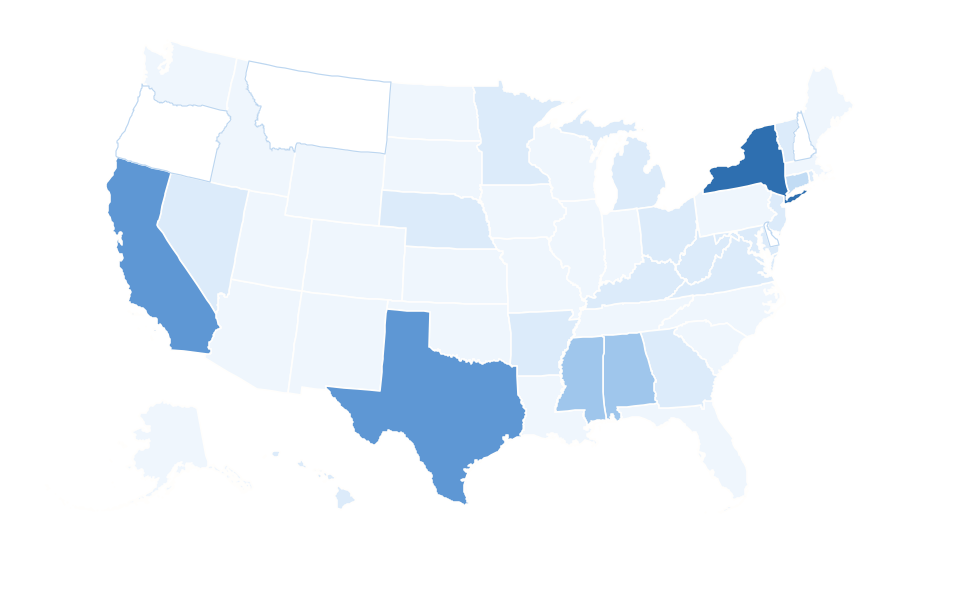
The table below provides a more detailed breakdown of each jurisdiction’s preferred position. The rates shown are the sum of state and average local taxes.
| State / Territory | Taxable Digital Categories* | State Rate | Local ? | Combined Avg Rate* | Notes & Links |
|---|---|---|---|---|---|
| Alabama | SDPs & software | 4.00% | Yes | 9.29% | Fully taxable; consult AL DOR |
| Alaska | Local taxes on downloads/SDPs | 0.00% | Yes | 1.82% | No state tax; Borough rates vary |
| Arizona | SDPs, software | 5.60% | Yes | 8.38% | “Tangible personal property” definition |
| Arkansas | SDPs, SaaS | 6.50% | Yes | 9.45% | Digital advertising tax separate |
| California | Download + physical media taxable | 7.25% | Yes | 8.85% | Digitally-only exempt; see CA CDTFA |
| Colorado | Software, downloaded media | 2.90% | Yes | 7.81% | Cloud services exempt under 2018 amendment |
| Connecticut | SDPs, software (personal use) | 6.35% | No | 6.35% | Reduced 1% rate for business use |
| Delaware | — (no sales tax) | 0.00% | No | 0.00% | Jurisdiction of incorporation |
| DC | SDPs, software, apps | 6.00% | No | 6.00% | Includes streaming lanes |
| Florida | Exempts digital goods | 6.00% | Yes* | 7.00% | Communications tax applies |
| Georgia | SDPs, software, codes | 4.00% | Yes | 7.38% | Economic nexus threshold: $100K |
| Hawaii | SDPs, streaming, SaaS | 4.00% | Yes | 4.50% | Uses General Excise Tax (GET) |
| Idaho | SDPs (permanent licenses) | 6.00% | Yes | 6.03% | Leases/exempt subscriptions |
| Illinois | Download exempt; streaming taxable* | 6.25% | Yes | 8.86% | Chicago amusement tax on streaming |
| Indiana | SDPs with permanent right | 7.00% | No | 7.00% | Ringtones & photos if permanent |
| Iowa | SDPs, SaaS | 6.00% | Yes | 6.94% | “Commercial use” exemption |
| Kansas | Download exempt; streaming exempt | 6.50% | Yes | 8.65% | Did not adopt SST digital def. |
| Kentucky | SDPs, software | 6.00% | No | 6.00% | Limited carve-outs exist |
| Louisiana | Downloads taxable | 4.45% | Yes | 9.55% | Digital advertising tax pending |
| Maine | SDPs, SaaS | 5.50% | No | 5.50% | Exempts streaming subscriptions |
| Maryland | SDPs, digital downloads | 6.00% | No | 6.00% | Digital ad tax enacted in 2021 |
| Massachusetts | Software taxed; other SDPs exempt | 6.25% | No | 6.25% | E-books & video exempt |
| Michigan | Prewritten software taxable | 6.00% | No | 6.00% | Other digital goods exempt |
| Minnesota | SDPs, software | 6.88% | Yes | 8.04% | Photos & data exempt |
| Mississippi | SDPs, ebooks, photos | 7.00% | Yes | 7.08% | No carve-outs for SaaS |
| Missouri | Exempts digital downloads | 4.225% | Yes | 8.39% | Letter ruling for exemptions |
| Montana | — (no general sales tax) | 0.00% | No | 0.00% | Ideal for digital-only businesses |
| Nebraska | SDPs, codes | 5.50% | Yes | 6.97% | Streaming services included |
| Nevada | Exempts SDPs | 6.85% | Yes | 8.24% | No tax on digital downloads |
| New Hampshire | — (no general sales tax) | 0.00% | No | 0.00% | Use tax exists for intangibles |
| New Jersey | SDPs, installation services | 6.63% | No | 6.63% | Includes support & training |
| New Mexico | Gross receipts on digital goods | 4.88% | Yes | 7.62% | Lacks SST adoption |
| New York | Exempts SDPs* | 4.00% | Yes | 8.52% | Software remains taxable |
| North Carolina | SDPs, streaming, ebooks | 4.75% | Yes | 7.00% | Economic nexus: $100K/200 txns |
| North Dakota | Exempts SDPs | 5.00% | Yes | 7.04% | No telecom tax on streaming |
| Ohio | SDPs, SaaS, downloads | 5.75% | Yes | 7.24% | Marketplace facilitator rules |
| Oklahoma | Exempts digital goods | 4.50% | Yes | 8.99% | Cloud services taxable |
| Oregon | — (no general sales tax) | 0.00% | No | 0.00% | Source-free digital downloads |
| Pennsylvania | SDPs, streaming, codes | 6.00% | Yes | 6.34% | Local rates minimal |
| Puerto Rico | SDPs, streaming | 10.50% | Yes | 11.50% | Territorial tax system |
| Rhode Island | SDPs, SaaS | 7.00% | No | 7.00% | Streaming & downloads taxed |
| South Carolina | Exempts software delivered electronically | 6.00% | Yes | 7.50% | Streaming taxable |
| South Dakota | SDPs, SaaS | 4.20% | Yes | 6.11% | Origin sourcing rule |
| Tennessee | SDPs, artwork, streaming | 7.00% | Yes | 9.55% | Specified digital products |
| Texas | SDPs, streaming, SaaS | 6.25% | Yes | 8.20% | Matches tangible tax status |
| Utah | SDPs, SaaS, downloaded software | 4.85% | Yes | 7.25% | No carve-out for streaming |
| Vermont | SDPs, SaaS | 6.00% | Yes | 6.36% | Photos exempt |
| Virginia | Exempts all digital products | 5.30% | Yes | 7.75% | Failed 2024 digital tax bill |
| Washington | SDPs, streaming, SaaS | 6.50% | Yes | 9.38% | All digital products taxable |
| West Virginia | Exempts SDPs | 6.00% | Yes | 6.57% | Streaming taxed separately |
| Wisconsin | Exempts SDPs if tangible sale exempt | 5.00% | Yes | 5.70% | Software taxable if prewritten |
| Wyoming | SDPs, SaaS | 4.00% | Yes | 5.44% | Perm. use criterion |
- SDPs = specified digital products (audio, audiovisual, books).
- The same as state and average local; remember to double-check locally.
- Streaming/video chat is also taxed under Florida’s communications services tax.
- Downloads are exempt in Illinois, but Chicago adds a 9% amusement tax on streaming.
- New York imposes a tax on prewritten software but does not tax software development platforms (SDPs).
Types of Digital Goods Typically Subject to Sales Tax
Downloadable Software & Games
- Perpetual License: All states that assess tax on downloads impose sales tax.
- Console and PC Games: Generally, if delivered digitally, they get lumped in with the physical media rules.
Streaming & Subscription Services
- Music and Videos: Impacted with a communications tax or general sales tax
- SaaS & Cloud Tools: Increasingly, these are taxed as a service.
E-Books, Magazines & Newspapers
- E-Books: Taxed in PA, IA, NY, and MA, exempt.
- Digital Newspapers: Some states that echo the exemptions for print editions also exempt them.
Video Games’ Virtual Items
- Skins & DLC: Taxed if the underlying game is taxable in downloadable form.
- In-Game Currency: Treated as digital codes; tends to be taxed where the base game is taxed.
Stock media, digital art, and NFTs
- Photos and Clips: Taxed under stock media rules, or often exempt under MN, MI.
- NFTs: A new type; Taxed if held as personal property in most states, treated as artwork/software.
Online Courses and Digital Publications
- Webinars and Modules: A subset of digital audiovisual works that are taxable.
Understanding Nexus & Sourcing for Digital Sales
Physical Nexus
Caused by:
- Offices, warehouses (including FBA)
- Remote employees
- Company vehicles
- Trade shows participation
Freelancers, even those working in different states, contribute toward establishing a nexus for digital sales.
Post-Wayfair Economic Nexus
Common thresholds:
- $100,000 in annual sales or 200 transactions.
- Aggregates all sales, excluding exempt digital goods.
Example: 200 $2.99 e-book sales in SD create nexus and tax obligation.
Market Place Nexus
Major Platforms (Amazon, Etsy) shift the responsibility of tax collection to the seller when the marketplace acquires nexus.
Sourcing Rules for Digital Goods
- Destination-based: Tax follows the buyer’s billing address, shipping address, or the first location where the goods will be used.
- Origin-based: Based on the seller’s location (very few jurisdictions use this for SaaS).
Challenge: A subscriber located in CA using the service while traveling creates confusion around those sourcing rules.
Common Compliance Challenges
- Rapid changes in the law: States regularly change definitions, rates, and thresholds.
- Complexity of Multijurisdictions: Hundreds of local districts adding their levies with particular intensity in WA, TX.
- Classification Of The Product: Digital service versus tangible download.
- Data Capture for the Sourcing: Obtaining customer location (IP, billing, ship).
- Exposure During Audit: Stricter scrutiny due to the ever-changing regulations often associated with digital goods.
Best Practices for Managing Digital Goods Sales Tax
- Tax Process Automation: Implement a streamlined sales tax system through Commenda’s tax engine for real-time rate evaluation, taxability criteria, and automated filing procedures.
- Preserve Detailed Documentation: Keep detailed documentation, including transaction data, geolocation, exemption documents, and rationale for tax calculations.
- Perform Timely Self-Audits: Conduct quarterly self-reviews to identify under- or over-collection and make changes to tax codes as necessary.
- Tax Visibility: Visibly display tax charges before the final checkout stage. For ease, consider all-inclusive pricing.
- Track Regulatory Changes: Monitor Direct-of-Service Department (DOR) updates and other news with the Streamlined Sales Tax (SST) Board.
- Professional Rulings: Request a letter ruling for new taxable digital products and proposals for guides defining the tax regulation.
How to Determine If Your Digital Products Are Taxable
- Consider a Taxonomy of Products: Make an organized listing: downloads, streaming, SaaS, and other forms of media.
- Consult Each State’s Statutes and DOR Guidelines: Go through everything in each jurisdiction’s provided definitions and catchphrases with bullet points.
- Check SST Definitions: For SST states, begin with boarding SDP standards and confirm local adoptions.
- Assess Analog Versions: If there exists an analog version, the criterion for taxation would naturally extend to the digital version.
- Fetch Rulings Of One’s Own Making: If there are doubts, filing a request would be appropriate to obtain a letter ruling from the state’s revenue department.
How to Track Changes in State Digital Sales Tax Rules
Automated compliance checks and changes: systems that automatically alert when there is a change in laws or rates.
DOR Newsletters: Personalized email notifications from every Department of Revenue (DoR) in every US state.
Industry Forums & Blogs: Check out Commenda’s blog for helpful updates as well.
Contact Professional Associations: SST Board, CCH Tax, AICPA Sales Tax Committees.
Simplify Digital Goods Sales Tax Compliance with Commenda
Commenda provides a comprehensive solution for digital products sales tax:
- Multi-State Permit Management: Auto-registration in nexus states.
- Real-Time Rate Engine: State and local accuracy for rates on every transaction down to the cent.
- Automated Taxability Mapping: Off-the-shelf definitions for SDPs, SaaS, and streaming services.
- Automated Filings and Remittances: Easy e-filing across multiple jurisdictions based on predefined timeframes.
- Robust Audit Support: Cavernous access to letters of historical ruling, documentation, and expert guidance.
To ease your sales tax obligation for digital products by state, book a free demo with Commenda.
Reach out to Commenda for a tailored demo and eliminate the uncertainty from your obligations concerning multi-state digital taxation.