















Why Sales Tax Compliance Breaks Down in Syspro
Syspro is built to support structured, process-driven financial environments. U.S. sales tax, on the other hand, operates through a fragmented system of state and local rules that change independently. That disconnect often creates gaps when tax compliance relies on manual processes or basic configurations. Common points where compliance can weaken include:
- Tax rates that depend on manual updates and may lag behind current jurisdiction changes.
- Limited visibility into economic nexus exposure as sales expand into new states.
- Filing workflows that rely on spreadsheets or manual preparation, increasing error risk.
- Jurisdiction coverage that does not fully account for city or special district taxes.
Over time, these challenges increase operational pressure and make sales tax harder to manage alongside day-to-day financial responsibilities.
Who This Sales Tax Integration Is Built For
Sales tax automation for Syspro is designed for organizations that need dependable compliance without adding administrative burden to finance teams. It supports a variety of operational models, including:
- Manufacturing companies shipping products to customers across multiple U.S. states.
- Distributors managing taxable goods through complex supply chains.
- Ecommerce and hybrid sellers operating across direct and third-party channels.
- Businesses running multiple legal entities within a shared financial structure.
- Finance and accounting teams responsible for filings, audits, and reporting.
- International companies establishing or scaling U.S. sales operations.
The integration works alongside existing Syspro workflows, allowing teams to strengthen compliance without reworking established processes.
Common Sales Tax Challenges for Syspro Users
Sales tax issues often surface gradually and become harder to ignore as operations grow. Syspro users frequently encounter challenges such as:
- Increased audit exposure tied to inconsistent filings or incomplete records.
- Heavy reliance on spreadsheets to track liabilities and filing schedules.
- Difficulty coordinating compliance requirements across multiple states.
- Upcoming filing deadlines and registration requirements are not always clearly visible to finance teams.
- Added complexity from multi-channel or multi-entity sales activity.
These challenges can shift finance teams into reactive mode, making compliance feel disruptive rather than controlled.
What Is Sales Tax Automation Software for Syspro?
Sales tax automation software for Syspro is an external solution that connects to the platform to manage sales tax from calculation through filing. Instead of relying on manual calculations or disconnected tools, businesses use a dedicated tax engine that applies jurisdiction-specific rules automatically. Core capabilities typically include:
- Sales tax calculated automatically on invoices and transactions.
- Continuous monitoring of economic nexus thresholds by state.
- Sales tax returns are handled through an automated process that covers preparation, submission, and payment without manual intervention.
- A centralized view brings together tax liabilities, filing activity, and compliance status across all relevant jurisdictions.
Syspro continues to function as the primary financial system, while sales tax logic is managed separately in a way that supports scale, accuracy, and long-term control.
How Commenda Integrates With Syspro
Commenda connects with Syspro through secure API-based integration designed for finance teams, not developers. The setup aligns with existing financial operations and does not require engineering involvement. Once connected, relevant data moves automatically between systems, keeping sales tax activity out of daily workflows. The connection keeps the following information aligned:
- Transaction and invoice data so tax calculations reflect actual sales activity.
- Customer and location details to apply the correct jurisdiction rules.
- Product and service tax classification details used to apply the correct tax rules in each jurisdiction.
Sales tax automation runs quietly in the background while Syspro continues to manage core operational and financial processes.
Real-Time Sales Tax Calculation
Sales tax calculation for Syspro occurs at the transaction level using current jurisdiction rules. Each calculation reflects a combination of factors that determine how tax should be applied. Key inputs include:
- Customer location and sourcing rules that define taxing authority.
- Product or service classification under state and local regulations.
- The correct combination of state, county, city, and special district tax rates based on each transaction.
- Valid exemptions or resale certificates when available.
Accurate calculations at the point of transaction help reduce downstream adjustments and improve confidence in reported tax amounts.
Economic Nexus Monitoring and Alerts
Economic nexus laws require businesses to register and collect sales tax once sales or transaction thresholds are exceeded within a state. Tracking these thresholds manually becomes increasingly difficult as geographic reach expands.
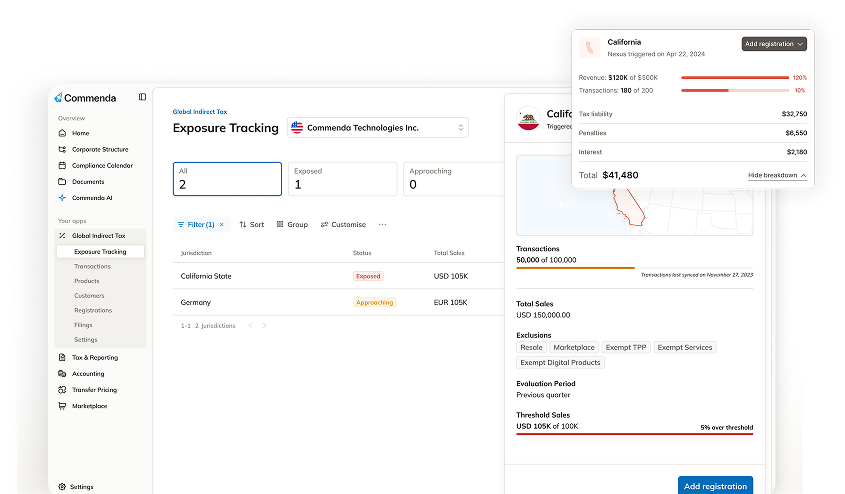
Commenda monitors economic nexus for Syspro users by continuously analyzing transaction data across jurisdictions. Advance alerts notify finance teams before thresholds are crossed, allowing time to register and prepare. This visibility helps reduce unexpected exposure and supports more controlled expansion into new markets.
Automated Sales Tax Filing and Remittance
Sales tax filing for Syspro becomes more manageable through automation that covers the full filing lifecycle. Commenda manages filings across state and local jurisdictions through a centralized workflow. That workflow includes:
- Sales tax returns prepared using synchronized transaction data.
- Filings submitted according to state and local deadlines.
- Payments and remittances coordinated across jurisdictions.
- Confirmations and filing records tracked for reference and audits.
Centralized filing reduces administrative effort and lowers the risk of missed deadlines or penalties.
Centralized Compliance Dashboard
A centralized compliance dashboard gives Syspro users a clear, consolidated view of sales tax obligations. All relevant information is available from a single interface. Finance teams can access:
- Current sales tax liabilities by state and jurisdiction.
- Upcoming filing deadlines across active registrations.
- Filing progress and payment history.
- Historical records that support audits and internal reviews.
Clear visibility supports consistent compliance management and improves audit readiness without adding complexity.
Multi-Entity and Multi-Channel Support
Many Syspro users operate across multiple entities or sell through more than one channel. Sales tax automation software brings those data sources together under a unified compliance framework. Support typically includes:
- Multiple legal entities managed within a single account.
- Sales data captured from ecommerce platforms, billing tools, and marketplaces.
- Unified reporting across entities and sales channels.
Consolidation helps maintain consistent tax treatment while reducing reconciliation work as operations expand.
Time to Value and Ongoing Maintenance
Sales tax automation for Syspro is designed to deliver value without prolonged configuration or disruption. Once connected, jurisdiction updates and regulatory changes are handled automatically. Ongoing maintenance managed by Commenda includes:
- Tax rate updates when jurisdictions make changes.
- Adjustments reflecting new or revised regulations.
- Filing rule updates as state and local obligations evolve.
This approach allows finance teams to focus on review and oversight rather than ongoing system maintenance.
Commenda vs. Generic Sales Tax Tools
Generic sales tax tools often stop at calculation, leaving filing and remittance responsibilities with the business. Commenda follows a broader approach built around end-to-end compliance. Compared to basic tools, Commenda provides:
- Filing and remittance support across the full compliance lifecycle.
- Finance-grade workflows designed for accuracy and review.
- Centralized visibility into liabilities, filings, and deadlines.
- Reduced operational risk as compliance requirements grow.
Spreadsheets and lightweight plugins further highlight these differences, as they struggle to scale and introduce higher error risk over time.
Security, Accuracy, and Compliance Standards
Sales tax compliance systems must meet high standards for data security and reliability. Commenda is built with secure data handling, detailed audit trails, and dependable reporting. These safeguards help ensure:
- Filings remain consistent and defensible across jurisdictions.
- Records stay accessible during audits or regulatory reviews.
- Compliance operations remain reliable over time.
Every integration prioritizes data protection while maintaining accurate, trustworthy records.