















Why Sales Tax Compliance Breaks Down in Infor M3
Infor M3 is engineered for operational depth but U.S. sales tax compliance sits outside its core design. Like most enterprise ERPs built for global operations, M3 relies on manually maintained tax tables and static rate configurations. It can’t keep pace with the ever-shifting U.S. tax landscape.
Here’s where the gaps typically appear:
- Static tax rates that require manual updates as rates change across thousands of U.S. jurisdictions.
- No built-in nexus tracking, leaving multi-state sellers exposed as economic nexus thresholds shift post South Dakota v. Wayfair.
- Limited jurisdiction coverage that doesn’t account for county, city, and district-level tax rules.
- Manual filing workflows that increase the risk of errors, missed deadlines, and audit exposure.
For growing manufacturers and distributors using Infor M3 Sales Tax Integration, these gaps compound quickly. It makes purpose-built Sales Tax Integration Software not just helpful, but essential.
Who This Sales Tax Integration Is Built For
Sales Tax Integration for Infor M3 is designed for businesses where compliance complexity has outgrown manual processes. If any of the following describe your organization, this integration was built with you in mind:
- SaaS and subscription businesses navigate product taxability rules that vary by state.
- E-commerce sellers with high transaction volumes across multiple jurisdictions.
- Multi-entity companies that need consolidated, accurate tax reporting across business units.
- Finance teams and accountants looking to eliminate manual tax calculations and reduce audit risk.
- International businesses entering the U.S. market, unfamiliar with nexus obligations and state-level filing requirements.
Whatever your industry, if you’re running Infor M3 and selling across U.S. states, Infor M3 sales tax automation keeps your compliance current without adding headcount.
Common Sales Tax Challenges for Infor M3 Users
Finance teams using Infor M3 often hit the same walls as the business grows. These are the pain points that surface most:
- Audit exposure from miscalculated tax on customer orders and invoices processed through Infor M3.
- Missed or late filings caused by manual tracking of due dates across multiple state registrations.
- Spreadsheet dependency for reconciling tax data that should flow automatically from M3 transactions.
- Scaling friction when entering new states, triggering nexus obligations that the existing setup wasn’t built to handle.
These aren’t edge cases, they’re the everyday reality of sales tax automation done without the right tools. The longer they go unaddressed, the greater the compliance liability.
What Is Sales Tax Automation Software for Infor M3?
Sales Tax Automation Software for Infor M3 is a dedicated compliance engine. It connects directly to your Infor M3 environment to handle the tax tasks your ERP wasn’t designed to manage on its own.
Here’s what it does in practice:
- Real-time tax calculation applied automatically to customer orders, invoices, and transactions as they move through Infor M3.
- Nexus monitoring that tracks where your business has triggered tax obligations. So you’re never caught off guard when entering a new state.
- Jurisdiction-level accuracy covering state, county, city, and district tax rules across all U.S. jurisdictions.
- Automated return preparation and filing, replacing the manual spreadsheet workflows that slow finance teams down.
Sales Tax Integration Software for Infor M3 works alongside. It pulls transaction data from M3, applying the correct tax logic, and pushing accurate results back. The outcome is a fully connected compliance workflow that scales with your business.
How Commenda Integrates With Infor M3
Commenda connects to Infor M3 through a secure, API-based integration that requires no custom development or internal engineering resources. Once connected, the Infor M3 Sales Tax Integration runs in the background.
Here’s what the integration handles automatically:
- Commenda pulls sales data directly from Infor M3 as orders and invoices are generated, ensuring tax is calculated at the right moment in the transaction lifecycle.
- Ship-to addresses, customer exemption status, and entity types are carried across to determine the correct tax treatment for every transaction.
- Calculated tax values are written back into Infor M3, keeping your ERP records accurate and audit-ready without manual reconciliation.
- Updates to transactions, credit memos, and adjustments in M3 are reflected in Commenda in real time, maintaining a single source of truth across both systems.
The result is a fully operational Sales Tax Integration for Infor M3. Finance teams can manage without leaning on IT from initial connection through to ongoing sales tax filing.
Real-Time Sales Tax Calculation
Every transaction moves through Infor M3. Customer orders, invoices, and credit memos all carry tax implications. Static rate tables simply can’t resolve them accurately. Commenda’s Infor M3 sales tax automation applies real-time tax calculation at the transaction level, using current jurisdiction rules the moment a sale is recorded.
The result is transaction-level accuracy built directly into your Infor M3 workflow. No manual overrides, no rate lookups, and no end-of-period corrections to chase down.
Economic Nexus Monitoring and Alerts
Economic nexus means that once your sales into a state cross a certain revenue or transaction threshold, your business becomes legally required to collect and remit sales tax there. Even without a physical presence.
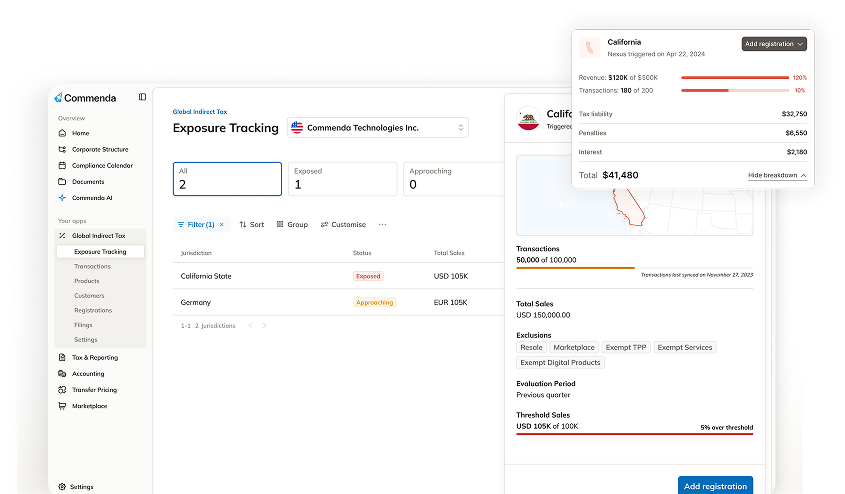
Commenda removes that burden entirely through continuous nexus monitoring built into the Infor M3 Sales Tax Integration:
- Commenda monitors your sales volume and transaction counts in every U.S. state against current economic nexus thresholds.
- Your finance team receives notifications before a threshold is reached. It gives you time to register, configure tax collection, and avoid retroactive liability.
- A clear, real-time view of where your business has established nexus, where you’re approaching limits, and where no obligation currently exists.
For manufacturers, distributors, and multi-channel sellers using Infor M3, this proactive approach is what separates manageable compliance from costly surprises.
Automated Sales Tax Filing and Remittance
Calculating tax accurately is only half the equation. The other half is preparing, submitting, and remitting returns across every state where you have nexus. This is where sales tax filing for Infor M3 gets operationally demanding. Commenda automates the entire filing lifecycle, so finance teams spend less time on compliance administration and more time on work that drives the business forward.
Here’s how end-to-end filing works with Commenda:
- Commenda consolidates all taxable transaction data synced from Infor M3. We organize it by jurisdiction, and prepare accurate returns that reflect every sale, exemption, and adjustment for the filing period.
- Returns are filed directly with the relevant state and local tax authorities on your behalf. It covers all jurisdictions where your business has an active nexus obligation.
- Filing schedules vary by state, ranging from monthly to quarterly to annual frequencies. Commenda tracks every deadline automatically and submits on time.
- Tax payments are calculated and remitted to the appropriate authorities as part of the same automated workflow.
- Every return filed through Commenda is logged and accessible. Thus giving your team a complete, organized record of all Infor M3 sales tax automation activity across every jurisdiction.
The result is a fully managed Sales Tax Integration for Infor M3 filing process accurate, on time, and built to scale as your state registrations grow.
Centralized Compliance Dashboard
Managing Sales Tax compliance across multiple states means juggling liabilities, deadlines, filings, and transaction records, often across different systems. Commenda brings all of that into a single, centralized dashboard that gives your finance team complete visibility at a glance.
From one screen, you can access:
- See exactly how much tax has been collected, what’s owed, and which jurisdictions require action.
- Upcoming and completed filings. So your team always knows what’s been submitted, what’s pending, and when the next deadline falls.
- Every return, remittance, and compliance event is logged and searchable.
- Customer exemption certificates are stored and tracked within the dashboard. It reduces the manual effort of locating documentation during a review.
This level of consolidated visibility transforms Infor M3 sales tax automation from a back-office function into a fully transparent, well-documented compliance process. Your team can confidently stand behind at any time.
Multi-Entity and Multi-Channel Support
Many businesses running Infor M3 operate across more than one legal entity, brand, or sales channel. Each generates transactions that carry independent tax obligations. Commenda is built to handle that complexity without requiring separate compliance workflows for each entity or channel.
Each legal entity connected to Infor M3 is treated as a distinct compliance unit, with its own nexus tracking, filing schedule, and liability reporting. All of these are managed from a single Commenda account.
Sales flow through Infor M3’s core is order management, a connected e-commerce platform, a billing tool, or a marketplace integration. Commenda pulls transaction data from every channel and applies consistent tax logic across all of them.
For enterprise manufacturers and distributors, Commenda makes multi-entity compliance scalable and manageable.
Time to Value and Ongoing Maintenance
One of the most common concerns finance teams have about adding a new compliance tool is the implementation burden. With Commenda’s Sales Tax Integration Software for Infor M3, that concern is addressed from day one. The integration is designed for fast setup with minimal configuration required on your end.
Commenda walks your team through the connection to Infor M3 step by step, with no internal engineering resources required to get the integration live. Your existing Infor M3 data structures, customer records, and transaction workflows are mapped automatically.
As U.S. tax laws change, jurisdiction rates update, and nexus rules evolve, Commenda handles all rule updates in the background. New states, new product categories, and new filing requirements are incorporated into the platform on an ongoing basis.
The goal is straightforward. Get your team compliant quickly, and keep them that way without adding ongoing operational effort.
How Commenda Compares: Automation vs. Spreadsheets and Basic Tax Plugins
Not all approaches to automate sales tax with Infor M3 deliver the same outcome. Spreadsheets and entry-level tax plugins can handle basic scenarios. But as transaction volumes grow and nexus obligations multiply, the gaps become costly. Here’s how a full-service solution like Commenda stacks up:
| Capability | Spreadsheets | Basic Tax Plugins | Commenda’s Sales Tax Automation Software for Infor M3 |
| Tax Calculation | Manual, error-prone rate lookups | Automated but limited jurisdiction coverage | Real-time, transaction-level calculation across all U.S. jurisdictions |
| Nexus Monitoring | Manual tracking per state | None or basic alerts | Continuous threshold monitoring |
| Filing and Remittance | Entirely manual, spreadsheet to portal | Calculation only, filing manual | End-to-end: return preparation, multi-state submission, and remittance |
| Infor M3 Data Sync | Manual export and re-entry | Partial or one-directional sync | Bi-directional sync of invoices, transactions, customers, and adjustments |
| Exemption Certificate Management | Stored offline, manually applied | Limited or unsupported | Centralized storage, automatic validation, and application at the transaction level |
| Audit Readiness | Fragmented records across files | Partial transaction logs | Complete filing history, remittance records, and exemption documentation in one dashboard |
| Maintenance Required | High | Moderate | None |
| Finance Team Independence | High dependency on manual processes | Some reliance on IT for configuration | Fully finance-managed |
Spreadsheets and basic plugins were built for simpler times. Sales Tax Integration through Commenda is built for manufacturers, distributors, and multi-entity businesses. These actually operate with finance-grade workflows, full-service filing, and the scalability to grow without rebuilding your compliance stack every time you enter a new state.
Security, Accuracy, and Compliance Standards
When financial and tax data is moving between Infor M3 and a third-party compliance platform, security and reliability aren’t optional, they’re foundational. Commenda is built with the standards that finance teams and enterprise organizations require before connecting any tool to their core ERP environment.
All data synced between Infor M3 and Commenda is encrypted in transit and at rest. Tax logic is maintained and updated by Commenda’s compliance team. Every tax calculation, filing submission, and remittance event is logged with a full timestamp and transaction reference. Infor M3 sales tax automation through Commenda is designed to operate without disruption. Tax is calculated and compliance records are maintained even during high transaction volume periods.
Sales tax compliance carries real financial and reputational stakes. Businesses can’t afford gaps in accuracy or transparency. Commenda delivers the stability that enterprise-grade Sales Tax Compliance for Infor M3 demands.