VAT registration in Estonia is important for foreign companies to ensure compliance with Estonian tax laws, avoid penalties, and smoothly conduct business within the Estonian market. This blog covers VAT registration for foreign companies in Estonia, including eligibility, process, and compliance.
Why Non-Resident Firms Must Register for VAT in Estonia
VAT registration in Estonia is essential for non-resident businesses because it ensures legal compliance, access to input VAT deductions, and seamless operations across the Estonian (and broader EU) market. Without registration, companies risk facing fines for late or missing registration, interest penalties, and potential refusal of VAT refunds.
Additionally, unregistered foreign suppliers may trigger forced company liquidation or heightened tax scrutiny if deemed lacking economic substance. To avoid these risks and ensure smooth cross-border trade, timely VAT registration for non-resident businesses in Estonia is essential.
When Does a Foreign Business Need to Register? Key Triggers
Foreign businesses must register for VAT in Estonia under several circumstances, even without a physical presence. The primary triggers for VAT registration in Estonia include:
- Taxable supplies in Estonia: If a foreign business is supplying taxable goods or services in the country, it must register immediately, regardless of turnover.
- Receipt of reverse-charge services: Estonian taxable persons receiving services from abroad under the reverse-charge mechanism may need to register for VAT to properly account for the tax
- Export and import of goods: Engaging in the export or import of goods through Estonia generally requires VAT registration to comply with EU customs and VAT rules.
Country-Specific Examples
Below are two illustrative scenarios that highlight when foreign businesses must register for VAT in Estonia:
- USA: A U.S.-based e-commerce firm that places inventory in an Estonian warehouse (e.g., via a 3PL service) must register for VAT, even before any sales occur.
- EU: A French SaaS company delivering software to end-users in Estonia who exceed €10,000 in annual sales must register for VAT in Estonia to comply with local rules.
Note: For more detailed information, see the Estonia VAT registration guide from the Estonian Tax and Customs Board.
Registration Thresholds & Nexus Tests
VAT registration in Estonia is mandatory when specific thresholds or nexus criteria are met, even in the absence of a physical presence. Resident businesses must register when their annual taxable turnover in Estonia exceeds €40,000, but VAT registration for foreign companies in Estonia generally kicks in immediately upon engaging in any taxable activity; essentially a nil threshold.
Digital Services
Foreign providers of digital services (e-services, software, online courses, e-books, etc.) to private (B2C) customers in Estonia may need to register specific to Estonian VAT. This can be avoided if they opt into the EU One-Stop Shop (OSS) scheme, which can simplify cross-border compliance by consolidating VAT reporting through a single EU Member State.
Low-Value Imports & Distance Selling
For non-EU sellers shipping goods directly to Estonian consumers, VAT registration becomes necessary unless using the Import One-Stop Shop (IOSS) for consignments under €150. The IOSS permits single-point-of-sale VAT collection and reporting, easing customs clearance.
Estonia VAT Number Format Explained
When handling VAT registration in Estonia, it’s essential to understand the structure of the Estonian VAT number, known locally as the KMKR (Käibemaksukohustuslase number). The table below breaks down the different elements of the Estonian VAT number:
| Component | Description |
| Country Prefix | Two-letter code “EE” |
| Numeric Sequence | Nine digits |
| Full Format | Combined prefix and digits |
Some examples of Estonian VAT numbers include:
- Standard company: EE123456789
- Branch of a foreign company: EE987654321
- Individual entrepreneur (sole proprietor): EE135792468
Common mistakes include missing the “EE” prefix or including the wrong number of digits (e.g., EE12345678 or EE1234567890) will result in invalid entries.
Accurate formatting helps ensure seamless validation via systems like VIES and smooth cross-border VAT administration. Proper attention to detail avoids rejections and delays in transactions with EU partners.
Is a Local Tax Agent or Fiscal Representative Required?
Non-resident businesses do not always need to appoint a local tax agent or fiscal representative for VAT registration in Estonia. However, they may choose to do so for ease of compliance. If appointed, the representative may assume joint liability for VAT obligations. Some jurisdictions may require a bank guarantee or bond to secure tax payments, though this varies by country.
Special Schemes & Simplifications
Estonia offers several schemes to simplify VAT compliance and ease operations for various businesses.
- Import-VAT Deferment: Eligible entities (including non-residents) with strong compliance records and often zero-rated sales may defer import VAT by reporting it in their VAT return instead of paying at customs.
- Small Business Exemption: Foreign SMEs whose Estonian turnover stays under €40,000, and EU-wide sales remain below €100,000, can apply for VAT exemption.
- OSS & IOSS Simplified Schemes: The OSS allows a single quarterly VAT return via Estonia for all EU B2C sales, while the IOSS supports non-EU sellers in collecting and remitting VAT at the point of sale for imports up to €150.
Step-by-Step: How to Register for VAT in Estonia
VAT applies to most goods and services supplied in Estonia, so most resident and non-resident businesses must register for VAT if their taxable activities meet certain criteria. Follow these steps to complete the VAT registration process:
1. Check VAT Threshold: For Estonian residents, the obligation to register arises if the supply of taxable transactions exceeds €40,000 from the beginning of the year. For non-resident tax registration in Estonia, there is no threshold.
2. Gather Required Documents: Company registration details, Articles of Association, business activity description, and proof of address.
3. Create an e-MTA Account: Register on the Estonian Tax and Customs Board’s e-services portal, e-MTA.
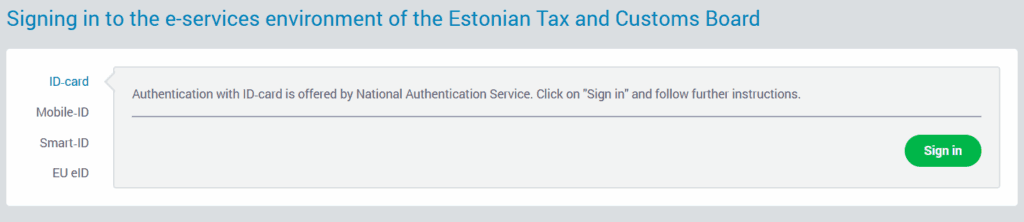
4. Submit Application: Complete and submit the Form R2 through e-MTA.
5. Pay Any Applicable Fees: There are no state fees for VAT registration in Estonia.
6. Receive VAT Registration Number: Wait for the Estonian Tax and Customs Board to issue your VAT ID.
Required Documents Checklist
When registering for VAT in Estonia as a non-resident business, you will need to provide several key documents to complete your application. Below is a checklist of the required documents you should gather before starting the registration process:
- Form R2: Non-resident taxpayer registration form.
- Certificate of Incorporation: Proof of your company’s legal existence.
- Authorisation Document: Certifies the person responsible for the permanent establishment.
- Specimen Signature: Notarised or certified signature of the responsible person.
- Tax Representative Agreement: Written agreement with the appointed tax representative, if applicable.
Processing Time & Government Fees
Registering for VAT online in Estonia usually takes around five business days for the tax authorities to process and approve your application. The Estonian Tax and Customs Board will review your application, and upon approval, you will receive your VAT registration number.
It’s important to note that there is no fee to register for VAT online in Estonia. However, if you are a non-EU business, you may be required to appoint a tax representative to handle your VAT obligations. Additionally, a bank guarantee might be necessary to secure tax payments if your business is considered high-risk or lacks a prior tax history in Estonia.
Post-Registration Obligations
After completing VAT registration in Estonia, businesses must adhere to several ongoing compliance requirements. Here are some common obligations to always keep in mind:
- Monthly VAT Returns: Submit VAT returns monthly, even if there are no transactions to report.
- Timely Payments: Ensure VAT payments are made promptly to avoid penalties.
- Invoicing Compliance: Issue invoices that meet Estonian VAT requirements, including proper documentation for input tax deductions.
- Record Keeping: Maintain accurate records of all transactions, including sales and purchases, for at least seven years.
- Threshold Monitoring: Regularly monitor your turnover to ensure compliance with VAT registration thresholds.
Claiming Input-Tax Credits & Refunds as a Non-Resident
Non-resident businesses can reclaim VAT paid on business expenses in Estonia under specific conditions. The process involves the following steps:
- Eligibility: Non-resident businesses must be VAT-registered in their home country and have a minimum VAT refund claim of €320 per calendar year.
- Documentation: Submit a completed Form KMT, original invoices, and a certificate from your home country’s tax authority confirming your VAT registration status.
- Application Deadline: Applications must be submitted by September 30th of the year following the refund period.
- Refund Processing Time: Refunds are typically processed within six months of receiving the application.
- Reciprocity Requirement: Estonia applies the principle of reciprocity; VAT refunds are granted to non-EU businesses only if their home country offers similar refunds to Estonian businesses.
Penalties for Late Registration or Non-Compliance
Failure to comply with VAT registration or submission deadlines in Estonia can result in various penalties and interest charges. Here’s an overview of the consequences:
- Fines: The Estonian Tax and Customs Board may impose fines for non-compliance with VAT obligations. For instance, failure to report arrangements can lead to fines of up to €3,200 for legal entities.
- Interest: Late VAT payments incur interest at a daily rate of 0.06%, equating to an annual rate of 21.9%.
- Import Restrictions: Non-compliance can lead to restrictions on imports and may require the provision of security deposits.
- Director Liability: In cases of negligence, company directors may be held personally liable for VAT-related penalties.
To avoid these penalties, businesses must ensure timely VAT registration in Estonia and adherence to all VAT obligations.
Deregistration & VAT Number Changes
If your business no longer meets the requirements for VAT registration in Estonia, it’s important to initiate the deregistration process promptly to avoid unnecessary tax obligations.
- When to Cancel: Submit an application if your taxable supplies in Estonia have not exceeded €40,000 in the current or previous calendar year and are not expected to exceed this threshold in the following 12 months.
- Deadline: Deregistration applications should be submitted promptly once the criteria are met to ensure timely processing.
- Online Cancellation: You can apply for deregistration through the Estonian Tax and Customs Board’s e-MTA portal.
- VAT Number Changes: If there are changes to your business structure or activities that affect your VAT registration status, update your details through the e-MTA portal.
- Tax Representative: If you have appointed a tax representative, ensure they are informed of any changes to your VAT registration status.
Conclusion
Understanding VAT registration in Estonia is crucial for any foreign business planning to operate in the country. Whether registering due to exceeding thresholds, voluntarily registering, or updating/canceling your VAT number, staying compliant helps avoid penalties.
Navigating VAT obligations in Estonia can be complex for non-resident businesses, but Commenda can simplify the process. Our experienced team supports foreign companies with VAT registration, ongoing compliance, and communication with the Estonian Tax and Customs Board.
Focus on expanding your business in Estonia while we handle your VAT obligations. Book a free demo with Commenda today to see how we can assist!