You cannot register a new company, sign a partner, or wire money to an Oregon vendor until you confirm what the state has on record. A name might be taken. An entity might be dissolved. A registered agent might have lapsed.
The Oregon business entity search is the free public lookup run by the Oregon Secretary of State (SOS) Corporation Division, reached through the Oregon SOS Find a Business page. It returns registration records for every entity on file. This guide walks the oregon secretary of state business search step by step, including the oregon business name search, status labels, fees, and due diligence checks.
What Is the Oregon Business Entity Search?
The Oregon business entity search is a free public tool run by the Oregon Secretary of State Corporation Division, accessed through the Oregon Business Registry. It returns the registration record for every entity registered in the state. People type it as the oregon business registry search, the oregon corporation division business search, or the oregon sos business entity search. All point to the same lookup.
| Detail | Value | Source |
|---|---|---|
| Operator | Oregon SOS Corporation Division | Oregon SOS Find a Business |
| Official page | sos.oregon.gov/business/Pages/find.aspx | Oregon SOS Find a Business |
| Short link | sos.oregon.gov/bizsearch (301 redirects into the live search) | Oregon SOS |
| Cost to search | Free, no login or account gate | Oregon SOS Business Registry Fee Schedule |
| Data currency | Filings received as of 7/10/2026 | Oregon SOS Find a Business |
| Phone | 503-986-2200 | Oregon SOS Find a Business |
Five jobs cover most searches: check name availability, check entity status, pull business details, confirm good standing, and find the registered agent.
How Do You Perform an Oregon Secretary of State Business Search?
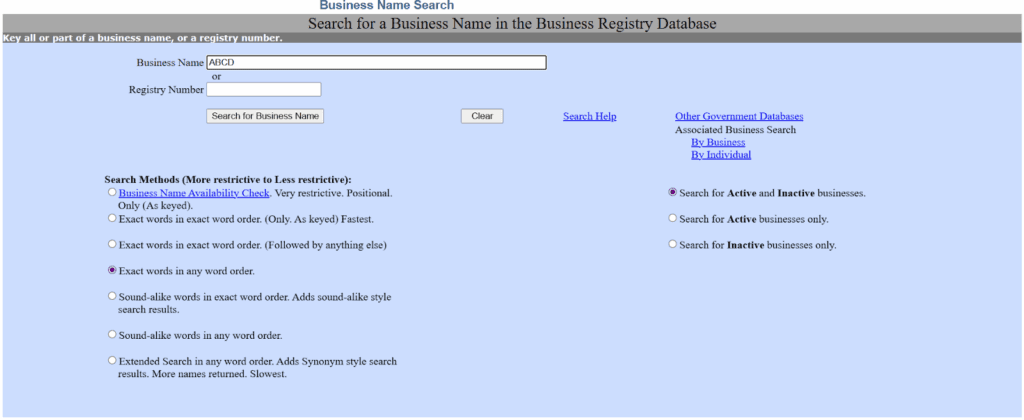
Go to the Oregon SOS Find a Business page, enter a business name or registry number, review the results list, then click into a record for the full detail page. The search box takes one field. The page prompts you to “Enter a Business Name or Business Registry Number to search,” per the Oregon SOS Find a Business page.
Follow these steps:
- Open the Oregon SOS Find a Business page.
- Enter the business name or registry number. Omit the dash in the registry number, which the SOS search-help instructions confirm.
- Pick a matching method. The SOS defines six word-matching methods, from “exact words in exact word order” to a fuzzy “extended search,” per the Oregon SOS business name search help page.
- Review the results list by name, registry number, and status.
- Click into an entity to open its full record.
Registry number length varies by age. New numbers now run 9 digits, such as registry number 259861194 filed 2026-07-06, per Oregon’s open data portal data.oregon.gov. A nonprofit registered in 1850 still carries the 6-digit number 299818, per data.oregon.gov. Across all active entities, none of the 561,601 distinct registry numbers store a dash, per data.oregon.gov.
What Is the Advanced Business Name Search?
The basic search covers all records by name or registry number, while the Advanced Business Name Search filters records with more granular options. Use basic search for a quick lookup. Use Advanced when the basic search returns too many results or when you confirm name distinguishability before filing. The Advanced Business Name Search runs on the legacy egov.sos.state.or.us domain, still linked live from the Find a Business page as of July 2026, per the Oregon SOS Find a Business page. A separate Search Active Business Registration Records tool surfaces active registrations only. For lookups beyond the registry, the SOS Government Databases page aggregates name-search tools from other Oregon agencies.
How Do You Check If a Business Name Is Available in Oregon?
Search the registry for exact and similar matches. If nothing distinguishable-conflicting appears, the name is likely available, but final approval happens at registration. Oregon applies a “distinguishable on the record” standard, codified in Oregon Administrative Rules (OAR) 160-010-0012 and explained on the Oregon SOS name availability help page. This section covers verification only. Reserving the name is a separate step below.
Two caveats matter. First, a name is not distinguishable based on entity designators (Inc., LLC), punctuation, spacing, articles, or capitalization alone, per OAR 160-010-0012. Small punctuation differences do not count. Second, registry availability does not grant exclusive usage rights. Run a trademark search and secure a domain before you commit. You can screen a name across jurisdictions first with Commenda’s company name checker.
Can You Reserve a Business Name in Oregon After Searching?
Yes, through one of two SOS filings, and the original post conflated them. Oregon offers a formal Application for Name Reservation for a $100 fee, per the Oregon SOS Business Registry Fee Schedule. Separately, an Assumed Business Name (ABN) registration costs $50, runs statewide, lasts two years, and renews at $50 every two years, per the same fee schedule. The name reservation holds a name while you prepare formation documents. The ABN registers a trade name you actually use.
How Do You Search Oregon Assumed Business Names (DBAs)?
Assumed business names, also called DBAs (doing business as), register with the SOS and appear in the same Business Name Search results as entities. Sole proprietors, partnerships, and entities operating under a second name file an ABN. The fee is $50 to register and $50 to renew every two years, per the Oregon SOS Business Registry Fee Schedule.
An ABN links back to the operating person or entity. Searching it maps every trade name a business uses, which matters for due diligence. To hold a name before you use it, file the separate Application for Name Reservation described above.
What Do Oregon Business Entity Statuses Mean?
The status field shows whether the state considers the entity legally alive and compliant. Read it first on any record.
| Status | What it means | Due-diligence signal | Source |
|---|---|---|---|
| Active | Registered, current on filings, in good standing | Safe to transact; confirm with a certificate | Oregon SOS Corporation Division |
| Inactive | Not currently active, by choice or state action | Investigate the cause before relying on it | Oregon SOS Corporation Division |
| Dissolved | Legally ceased; no longer recognized under Oregon law | Entity cannot transact; verify successor | Oregon SOS Corporation Division |
| Administratively Dissolved | State dissolved it for missed filings, such as an annual report | Compliance failure; reinstatement needed | Oregon SOS Corporation Division |
| Inactive – Withdrawn | Voluntarily withdrew registration; no longer operating in Oregon | Confirm where the entity now operates | Oregon SOS Corporation Division |
How Do You Check an Oregon Business’s Filing History?
Open the entity’s detail record. The summary history lists every filing with dates, including formation, amendments, and annual reports. Gaps in annual reports signal risk. Oregon dissolves entities administratively when they stop filing, so a missing report is an early warning of an entity heading toward Administratively Dissolved status. Consistent filings signal stability. Amendments, name changes, mergers, and reinstatements each tell part of the entity’s story before you sign anything.
How Do You Verify an Oregon Business Is in Good Standing?
An Active status is the informal check. The official proof is a Certificate of Existence, Oregon’s Certificate of Good Standing, ordered through the SOS certificate service for $10, per the Oregon SOS Request for Certificate form. Lenders, partners, and other states’ filing offices ask for this document when you open bank accounts, take loans, or foreign-qualify elsewhere.
Certificates ordered online through the Oregon Business Registry issue in minutes, while paper requests by fax or mail take 5 to 10 business days, per the Oregon SOS certificate page. An out-of-country certificate needing authentication (apostille) costs an extra $10, per the SOS Request for Certificate form. Good standing depends on current annual reports, so a lapsed report can void the certificate.
How Do You Find an Oregon Business by Registered Agent?
The SOS offers a dedicated Registered Agents and Service of Process lookup through the Oregon Business Registry. Search this way to find an entity’s agent for serving legal process, or to see which other entities share one agent. The SOS Associated Name Search also lets you enter a registry number to find every entity associated with that business, per the Oregon SOS Associated Name Search help page. A lapsed or missing agent is a common red flag in due diligence.
How Do You Use the Oregon Business Registry for Due Diligence?
Check status, filing history, registered agent, and formation date before you sign. Work the list top to bottom:
- Confirm the entity is Active and order a Certificate of Existence.
- Verify the legal name matches your contracts.
- Confirm the registered agent is current.
- Review filing history for gaps, reinstatements, or name changes.
- Cross-check assumed business names to map every trade name in use.
- Run the SOS Uniform Commercial Code (UCC) search to reveal security interests and liens against the business.
Know the scope boundary. The registry confirms registration only. It does not verify business licenses, permits, or regulatory compliance. Use the Business Xpress License Directory for licensing checks and the relevant state agency for regulatory status. The SOS Government Databases page links other agency records, including the Construction Contractors Board and the Department of Justice charity search.
What Business Entity Types Appear in Oregon Search Results?
Registered entities appear. Sole proprietorships and general partnerships appear only if they filed an ABN.
| Entity type | Formation document | In search results? | Source |
|---|---|---|---|
| Limited Liability Company (LLC) | Articles of Organization | Yes | Oregon SOS Corporation Division |
| Corporation (business, nonprofit, professional) | Articles of Incorporation | Yes | Oregon SOS Corporation Division |
| Limited Liability Partnership (LLP) | Registration application | Yes | Oregon SOS Corporation Division |
| Limited Partnership (LP) | Certificate of Limited Partnership | Yes | Oregon SOS Corporation Division |
| Sole Proprietorship | None unless using an assumed name | Only with an ABN on file | Oregon SOS Corporation Division |
| Assumed Business Name (DBA) | Assumed Business Name registration | Yes | Oregon SOS Corporation Division |
Oregon also distinguishes domestic entities, formed in Oregon, from foreign entities, formed elsewhere and registered to do business in the state. Results show which one you are viewing.
What Do Oregon Business Searches and Filings Cost?
Searching is free. Filings and certificates carry set fees. The SOS Business Registry Fee Schedule lists roughly 50 itemized transactions and no line item for searching or looking up records.
| Item | Cost | Source |
|---|---|---|
| Business name search | Free | Oregon SOS Business Registry Fee Schedule |
| Assumed Business Name registration | $50, renews every 2 years at $50 | Oregon SOS Business Registry Fee Schedule |
| Application for Name Reservation | $100 | Oregon SOS Business Registry Fee Schedule |
| Articles of Organization or Incorporation | $100 | Oregon SOS Business Registry Fee Schedule |
| Certificate of Existence | $10 | Oregon SOS Request for Certificate form |
| Authentication (apostille) add-on | +$10 | Oregon SOS Request for Certificate form |
| Certificate turnaround | Online in minutes; paper 5-10 business days | Oregon SOS certificate page |
For help, the Corporation Division front desk takes walk-ins Monday through Friday, 8 a.m. to 5 p.m. Phones run Monday through Thursday, 8 a.m. to 4:30 p.m., and Friday, 8 a.m. to 12 p.m., at 503-986-2200, per the Oregon SOS Find a Business page.
What Should You Do After Your Oregon Business Search?
Your next step depends on why you searched. Founders and researchers split here.
Founders: register the entity through the Oregon Business Registry, check the Business Xpress License Directory for required licenses, and register with the Oregon Department of Revenue for tax accounts.
Researchers: save your results, order official records, and calendar the renewal. Most entities file annual reports, and assumed names renew every two years. Before you act on a notice, check the SOS “Don’t be misled” alerts page. The SOS warns owners not to pay third-party firms for services they can do free on the state site, per the Oregon SOS consumer-protection page.
How Commenda Simplifies Oregon Entity Management
The search tells you where an entity stands today. Keeping it Active is the ongoing work. Commenda’s entity management platform centralizes filings, documents, and deadline tracking so annual reports and ABN renewals never lapse. Its compliance calendar tracks filing deadlines by entity and jurisdiction, and stores your registry IDs in one dashboard instead of scattered spreadsheets.
Book a demo to see every entity’s status, filings, and deadlines in one place.