You need to confirm a New York business is real, active, and filed the way it claims. It could be a vendor, a potential partner, or your own new company. The state’s own records are the only authoritative source, and checking them costs nothing.
The tool is the free New York Department of State Public Inquiry portal, run by the New York Department of State (NY DOS). This guide shows what the search returns, what every field means, and how to read status, the Department of State Identification Number (DOS ID), and foreign-entity records for real due diligence.
What Is the New York Business Entity Search?
The New York business entity search is a free public lookup run by the NY DOS Division of Corporations, State Records and Uniform Commercial Code (UCC), under the Secretary of State. It reports the public record for business corporations, not-for-profit corporations, limited liability companies (LLCs), partnerships, and assumed names. The legacy database now redirects to the current Public Inquiry portal.
The division is made up of three units and maintains formation documents for every registered entity, per the NY DOS Division of Corporations overview. The old Corporation and Business Entity Database URL now returns an HTTP 302 redirect to the Public Inquiry portal, confirmed on 2026-10-19, so any guide still linking the old system is pointing at a dead link.
How Do I Find a Business in New York?
Open the Public Inquiry portal and search by entity name, DOS ID, assumed name or Assumed Name ID, or officer and registered agent, then open a record for its full filing history. Choose a match mode (contains, begins with, or exact) and filter by status and entity type. NY DOS also runs a telephone search at (518) 473-2492 for up to five entity names per call, per its corporations FAQ.
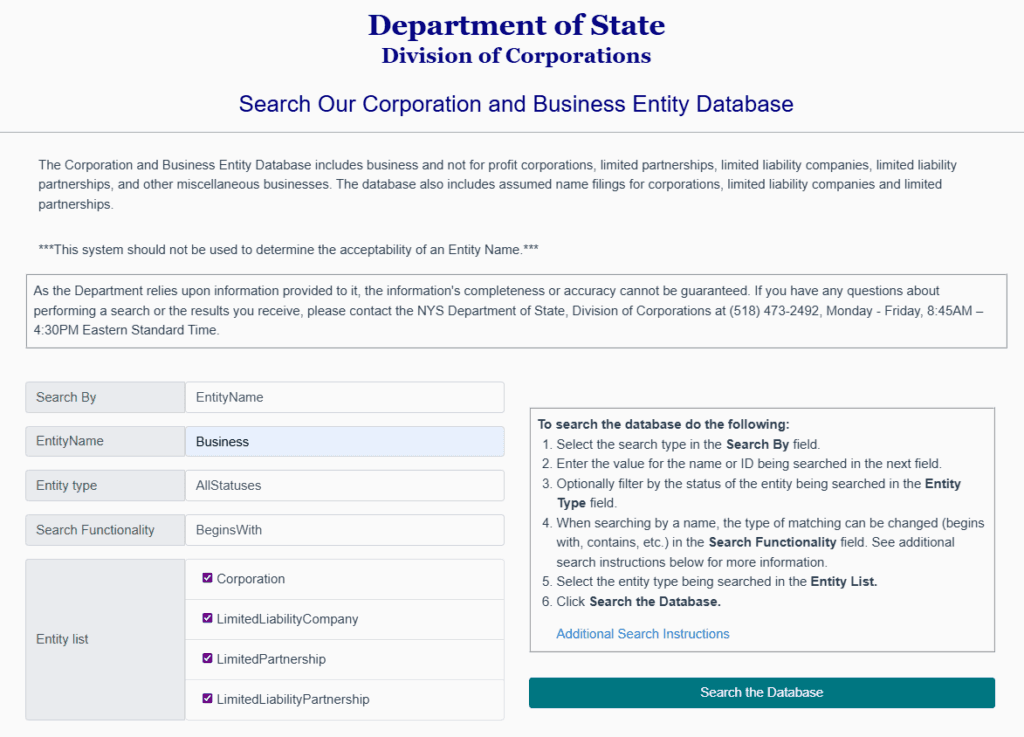
Follow these five steps:
- Open the portal. Go to the DOS Public Inquiry search.
- Enter criteria. Search by full or partial name, DOS ID, assumed name, or officer and registered agent.
- Apply filters. Narrow by status, entity type, and match mode.
- Review results. Scan the list for entity name, DOS ID, entity type, and status.
- Open the record. View the detail page, then order official documents if you need legal proof.
One trap costs people hits. The form asks you to select the entity type you believe the entity is filed as. A wrong guess can hide the record, so retry with other types before you conclude the entity does not exist.
What Do New York Business Search Results Show?
The results list shows entity name, DOS ID, Assumed Name ID, status, entity type, date of first filing, and county; the detail page adds date of organization, jurisdiction, registered agent, and the service of process address. NY DOS lists these fields in its corporations FAQ. The table below maps each one so you know what you are reading.
| Field | What it shows | Where it appears | Source |
|---|---|---|---|
| Entity name | Current legal name of the business | Results list and detail | NY DOS corporations FAQ |
| DOS ID | Unique Department of State ID number | Results list and detail | NY DOS corporations FAQ |
| Assumed Name ID | ID for a filed assumed name (DBA) | Results list | NY DOS corporations FAQ |
| Status | Current standing with the Department | Results list and detail | NY DOS corporations FAQ |
| Entity type | Corporation, LLC, LP, LLP, and more | Results list | NY DOS corporations FAQ |
| Date of First Filing | Date the first document was filed | Results list | NY DOS corporations FAQ |
| County | County of the office on record | Results list and detail | NY DOS corporations FAQ |
| Date of organization | Formation date (domestic) or authorization date (foreign) | Detail page | NY DOS corporations FAQ |
| Jurisdiction | New York (domestic) or home state/country (foreign) | Detail page | NY DOS corporations FAQ |
| Registered agent | Agent designated for service of process | Detail page | NY DOS corporations FAQ |
| Service of process (SOP) address | Where DOS forwards legal papers | Detail page | NY DOS corporations FAQ |
Reconcile the two date labels. The results list calls it “Date of First Filing,” while the detail page calls it “Date of organization.” For a foreign entity, that date is the authorization date, not a formation date.
What Is a DOS ID and How Do I Look One Up?
The DOS ID is the Department of State Identification Number that NY DOS assigns each entity at formation or authorization, and you can search the portal directly by it for one exact record with no near-duplicate noise. Find it on your filing receipt, formation certificate, or the detail page after a name search. The DOS ID is the state registration number, not a federal Employer Identification Number (EIN).
NY DOS requires the DOS ID to use the e-Statement filing service, to request a Certificate of Status, and to order copies of entity documents, per its corporations FAQ. An ID search beats a name search whenever names are common or similar.
Streamline your global entity management in one place
Stay on top of filings, records, and governance across every jurisdiction
What Do New York Entity Status Codes Mean?
Status reflects an entity’s standing with the Department of State, not its tax standing. The search can return any of the codes below. An “Active” result does not prove the business is current on its taxes.
| Status | What it means | Source |
|---|---|---|
| Active | Formed or authorized and on the record as operating | NY DOS records |
| Inactive | No longer operating; dissolved, withdrawn, or lapsed | NY DOS records |
| Dissolved | Domestic entity ended its legal existence | NY DOS records |
| Suspended | Lost authority to do business, e.g. an LLC missing publication | NY DOS corporations FAQ |
| Annulled | Registration voided as if it never existed | NY DOS records |
| Merged | Absorbed into another entity and no longer independent | NY DOS records |
| Consolidated | Combined with others into a new entity | NY DOS records |
| Surrendered | Foreign entity voluntarily gave up its NY authority | NY DOS records |
Treat “Active” with care. New York has no annual report for most entities, and the Department of Taxation and Finance can dissolve a corporation by proclamation for unpaid franchise taxes. DOS status may lag that action, so confirm tax standing separately before you rely on an “Active” result.
How Do I Search an Assumed Name in New York?
Assumed names, also called DBAs (doing business as), appear in the state search when a corporation, LLC, or limited partnership files a Certificate of Assumed Name with NY DOS. Search by assumed name or Assumed Name ID. Sole proprietors and general partnerships file at the county clerk instead, so they never appear in the state search.
New York General Business Law §130 requires the certificate (a base state fee of $25 plus county fees) and directs the Secretary of State to keep an alphabetical index of all certificates filed. An assumed-name hit links back to the underlying legal entity and its DOS ID.
How Do I Get a Certificate of Status in New York?
The Certificate of Status is New York’s equivalent of a Certificate of Good Standing, the official proof that an entity is registered and in standing. Order it from NY DOS using the DOS ID or the exact formation or authorization date. The free search is never legal proof. Banks, lenders, and other states require the certificate.
You need it for banking, financing, qualifying as a foreign entity in another state, and cross-border transactions, which matters to overseas firms verifying or proving a New York registration. NY DOS also issues certified copies and plain copies of filed documents. Current fees and turnaround options are below.
| Document or service | Fee | Turnaround | Source |
|---|---|---|---|
| Certificate of Status | $25 | Standard processing | NY DOS corporations FAQ |
| Certified copy of a filed document | $10 | Standard processing | NY DOS corporations FAQ |
| Expedited handling (24-hour) | $25 | Within 24 hours | NY Executive Law §96 |
| Expedited handling (same-day) | $75 | Same business day | NY Executive Law §96 |
| Priority handling (two-hour) | $150 | Within two hours | NY Executive Law §96 |
How Do I Look Up a Registered Agent in New York?
Search by officer or registered agent in the Public Inquiry portal, or open any record to see the agent and the service of process (SOP) address. In New York the Secretary of State is the default statutory agent for service of process on every entity, per the NY DOS division overview. A commercial registered agent is optional here, unlike in many other states.
The agent and SOP address are the ownership ceiling of the public record. The search reveals who accepts legal papers, not full ownership. Order certified documents from DOS to go deeper.
How Do Foreign Entities Appear in New York Search Results?
A foreign entity is a business formed in another U.S. state or another country that filed an Application for Authority to operate in New York. Its record shows a non-New York jurisdiction and an authorization date instead of a formation date. New York Business Corporation Law §1301 requires that authorization before a foreign corporation does business in the state.
A UK or Indian company authorized in New York appears here with its home country as the jurisdiction. The NY record confirms New York authorization only, separate from the home-jurisdiction registration held at Companies House in the UK or the Ministry of Corporate Affairs (MCA) in India. When a foreign entity withdraws, its status shows as Surrendered.
How Do I Check Business Name Availability in New York?
No. The search is a preliminary screen only. NY DOS states on its entity search database page that the database “should not be used to determine the acceptability of an Entity Name.” Only a formal written request to the Department confirms a name is available, and an Application for Reservation of Name holds it before you file.
| Reservation fact | Value | Source |
|---|---|---|
| LLC / corporation / LP filing fee | $20 | NY DOS reservation of name |
| Reservation period | 60 days | NY DOS (LLC Law §205) |
| Extensions | Up to two 60-day extensions, $20 each | NY DOS reservation of name |
| Not-for-profit corporation fee | $10 | NY DOS (N-PCL §303) |
For a fast first screen before you request confirmation, run the name through Commenda’s company name checker.
What Entity Types Appear in New York Search Results?
Results span business corporations, LLCs, limited partnerships (LPs), limited liability partnerships (LLPs), and not-for-profit corporations. Each files its own formation document and carries its own liability treatment. The table below lists the common types, their formation documents, and current state filing fees.
| Entity type | Formation document | State filing fee | Liability note | Source |
|---|---|---|---|---|
| LLC | Articles of Organization | $200 | Members shielded from business debts | NY DOS |
| Business corporation | Certificate of Incorporation | $125 + tax on shares | Shareholders shielded; perpetual existence | NY DOS |
| Limited partnership (LP) | Certificate of Limited Partnership | $200 | General partners liable; limited partners capped | NY Revised LP Act §121-201 |
| Limited liability partnership (LLP) | Certificate of Registration | $200 per partner | Partners shielded from each other’s acts | NY Partnership Law §121-1500(a) |
What Is the New York LLC Publication Requirement?
A new New York LLC must publish notice of its formation in two newspapers designated by the county clerk, once a week for six consecutive weeks, then file a Certificate of Publication with NY DOS. An LLC that misses the requirement within 120 days has its authority to do business suspended, which surfaces in the search status, per the NY DOS corporations FAQ.
What Is the New York Biennial Statement Filing?
Most New York corporations and LLCs file a Biennial Statement every two years, in the anniversary month of formation or authorization, for a $9 fee via the DOS e-Statement service. Business Corporation Law §408 and Limited Liability Company Law §301(e) set the requirement, per the NY DOS biennial statements page.
| Biennial fact | Value | Source |
|---|---|---|
| Filing fee | $9 | NY DOS biennial statements |
| Frequency | Every two years | NY DOS biennial statements |
| Domestic due month | Month the original Certificate or Articles was filed | NY DOS corporations FAQ |
| Foreign due month | Month the Application for Authority was filed | NY DOS corporations FAQ |
| Filing credentials | Exact entity name and DOS ID | NY DOS biennial statements |
A past-due statement is a due-diligence red flag even when status reads Active. The search proves an entity exists; a current biennial statement proves someone is maintaining it.
Why Does a New York Entity Search Return No Results or Wrong Results?
Usual causes are punctuation sensitivity, common-name floods, unregistered businesses, recent filing lag, offline pre-December 5, 1977 records, and the wrong entity-type selection. Work through them before concluding the entity does not exist.
- Punctuation and special characters. Ampersands and commas can break a match. Simplify the query.
- Common-name floods. A generic name returns hundreds of hits. Filter by DOS ID, entity type, or county.
- Unregistered businesses. Sole proprietorships and county-level DBAs never appear, because they are not filed with NY DOS.
- Recent filing lag. A brand-new filing can take time to surface.
- Pre-December 5, 1977 records. Entities that ceased before that date are offline and require a manual DOS request.
- Wrong entity-type guess. The form hides records filed under a different type. Retry the search with other entity types selected.
Is the NYC Doing Business Database the Same as the State Entity Search?
No. The NYC Doing Business Search is a separate city database and is useless for entity verification. New York City created it under Local Law 34 of 2007 to restrict campaign contributions from people who do business with the city. For due diligence, use the state Public Inquiry portal instead.
It lists people tied to those entities: CEOs, CFOs, and COOs or their equivalents, owners and partners with at least 10% interest, senior managers, and lobbyists. The data comes from the Mayor’s Office of Contract Services (MOCS) Doing Business Accountability Unit and the City Clerk, not from formation filings.
How We Simplify New York Entity Compliance
The search is step one. Staying in good standing is the ongoing burden: biennial statements every two years, the LLC publication requirement, registered agent updates, and foreign qualification across states. Commenda’s entity management platform tracks every filing deadline and keeps your entities in good standing in New York and every other jurisdiction, so a “past due” status never catches you by surprise.
Use Commenda’s compliance calendar to see every New York deadline in one view, and lean on our guides for registering a business in New York, forming a New York LLC, and obtaining a business license. Researching across the region? See our New Jersey business entity search and New Hampshire business entity search guides.
Book a demo to get a free compliance-status review of your New York entities.
About the author

Ishwar is a serial entrepreneur and Y Combinator alum who has founded multiple venture-backed companies across global markets. Based in Bangalore, he brings a founder’s perspective to the complexities of international operations, with deep expertise in transfer pricing and cross-border structuring.
Disclaimer: Commenda and its affiliates do not provide tax, accounting, or legal advice. This material has been prepared for informational purposes only, and is not intended to provide or be relied on for tax, accounting, or legal advice. You should consult your own tax, accounting, and legal advisors before engaging in any related activities or transactions.