















Why Sales Tax Compliance Breaks Down in Odoo Enterprise
Odoo Enterprise is designed to streamline financial and operational processes, yet U.S. sales tax operates in a fragmented environment governed by numerous state and local authorities. Jurisdiction rules evolve independently, which makes long-term manual monitoring difficult to maintain with complete accuracy. Over time, several pressure points usually surface, such as:
- Tax rates often require manual review and updates, which can gradually fall out of sync with current jurisdiction rules.
- Limited visibility into economic nexus exposure as sales begin to spread across additional states.
- Filing workflows relying on spreadsheets or manual preparation, increasing the likelihood of inconsistencies.
- Coverage gaps appear when city or special district taxes are not fully captured in standard configurations.
As these issues accumulate, finance teams may experience additional strain, and sales tax management can start to feel disconnected from otherwise well-structured accounting workflows.
Who This Sales Tax Integration Is Built For
Sales tax automation for Odoo Enterprise is suited for organizations that want dependable compliance without disrupting their existing accounting and operational setup. The integration supports a variety of business models while allowing familiar processes within Odoo Enterprise to continue unchanged. Typical use cases include:
- SaaS companies invoicing customers across multiple U.S. states through subscription or recurring billing models.
- Ecommerce businesses process orders through online storefronts, marketplaces, or direct sales channels.
- Service-based organizations delivering taxable digital or professional services across jurisdictions.
- Small finance teams managing compliance responsibilities without a dedicated in-house tax department.
- Companies operating multiple legal entities within a consolidated financial structure.
- International organizations expanding their commercial presence into the U.S. market.
Odoo Enterprise remains the central system for accounting and reporting, while the integration strengthens how sales tax obligations are handled in the background.
Common Sales Tax Challenges for Odoo Enterprise Users
Sales tax challenges rarely emerge all at once and instead tend to build gradually as businesses expand beyond a single state. As operations grow and transactions become more geographically distributed, additional compliance demands begin to surface. Odoo Enterprise users often encounter situations such as:
- Increased audit exposure due to inconsistent filings or incomplete supporting documentation.
- Continued reliance on spreadsheets to monitor liabilities and maintain filing calendars.
- Difficulty aligning compliance timelines across several states simultaneously.
- Reduced clarity around upcoming deadlines and newly triggered registration requirements.
- Added complexity when sales occur across multiple channels or through multiple legal entities.
Over time, these factors can shift teams into a reactive compliance mode where sales tax feels disruptive rather than well controlled and predictable.
What Is Sales Tax Automation Software for Odoo Enterprise?
Sales tax automation software for Odoo Enterprise is an external solution that connects directly to the platform and manages sales tax from calculation through filing. Manual rate checks and disconnected tools are replaced with a dedicated tax engine that applies the correct jurisdiction rules automatically and consistently. Core capabilities typically include:
- Sales tax being calculated automatically on invoices and transactions using current jurisdiction data.
- Continuous tracking of economic nexus thresholds across states so registration needs are not overlooked.
- Preparation and submission of sales tax returns handled within one connected compliance process.
- A single interface where liabilities, filing progress, and overall compliance status can be reviewed.
Odoo Enterprise continues to act as the primary source of financial records, while specialized tax logic operates alongside it in a more scalable and controlled manner.
How Commenda Integrates With Odoo Enterprise
Commenda connects with Odoo Enterprise through secure API-based integration designed specifically for finance teams rather than requiring engineering-heavy involvement. The setup aligns naturally with existing accounting routines and does not disrupt daily operational workflows. Once the connection is established, relevant data flows automatically between both systems, allowing sales tax tasks to remain out of routine manual work. Data exchanged between the platforms typically includes:
- Invoice and transaction details so tax calculations reflect actual sales activity.
- Customer and location information that ensures the correct jurisdiction rules are applied.
- Product and service taxability attributes that support accurate treatment across regions.
Sales tax automation then runs quietly in the background while Odoo Enterprise continues to manage core accounting and operational responsibilities as usual.
Real-Time Sales Tax Calculation
Sales tax for Odoo Enterprise is calculated at the transaction level using up-to-date jurisdiction rules that reflect current regulatory requirements. Each calculation incorporates multiple factors that influence how tax should apply to a specific sale, ensuring consistent accuracy across invoices. Important inputs considered include:
- Customer location and sourcing rules that determine the appropriate taxing authority.
- Product or service classification under relevant state and local tax regulations.
- Combined tax rates set by state, county, city, and special district jurisdictions.
- Valid exemptions or resale certificates whenever they are applicable.
Accurate calculation at the point of transaction reduces the need for later corrections and helps maintain confidence in reported tax figures and financial statements.
Economic Nexus Monitoring and Alerts
Economic nexus laws require businesses to register and begin collecting sales tax once revenue or transaction thresholds are exceeded within a state. Tracking these thresholds manually becomes increasingly difficult as geographic reach expands and transaction volumes grow.
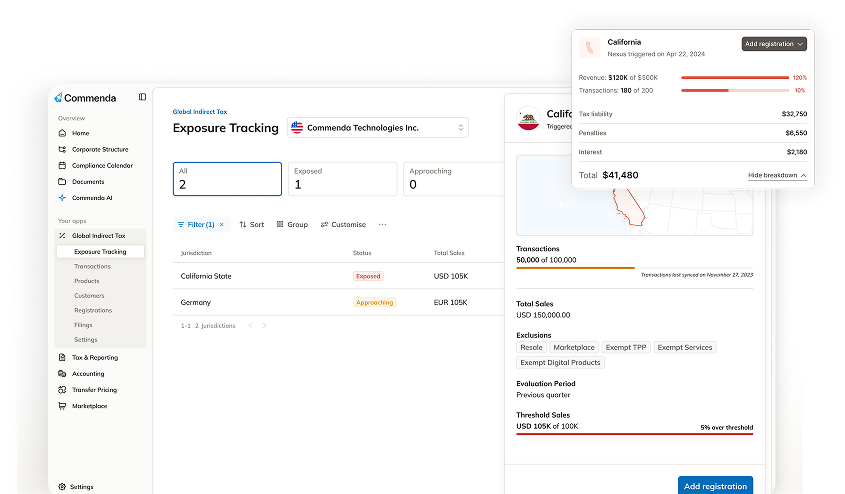
Commenda reviews transaction data across jurisdictions on an ongoing basis for Odoo Enterprise users. Early alerts are generated before thresholds are crossed, giving finance teams time to register, plan filings, and adjust processes accordingly. This visibility helps prevent unexpected compliance exposure and supports more deliberate expansion into new markets.
Automated Sales Tax Filing and Remittance
Sales tax filing for Odoo Enterprise becomes more manageable when automation covers the entire filing lifecycle across jurisdictions. Commenda oversees filings through a centralized and organized process that keeps deadlines and documentation aligned with regulatory requirements. This process involves:
- Preparing returns using synchronized transaction data pulled directly from Odoo Enterprise.
- Submitting filings according to each jurisdiction’s specific deadlines.
- Coordinating payments and remittances across multiple tax authorities.
- Recording confirmations and storing filing documents for audit reference.
Centralized filing reduces administrative effort while lowering the likelihood of penalties tied to missed, delayed, or inaccurate submissions.
Centralized Compliance Dashboard
A centralized compliance dashboard gives Odoo Enterprise users a clear and consolidated overview of their sales tax obligations in one place. Key compliance details are presented through a single interface, which makes ongoing oversight much simpler for finance teams. Within this dashboard, teams can review:
- Current sales tax liabilities organized by state and jurisdiction.
- Upcoming filing deadlines across all active registrations.
- Filing progress along with payment and submission history.
- Historical records that support audits and internal reporting requirements.
Stronger visibility helps maintain steady compliance management without adding unnecessary complexity to everyday financial operations.
Multi-Entity and Multi-Channel Support
Many Odoo Enterprise users operate multiple legal entities or generate revenue through several sales channels simultaneously. Sales tax automation software consolidates these diverse data sources into one unified compliance framework that remains easy to manage. Support typically includes:
- Multiple legal entities managed within one consolidated account structure.
- Sales data captured from ecommerce platforms, billing tools, and online marketplaces.
- Unified reporting that reflects activity across entities and channels together.
Bringing everything into a single framework helps maintain consistent tax treatment while reducing reconciliation work as the business continues to scale.
Time to Value and Ongoing Maintenance
Sales tax automation for Odoo Enterprise is designed to deliver practical value quickly without requiring extensive configuration or long onboarding cycles. Once the integration is active, ongoing maintenance responsibilities related to tax rules and jurisdiction changes are handled automatically in the background. The maintenance support managed by Commenda includes:
- Updating tax rates whenever jurisdictions introduce new or revised rates.
- Adjusting logic to reflect newly introduced or modified regulations.
- Revising filing rules as state and local obligations evolve over time.
This setup allows finance teams to focus on oversight and strategic review rather than spending time manually maintaining tax configurations.
Commenda vs. Generic Sales Tax Tools
Generic sales tax tools often concentrate primarily on calculation, leaving filing and remittance responsibilities with the business. Commenda follows a broader approach that supports the entire compliance lifecycle, which becomes increasingly valuable as organizations scale operations. Compared to basic tools, Commenda provides:
- Filing and remittance support that spans the full compliance process.
- Finance-grade workflows designed to encourage accuracy and structured internal review.
- Centralized visibility into liabilities, filings, and upcoming deadlines.
- Reduced operational risk as compliance requirements grow more complex.
The difference becomes even more noticeable when compared with spreadsheets or lightweight plugins, which often struggle to keep pace with multi-state regulatory demands.
Security, Accuracy, and Compliance Standards
Sales tax compliance systems must meet strong expectations around data protection, reporting reliability, and audit readiness. Commenda is designed with secure data handling practices, detailed audit trails, and dependable reporting capabilities that support consistent compliance operations. These safeguards help ensure:
- Filings remain consistent and defensible across multiple jurisdictions.
- Records stay organized and easily accessible during audits or regulatory reviews.
- Compliance workflows continue to operate reliably as the business expands.
Each integration emphasizes both data protection and the accuracy required for trustworthy, long-term compliance management.