An invalid Hungarian VAT (Value Added Tax) number risks denied input VAT deductions and default penalties of up to HUF 1,000,000 from NAV (Nemzeti Adó- és Vámhivatal, the National Tax and Customs Administration). The safe move is simple. Verify every number before you invoice, using the European Commission’s VIES (VAT Information Exchange System) portal.
This guide shows how to check a Hungarian VAT number on VIES and NAV, what the format means, and how to fix invalid results. The short verdict: use VIES to confirm an EU/intra-Community number, and use NAV’s taxpayer query for domestic status, suspension, or cancellation.
What Is a Hungarian VAT Number and How Is the Adószám Structured?
The domestic Hungarian tax number (Adószám) is 11 digits in the form XXXXXXXX-Y-ZZ, and the EU VAT number is “HU” plus the first 8 digits of that Adószám, according to NAV’s community tax number guidance. ÁFA (Általános forgalmi adó) is the Hungarian term for VAT. The EU’s EUIPO reference table lists the format as HU99999999, 8 digits after the prefix.
The two numbers serve different purposes. The 11-digit Adószám identifies the taxpayer domestically. The 8-digit HU number identifies it for intra-EU trade. The table below breaks down each segment. All sample numbers are format illustrations only, since a real base number must pass the check-digit test.
| Segment | Digits | Meaning | Example | Source |
|---|---|---|---|---|
| Base number (törzsszám) | 1–8 | Core registration number; digit 8 is the check digit; these 8 digits form the EU VAT number | 12345676 | NAV |
| VAT code (Y) | 9 | ÁFA status: 1 = exempt, 2 = standard taxpayer, 3 = EVA (obsolete since 2020), 4 = VAT group member, 5 = VAT group common number | 2 | NAV |
| County code (ZZ) | 10–11 | Territorial code of the registering tax office, 01 = Budapest through 20 = Zala | 13 | KSH decree 31/2011 |
A full illustrative Adószám therefore reads 12345676-2-13, and its EU VAT number is HU12345676.
How Does the Hungarian VAT Check Digit Validation Algorithm Work?
The 8th digit is a check digit computed from digits 1–7 using the weights 9, 7, 3, 1, 9, 7, 3, per the Hungarian government’s Céginformációs Szolgálat validation reference. Multiply each digit by its weight, sum the products, take the sum modulo 10, then the check digit equals (10 − remainder) mod 10.
Here is a worked example a developer can reproduce, using illustrative base digits 1234567:
- 1×9 = 9
- 2×7 = 14
- 3×3 = 9
- 4×1 = 4
- 5×9 = 45
- 6×7 = 42
- 7×3 = 21
- Sum = 144
- 144 mod 10 = 4
- Check digit = (10 − 4) mod 10 = 6
So the valid base number is 12345676. Passing the check digit proves the number is structurally valid only. It does not prove the number is registered or active. Only NAV or VIES confirms real-world status.
How Do You Verify a Hungarian VAT Number on the VIES Portal?
Use the European Commission’s VIES tool, select Hungary or enter “HU”, enter the 8 digits, and click verify. A valid result confirms the number is active for intra-EU transactions and may show the registered name and address. VIES is a real-time search engine querying national VAT registers, per the EU’s Your Europe guidance.
Follow these steps:
- Open the official VIES VAT number validation tool.
- Select “Hungary” from the Member State dropdown, or enter “HU” as the country code.
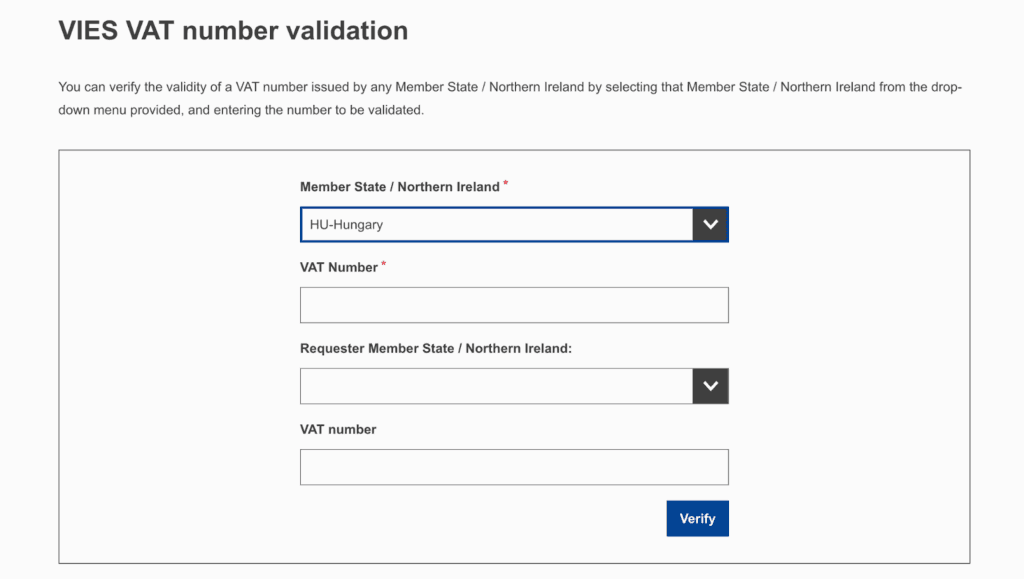
- Enter the 8-digit Hungarian VAT number.
- Click “Verify” to see valid or invalid status, plus name and address where disclosed.
- Save the consultation number (unique reference number) that VIES returns. NAV treats this retained result as your provable audit evidence of the check.
VIES validates intra-Community registration only. A number valid at NAV can still show invalid on VIES, which the troubleshooting section below explains.
Why Is My Hungarian VAT Number Invalid on VIES?
The most common reason is that the business holds a valid domestic Hungarian VAT registration but has not been activated for intra-Community transactions, so NAV shows it as valid while VIES shows it as invalid, per the EU’s Your Europe guidance. Typos, propagation lag, and cancellation cause the rest. Work through the table below.
| Error result | Likely cause | Fix |
|---|---|---|
| Invalid on VIES, valid at NAV | Registered for domestic VAT only, not activated for intra-EU trade | Apply to NAV for a közösségi adószám (Community VAT number) |
| Invalid or not found | Typo: missing digit, wrong country code, spaces or hyphens, HU prefix omitted, or full 11-digit number entered | Enter exactly HU plus the first 8 digits, no spaces |
| Not found for a new number | Newly issued number not yet searchable | Wait 24–72 hours after NAV registration, then retry |
| Invalid | Number suspended or cancelled by NAV | Check NAV’s cancelled tax number list |
| Service unavailable | Member state database temporarily down | Retry later; this is not an invalid number |
How Do You Validate a Hungarian VAT Number for Invoicing?
Validate before the first invoice and re-check periodically, because a valid customer VAT number is a condition for zero-rating intra-EU B2B (business-to-business) supplies, and an invalid supplier VAT number on a purchase invoice can lead NAV to deny the corresponding input VAT deduction. A short workflow keeps you covered.
- Run the check-digit test to catch typos before any lookup.
- Do a VIES check and save the consultation number as audit proof.
- Run a NAV taxpayer query for domestic counterparties to confirm status and VAT category.
- Re-verify quarterly, or before large payments, since a number can be suspended or cancelled.
Valid VAT numbers also keep your own governance in order. For local Hungarian businesses, verified counterparty numbers support clean corporate tax filings, accurate business registration records, and protection against fraudulent suppliers or customers. Getting this right is a condition of staying registered and compliant with NAV, not just of individual invoices.
Commenda’s Global Tax ID Verification tool verifies VAT and tax IDs across countries at the point of onboarding.
What Are Hungary’s VAT Rates and Registration Thresholds?
Hungary’s standard VAT rate is 27%, the highest in the EU, with reduced rates of 18% and 5%, and the domestic VAT exemption threshold rose to HUF 18 million in 2025, per NAV. The table below summarizes each figure.
| Rate / Threshold | Applies to | Source |
|---|---|---|
| 27% standard | Most goods and services; highest standard VAT rate in the EU | NAV |
| 18% reduced | Certain foods (dairy, bakery products) and some accommodation | NAV |
| 5% reduced | Medicines, books, district heating, certain foods, qualifying new residential property | NAV |
| HUF 18 million | Domestic VAT exemption threshold (alanyi adómentesség), raised in 2025 | NAV |
What Penalties Apply for Using an Invalid Hungarian VAT Number?
Default penalties reach HUF 1,000,000 for a company, doubled permanently from HUF 500,000 effective 1 January 2025, alongside late filing fines, late payment interest, and denied deductions. The increase is set in Article 220 of Act CL of 2017 on the Rules of Taxation. The table lists each consequence.
| Violation | Penalty | Effective date | Source |
|---|---|---|---|
| Default penalty (mulasztási bírság), non-natural person | Up to HUF 1,000,000 | 1 Jan 2025 (doubled from HUF 500,000) | Act CL of 2017, Art. 220 |
| Default penalty, natural person | Up to HUF 400,000 | 1 Jan 2025 (doubled from HUF 200,000) | Act CL of 2017, Art. 220 |
| Late VAT return filing | HUF 100,000–500,000 | Current | NAV |
| EU recapitulative statement (EC Sales List) failure | Up to HUF 1,000,000 | Current | NAV |
| Late payment interest | Central bank base rate plus 5 percentage points, calculated daily | Current | NAV |
| Invalid supplier VAT number | Denial of the input VAT deduction | Current | NAV |
Does a Non-Resident Business Need a Fiscal Representative in Hungary?
Businesses established outside the EU must appoint a Hungarian fiscal representative to register for Hungarian VAT, while businesses established in another EU member state may register with NAV directly without one, under the EU VAT rules summarized in the EU’s Your Europe guidance. The rule turns on where the business is established, not where it sells.
The fiscal representative registers the company for VAT, files its VAT returns through NAV’s electronic systems, handles appeals, and ensures ongoing ÁFA compliance on the company’s behalf. In Hungary the representative is often jointly and severally liable for the represented company’s VAT obligations, which makes it a real cost and risk factor, not a formality.
Can You Bulk-Validate Hungarian VAT Numbers Automatically?
Yes. The VIES SOAP/REST API supports programmatic checks, and platforms like Commenda validate VAT numbers in bulk via CSV (comma-separated values) upload and API (application programming interface). Manual entry through VIES or NAV, one number at a time, is slow and error-prone at volume, so automated validation is the practical route for finance teams checking many supplier or customer numbers.
Commenda supports 100+ ERPs (enterprise resource planning systems), APIs, and custom integrations, listed on the Commenda integrations page, so validation fits into the systems your finance team already runs.
How Commenda Helps With Hungarian VAT Compliance
Commenda’s global indirect tax platform handles Hungarian VAT registration, bulk VAT number validation via CSV and API, filings, and NAV compliance tracking, and connects to 100+ ERPs, APIs, and custom integrations. It gives your controller one place to confirm every VAT number is valid and every filing is handled.
Pair it with Commenda’s Global Tax ID Verification tool to check counterparty numbers at onboarding, and the compliance calendar to track NAV filing deadlines by entity. Book a demo to get your Hungarian and EU VAT numbers validated and your registration obligations mapped.