An invalid or unverified Taxpayer Identification Number (TIN) blocks your tax filings, stalls withholding tax (WHT) remittance, and freezes supplier payments. It also exposes your business to administrative penalties.
You can verify any Nigerian TIN for free on the official government portal at taxid.nrs.gov.ng. This guide covers single checks, error fixes, supplier due diligence, and bulk verification, updated for the 2026 switch from the Federal Inland Revenue Service (FIRS) to the Nigeria Revenue Service (NRS).
Nigeria TIN verification at a glance (2026)
| Question | Answer | Source |
|---|---|---|
| Who issues TINs now? | The Nigeria Revenue Service (NRS), successor to FIRS from 1 January 2026 | NRS (Establishment) Act 2025 |
| Where do you verify? | Official portal taxid.nrs.gov.ng (mirror taxid.jrb.gov.ng) | FCT-IRS |
| What is the new identifier? | A system-generated 13-digit Tax ID, live 1 January 2026 | FCT-IRS |
| How much does verification cost? | Free | FCT-IRS |
| Is there a bulk or API option on the portal? | No, it checks one record at a time | Official portal |
What is a TIN in Nigeria?
A TIN is the unique tax identifier assigned to individuals and businesses in Nigeria for every tax transaction. The Nigeria Tax Administration Act 2025 (NTAA) legally defines the Tax ID as a unique identifier for businesses, individuals, and other entities, per the NTAA 2025 text. The TIN is the number itself.
The tax registration certificate is a separate document. It confirms that a taxpayer is registered and displays the TIN on its face. You verify the number, not the certificate, when you run a check.
Who issues TINs in Nigeria: FIRS, JTB, or NRS?
The Nigeria Revenue Service (NRS) now issues and administers TINs. Historically the Joint Tax Board (JTB) coordinated the national TIN registry while the Federal Inland Revenue Service (FIRS) issued corporate TINs. The NRS (Establishment) Act 2025, signed 26 June 2025, repealed the FIRS Act and renamed FIRS as the NRS.
This is why searchers still see both “FIRS TIN” and “JTB TIN.” The Joint Revenue Board (Establishment) Act 2025 also abolished the JTB, first set up under the Personal Income Tax Act 2004, and reconstituted it as the Joint Revenue Board (JRB). FIRS completed its operational rebrand to the NRS on 1 January 2026, as ThisDay reported.
Why do businesses and individuals need a TIN in Nigeria?
A valid Tax ID is mandatory for almost every formal transaction. Section 4 of the NTAA 2025 requires every taxable person to register and obtain a Tax ID, and Section 8 makes it a precondition for government contracts and bank accounts. Without one, you cannot file returns, register for Value Added Tax (VAT), or bid on tenders.
| Transaction | Why a valid Tax ID is required | Source |
|---|---|---|
| Filing CIT, VAT, and PAYE returns | Section 4 NTAA 2025 mandates registration for all taxable persons | NTAA 2025 |
| Government contracts and tenders | Section 8 makes a Tax ID a precondition for any contract with a federal, state, or local MDA | NTAA 2025 (LIRS brief) |
| Opening or operating bank accounts | Section 8 requires a Tax ID for banks, insurers, and stockbrokers | NTAA 2025 (LIRS brief) |
| Non-resident supply or Nigerian-source income | Non-residents supplying taxable goods or services must register for a Tax ID | NTAA 2025 |
CIT means Companies Income Tax. PAYE means Pay As You Earn. MDA means Ministries, Departments and Agencies.
What is the TIN format in Nigeria?
Nigeria now uses a single, system-generated 13-digit Tax ID that became effective 1 January 2026, replacing every TIN previously issued by FIRS, the JTB, and state tax authorities. Individuals link their Tax ID to the 11-digit National Identification Number (NIN); businesses link theirs to the Corporate Affairs Commission (CAC) registration number.
| Taxpayer type | Current identifier | How it is generated | Source |
|---|---|---|---|
| Individuals | 13-digit Tax ID | Linked to the 11-digit NIN plus name and date of birth on record | FCT-IRS |
| Businesses and entities | 13-digit Tax ID | Linked to the CAC registration number (RC for companies, BN for business names) | FCT-IRS |
| Legacy (pre-2026) TINs | FIRS, JTB, or state-issued numbers | Replaced by the unified 13-digit Tax ID from 1 January 2026 | LIRS Tax ID notice |
The older format tables that mixed 12-digit corporate and 10-digit individual numbers no longer reflect the live system. Verify the current format on the official portal before relying on it.
How do you verify a TIN online in Nigeria?
Go to the official portal, choose a search criterion, enter the value, and read the returned status. The NRS portal shows the current status only, with no history of past status changes. Track any prior changes in your own records.
- Open the official portal at taxid.nrs.gov.ng, or the FIRS/NRS verification page.
- Pick a search criterion. The verification portal accepts the TIN, the RC/BN (CAC registration) number, or the registered phone number.
- Enter the value and click Start Verification.
- Read the status the system returns.
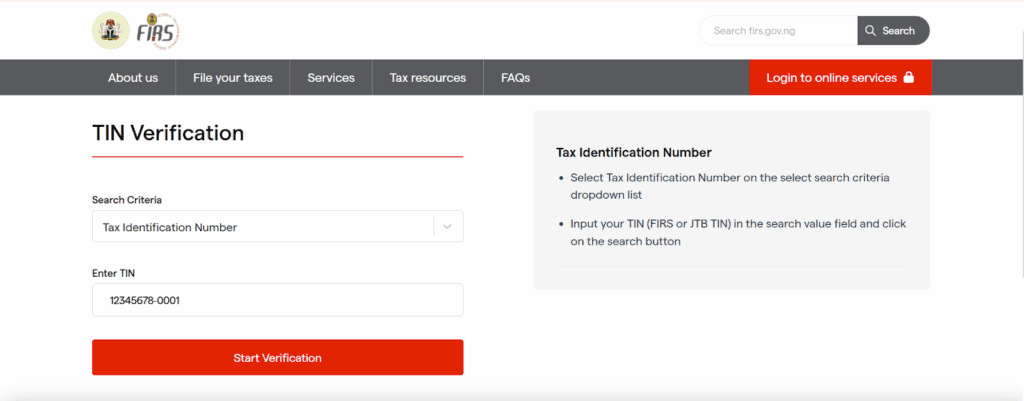
To retrieve your own Tax ID on the new portal, individuals search with their NIN and businesses search with their CAC number. Verifying a third party, such as a supplier, uses the same search by TIN, RC/BN, or phone number.
How do you get a TIN? Automatic issuance via CAC and NIN
Companies now receive a Tax ID automatically through registration data, and individual Tax IDs generate from the NIN. Section 7(1) of the NTAA 2025 requires the tax authority to register and issue a Tax ID to every taxable person, per the NTAA 2025 text. Businesses retrieve theirs using the CAC number.
If no Tax ID appears, retrieve it on taxid.nrs.gov.ng using your NIN (individuals) or CAC registration number (businesses). A taxpayer may hold only one valid Tax ID, and it is not transferable, under Section 7(5) to 7(7) of the NTAA 2025. If you are still registering a company, our guide to registering an LLC in Nigeria walks through the CAC step that triggers your Tax ID.
How do you fix an invalid or inactive TIN error?
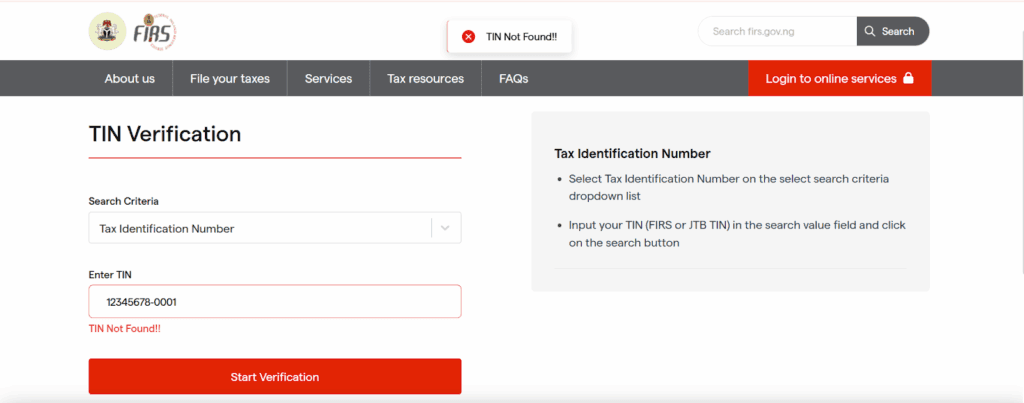
Most failed checks come from a typo, a newly issued ID not yet synced, a legacy JTB record not migrated, a name mismatch, or a company TIN deactivated after lapsed filings. Re-check the digits first, then try an alternate identifier, then escalate to the NRS.
| Result | Likely cause | What to do | Escalation |
|---|---|---|---|
| Invalid or not recognized | Typo, or the TIN was never registered | Re-check digits; search by RC/BN or phone instead | Nearest NRS tax office |
| Inactive ID | Newly issued and not yet synced, or deactivated after lapsed filings | Allow a newly issued ID time to sync; regularize overdue returns | NRS helpdesk |
| No record found | Legacy JTB record not migrated to the new system | Retrieve your 13-digit Tax ID via NIN or CAC number on taxid.nrs.gov.ng | JTB portal |
| Mismatch with records | Name or details differ from the register | Confirm the registered name, RC/BN, and NIN | Update via CAC or NIMC |
NIMC means the National Identity Management Commission, which holds NIN records.
How do you verify a supplier’s TIN for due diligence in Nigeria?
Verify every supplier’s TIN before onboarding and before you pay an invoice, because you need a valid supplier TIN to remit withholding tax (WHT) correctly and to claim input VAT. Paying against an invalid TIN creates tax exposure for your business. Every invoice should quote a valid Tax ID.
Company TINs tie to the CAC registration number and affect VAT compliance, WHT credits, and tender eligibility. Re-verify high-value suppliers quarterly, or before any large payment, since a TIN can be deactivated after a supplier misses filings. For the tax obligations behind these checks, see our guide to corporate taxes in Nigeria. The same verify-before-you-pay logic applies to any sales tax permit registration and verification.
What are the penalties for an invalid or missing TIN in Nigeria?
Operating without a valid Tax ID triggers an administrative penalty plus knock-on compliance losses. The NTAA 2025 sets a ₦1,000,000 administrative penalty for failing to use a Tax ID where required, in addition to possible fine and imprisonment. You also lose WHT credits, VAT registration, and tender access.
| Trigger | Consequence | Source |
|---|---|---|
| Failing to use a Tax ID where required | ₦1,000,000 administrative penalty, plus possible fine and imprisonment | NTAA 2025, s.8 (LIRS brief) |
| Holding multiple Tax IDs | Only one valid Tax ID is allowed; extras are reported for unification | NTAA 2025, s.7(5)-(7) |
| No valid Tax ID at onboarding | Blocked WHT credits and denied input VAT claims | NTAA 2025 |
| No Tax ID for a government contract | Excluded from federal, state, and local MDA contracts | NTAA 2025, s.8 |
| No Tax ID for banking | Cannot open or operate bank, insurance, or stockbroking accounts | NTAA 2025, s.8 |
Track your filing deadlines so a lapsed return never deactivates your Tax ID with Commenda’s compliance calendar.
How do you verify TINs in bulk or via API?
The official portal has no bulk option. It checks one record at a time, so finance and procurement teams verifying hundreds of suppliers need CSV upload or API-based validation. API means Application Programming Interface; CSV means comma-separated values.
Commenda’s Global Tax ID Verification validates tax registration numbers across countries through CSV upload and API, so you can clear an entire supplier list in one pass. Commenda supports 100+ ERPs, APIs, and custom integrations, listed on the integrations page. ERP means enterprise resource planning.
How we help with Nigeria TIN verification
Commenda’s global indirect tax software validates tax registration numbers in bulk through CSV upload or API and keeps your supplier records compliant across every jurisdiction you operate in. It is built for controllers who need certainty that each supplier TIN checks out before a payment goes out.
Run batch checks with Commenda’s Global Tax ID Verification, connect it to your stack through 100+ ERPs, APIs, and custom integrations, and stay ahead of filings with the compliance calendar. For foreign businesses entering Nigeria, our overview of international tax solutions frames where TIN verification fits.
Book a demo to see bulk TIN verification run against your own supplier list.
About the author

Sam is a seasoned expert in sales tax, leading Commenda's effort to build the worlds most comprehensive database of global tax rules and business regulations. At Silverhaze Partners, he worked in early-stage venture capital, where he saw firsthand how tax complexity and regulatory friction hold back startups from scaling internationally. That experience now powers his work at Commenda-bringing clarity, precision, and real-world insight to one of the most frustrating parts of doing business globally.
Disclaimer: Commenda and its affiliates do not provide tax, accounting, or legal advice. This material has been prepared for informational purposes only, and is not intended to provide or be relied on for tax, accounting, or legal advice. You should consult your own tax, accounting, and legal advisors before engaging in any related activities or transactions.