

Choosing the wrong business name or partnering with an unreliable company can lead to costly legal disputes, failed registrations, and damaged reputations. That’s why conducting a thorough West Virginia business entity search is a critical first step before launching or expanding your business.
The West Virginia Secretary of State’s official search system provides direct access to vital business records, allowing you to verify name availability, check entity status, and conduct essential due diligence.
Whether you’re forming a new company, vetting potential partners, or researching competitors, mastering this search process helps you avoid compliance issues and make informed decisions with confidence.
This comprehensive guide walks you through the state’s official portal, explains how to interpret search results, and shows you how to use this data strategically for your business.
What is a West Virginia Business Entity Search?
A West Virginia business entity search is a lookup tool provided by the West Virginia Secretary of State through their Business Organization Search portal. When you enter a business entity name and click the search button, you will receive entity names that match your search criteria along with entity type, city and status.
Business owners, entrepreneurs, attorneys, and researchers utilise this tool to verify entity status, check name availability, and gather business intelligence through the state’s primary portal for accessing business registration information.
The primary purposes of West Virginia’s business entity search include:
- Name availability verification – Ensuring your desired business name isn’t already registered
- Entity status confirmation – Verifying current standing and compliance status of existing businesses
- Due diligence research – Investigating potential partners, competitors, or acquisition targets
- Document access – Obtaining official filings, certificates, and compliance records
Importance of Conducting a West Virginia Entity Search
Conducting thorough West Virginia entity searches protects your business interests while ensuring compliance with state regulations. This research process mitigates risks, saves time, and provides strategic advantages in competitive business environments.
Checking Name Availability
West Virginia law requires unique business names within each entity type category. Your chosen name cannot be identical or confusingly similar to existing registered entities, making preliminary searches essential before filing formation documents.
Conducting name searches reveals potential conflicts early in planning, allowing you to develop alternatives before investing in branding or legal documentation. This proactive approach prevents costly rebranding efforts and ensures smooth registration processes.
Due Diligence & Risk Mitigation
Entity searches provide crucial intelligence about potential business partners, competitors, and market conditions. You can verify the legitimacy and standing of companies before entering into contracts, partnerships, or investment agreements.
Professional investors, lenders, and business partners expect thorough due diligence before engaging in significant transactions. West Virginia entity searches demonstrate professional competence while protecting your interests from fraudulent or non-compliant entities.
Legal Compliance
West Virginia requires accurate entity information for tax reporting, licensing, and regulatory compliance. Regular entity searches ensure your business maintains current status and meets ongoing obligations.
Access to official documents through the search system supports legal proceedings, contract negotiations, and regulatory filings. This documentation provides evidence of corporate authority and compliance status that satisfies legal requirements.
Types of Business Entities in West Virginia
West Virginia recognises several business entity types, each offering unique advantages for different business needs. Understanding these entities helps you interpret search results and make informed formation decisions.
- Limited Liability Company (LLC): Popular choice providing operational flexibility with limited liability protection, suitable for small to medium businesses seeking simplified management structure.
- Corporation: Traditional business structure offering strong liability protection and investment opportunities through stock issuance, ideal for businesses planning significant growth.
- Limited Liability Partnership (LLP): Professional service firms utilize this structure, combining partnership benefits with liability protection against other partners’ actions.
- Limited Partnership (LP): Investment-focused entities featuring general partners managing operations and limited partners providing capital with restricted liability.
- Nonprofit Corporation: Organizations pursuing charitable, educational, or religious purposes benefit from tax-exempt status while serving community interests.
- Professional Limited Liability Company (PLLC): Licensed professionals such as attorneys, doctors, and accountants operate under this structure, maintaining professional licensing requirements while enjoying LLC benefits.
How to Perform a West Virginia Business Entity Search
West Virginia’s business entity search process utilises the official Secretary of State portal, providing straightforward access to comprehensive business information. Follow these steps to conduct effective searches and obtain accurate results.
Step 1: Visit the West Virginia Secretary of State Website
Navigate to the official West Virginia Business Organisation Search portal. This portal serves as the exclusive gateway for accessing official business entity information maintained by the Secretary of State’s office.
The website features user-friendly navigation with clearly marked sections for different search types and business services. Ensure you’re accessing the official state portal to guarantee data accuracy.
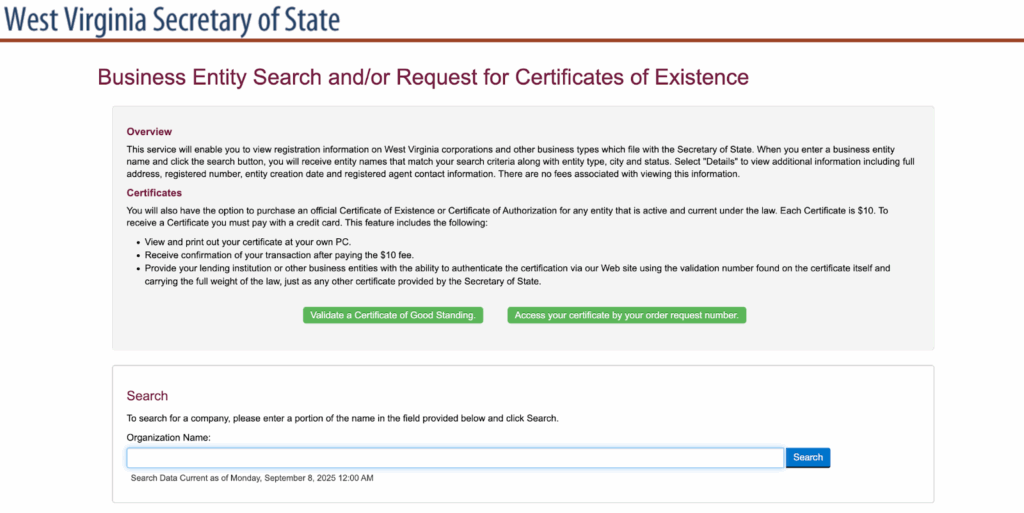
Step 2: Select Search Type
Advanced search options may be selected below. You may select any combination of items, from one to many. Choose your preferred search method from the available options, including entity name, organisation number, or specific location criteria.
Select appropriate search parameters based on your available information. Exact name searches provide precise results, while partial searches help when you’re uncertain about exact spelling or complete entity names.
Step 3: Review Search Results
Search results display entity names, organisation numbers, entity types, and current status information. Select the West Virginia business entity that you wish to review by clicking on the “Details” button at the end of its row.
Look through the first area where details such as the West Virginia business’s name, organisation number, status information, and stock information can be found. Review multiple results carefully, as similar names may exist within the database.
Step 4: Request Official Documents (optional)
The Secretary of State portal enables access to official documents and filings for registered entities. Standard document requests are processed efficiently through the online portal, while expedited services accommodate urgent business requirements.
Contact the West Virginia Secretary of State directly for certified copies of specific documents or comprehensive filing packages that support your business research needs.
Understanding West Virginia Entity Search Results
West Virginia entity search results provide detailed status information that reveals current compliance standing and operational status. Understanding these designations helps you make informed business decisions and assess entity reliability.
- Active: Entity maintains good standing with the state, having satisfied all filing requirements and fee obligations. Active entities can conduct business legally and maintain full operational authority.
- Inactive: Entity has ceased operations voluntarily or failed to maintain required filings. Inactive status indicates the business is not conducting active operations but may retain legal existence.
- Forfeited: State has revoked the entity’s authority due to non-compliance with tax obligations or failure to file required reports. Forfeited entities cannot legally conduct business until reinstated.
- Dissolved: Entity has completed formal dissolution procedures, terminating legal existence. Dissolved entities cannot be reinstated and require new formation if business operations resume.
- Revoked: The Secretary of State has cancelled the entity’s registration due to serious compliance violations or fraudulent activities. Revocation represents severe enforcement action requiring comprehensive remediation.
- Merged: Entity has combined with another business entity through formal merger procedures. The surviving entity maintains operations while the merged entity ceases independent existence.
- Converted: Entity has changed its legal structure while maintaining continuous existence. Conversions allow businesses to modify their entity type without dissolving and reforming.
- Suspended: Temporary loss of good standing due to specific compliance issues. Suspended entities can regain active status by addressing underlying violations and paying required fees.
Common Issues with West Virginia Business Entity Searches
Understanding frequent search challenges helps you navigate the system efficiently and obtain accurate results. These common issues affect both new and experienced users of West Virginia’s entity database.
- Name Variations and Spelling Differences: Business entities may register under slightly different names than expected, including abbreviated forms, punctuation variations, or alternative spellings. If you have trouble finding a business, try the following: Search using multiple name variations and consider common abbreviations like “Corp” versus “Corporation” or “LLC” versus “Limited Liability Company.”
- Limited Ownership Information: West Virginia’s public database focuses on entity information rather than detailed ownership structures. Private ownership details, percentage holdings, and internal management arrangements typically require additional research through business contracts or direct entity contact.
- Recent Filings Not Immediately Reflected: Database updates may experience delays during high-volume periods or system maintenance. Newly filed entities or recent status changes might not appear immediately in search results. Allow several business days for routine filings to reflect in the database.
- Technical/Browser Issues: The Secretary of State system performs optimally with updated browsers and enabled JavaScript. Clear browser cache and cookies if experiencing loading issues, and ensure pop-up blockers allow the state website.
- Incomplete Information: Search results provide basic public information but may lack comprehensive business details. Entity addresses, phone numbers, and business descriptions require additional research through business licenses or direct contact with the entities.
Steps After Completing Your West Virginia Entity Search
Your entity search results inform specific next steps depending on whether you’re forming a new business or managing existing operations. These actions ensure compliance and protect your business interests.
For New Businesses
- Name Reservation Process: You can reserve your LLC name with the SOS for $15. This protection prevents other entities from registering your chosen name while you complete formation procedures, typically providing exclusive rights for a specified period.
- Formation Document Filing: The SOS charges $100 to file the Articles of Organisation. Corporations require similar filing procedures with their respective formation documents. Complete your formation documents accurately to avoid processing delays or rejection.
- Tax Registration Requirements: Register for state taxes with the West Virginia Department of Revenue immediately after entity formation. West Virginia requires business registration and tax compliance for most entity types operating within the state.
- License Acquisition Needs: Professional licenses, business permits, and industry-specific authorisations may require additional applications and fees. Research your industry’s licensing requirements early in the formation process.
For Existing Businesses
- Document Acquisition Processes: Request certified copies of formation documents, annual reports, and compliance certificates through the Secretary of State. These documents support various business needs, including banking, contracts, and legal proceedings.
- Annual Report Requirements: West Virginia requires LLCs to file an annual report with the Secretary of State. You can do this online. There is a $25 filing fee. Corporations have similar annual reporting obligations to maintain good standing with the state.
- Reinstatement Procedures: Entities with forfeited or suspended status require specific reinstatement procedures, including payment of outstanding fees, filing delinquent reports, and addressing underlying compliance issues.
- Ongoing Compliance Maintenance: Implement systems for tracking filing deadlines, fee payments, and regulatory changes affecting your entity. Regular compliance monitoring prevents costly penalties and maintains good standing.
Simplify Your West Virginia Business Setup with Commenda
Managing business entity compliance in West Virginia involves complex rules, tight deadlines, and constant updates. Commenda simplifies this with automated entity management that handles filings, tracks deadlines, and ensures ongoing compliance, all in one platform.
Our system integrates with state filing portals, providing real-time updates and expert support to keep your business in good standing without the hassle.
See how professional entity management makes compliance easy. Schedule a free demo today and protect your business with automated precision.
FAQs on West Virginia Business Entity Search
Q: How do I verify if my chosen business name is available in West Virginia?
Use the West Virginia Business Organization Search to check your exact desired name. If no results appear, the name is likely available, but also search variations to avoid similar-name conflicts.
Q: Can I reserve a business name in West Virginia after my entity search?
Yes, you can reserve a name for $15, securing exclusive rights for a set period. Submit the reservation via the Secretary of State once availability is confirmed.
Q: What does it mean if a business entity in West Virginia is listed as “forfeited”?
Forfeited status indicates the state has revoked the entity’s authority due to non-compliance with registration fees or required filings. These entities cannot legally conduct business until they complete reinstatement procedures and resolve underlying compliance issues.
Q: How frequently is the West Virginia business entity database updated?
The database receives updates continuously as filings are processed, but new information typically appears within several business days of submission. Complex documents or high-volume periods may cause additional processing delays.
Q: Can sole proprietorships be found through West Virginia’s entity search tool?
No, sole proprietorships do not require registration with the Secretary of State and will not appear in entity search results. These business structures register only for tax purposes and licensing requirements through other state agencies.
Q: Are official business documents available directly via West Virginia’s entity search platform?
Basic entity info and filing history are accessible online. Certified copies of official documents must be requested directly from the Secretary of State.
Q: Why might my West Virginia entity search return no results for an existing business?
Possible reasons include operation as a sole proprietorship, a different registered name, registration in another state, or recent filings not yet reflected. Try name variations or contact the business directly.