Filing Form 944 is a critical requirement for small businesses with employees to remain compliant with federal tax laws. The form reports federal income tax withheld from employees, along with social security and Medicare taxes. This annual filing is designed specifically for small employers whose total payroll tax liability is $1,000 or less for the entire year.
This guide walks you through everything you need to know, from who needs to file it to common mistakes to avoid, ensuring you’re well-prepared to handle this critical aspect of your business’s payroll.
Understanding IRS Form 944
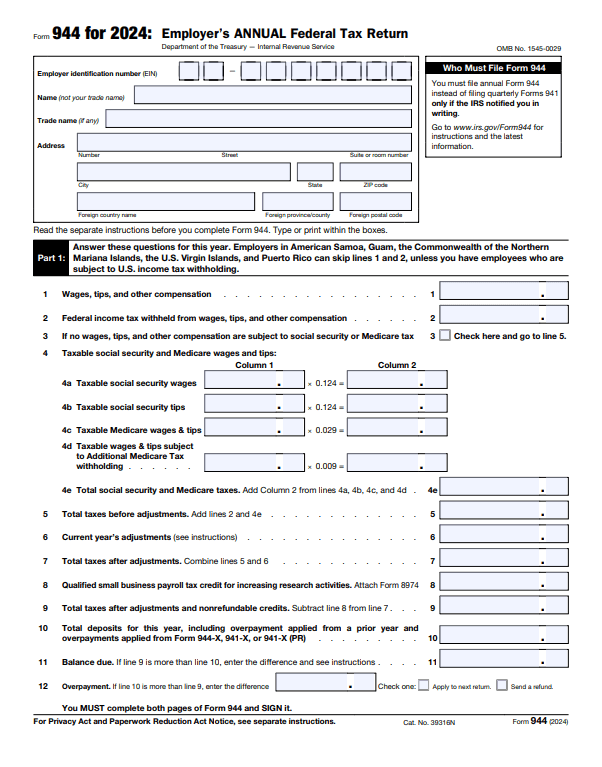
Form 944, known as the Employer’s Annual Federal Tax Return, is designed for small businesses to report payroll taxes to the IRS once a year instead of every quarter. It covers:
- Federal income tax withheld from employees.
- Employer and employee shares of social security and medicare taxes.
This form is meant to make life easier for businesses with a small payroll tax liability, reducing the number of filings from four per year to one. The idea is to simplify the process for businesses with a small tax liability—specifically those with a total annual liability of $1,000 or less. Filing annually instead of quarterly can save time and paperwork for these smaller operations.
Why Filing Form 944 Matters?
Filing Form 944 is just as important as its quarterly counterpart, Form 941, especially for small businesses that qualify to report employment taxes annually. Here’s why filing Form 944 matters:
- Tax Compliance: It keeps your business in line with IRS requirements by reporting annual payroll taxes, including federal income tax withheld, Social Security, and Medicare taxes.
- Accurate Reporting: Form 944 captures total wages paid and taxes withheld over the full calendar year, ensuring the IRS has a complete record of your payroll activity.
- Avoid Penalties: Filing on time and with accurate figures helps prevent late filing penalties, interest charges, and other compliance issues.
- Employee Benefits: Proper filing ensures that your employees’ Social Security and Medicare contributions are correctly recorded, protecting their future benefits.
Eligibility Criteria Determined by the IRS
When you are trying to understand the Form 944 instructions, then do understand that the IRS decides whether your business qualifies to file Form 944. You’re not automatically eligible. The IRS sends you a notice if you can use it. However, the following are the general rules:
- Your estimated total employment tax liability is $1,000 or less for the calendar year.
- This typically means you pay one or two employees a modest wage.
- New businesses can request to file Form 944 when applying for an Employer Identification Number (EIN) using Form SS-4.
If your business grows and you no longer meet the threshold, you’ll need to switch back to Form 941. You can also request to file Form 944 if you think your tax liability will be small enough. However, you will need IRS approval to make the change.
If you’re unsure about whether your business needs to file Form 944 or need assistance with the process, Commenda can provide expert support to ensure you’re meeting all requirements and staying compliant with IRS regulations
Difference Between Form 941 and Form 944
Understanding the difference between Form 944 and Form 941 is essential to ensure you are filing the correct form based on your business’s tax liability and reporting requirements. The following table highlights the key differences between both these forms:
AspectForm 941Form 944Filing FrequencyQuarterly (4 times a year)Annually (once a year)Who FilesEmployers with a tax liability of $1,000 or more per yearEmployers with a tax liability of $1,000 or less per yearTax FilingReports wages, taxes, and adjustments for each quarterReports wages and taxes for the entire yearPayment RequirementTypically, quarterly paymentsAnnual payment, with one year-end settlement
Filing Deadlines and Obligations for IRS Form 944
Understanding the deadlines and filing requirements for Form 944, the Employer’s Annual Federal Tax Return, is crucial for small businesses to maintain compliance with IRS regulations. Here’s what you need to know:
Annual Filing Deadline for the 2024 Tax Year
For the 2024 tax year, Form 944 is due by January 31, 2025. This deadline applies to all employers required to file this form, ensuring that annual employment taxes are reported in a timely manner. Missing this deadline can result in late filing penalties and interest on unpaid taxes, even if your total tax liability is low. The return must be sent to the IRS either electronically or by mail, depending on your filing method.
Extended Filing Deadline with Timely Deposits
If you’ve made all required tax deposits on time and in full throughout the year, the IRS grants an extension for filing Form 944. In this case, you may file the return by February 10, 2025. This extension rewards diligent taxpayers who have met their deposit obligations promptly.
If you made any late payments or underpaid at any point during the year, then your business will not be eligible for this extension. Keep in mind that even if you qualify for the extension, your tax payments must still be complete and on time throughout the year.
Obligation to File Even with No Taxes or Wages
Even if your business did not pay any wages during the tax year or owes no employment taxes, you’re still obligated to file Form 944 if the IRS has notified you to do so. Filing a zero return informs the IRS of your business’s status and helps maintain accurate records. If your company has closed or you stopped paying employees, you should mark the form accordingly and enter the date on which the final wages were paid.
Key Points to Remember:
- Timely Filing: Ensure you submit Form 944 by the appropriate deadline to avoid potential penalties.
- Accurate Reporting: Even in the absence of wages or tax liability, filing the form as required keeps your business compliant.
- Final Returns: If your business has closed or stopped paying wages, indicate this on Form 944 by checking the box on line 14 and entering the final date wages were paid.
Step-by-Step Instructions for Filling Out Form 944
Filling out Form 944 correctly is essential for ensuring proper tax reporting and compliance. Here’s a step-by-step guide to help you through the process:
1. Provide your Business Information
- Enter your Employer Identification Number (EIN).
- Include your business name, trade name (if applicable), and address.
- Make sure the calendar year at the top of the form matches the year you’re filing for (e.g., 2025).
2. Report Total Wages and Taxes
- In Part 1, report the number of employees who received wages during the year.
- Enter the total wages, tips, and other compensation paid to those employees.
- Include the federal income tax withheld from employee paychecks.
3. Calculate Social Security and Medicare Taxes
- Report total social security wages and tips.
- Report total medicare wages and tips, including any additional medicare Tax for wages over $200,000.
- The form will guide you to calculate the employee and employer shares using the current IRS percentages.
4. Report Adjustments
- Enter any adjustments related to:
- Sick pay
- Tips not subject to Social Security/Medicare
- Group-term life insurance
- Adjustments help fine-tune your total tax liability for the year.
5. Calculate Total Taxes Due
- Still in Part 1, add up the taxes owed after applying any adjustments.
- If eligible, claim tax credits such as the research payroll tax credit.
- The form will guide you to subtract any credits and arrive at your final tax liability for the year.
6. Account for Any Deposits Made
- Report the total amount of federal tax deposits you’ve already made throughout the year.
- If you’ve deposited more than you owe, you’ll report an overpayment and choose whether to apply it to next year or request a refund.
- If you still owe money, the balance due is shown here.
7. Complete the Tax Liability Schedule
- If your total tax liability is $2,500 or more, you must complete Part 2, showing your liability by month.
- If it’s under $2,500, you can skip this section (as long as you’re not a monthly schedule depositor).
8. Indicate Business Status
- In Part 3, check the box if this is your final return (for example, if your business closed or you stopped paying wages).
- Enter the last date wages were paid, if applicable.
9. Sign and Date the Form
- The business owner or an authorized signer must sign and date the form.
- Provide a contact phone number and title.
- If a third-party preparer completed the form, they must also sign and include their info.
10. Submit the Form
- E-file using IRS-approved software, or
- Mail it to the correct IRS address based on your state and whether you’re including a payment.
- The standard due date for filing is January 31 of the following year (or February 10 if all deposits were made on time).
After filling out the form section by section, the next step is understanding how to handle your tax deposits and report your total liability accurately.
Details on Tax Deposits and Liability
Managing your tax deposits and understanding how to report your liability accurately are key parts of filing Form 944. Here’s what you need to know:
1. Reporting Your Tax Deposit Schedule
While Form 944 is filed annually, deposits for withheld federal income tax and both the employer and employee portions of social security and medicare must still be made throughout the year. Your deposit schedule depends on the total tax liability you report:
- If your total tax liability for the year is $2,500 or less, you can typically pay the entire amount when you file the form (either by check or electronically).
- If your tax liability exceeds $2,500, you’ll generally need to make monthly deposits using the Electronic Federal Tax Payment System (EFTPS).
- The IRS will let you know your required deposit schedule when you first become an employer or if it changes.
2. Calculating Total Tax Liability and Deposits Made
On Form 944, you’re required to:
- Calculate and report your total payroll tax liability (this includes federal income tax withheld and both sides of Social Security and Medicare taxes).
- Include any adjustments for sick pay, tips, group-term life insurance, and tax credits (if applicable).
- List the total amount of deposits you’ve already made for the year (line 12 on the form).
3. Handling Balance Due or Overpayments
After subtracting your deposits (line 12) from your total tax liability (line 11b), you’ll either have a balance due or an overpayment. Make your selection clearly on line 14 of the form.
Information Required for Filing Form 944
To complete Form 944, you’ll need:
- Employer Identification Number (EIN): Your official IRS-issued business ID used for tax reporting.
- Total Wages and Tips: Include all taxable compensation paid to employees during the year, such as wages, tips, bonuses, and commissions.
- Federal Income Tax Withheld & Payroll Taxes: Report the amount withheld for federal income tax, plus total Social Security and Medicare wages and tips. Be sure to include both the employer and employee portions of these taxes and factor in any adjustments or applicable tax credits.
Once you’ve calculated your total tax liability and accounted for all deposits, the final step is to carefully review, sign, and submit Form 944 to ensure everything is complete and sent in on time.
Review, Sign, and Submit Form 944
Before you send Form 944 to the IRS, it’s important to double-check everything to avoid delays, penalties, or rejection. Here’s how to wrap it up the right way:
Verification and Review Process Before Submission
- Go line-by-line to confirm that all figures, wages, taxes, deposits, adjustments are correct.
- Make sure all required fields are filled in and match your payroll records.
- Check your math, especially when calculating Social Security and Medicare taxes.
- Confirm that your EIN, business name, and address are accurate and up to date.
Signature Section Including Options for Signing
- The form must be signed by an authorized person, such as the business owner, corporate officer, or partnership member.
- Include the printed name, title, phone number, and date of signature.
- If a paid preparer (like an accountant) filled out the form, they must also complete the preparer section with their details and signature.
- You can e-sign if you’re filing electronically using IRS-approved software.
Effectively Transmitting the Form to the IRS
You have two options to file Form 944:
- Electronically: Use the IRS e-file system through approved providers. It’s faster and you get confirmation once it’s submitted.
- By mail: If filing on paper, send it to the correct IRS address based on your business location and whether you’re including a payment. The IRS provides a mailing address chart for Form 944 each year.
Potential Penalties and Compliance
Filing Form 944 is a legal obligation. Mistakes, delays, or missing information can lead to unnecessary penalties. Here’s what to keep in mind:
Penalties for Late Filing or Inaccuracies
- If you file late, the IRS may charge a failure-to-file penalty, which typically starts at 5% of the unpaid tax per month, up to a maximum of 25%.
- If your tax payments are late, expect a failure-to-pay penalty and interest on the unpaid balance.
- Providing inaccurate or incomplete information may result in additional penalties or audits. Even simple math errors can trigger issues.
Importance of Accurate Completion and On-Time Tax Deposits
- The IRS takes payroll taxes seriously because you’re holding funds on behalf of your employees.
- Accurately reporting wages, withheld taxes, and deposit amounts ensures proper credit to your account and keeps your business in good standing.
- Timely deposits help you avoid penalties and build a solid compliance history with the IRS.
Steps to Ensure Compliance with IRS Requirements
- Use reliable payroll software or a trusted payroll provider to calculate and track taxes.
- Set reminders for deposit due dates and the annual filing deadline.
- Review the form carefully before submission, double-checking all entries and calculations.
- Keep detailed payroll and deposit records in case of future IRS questions.
- If you’re unsure about any part of the form, consult a tax professional or refer to the official IRS instructions.
Conclusion
Filing Form 944 accurately and on time is key to staying compliant with federal payroll tax laws. It ensures your business avoids penalties, keeps clear tax records, and maintains good standing with the IRS. If you’re unsure about any part of the form or need help, the IRS provides detailed instructions, FAQs, and tools online to guide you through the process.
Commenda offers automated solutions to ensure your payroll tax filings are accurate and IRS-compliant. Our platform simplifies the process of tax calculation and reporting, making it easy for businesses to file Form 944 on time and avoid penalties. By integrating with your payroll system, we help ensure that your business remains compliant and up-to-date with all IRS filing requirements. For more information, visit Commenda Compliance Solutions.
Don’t leave your tax filing to chance. Make sure your Form 944 is filed correctly and on time—Schedule a demo today!